 RSS
 Apple Podcasts
 YouTube
 Amazon Music
 Spotify
 CastBox
 Player.fm
 TuneIn
 Audible
 Podbean
 App not listed? Try this RSS link
 In this episode of The Animal Law Podcast, Mariann Sullivan speaks with Rebecca Cary and Melissa Alpert, attorneys at Humane World for Animals, about the federal government’s unprecedented lawsuits challenging California’s Proposition 12 and Michigan’s cage-free egg law. The government argues that the Egg Products Inspection Act — a 1970 statute about inspecting liquid and dried egg products for adulteration — expressly preempts state-level farm animal welfare sales bans. The discussion covers the government’s novel and contested theory of sovereign standing, the surprising split between the California and Michigan courts, and why the egg industry has broken ranks with the pork industry to side with animal advocates in these cases.
- Prop 12’s legal history and the Supreme Court victory in NPPC v. Ross: a recap of California’s evolving farm animal welfare laws from Proposition 2 (2008) through Proposition 12 (2018), and the Supreme Court’s unanimous 2023 decision upholding the pork sales ban against dormant commerce clause challenges
- The federal government’s EPIA preemption argument explained: how the government relies on a single preemption clause about egg grading standards (size, quality, condition) to claim that cage-free hen housing requirements are preempted, despite the Egg Products Inspection Act having nothing to do with on-farm animal welfare
- Constitutional standing and the sovereign injury theory: why the government’s standing allegations are remarkably thin, how the California court found standing but certified the question for interlocutory appeal to the Ninth Circuit, and why the Michigan court dismissed the case entirely for lack of injury
- The egg industry’s shift from opposition to alliance: how the egg industry, after losing early challenges to Prop 2 and California’s AB 1437, pivoted to embrace cage-free production as a market opportunity and is now intervening alongside animal advocates against the federal government’s lawsuits
- The Save Our Bacon Act and broader threats to state animal welfare laws: the latest version of the decades-old King Amendment effort to federally preempt state agricultural sales bans, its inclusion in the House farm bill, and what it means for the future of farm animal protection legislation
ABOUT OUR GUESTS
Rebecca Cary is a managing attorney within the Animal Protection Law section of Humane World for Animals, where she has worked since 2010. Her practice includes farm animal welfare and constitutional defense issues, and she has been the lead attorney on multiple challenges to state farm animal confinement and sales initiatives, including the NPPC v. Ross case in which the Supreme Court upheld California’s Proposition 12 against a pork industry challenge. Rebecca is a 2009 graduate of Northeastern University School of Law and a 2005 graduate of the University of California San Diego, where she was a founder of a student animal welfare group. She has taught animal law courses at George Mason University and George Washington University, and she is the co-chair of the District of Columbia Bar’s animal law section. Rebecca lives in Maryland with her two rescue cats.
Melissa Alpert is a Staff Attorney within the Animal Protection Law section of Humane World for Animals, focused on farm animal issues. She is a graduate of Harvard College and Harvard Law School, and joined Humane World for Animals in 2024 after working at large law firms in Washington, DC, and Pittsburgh, PA. At Humane World for Animals, she has been active in litigation related to farm animal confinement laws, including the defense of California’s Proposition 12.
INTERVIEW TRANSCRIPT
Mariann Sullivan: Welcome to The Animal Law Podcast. I'm so excited about this week because we get to talk about Prop 12 again! How much litigation can one law possibly give rise to? Well, even more. So our guests this month are Rebecca Cary, who's, uh, welcoming, we're welcoming back to the podcast, and Melissa Alpert.
They're both attorneys at Humane World for Animals, which used to be the Humane Society of the United States. I don't, I don't know how long it has, we have to go before we stop saying that. Um, they're here to talk about this new legal attempt to undermine Prop 12 in California. Also, um, a, a, a Michigan law, a similar law.
They're all, all relating to the egg provisions, which have not recently, as far as I am aware, been, been particularly the focus. It's clear that these laws, maybe you, you thought these laws weren't enough or weren't good enough. Well, they're driving the industry nuts, that's totally clear, so that's gotta be good.
And so the, the, the industry didn't, didn't bring this lawsuit. We'll talk about that a little bit, too. Um, and so we have a lot to cover.
I do have a couple of, uh, important announcements before we get to that. And, uh, so just bear with me, and then we'll get into the cases. Today, the t- the day this goes out, Friday, October 30th, is the launch of Our Hen House's year-end fundraiser, which is basically how we survive for the entire year.
And, um, I don't know, some of you just, may just listen to The Animal Law Podcast, uh, but you might not know that Our Hen House, which is the publisher of The Animal Law Podcast, along with the Our Hen House podcast, is a not-for-profit. And Jasmin Singer and I started it back in January 2010. Yes, 2010. That, that was not me misspeaking.
Um, we're going to be recording our 1,000th episode of the Our Hen House podcast, uh, very soon. This will be our 137th episode of The Animal Law Podcast. They tell me that's 3.1 million listens combined, and, uh, that seems unreliable, but they tell m- they, they have convinced me that that's actually true.
So over the past year, we've also increased podcast frequency, focused on video, including on YouTube, and seen our social media engagement really, really go up, especially because of TikTok of all things, which I don't even, I don't even watch. Um, don't tell them that. We also have this really exciting secret project that we'll launch next year.
I'm not allowed to talk about it, so I hope it happens after I've said that. And right now, as in other years, we have our special fundraising project. It's a little complicated. Um, our highest donors, we call them our Barnyard Benefactors, pool their funds to create a $25,000 matching fund for our listeners and supporters to match.
And as a result, any of your contributions between October 30th and December 31st will be matched up to 25,000, but only if we meet that 25,000. We have to hit that $25,000 exactly. So I know that times are tough. I hate asking people for money, um, and things are scary. But if you're able, uh, donations of any amount count towards our goal and are tax deductible.
And this is true of any not-for-profit, not just of ours. You may think a small donation doesn't make a difference. And it totally does, A, because it's money, and money, any amount of money can make a difference. But also, it conveys to larger donors that your listeners or your supporters are out there and they really care.
So it's really important. Um, if you're... You can also join the Flock. Uh, you don't have to. You can make a donation of any amount, but, um, if you're not already part of the Flock, you can join us as a member with options starting at $10 a month or $100 a year. And if you're able, and if you value what we do, please visit ourhenhouse.org/support.
And thanks again for your support in the past and for listening and for changing the world for animals.
I have a second announcement as well, and this is about this amazing program at Vermont Law and Graduate School. And we get asked all the time, Jasmin and I get asked all the time, "How can I do more for animals?"
Maybe, "How can I change my career? What contribution can I make?" And if you want to make advocacy your career at a serious level, you should be exploring the Animal Law and Policy Institute at Vermont Law and Graduate School. Th- this covers a lot of different programs. You can get a JD if you want to be a lawyer with a concentration in animal law, so you can start out just focusing on animal law.
Um, you can get an a- if you're already a lawyer, you can get an animal law LLM, or you can get a graduate certificate or master's in animal protection policy, uh, which does not require being a lawyer, and you can learn how to use the law and public policy to create lasting protections for animals. And this, this is really at a high level, and the animals need people at a high level and committed advocates in, in courtrooms, legislatures, government agencies, nonprofits, and beyond.
And if you're ready to be one of them, visit vermontlaw.edu/animallaw and learn how you can earn a degree. It can be either residential or online. I think some of them might have to, might be a hybrid. Uh, but you know, it's Vermont, so, like, that's not such a punishment to be able to go to Vermont a couple of times a year.
Um, and so, uh, check that out, and now let's get to it. Welcome back, Rebecca, and, and welcome, Melissa. Uh, it's so great to have you here to talk about Prop 12, 'cause, you know, what else? Rebecca, I feel like your entire career might be devoted to this law. Is that true?
Rebecca Cary: That is not an exaggeration. I have pretty much been working on some case or another related to California's various, uh, Prop 12 and Prop 12-like laws since I started at, uh, then HSUS, now Humane World for Animals in 2010.
Mariann Sullivan: Wow. It, it's, it, I bet that wasn't the plan, but thank God you're out there doing it. I mean, I know that this is a big ask to start out with, and many of our listeners are very familiar with Prop 12 and the background, and not just Prop 12, but the other laws as well, but some are probably not. So can you briefly talk about animal product sales bans, what they are, where they are, which animals are involved, and, um, and maybe the background of the litigation that led up to the two cases we'll be discussing today?
Rebecca Cary: Absolutely, and I'll try to keep it pretty brief 'cause I know we have a lot of things to get to. But, um, California has been legislating for animals, for farm animals specifically, since way back in 2008, and that's when they passed, uh, Proposition 2, which is the precursor to Proposition 12. Proposition 2 was an in-state production ban, and basically what it did was say that animals, uh, covered species, veal calves, egg-laying hens, and mother pigs, needed to have enough room to be able to stand up, lie down, turn around in a circle, and stretch their limbs. Um, and these very basic behaviors when we were campaigning for this ballot initiative, um, were wildly popular because the average Californian at that time didn't know that animals on standard factory farms couldn't do those things. So the ballot initiative passed with so much help from a variety of advocates across the country, um, by a overwhelming majority of the California voters, and it was very exciting.
We celebrated, and two years later, the California Legislature passed AB 1437. That's a t- 2010, uh, law that says that eggs sold in the state of California need to come from animals who have those, uh, same abilities of those Proposition 2 behaviors, so the ability to stretch their wings.
Mariann Sullivan: And then just let me, just let me take a moment to point out the big thing. Eggs sold in California, not just raised in California.
Rebecca Cary: So this was the first sort of component of a sales scheme related to farm animal products in California. And, uh, there were some early challenges to those laws, as, uh, previously mentioned. They were largely from a- the egg industry, and the egg industry largely challenged them on constitutional vagueness grounds, saying, for example, that they didn't know what it meant exactly for a hen to be able to turn around or stretch her limbs, or how much space that required. And these early cases all got tossed out of court. Um, after those losses, the, uh, a coalition of a bunch of states, the attorneys general of those states tried to file a sort of similar, um, uh, type of challenge. Well, different claims, but similar in that they were going after the egg sales laws in California. And those cases lost, too. Um, and the, it-- the attorneys general even tried to bring an original jurisdiction action, um, in the Supreme Court, and the Supreme Court, um, as, as listeners might know, doesn't take very many of those original jurisdiction actions ever. Um, and so they declined to take that one as well. So this sort of early success that we had in these early cases led Californians to dream of even bigger, bolder protections for farm animals. And that's how we got to Proposition 12 in 2018, which was another ballot initiative passed by a similar, um, very exciting margin of California voters. And this, uh, ballot initiative, what it changed, what was different than Proposition 2 and AB 1437, um, was that it, it built on those laws, and it was a sales law that says that all covered products sold in the state of California from those three species, mother pigs, egg-laying hens, and calves raised for veal, need to come from animals who have those basic behavior abilities we already described, um, that were, uh, part of the production bans in Proposition 2. But importantly, they, uh... Proposition 12 added a component that said that animals also needed to be able to have a certain amount of usable floor space, and those vary by species. For example, in the case of egg-- uh, sorry, of mother pigs, that's 24 square feet per animal. Um, so it, it, it basically, um, added to the protections that were already there, um, and, uh, and it had this, this sales component. And that, uh, was, uh, when we started seeing the pork industry get involved in some of these challenges. And many of your listeners, I'm sure, have heard of the NPPC v. Ross case, National Pork Producers v. Ross. Before that one, we also had another challenge from a group of pork producers, um, NAMI, um And, uh, but the National Pork Producers case was the first one that the Supreme Court decided to hear. Now, this is after the pork producers lost in the district court and in the Ninth Circuit. This is a case that a lot of animal groups have been involved in. Humane World led a coalition of animal, uh, groups that wanted to see this law, um, preserved because, of course, we were the ones who drafted it and supported it and were the major proponents and got Californians excited and out to vote. So, uh, the Supreme Court, fast-forwarding through a lot of, um, what happened during that time, ultimately upheld the law in the NPPC v. Ross case. And in fact, the Supreme Court, uh, unanimously decided that the pork producers' major dormant commerce claim, the one related to extraterritoriality or so-called extraterritoriality, um, uh, could not stand.
And, and we also won on their, on their secondary claim. So it was a hugely exciting moment. Animal advocates all across the country celebrated with us, and we were hoping that that might be the end of the story and the end of these challenges, but it wasn't. And we've had several more, um, well, challenges since then, a couple of which we're going to talk about, I know, in more detail today
Mariann Sullivan: Well, that was a heroic, heroic, uh, distillation of, of a lot of information, and, uh, yes. I shouldn't have laughed 'cause it's not funny that it's unending, but it was a laugh of, of, um, you know, bemusement as, uh,
Rebecca Cary: I, I feel it. You're, you're
Mariann Sullivan: So I know that the federal government is the one who's bringing the cases today. Has, has any of the prior litigation been by the federal government, or has it all been by the industry?
Rebecca Cary: Yeah, it hasn't. This is, this is the first time we've seen the federal government get involved. Up into this, up to this point, it's been, like I said, the egg industry, the attorneys general sort of supporting the egg industry, and then, uh, the pork industry most recently. So this is the first time we've seen the federal government's involvement in these cases
Mariann Sullivan: And, and the other cases, are they all resolved? Are there any still active cases from industry players?
Melissa Alpert: Almost all of them are resolved. There is still one case that's active from the pork industry in California. Uh, that's the case Triumph v. Bonta, that's brought by a pork slaughterhouse, uh, against, uh, Prop 12's pork provisions, the sales ban. Uh, so that one is, uh... is that phrase from The Princess Bride? It's m- it's mostly dead, but it's not entirely dead. Um, so basically they brought a bunch of claims, constitutional claims. They brought a preemption claim. They brought implied, express preemption claim. They brought dormant commerce claim under two theories. They brought a due process claim. They brought an import-export clause claim, and the court dismissed all of them except for one of the dormant commerce clause claims. But that claim just relates to a very specific provision of the law, so not the whole law, but it, um, relates to what they call the, quote-unquote, "slaughterhouse exception." So in the definition of sale for the covered sales from Prop 12, there is an exception. Sale doesn't include the te- the, the, you know, the, the defined word sale doesn't include sales that occur on the physical premises of an FMIA-regulated slaughterhouse facility. Um, this challenge is being brought by an out-of-state slaughterhouse facility, but basically they're arguing that that creates a, a, sort of protectionist advantage for in-state slaughterhouses because, you know, so many people wanna walk up to the slaughterhouse floor and purchase their meat there, and there's gonna be such a huge shift in the market towards those sales that it's gonna be so violative of the dormant commerce clause.
It's gonna be so protectionist. There's gonna be this huge market shift towards. And that is the theory that still is alive.
Mariann Sullivan: That sounds like a... I mean, it doesn't sound like that interesting a case, to tell you the truth, 'cause it sounds weak. But you never know. You never know. And, um, hopefully that means that the industry is out of ideas. But now, as we mentioned, it's the federal government suing.
Um, and we'll get into that a little bit and perhaps why. But, but in the first place, so you're definitely not a party here. Um, what's your role? Is it as an amicus?
Melissa Alpert: We are a party here. We're an intervener.
So we, on behalf of a coalition, um, of the animal groups that, you know, supported and drafted and advocated for, uh, Prop 12 in the California case, um, yeah, moved to intervene, and the court granted our intervention, so we're a defendant intervener,
Mariann Sullivan: Okay
Melissa Alpert: so we're still a party in that case.
We were also, uh, granted intervener status in the Michigan case. So we're in it. We're briefing. Briefing in the Michigan case is word count limited, but we're still briefing.
Mariann Sullivan: It's a good discipline. Um, all right, let's talk about these cases. My understanding is that they are very similar, though they came out at, at... We're still at early stages. We're still in the standing stage, but they s- they, they have come out somewhat differently. Before we get into the details of what has happened, can you just give us a brief summary, uh, of, of, uh, like real- just the gravamen of what the government is arguing, perhaps starting with just telling us generally what the Egg Products Inspection Act is, 'cause I think that's what this case is all about.
Uh, correct me if I'm wrong. And, and kind of what the basic pre-em- what a preemption argument is and what their basic preemption argument is.
Melissa Alpert: Sure. So the federal government's argument in both cases is the same, uh, which is that the sales ban, is preempted by the Egg Products Inspection Act, specifically that it's expressly preempted by this one, uh, like preemption clause, uh, in the Egg Products Inspection Act. So stepping back, generally, the Egg Products Inspection Act up a system of federal inspection at facilities that make egg products.
Egg products is a defined term. It's not shell eggs. Egg products is, uh, basically like liquid or dried eggs, so basically the egg stuff that's not shell eggs. And so, uh, this was passed like back in 1970, and it was to address concerns about like filthy or adulturated
egg, eggs being used to make egg products, egg products that were not, you know, s-safe for consumption.
So the, so the federal-- So the EPI is primarily about that, is about, uh, inspecting and making sure th-that there's like standards for egg products to prevent them from being more adulturated.
Mariann Sullivan: Well, that makes total sense that it wouldn't include shell eggs 'cause, 'cause sh- kinda obvious that shell eggs haven't been adulterated 'cause they're still in the shell.
Melissa Alpert: There is... So there is a few, like, there's a few provisions in the APA that do concern shell eggs, but it's like the vast majority of it has to do with egg products. And one of the things that cover-- that describe shell eggs is this preemption clause that they're focusing on. So there's this, um, preemption clause at Section 1052B that says that, uh, "For eggs which have moved or are moving in interstate or foreign commerce, no state or local jurisdiction may require the use of standards of quality, condition, weight, quantity, or grade which are in addition to or different from the official federal standards."
And so that might be, like, a little confusing, but then later they define what the official federal standards are, and they basically define it to mean the egg grading standards that the Agricultural Marketing Service uses. So read with the definition in context what this provision is saying is that, uh, no state can pass, like, egg grading standards. that are different than the federal egg grading standards. You know, when you go buy an
Mariann Sullivan: This is grade A, yeah
Melissa Alpert: AA egg." And those grades relate to the egg's quality. Like the AA is the highest quality, right? And then like the
Mariann Sullivan: I always thought it
Melissa Alpert: and then I think below
Mariann Sullivan: I always thought it related to size, but it's not just size, it's other aspects of quality
Melissa Alpert: it does cover size, but that would be something like jumbo. Like, there's
Mariann Sullivan: Okay.
Just didn't know that.
Melissa Alpert: But yeah, so that's kind of... That's what the preemption clause is about, and it's about making sure that there's sort of like one, one set of egg grading standards, so when you, the consumer, go to buy an egg and the package says, "This is a jumbo egg," or, "This is a grade A egg," you kinda know what you're getting because the characteristic has sort of been established. Um, the government's argument is that that preemption clause there actually preempts Prop 12, Michigan's law, any laws that have, quote unquote, "standards" on the sale of eggs because they're basically saying the requirement that the hens have to live in certain non-extreme confinement conditions is a, quote unquote, "standard" of quality.
Mariann Sullivan: Okay.
Yeah, no, that was, that was very helpful. Um, and, and I want to get into the details, but, um, but I kinda want to go off on one sidetrack before we do. The government, I think, has talked about the rise in egg prices being behind why they are so suddenly, like, eager to litigate about this issue. I, I sense that you're not convinced of that argument.
Um, so just your opinion, uh, why do you think The, government filed these cases? What's going on?
Rebecca Cary: Yeah. The, um, the government's complaint in both the California and the Michigan cases contains, like you said, these references to sort of the high price of eggs in the country. Um, and that certainly matches certain political talking points in, in sort of in our culture right now. Um, and so the dots that, uh, the federal government seems to be trying to draw is to connect this sort of higher price of eggs to the cage-free egg laws in states like California and Michigan. Um, and I should say, um, that although California and Michigan, um, you know, are two of the states that have, um, uh, sales laws, there are a lot of other states that have laws, um, that deal with some type of farm animal product, sales bans. or confinement bans. There's around 15 of them now that do.
Um,
but, but, anyway, um, you know, it's, it's interesting because there's a couple problems with the government sort of argument on higher egg prices. One is that the egg industry itself has actually acknowledged that it's not laws like California's Proposition 12 that affect... that have caused higher egg prices. It's actually the outbreaks of this devastating, um, avian influenza, high pathogenic avian influenza, that has caused prices to spike. The other problem is that egg prices are actually going down in the country. They're going way down. And so it's not really as salient a talking point anymore to begin with. Um, and that might be why the government's briefing in the cases so far actually virtually abandons those arguments. Um, we saw them in the complaint, but we haven't seen much about, uh, the high egg prices since then.
Mariann Sullivan: Interesting.
Melissa Alpert: I was, I was gonna say, you know, Mariann, you say you're not convinced about that argument and I was gonna say I'm not sure that the government's convinced by that argument because they didn't make it in their, uh, uh, in their briefing to defend their standing.
Mariann Sullivan: Maybe we'll wait, maybe we'll go through the case a little bit more and wait and, but get a little bit more into the backstory of who's really behind this when, um, when, when we get a little further. But let's, let's talk about, we get to talk about everybody's favorite issues. There's preemption, there's standing, uh, all, all the hits.
But, but... And I wanna get back to the preemption claim, but so far the issue has been constitutional standing, and it's fun to hear the government being accused of not having standing, um, rather than animal protection lawyers. Um, can you just briefly run through generally what a plaintiff, which is here the federal government, has to show in order to be entitled to get in, in federal court?
Melissa Alpert: Yeah, sure. So, uh, the, you know, the case that everyone goes back to is the, is the great Lujan case. Um, so generally to establish standing, i.e. your right to file a lawsuit, uh, under Article III, the Constitution limits lawsuits to cases or controversies, and so courts have interpreted that to mean that you need to have actual conflict that you yourself, the plaintiff, are experiencing.
And to show that, you need to have an injury in fact that is caused by or traceable to the challenged conduct, and that is redressable by the court's ruling in the case. So those three: injury in fact, causation, redressability...
Mariann Sullivan: I, I believe, correct me if I'm wrong, that we're talking about injury here and, and what are the government's theories about how the government was actually injured by, uh, California and Michigan's laws?
Melissa Alpert: So it's an interesting question. Um, and in the California case, there actually was first a dismissal because the first complaint didn't really allege any injury at all. And although then they amended the complaint, and then the court did allow the second theory of standing to go through. But, um, in our opinion, they're both kind of the same theory that was articulated in both complaints, which was the sovereign injury. The federal government's sovereignty is affected by the mere existence of a state law that it claims is preempted. And so that was the main theory in the first one, although I will say the first complaint didn't even include like an allegation related to that. It was incredibly bare bones, but that was the theory they put forth.
Mariann Sullivan: It's sort of an insult rather than a actual injury. Like, they, they feel insulted that, that, um, their ability to preempt is going to be argued here, and just the fact that it's going to ... You know, it could exist, they're injured?
Melissa Alpert: Yeah, the theory was, uh, yeah, these, you know, it, there's a federal law that exists that according to us, the federal government says that there should be uniform standards, and we say California's law stands in the way of those federal standards and is preempted. And so it's sort of interfering with our ability to act as a sovereign to pass laws, and enforce those laws.
Mariann Sullivan: When California filed its second complaint, it, was it more about enforcement? Their ability to enforce this? This is all becoming clear 'cause I w- you know, I do, I do try to prepare for these, uh, interviews, but the, it, they're complicated. And, um, and I was like, the preemption argument seems to be exactly the same as the standing argument.
I don't, but now I feel a little vindicated 'cause they are very related, aren't they?
Melissa Alpert: So they're-- I think they're-- very related, and in fact, the government kind of indicated as much during one of the oral arguments. So they were kind of like, "Well, if, if you f- if you follow our, like, legal argument here about preemption, then you're gonna find standing, and if you don't really follow that, it'll be harder." Um, but, uh, basically the second time around, um, on their amended complaint, they, uh, added some more allegations in that were a little bit more specific as to trying to make a standing theory, and they basically said, "California's enforcement of this law interferes with our right to, uh, uh, you know, to, uh..." with the federal government's, um, through the EPIA's, uh, like, i-identification of its policy of having uniform standards for eggs. Uh, and then it kind of says, well, and that that policy, you know, was issued under the Dormant Commerce Clause. So it makes kind of like hints at other parts of the Constitution that they say are being implicated, but it's still incredibly vague.
The, the general, the general groundwork of the argument is still our sovereign injury is affected by the existence of this state law that, according to us, is preempted and, according to us, is interfering in some abstract way that we haven't really described with this uniform set of standards that we have for eggs. for
Mariann Sullivan: I again feel vindicated for having found it difficult to understand.
Um, I'm sorry I interrupted you. Go ahead
Melissa Alpert: No, that's... For instance, like in other-- lots of other cases where the federal government is establishing standing, they'll say something like, you know, this, you know, this state law is like interfering with our ability to, let's say, like run ICE flights out of a, uh, out of an airport, or they'll say it's-- it costs us money, uh, you know, costs us more money because of this law, or they'll say it's interfering with like a specific operation. For instance, something they didn't say here was that this law was interfering with like an egg grader's egg-grading decisions. You know, something that like federal... Like no federal operation was, uh, was identified that was like actually specifically being interfered with. It was kinda more like it's interfering with a policy preference. Um, court's ruling, uh, the second time around, in California, which did find that those amended allegations were sufficient for a standing, um, kind of acknowledged that like these were a lot more sparse allegations than in the other cases that the court was relying on. And, uh, and noted specifically that they're not...
they didn't identify any diversion of resources or things like that. Um, and it should be noted that in that exact same ruling where the court, uh, denied the motions to dismiss on standing grounds, it also sua sponte, meaning of its own accord, certified that question for an interlocutory appeal to the Ninth Circuit.
Mariann Sullivan: Yeah, no, that, that was really interesting. I've hardly ever read a decision that was less sure about ... But, you know, I was thinking maybe the court said, "Well, we should..." I mean, and actually the court specifically alluded to the fact that maybe we should get this settled before everybody, like, spends an enormous amount of time and effort litigating this case.
Um, so maybe that helped the court lean in the direction of, um, I guess they could've held the other way and still certified it. I don't know. Um, all Right.
Melissa Alpert: Well, I will say the court acknowledged it. It's like a very novel theory of standing because usually the federal government does actually identify operations that are affected or resources that are diverted or something. And so, um, and in this case, what's also kind of confusing is that a lot of the standing theory is kind of tied up with the merits of the case. Um, like a lot of the assertions about, well, this interferes with this federal policy. It's like, well, that's a legal conclusion about what this federal policy is, like, we don't think that's what the federal policy is, you know?
Um, and so, and the court did acknowledge that in the order about, uh, that part of the reason for the standing ruling was this taking as true some of these, like, legal claims.
Rebecca Cary: I was just gonna add, uh, build on sort of what Melissa was saying. I mean, at, at the end of the day, it's a real uphill battle for the government here in the sense that, you know, you've got this Egg Products Inspection Act, which as Melissa described is, you know, about dirty, filthy eggs, um, and egg products and the inspection of them. And that really, you know, has nothing to do with the treatment of animals on the farm where they're raised, which is what laws like Proposition 12 and Michigan's cage-free egg law are about. So, um, you know, in some ways I think it's no wonder that the injury allegations are just a little bit thin here because we're talking about two, um, universes that are, that are fairly separate, even if they, um, you know, have some touchpoints.
Mariann Sullivan: Yeah, no, now that you mention it, it is the, the, um, Egg Products Inspection Act, not the Chicken Welfare Inspection Act. Um, so I assume their inspection comes well after these eggs have been laid and transported and, um... And Michigan kind of, uh, agreed with that, right? The Michigan case. Was the Michigan case identical in its allegations and it, it, it came out differently?
Melissa Alpert: Yeah, the Michigan case had very, very similar complaint relates to the standing allegations, that the California one did. In fact, that's partially because of the timing here. So what happened was, um, when the California court dismissed based on standing the first time and allowed the federal government to amend its complaint, after that, the Michigan court invited the federal government to amend its complaint there. And so they ended up amending their complaint to be very in terms of standing.
So they're, they're looking at very similar allegations, and like you mentioned, they've reached two different conclusions. So the California court found that there was enough for standing, but then certified it for interlocutory appeal, and the Michigan court just said, "There's not enough for standing here.
There's no injury. The government hasn't identified any operations that are impacted. you know, the federal government is not, uh, is, like, not the subject of the sales ban. The federal government is not, like, an egg distributor, so it's gonna be harder for them to show standing, and then they haven't.
They haven't shown what their injury is.
Mariann Sullivan: Was there, was there an issue about labeling as well?
Melissa Alpert: Definitely not in the Michigan case. I don't remember
Mariann Sullivan: Okay
Melissa Alpert: one of the... But it would have not have, it would have been about a regulation if
it was in the California case. It, the main, the main argument is the, is this whole sales ban.
Mariann Sullivan: I'm just trying to figure out, like it's hard to understand exactly what they felt was being interfered with. Uh, but I guess that's the problem. But the court did, did, did find that, but, um, it's, it, it's just hard to understand since the federal government doesn't go and inspect chicken houses to make sure the chickens have enough, have room or anything like that.
Melissa Alpert: Well, and the egg grading standards are not about hen housing conditions, right? Like the egg grading standard's about how big is this egg. Um, if you read them, they're very much about like the physical attributes of the egg. What color is the shell? What size is the egg? And the, the phrase in like the, you know, jargon phrase is that like, what, what does the interior content look like when you twirl it before a candling light?
Can you see the yolk? These are all things that are very distinct from what is the hen's housing condition and, is that, you know, and is that extreme confinement and cruelty. And the egg grading standards, which are sort of the relevant standards for this preemption clause, have nothing to do with that.
Mariann Sullivan: I mean, if that basically covers the arguments in, in the lawsuits, then we'll actually have to be waiting to find out what happens in, I guess it would be the Ninth Circuit, the California cases being appealed to.
Melissa Alpert: So the Ninth Circuit, we already filed our petition for interlocutory appeal, but, um, the fun thing about interlocutory appeals is they're not appeals of right, they're appeals by permission, so it's up to the Ninth Circuit to take it. Um, the Sixth Circuit, the federal government hasn't appealed yet, but they have 60 days from the order, so it's possible that the Michigan case will also get appealed.
Mariann Sullivan: Can you t- just talk a little bit about one of the things that I think is most interesting here, which we alluded to in the beginning, was, was the egg industry's position. Um, 'cause the egg industry's position vis-à-vis, uh, Prop 12 and other laws has been very different from the pork industry's position.
And I'm just wondering what their position is vis-à-vis... I mean, they didn't bring this lawsuit. Um, so what is their position about regarding these lawsuits? And which I guess we have to just keep reminding ourselves, uh, telling myself that it... No, the, the government is the plaintiff.
It's hard to remember that.
Rebecca Cary: Yeah exactly. It's not the regulated industry bringing this claim, and I think a lot of your listeners might be surprised to learn that the egg industry, um, in both of these cases has actually been a participant, um, on our side of the V, on the State of California and the intervener, the other animal group intervener's side on this.
They've intervened in the case as well. Um, and we weren't actually surprised when that happened. We were thrilled to have their participation, um, in part because it's such an interesting story. After the egg industry lost all of those cases that I mentioned in the early days after Proposition 2 and AB 1437, um, the industry really started changing shape a bit, and it-- they really saw that there was a market opportunity for them to be supplying cage-free egg laws to markets like California and Michigan and others, where these humane-conscious consumers wanted to have eggs, but they wanted to have them from animals that were treated just a little bit better. And so, um the, egg industry actually has filed briefs, um, other times as well in some of the other litigation I mentioned, including, um, in that original jurisdiction action and also, um, the one where, uh, the state's attorneys general were, were fighting against Proposition 12, um, and 1437. And also the, uh, in the NPPC v.
Ross case, they filed an amicus brief there as well, um, basically saying their point in that brief was to show that even though the Ross case was about pork and not about eggs, um, they wanted to be able to show the court, you know, hey, we as a regulated industry, um, who is subject to Proposition 12 if we choose to sell our eggs in the state, we've been able to find ways to, um, comply, to separate our products for California from products that are destined for elsewhere, for instance, um, and that this is something that's, that's feasible and makes sense.
Um, and you know, as of today, I don't have the exact stat, but the egg industry is actually almost fifty percent cage-free, so that's a big difference between it and the pork industry. The pork industry has made some strides in being what's called gestation crate-free, so pork that's raised without these very restrictive, um, confinement scenarios where sows are kept in these cages where they cannot move much more than a foot forward and back, and they can't turn around in a circle. Um, a lot of the industry, um, including some of the major players, have seen that there's consumer demand, including in states that have crate-free laws, um, to, you know, to get some of these, uh, get some of their industry transitioned into crate-free housing. Um, but we haven't seen nearly as much of the industry transition there as we have the egg industry.
Mariann Sullivan: So just a little background. Um, i- is the pork industry somehow behind this lawsuit? Um, do you know what, what motivated the federal government to bring this lawsuit? And, uh, I, I-- and if so... Well, even if not, why is, why, why do you think we have such different attitudes from these industries? I mean, the egg industry has been on board.
They've been on board for e- like, for a very long time, years and years ago. I mean, HSUS, as it was then known, um, got that law proposed in Congress. The egg industry was on board. It was going to provide for national standards. It wasn't even cage-free. It was, uh, I think large cages, larger cages.
And, um, and the deal was done, and the pork industry said no. And apparently, that's all it takes for a law to get killed in Congress. But, uh, anyway, I'm, I'm-- it just makes me crazy. Like, what is the story here? Why does the pork industry care what the egg industry is doing?
Melissa Alpert: So I don't why the federal government brought this case, and I think we were actually a little surprised because, um, Becca mentioned that, uh, original jurisdiction case from back in 2018 when a very similar argument was brought by the Missouri State Attorney General. And in that case, the federal government actually, under the first Trump administration, they filed a brief with the Supreme Court that said, "This case has no merit.
This law is not preempted by the Egg Products Inspection Act. Nothing to see here. Like, this is not worth your time taking to the original jurisdiction case." So here, instead, they file this complaint that basically makes the exact same arguments from Missouri, that they, under the first administration, said have no merit.
So it's especially confusing for that reason because it looks like a flip-flop, like a full 180. Um, I think... And yeah, so I... So it was particularly, uh, confusing why they would bring this case. Um, I, I think anything else would be speculation. I mean, clearly the complaint has some allegations about egg prices and trying to frame these laws as causing high egg prices, but of course, that was abandoned in the briefing.
Mariann Sullivan: It seems like that's the general argument behind all of these arguments, that it's going to raise prices.
Other than that, what do they have as to why it's a problem? I
mean a problem for, for people.
Melissa Alpert: Well, for people, yeah. And that's the problem with standing. They have to show problem for themselves. Uh, that's what I meant by they abandoned the pricing argument, that they abandoned that from their sort of like theory of standing and switched to that sovereign injury in- instead.
Mariann Sullivan: But that's not an argument that's going to appeal to, to the public, that their sovereign power was insulted or something. I mean, the argument they wanna make to the public is that, um, prices are gonna go up, right?
Rebecca Cary: Yeah. Well, um, you know, in some ways it's a little bit like the theory of standing that that collection of attorneys general tried, um, in, in some of the early cases. At that point, those states tried something called parens patriae standing, which is, um, pretty rarely used. Um, and they tried to argue that they, as these attorneys general, were coming in on behalf of all of their sort of population as a whole to say, um, that California's laws were going to, you know, wreak havoc in the markets.
And the courts saw right through those arguments repeatedly and said, "No, what you're really trying to do, um, is, is have these arguments, is, is bring these cases on behalf of a small group of, um, you know, egg producers who might be affected, rather than as your po- for your population as a whole." Um, and those egg producers, you know, um, uh, could bring cases in their own right.
And we talked before about some of the early cases that the egg producers did bring. Um, but of course, the difference here and now is that, as we've talked about, the egg industry is not fighting these laws anymore. The egg industry, um, has seen sort of that, uh, that producers... Sorry, that consumers want laws like this, and that they want to meet the demand, um, of the consumers in those states.
So it's a, it's a... Things have shifted, for sure. And, I think, uh, your question about sort of what else is motivating this, like Melissa said, I, I think we don't really know. But, uh, one thing that, that is clear is that there is a, uh, a pretty coordinated effort, um, elsewhere to, to bring down laws like Proposition 12.
Um, I'm not sure if you've done previous podcasts on the, the SOB Act, the Save Our Bacon Act, that's, that's, uh, floating around the Hill right now. Um, but there's certainly a lot of powerful interests, including the pork industry, uh, that want to see, um, or at least parts of the pork industry, that want to see Proposition 12 overturned.
This could be another piece of that, but we're not really sure who else might be behind it.
Mariann Sullivan: That's who I think is behind it. I can't think of who else would be behind it. Are there any similar preemption clauses in in federal meat statutes that would apply to the pork industry?
Melissa Alpert: I mean, the pork industry has been trying to use different federal laws to make preemption claims. They've all been unsuccessful. So if you remember, so there was this case brought by the Iowa Pork Producers Association. They tried to argue that the Packers and Stockyards Act preempted Prop 12. That failed. Uh, this case brought by Triumph, which is, which I mentioned is, like, mostly dead, one of the claims that was, uh, killed off at the motion to dismiss stage was a Federal Meat Inspection Act preemption argument. That argument was also brought by that same plaintiff, Triumph, against Massachusetts law, um, uh, which also failed, and that went all the way up to the Supreme Court, which declined to, you know, hear their appeal. So they're trying to make preemption arguments.
Mariann Sullivan: And I guess preemption arguments tend to really depend on the wording of the particular stat- I mean, one isn't necessarily precedent for another, so they can, uh, try different arguments, 'cause the wording might be different or the practices might be different.
Melissa Alpert: Yeah, and, and like this case is just an express preemption case. They're not arguing that, say, just to back up about preemption, but there's multiple kinds of preemption arguments we can make. You can make an implied preemption argument where you say, um, like this federal law and the, and the state statute conflict with each other, or there's one where you say the federal regulatory scheme is so extensive that it's basically occupying the whole field of the subject, so no state can regulate in it.
And then there's express preemption where you say, look, the statute specifically has a preemption clause that says these kinds of state's laws are preempted. So for this case, it's just, it's just an express preemption claim. They're just saying, look at this line, you know, in this preemption clause, and that, uh, and that means that the federal law preempts the state law. Um, I mean, clearly the Save Our Bacon Act is an attempt to create a federal statute that would, know, preempt these laws, but they're bringing that because they're failing... They're trying to find federal preemption in all these other laws to invalidate it, and they're just not having success.
Mariann Sullivan: So, uh, I guess that I, I guess we've, we've done it to death. I don't know what else we could say about these cases. Is there anything you want to add about these cases? 'Cause I'd like to get a little bit more into the overall picture of, um, of, of, you know, the, the other cases you've litigated for animals and how this fits into that picture and, and of course into, uh, Rebecca's story of her entire career being, being devoted to this issue and how, how, how much fun that must be.
Melissa Alpert: I'm sure there's more that could be said, but I mean, I think, like luckily a lot of those other ones aren't still alive. Um, and this claim that remains about the slaughterhouse exception in the pork case that's still alive in California is not a huge provision. Like, it's similar, but it's also, it's very different because it's brought under a different statute.
It's preemption argument. It's not industry. So it is like, it's weird that they, that so many different entities are like trying to invalidate this very popular law that has, you know, pretty modest requirements for animal space.
Mariann Sullivan: Why do you think that is? Is, do you think that, do you think that they are really that aggrieved by this law? I mean, which is possible. I mean, you know, I'm sure it bites into somebody's profits somewhere. Or that they see this as the, you know, the, the first step, um, of, of dismantling their industry, which, you know, we're all keeping our fingers crossed that it is.
Rebecca Cary: I mean, you know, it's interesting because, like Melissa said, this case is different than some- in some ways. It's the federal government. It's this specific Egg Products Inspection Act statute that hasn't been fully, um, litigated before, um, even though it, it came up in previous cases. But, um, it's also just, I think, also part of the same story.
I mean, for the last 20 years or so, animal lawyers have been passing laws, uh, that sort of tackle the problem of how portable animal cruelty has become. In other words, you can, you know, create a cruel pork product at a farm in one state, transport it to another state where consumers don't know how the pig was raised who went into that product, or the same could be said for other industries.
The puppy mill industry, raising, uh, puppies in a puppy mill, you know, in Kansas, and then transporting puppies across the country to a family who's overjoyed to have a puppy, but maybe wouldn't have bought that puppy if they had known the kinds of conditions animals came from. I mean, this, this problem of sort of technology enabling us to send cruelty out into the world and not have consumers, um, know the kind of conditions the product came from, um, is, is a growing one.
And so the laws that animal advocates have passed, um, and Humane World has been at the forefront of a lot of those, have, um, you know, been really a response to the industry, um, trying to dupe consumers a lot of the time. And, uh, you know, from shark fin laws to foie gras sales laws, um, there's always been pushback from the industry. Almost every time we pass one of these laws, we end up in court litigating them, which is why we try to do a lot to make sure they are as, uh, you know, airtight and constitutionally sound as we can before we put them out into the world. Um, so, so laws, uh, you know, we've been lucky that, uh, as we've litigated, including at the Supreme Court in the Ross case and since then, we have this sort of growing body of laws, of, of case law to look to to say, you know what, states do have a right to cleanse their market of products of cruelty. Courts have upheld those kinds of laws again and again, and again and again, and including now at the highest court in the land. So, um, you know, this case certainly was surprising to see the federal government step in here, especially as Melissa said, since, uh, the first Trump administration previously took a contrary position.
Mariann Sullivan: Yeah, I, I don't find it surprising at all. I mean, the federal government is a bit of a mishmash, let's face it.
So whatever.
Rebecca Cary: Yeah, fair fair enough. But I guess, I guess I just sort of see it as part and parcel of some of the pushback we've been getting from, um, from industry, and it just so happens that this time it's coming from the federal government.
Mariann Sullivan: Yeah, it does seem to be this is the crucial law, and it's actually kind of surprising that the egg industry isn't, isn't... took a, a more measured view of it because, uh, it was Prop 12 that, that changed the world. I mean, Prop 2 was a great law and-- but it didn't really change the industry a lot. It just moved it to Idaho.
Uh, this, this Prop 12 changed everything and how they do business. So it is understandable that they would be as, as vehement as they are. It's interest-- I, I, I think it's interesting that you talk about how the implications of that for, for transparency as well, because I-- you know, everything is, uh, everything that they do, they, they find it so easy to get people to not wanna look, but still they have to work very hard to make sure that that doesn't happen.
And making sure everything comes from a, from a distance, that's an interesting factor in, uh, in maintaining transparency, that it's just all, it's just all coming to your supermarket from somewhere, and you don't have to think about where. The fact that it's even further away and not in your state, I guess, can, can even increase that.
Uh, it's interesting. There are ma-- I, I have trouble totally understanding the motivations of the pork industry 'cause, you know, they're hard to understand. But, but they, particularly the pork industry, will seem to fight anything. And maybe they're right. I mean, not morally right, but, uh, maybe they're right that give them an inch, we're gonna take a mile.
So, thank, thank you for fighting for that inch.
Rebecca Cary: Yeah, we'll, we'll, we definitely plan to keep fighting as long as these challenges keep coming. So, uh, yeah, stay tuned.
Mariann Sullivan: Outside of the courtroom, are, are there other threats to, um, animal product sales laws?
Rebecca Cary: Yeah, I think the, the biggest one has definitely been the Save Our Bacon Act I mentioned. Um, we have had some state level pushback as well on some laws for some of the, um, similar reasoning we talked about in terms of this sort of false connection between cage-free egg laws and, uh, uh, and price of eggs.
But, um, the Save Our Bacon Act, I mean, I think is, is the biggest threat. The current version does not include eggs. It includes other animal products, but, um, you know, at the risk of kind of repeating a little bit of what listeners might have heard on other podcasts of yours, um, you know, the, the language of the Save Our Bacon Act, this specific language might be new, but the type of, of bill has been around for, gosh, like over a decade now. Um, it's shifted a bit over the years, but
Mariann Sullivan: Steve King.
Rebecca Cary: Exactly, Steve King back in, I think, 2017.
Mariann Sullivan: This is revealing of my age, I suppose, but I started to Google it this morning 'cause I was, I don't know. I, I wanted to look something up, and I started to Google the King Amendment.
Rebecca Cary: Yeah. Yeah.
Mariann Sullivan: I'm living in the past.
Rebecca Cary: No, yeah, I, I spent-- I hear you. I spent an ear- a lot of my early career, um, working on, um, defeating the King amendment as well and, um, yeah, this is just sort of the latest. It's always some kind of prohibition on states from imposing conditions on agricultural products that are produced elsewhere, and sometimes the language is expanded a bit, and sometimes it's contracted a bit. Um, but I think what's, what's common to all of these versions of it, including in the Save Our Bacon Act right now, um, is this sort of attempt to undermine really the federalist system. I mean, states have always regulated aspects of agriculture in their own states, whether it's trying to make sure that, um, their, their crops stay pest-free by having restrictions on what kind of crops you can bring into the state, um, or having, you know, restrictions on cattle coming into the state if they've got brucellosis, things like that. Um, uh, states have regulated traditionally the, the sale of agricultural products in their state. And so, um, this is really sort of a, a attack on the way things have been in our federalist system. Um, uh... a- and, and they're just increasingly divorced from reality. I mean, like I said before, we, although segments of the pork industry still have not converted to crate-free laws and would rather fight us in court, um, over laws like Proposition 12, uh, we also have huge parts of the pork industry and even huger parts of the egg industry converting to meet the s- the demand of consumers for more humane products. Um, you know, we'll... we're, we're still trying to see what's going to happen on, uh, on the Save Our Bacon Act. Something like it remains a viable threat, um, especially since the House of Representatives most recently included it in their version of The Farm Bill. So animal advocates, uh, not just at Humane World, but of course all across very many organizations and individual players are keeping up the pressure on Congress to reject any attempt to overturn Proposition 12, Question 3, the Michigan Cage-Free Egg Law, so many laws like it.
Mariann Sullivan: Yeah. Can you talk a little bit, um, before I let you go, about the tension between, uh, uh, created by the, the, the necessity on defenders of these laws to argue, and which, you know, the, the, the industry is apparently abandoning now these arguments, that it's gonna increase the price of this food. I mean, I, I'm sure that, um, that many lawyers who are arguing for these laws and many people who are voting for them would like even greater improvements.
But that argument sort of limits, because it does cost money to take care of animals, and the industry's position seems to be that, that, um... it almost seems to be that, yeah, it's cruel, but it'll raise the price of food. I mean, they, they don't... I think there's tension on both sides in the argument, and I, I'm not sure what I want you to say, but it always fascinates me, this topic of like, I would like to see expensive improvements, not just to make people buy less of it, but because it costs a lot of money to treat animals well, And I'd like to see them treated better.
Rebecca Cary: Yeah
I think, I think I know what you're getting at. And one thing that I think, um, might be useful to know for your listeners is that, um, even when Proposition 12 was passed back in 2018, uh, voters knew what they were getting into. There had been reports done, it was in the voters, voters guide, that Proposition 12 would likely raise prices within the state of California, um, for pork chops and other covered products.
Um, and Californians made the calculated decision to vote for it anyway.
Mariann Sullivan: Totally.
Rebecca Cary: We've got then industry saying, "Oh my gosh, prices are going up and this is, you know, wreaking havoc." And, um, you know, there, there, uh, even, even the pork industry's own economists in the Ross case, um, said that the pork industry was blowing things out of proportion, and that just because prices are going to go up temporarily in California doesn't mean that they're going to go up nationwide because of these laws and things like that. Um, but I think the bigger point is that, um, states, people in a state should be able to choose if they think that calculation is worth it to them. And I think, um, what you're hitting on, Mariann, is that a lot of consumers do think it's worth it. Maybe not all of them, but a lot of them do. And certainly a, uh, uh, a huge majority of Californians thought that that was worth the cost when they voted Proposition 12 into place.
Mariann Sullivan: Yeah, absolutely. That is, uh, y- thank you for figuring out my question 'cause I, I hadn't figured it out exactly myself. Uh, it, it... Like, people are allowed to, to sa- I mean, most people know that treating animals better costs more money. I mean, if you've ever had a dog, you certainly know that. Like, like, it's a, it only makes... it's total common sense.
So if the majority of people are voting for it, there are other ways if you want to, um, to reduce prices for certain segments of the population that can't, uh, that can't afford it, there are other ways to do that, or you could just suggest that people eat other things. I mean, there's a lot of, uh, there are other legislative ways to take care of this other than the one th- way that the industry always turns to, that we have to allow cruelty, which, you know, people have, many people have decided is cruelty, in order to keep your prices low.
That's not the only way to address people's need for food.
Rebecca Cary: Yeah. and and not to mention the fact that from a producer's standpoint, it can be really good business to produce these products for... that might be more expensive to produce. But, um, you know, you can pass those, uh, extra costs on to consumers as many businesses do. Um, so if it's the case that, that production is more expensive, um, and it's going to, you know, a pork chop in California is going to cost more, um, consumers are sometimes willing to take on those costs.
So, um, that's why I think a lot of producers have figured out that there... it makes good business sense to make at least some of their products compliant with markets like California, Michigan, and other states.
Mariann Sullivan: I mean, I've always thought that the egg industry figured that out a long time ago. Maybe there were other forces going on, but the egg industry I think kind of knew they'd gone too far. Like, pictures of battery cages are just... people cannot tolerate that. So it's either hide the pictures or make the conditions something better.
Not good enough, as we all know, but, uh, a little better is a little better.
Um.
Rebecca Cary: Yeah, some great strides for sure.
Mariann Sullivan: So thanks for joining me today. This has really been interesting. Uh, someday we'll interview you, Rebecca, and of course you, Melissa, too, but, uh, we haven't done quite as many interviews with you about Prop 12. We'll interview you about something else.
I think we actually have interviewed you about, about puppy mills, but, uh, but, uh... And one day this will, this will be, uh, put to bed, and hopefully this is the case that we'll do it, so we'll see what happens.
Rebecca Cary: We look forward to that, yeah.
Mariann Sullivan: I can imagine. Thanks so much for joining us today, and, and thanks all of you for joining us.
It really means a lot to me that, uh, so many people care about these issues and are eager to do more for animals. And thanks to Vicki Beechler for her help in producing the podcast. Please remember to subscribe, like, and if you can, to donate. Uh, and thanks for being here.
**********
 You can listen to the Animal Law Podcast directly on our website (at the top of this page) or you can listen and subscribe on Apple Podcasts, YouTube, or your favorite podcatcher. Also, if you like what you hear, please rate it on Apple Podcasts, and don’t forget to leave us a friendly comment!
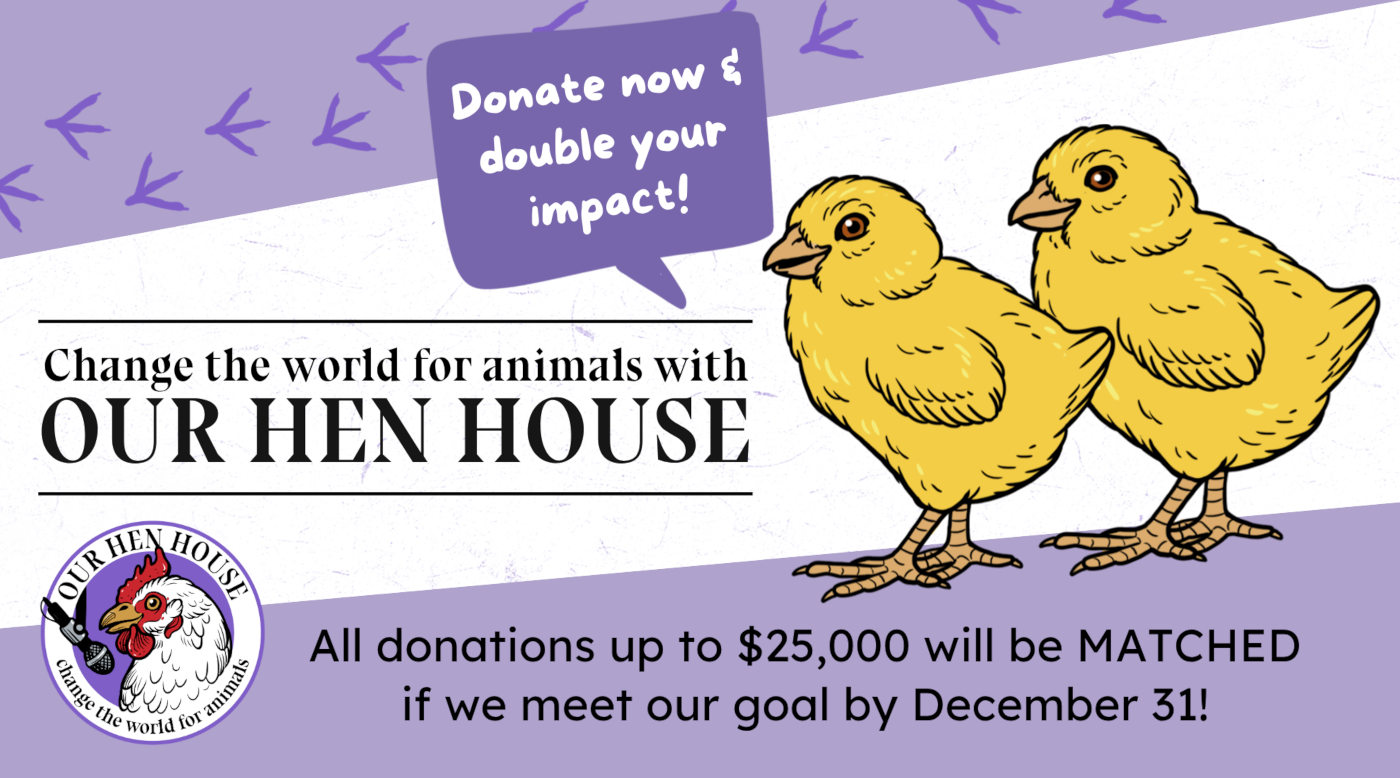
Of course, we would be thrilled if you would consider making a donation or becoming a member of our flock (especially if you’re a regular listener). All donations made before December 31 will be DOUBLED, up to $25,000 if we reach our goal. Contributions of any amount will go towards our fundraising goal and are hugely appreciated. Our Hen House is a 501(c)(3) nonprofit organization, so it’s tax-deductible. Thank you for helping us create quality content!
Don’t forget to also listen to the award-winning, weekly signature OHH podcast — now in its fifteenth glorious year!