
 Apple Podcasts
 RSS
 Amazon Music
 Spotify
 YouTube
 PocketCasts
 CastBox
 Player.fm
 TuneIn
 Audible
 App not listed? Try this RSS link

Vegan SoulFest, the Black Veg Society, Maryland Vegan Restaurant Month, plus fabulous vegan soul food restaurant, The Land Of Kush. What do all of these things (and more) have in common? Naijha Wright-Brown, that’s what. Join us to find out how Naijha does it all, and how she keeps it all edu-taining (education and entertaining) for her audience.
Plus, we have a quick update from Almira Tanner, lead organizer of Direct Action Everywhere, about the recent trial and conviction of activist Wayne Hsiung.
ABOUT OUR GUEST
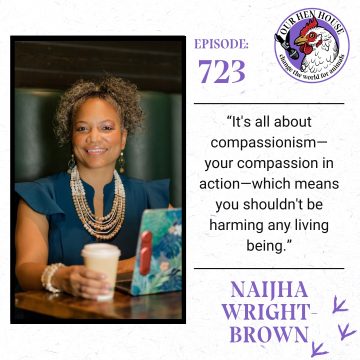
Naijha Wright-Brown is on the Baltimore Sun’s list of 25 Black Marylanders to Watch in 2023 and a 2021 Baltimore Business Journal Enterprising Women of Excellence Honoree. A native New Yorker, raised in the South Bronx, Naijha has an MBA in Business from the University of Phoenix and is a serial entrepreneur and co-owner of The Land of Kush, a multi-award-winning vegan soul food restaurant, co-founder of Vegan SoulFest and Maryland Vegan Restaurant Month and Vice Chair of the Board of the Restaurant Association of Maryland. She is also the Executive Director of the Black Veg Society, a non-profit organization that is on a mission to help Black, Indigenous, and People of Color close the gap in health disparities by educating on holistic health, veganism, and plant-based lifestyles. Her digital talk show, Naijha Speaks, helps others find their vegan soul through food, people, events, and culture.
RESOURCES

INTERVIEW TRANSCRIPT
Mariann Sullivan: Welcome to Our Hen House, Naijha.
Naijha Wright Brown: Thanks for having me.
Mariann Sullivan: I'm excited to have you. I can't wait for this conversation, because you are doing really a lot of different things. And so I thought about it a lot, like, where should we start? And then I thought, maybe it would be good to start at the beginning...
So you have kind of built your whole life, at least your professional life, around veganism. Can you tell us how and why it all happened?
Naijha Wright Brown: People always think, when they first meet me in the vegan movement, they think I have built my whole life around veganism, but that's not true. I've been working since 14. I haven't always been vegan. I grew up in a New York City housing project in the Bronx, the South Bronx.
So born in Lower East Side, raised in the South Bronx.
Mariann Sullivan: I just want to interrupt you for a second, because I just want to mention I was born in the Bronx as well.
Naijha Wright Brown: Oh, wow. Awesome. Great. What part of the Bronx?
Mariann Sullivan: Norwood. Kind of central, near Montefiore. Yeah.
Naijha Wright Brown: Okay, alright!
Mariann Sullivan: Other people probably don't need to have more specifics, but it's always nice to meet another person from the Bronx,
Naijha Wright Brown: I always have to describe that because it's all concrete. You got tall buildings, I walked 10 blocks to school. We had the box food. We waited for the box cheeses, the government cheese. We were on public assistance. So you can imagine the meals that we were eating weren't plant based. We're talking about all animal products, box products.
It's not the most healthiest diet for a few years, but when my mother sent me to camp at age six, she sent me out to the Berkshires and she wanted me to get a new perspective, a new life in terms of out of the concrete, more into nature. So starting at age six, I spent summers with a family in the Berkshires.
And that would open my eyes to a lot of different things, including eating from the garden, because we would eat from the garden every day. We would make our own bread. In that time they had a farm, friends would farm, so you would go get the food from the farms, whatever that food may be. We would get a lot of our food from the farm animals.
And it was a whole nother experience, you know, walking the rivers and things like that. So I would do that for a few years. They even took me to Italy at age 21. So imagine I'm 6, and I'm with this family, throughout the summers and sometimes through holidays up until age 21, 22. So that's a very long time to be exposed to a family.
And as a matter of fact, when we mentioned this, the couple was a Dutch wife and a Jewish husband. So now you have two different cultures together, and they were also self employed. The husband was a carpenter and the wife was a painter.
Mariann Sullivan: Fascinating.
Yeah. What a contrast.
Naijha Wright Brown: Just think from the age of six all the way to 21, this is what I'm exposed to in the summers. And again, sometimes throughout the year during holidays, and Christmas holidays as well.
Mariann Sullivan: Yeah.
Naijha Wright Brown: The vegan part of my life didn't come until I was 33. So I'm 50, I'm going to be 52 in February.
Mariann Sullivan: Well, you're looking very good!
Naijha Wright Brown: Thank you. Veganism wasn't introduced to me until age 33. So we're talking about a little over 20 years ago.
Mariann Sullivan: I went vegan when I was 45, so you're ahead of me.
Naijha Wright Brown: So I started working at 14. I always got to tell people that because when you start working, you're exposed to a lot of things. When you start going outside of your neighborhood, doing a lot of different things, you're exposed to a lot of different things and a lot of different people. So when I was 33, I was relocated to Maryland through company relocation.
I worked for Verizon Wireless for 10 years, and this was post 9/11. Because before 9/11, I had a great job. I had an entertainment company. I was promoting talent shows and producing comedy shows, doing all that type of fun stuff that you do in New York City.
I was a nightclub promoter, all of that. And then, 9/11 came and the type of job I had, they were laying off people, and I thought my life was ending. So to be honest, in my twenties, I was this person, like, where am I going to go next?
What am I doing? Blah, blah, blah. And then I landed on this job at Verizon Wireless, which I didn't really like or appreciate at first because it was paying me less than half of what I used to get paid. So I was kind of crying to my mom. She's like, when one door closes, another door opens.
So I would spend 10 years at Verizon Wireless. And landed in Maryland in 2005. So, you know, when you go state to state, you got to find a new dentist. You got to find a new doctor. You got to find, you know, all these type of people, because you're in a whole nother area. I would have never imagined that I would be in Maryland coming from New York and New Jersey.
But I landed here and I thought I was in the best health. I used the gym at my job, I was eating all the protein I could possibly eat, with eggs and cheese and milk. I was doing what the food guidelines were telling me to do. All of this stuff, all to find out that my cholesterol was high, and if I didn't do something about it, I was going to be prescribed meds.
And I'm holistic, so if no one understands that, or knows what that is, drugs are the last thing on my list. I don't want any counter drugs, I don't, everything is holistic. So just think boron, think, chest towel when you get a cold. Those are the type of products that I use. Natural.
Mariann Sullivan: Yeah, I tend to be the same way. It's just kind of how I was brought up. My mother hated taking, you know, and it just, that sticks with you your whole life.
Naijha Wright Brown: I don't want to be addicted to drugs and, you know, more research you do nowadays and all the commercials that you see nowadays, it's all about being addicted to drugs and I'm not into drugs.
Mariann Sullivan: Every single commercial. It's unbelievable. Like, what is wrong with us? Well, everything is wrong with us, apparently. It's just drugs,
drugs, drugs.
Naijha Wright Brown: And I wasn't having it.
Mariann Sullivan: I mean, sometimes medical care is very helpful and very important for people with conditions, but it just seems like everybody in the world is just stuffing themselves full of pills all the time.
Naijha Wright Brown: And, you know, later on, we'll talk about food being medicine, but I wasn't going to be on drugs. That's it. So that terrified me. So I went home and I searched some things on Google. I call it Dr. Google. You know, you got your WebMD, you got all type of stuff on Google. And it would walk me through how do you reduce cholesterol?
And the bottom line is don't eat things with cholesterol. So at that time, I don't know about vegan, vegetarian, I didn't know about any of these labels. I just knew I had to not consume anything that had cholesterol. So yeah, there was the skim milk, things like that. Also garlic pills, all of this type of stuff that I was putting in my daily regimen until I met Gregory Brown, who also worked at Verizon Wireless.
He came into the job a year after I had moved down to Maryland, and he was a very interesting gentleman. He was bringing all these different dishes to work, dishes that I wasn't familiar with. He had nice, beautiful, long locks. He had all these type of interesting books in his cubicle and come to find out this was a gentleman that was trying to open up a vegan restaurant in Baltimore.
He was vegan. He's been practicing vegan for a long time into meditation, yoga, and things like that so this is where I started learning about the diets in terms of plant based and the vegan lifestyle and what it is. My thing was the business because I came to Maryland trying to figure out what was the next thing I was gonna do. Because in New York, in New Jersey, I was doing a lot of different things.
I was doing comedy shows, talent shows, nightclub promoting, and I was looking to see what was I going to get into in Maryland. And meeting Gregory and talking about this dream of opening a vegan restaurant got my wheels spinning. I'm like, this might be it. I'm passionate about the lifestyle.
I'm trying to do better and eat better and get my cholesterol down. Maybe this is it. I don't know about food service, never worked in food service, wasn't interested in food service, but this piqued my interest.
Mariann Sullivan: Yeah, it sounds like this was a match made in heaven.
Naijha Wright Brown: Exactly!
Mariann Sullivan: Because he had one aspect of it and you had the other aspect of it, this business with a mission. So tell us, what did you find were the elements that go into creating a successful? business model that serves a greater purpose?
Where do you hit that balance of doing good, but also making money?
Naijha Wright Brown: Yeah, well, we'll get to that money piece in a minute. Well, in the market of food service, people assume that everyone is your market and everyone isn't your market because there are different cuisines for a reason. Some people like this cuisine, it could be Italian, Asian, American and soul food.
So I was always a soul food person, you know? We're talking about growing up in New York and in New Jersey and Harlem. I always loved soul food. I had talked to Greg about the idea if he was trying to reach the Baltimore city market and surrounding areas that we need to create a soul food menu.
So you're talking about your collard greens, which I loved, and baked mac and cheese, which I loved, and you've got vegan drummies and barbecue ribs and yams, and you know, so you get the idea.
Mariann Sullivan: I'm getting hungry. Yeah.
Naijha Wright Brown: So this was tested out and he's a self made, self educated chef. Didn't go to culinary school, but he knew how to make sauce, and sauce is the boss.
You season things with herbs and spices and all types that he knew how to make curry sauces and barbecue sauces and mustard sauces and you know, just you name it, all type of different sauces. And we would test these recipe ideas starting with the barbecue ribs and the collard greens and yams and mac and cheese at the African American Heritage Festival, which is a festival that took place at Camden Yard.
So if anyone's been to Baltimore and they've been to an Orioles game, you know, that's a big yard. It went on for three days. We were the only vegan vendor there. So if you can imagine a three day event, all these type of different cuisines, we would sell out every single night at this festival.
Mariann Sullivan: That's really impressive.
And that was before veganism really became as trendy as it is now, which is probably partly because of the work you've done, why it's become so trendy. But you must have been really introducing these foods to people who really haven't thought about it before.
So where do you hit that balance between making it healthy and recognizing that we're doing this for health, but making it delicious for people who are used to eating much less healthy food. Like, how do you hit that? Was he more interested in really hitting the health aspects? And did you have to make modifications to make people want to eat it?
Naijha Wright Brown: Well, you gotta season it. I mean, a lot of times if you think about collard greens, some of the ingredients are smoked animal something.
Mariann Sullivan: Yeah, collard greens by themselves are not that delicious, you gotta do something with them.
Naijha Wright Brown: Exactly, you gotta season them. And initially we started with the smoked tofu. So we had cubed smoked tofu bits in the collard greens. So, you know, nowadays, especially with the rise of food costs, it's just liquid amino acids right now that are smoked. So just a smoked liquid in there.
But back then we chopped up the smoked tofu and we put it in there, and with the herbs and spices it was really, really good. And it's still good today. We allow people to sample. So that's one thing. If people aren't sure about the food, you just can't expect them to buy stuff. You have to allow them to sample.
People are like, vegan barbecue ribs, what is that? You know, and then you have information to hand out. At that time, it was nutritional science. There was a newsletter I used to get. It was called Nutritional Science. And there was an edition that talked about red meat and how bad red meat was for you.
So I had that out there that literature that I was distributing to anyone that came up and tried a sample of the barbecue ribs because if you're thinking about beef, now I have this literature to give you about hey You want to reduce your red meat intake because of these reasons that this nutritional science newsletter laid out So we had the education there, we had the samples that we were given out, and people would buy, and people would buy the yams, and they just would get sold onto it while you're here at this festival.
Hey, you know, let me try this. This tastes good. Oh, I wanted to start a healthier journey. Okay, let's do this today. So, I mean, that, that, had a lot to do with it.
Mariann Sullivan: Did you see the signs right then that Black veganism was going to take off in a different way? Was it because people knew that what they were eating wasn't healthy and they were looking for something new?
Because black veganism has really exploded and uh...
Naijha Wright Brown: People know.
You smoke a cigarette, you know it's not the healthiest thing. People that are doing things that are unhealthy, they know it's not healthy. It's just a matter of being around, I always call this the circle of influence, being around the support system that can help you get to where you need to go.
Because if you continue to hang, and not to say you gotta get rid of your old friends, but if you're continuing to be around that circle of influence, of these habits, whatever the habits are that you want to get rid of, it's going to be difficult, you know?
Mariann Sullivan: Totally. Yeah. We are primates. We learn from each other. I was just watching that show, the Blue Zones show on Netflix. And one of the pieces of advice he said was to have at least one vegan friend.
Naijha Wright Brown: Absolutely.
Mariann Sullivan: Just in your circle, have one vegan friend, and that will change the way you eat.
Naijha Wright Brown: Exactly, now your question about the rise of Black vegans, well, this lifestyle has been around for a long time. If you think of the Rastafarians, the reason why Jamaican restaurants will have what they call an Ital menu is because of those that do not consume Meat or Dairy. It's an ITAL menu.
So they've been around for ages before this vegan, veganism. Donald Watson, from what I understand, this is a 1970s term. Vegetarianism has been around for a long time, and there's always been pure vegetarians. I don't know why people assume vegetarians always eat milk or dairy. That wasn't true. There were, and still are, pure vegetarians.
This is why I have this issue with labeling, because it's a separation process, in my mind. That's why when you went to the doctor, they asked were you lacto, ovo-lacto, or Ovo, or Pure Vege, these are questions that they would ask. So you had your Black Hebrew Israelites in Judaism, the Hindus, you know. This was nothing new.
Mariann Sullivan: So the roots were there. The roots were there, they just had to be tended.
Naijha Wright Brown: Exactly. You just had somebody come out with, okay, let's take this a little further and we're focusing on the animals.
But if you think of Ahimsa, violence and cruelty was also stated in that definition, minimizing your acts of cruelty, whether it's through your words or through your action through Ahimsa, right?
Mariann Sullivan: Yeah, that was kind of my next question for you. You know, of course, we're more of an animal rights podcast than a vegan podcast, tho they're kind of the same thing in so many different ways. But, when people start coming to veganism because of health, do you find it's good to stay away from the animal issue?
Or is it best to go there and really bring the full picture of why? Or does it depend on who you're talking to?
Naijha Wright Brown: You still bring the education in there and that's how we evolved with the Land of Kush because in the beginning, we had the Land of Kush logo with vegetarian cuisine and for some reason people were confused about the term vegetarian cuisine. Does it have milk, eggs? We had to educate them on pure vegetarianism that existed. You know, fast forward to now, now we're Vegan Soul Bistro.
But, the education was still there about not being cruel to animals and understanding the level of compassion. It's all about compassionism. Just being more compassion, your compassion in action, which means you shouldn't be harming any living being.
So we always had this education out there, but when you're thinking about a demographic which if we're targeting the Black and African Americans and Latinos, we're talking about the health disparities and sometimes you got to take it as what's in it for me?
We've seen people beaten, killed, stomped, all the children, young children are seeing this. And if you're coming into the community just talking about animals, people will look at you like, Hey, did you, you know what I saw last night?
It was worse than that.
Mariann Sullivan: No, I know. The animal issue can really, for a lot of different reasons, and a lot of different people can really put people off. Some people, and for other people, they really embrace it.
Naijha Wright Brown: it's all about the person.
Mariann Sullivan: I guess, you're always kind of seeing what works with different people.
Naijha Wright Brown: It's all about the individual.
Mariann Sullivan: I also find, once people really adopt this way of eating, they're more open to the animal issue. And, also, I find a lot of communication on kind of an anti colonial kind of attitude. This understanding that a lot of these foods that are really bad for you are not traditional foods if you go back far enough.
They were introduced in times of oppression.
Naijha Wright Brown: Exactly. So this is back to the education piece. So you're 100 percent correct. And then on the reverse of that, when you talk about colonialism, a lot of times when you're coming into the community, if it's a missionary or a person of help and trying to lead the people, people can take that as, okay, you're trying to colonialize with this movement.
Mariann Sullivan: That it's a new white thing, rather than a way that people have always eaten.
Naijha Wright Brown: Exactly. So there's so many different levels to this.
Mariann Sullivan: No matter where you are, people, no matter who you're talking to, they're going to have a lot of defenses about why they don't have to be vegan. I mean, that's just, that's just, a fact. Changing what you eat is hard.
Naijha Wright Brown: And not only that, not changing what you eat, because again, food is social, and the first thing people were thinking about, Okay, once I change my food habits, now, where's my social environment? I don't want to lose friends over this, so they're going to judge your way. And no matter what you say, or how you say it, The person has to be psychologically ready.
So my approach is always why do you want to do this? And our society, the Black Veg Society, we're going to meet you where you are. That is the mission, wherever you are on the journey, because it's still about the whole person. I'm Naijha before I'm vegan. So, hey. Naijha is my name and I was Naijha before I even became vegan and this is what I want you to understand about me before we even go into the conversation about veganism because the way you became vegan wasn't the way I became vegan.
It's two different stories. So, everyone has a personal journey and we need to respect that and we need to respect the fact that if you weren't born vegan, then you should already know that there is a way that this happens. Some people can do it overnight. They watch a documentary and that's it.
Some people watch a documentary and, Hey, this is like a scary movie to me. And now they're moving on to the next thing.
Mariann Sullivan: And for other people, it's an enormous struggle. And, you know, there's no point in getting frustrated with people if it's a struggle. For some people, changing what they eat is just harder than for other people, and that's where they are.
Naijha Wright Brown: And, then people don't want to be told what to do. That's another thing.
Mariann Sullivan: I don't.
Naijha Wright Brown: And now you're talking about an oppressed people that really don't want to be told what to do.
Mariann Sullivan: Well, another thing, another thing too is that... well, I wanted to talk a little bit also about availability, which has always been an issue in a lot of communities. That, the food just isn't there. I'm wondering whether you've seen any improvement with that, but aside from availability, there are other things that I don't think get talked about enough.
For one thing, these foods are addictive and so it's not just a matter of, you don't just put fruits and vegetables and a bunch of collard greens in front of somebody and say, see, this is great. Now you have them. People don't know how to cook them because over these years of fast food and everything, people have lost their whole family history of you cook things.
Naijha Wright Brown: And they've lost time. Yeah, not even that, they lost time. We're living in a society that 24 hours for some reason isn't enough for anybody anymore. And the larger your family is, it's less and less time. So if you're talking about, hey, I'm gonna spend an hour in the kitchen after I get off of work.
Mariann Sullivan: And if people have two jobs, and uh...
Naijha Wright Brown: Two, three sometimes. Some people are working on the weekends. I had to convince a mother to stop working on the weekends because she was losing her mind. I said you got to get rid of one of these jobs. And this goes back to the whole person thinking about the whole person and what they're going through. Understand you have your mission.
it's for the animals and we understand that but understand individuals have their own missions first before anything. And whatever that mission is, it's inclusive of their family and if they have kids and how are they surviving? How much money do they have? How much time do they have?
You see...
Mariann Sullivan: There's a lot of different factors and people are different, you know, like their goals are different, the availability of their time is different. Their income is different. No one message works for everybody.
Naijha Wright Brown: What I see here in the community, in the Baltimore community that's happening right now, that's great, is a focus on growing your own food. So a lot of that goes on and making farmer's markets available to those that can get to them. So remember, if you don't have a car. Or you have to rely on public transportation, that can be the determining factor whether this is going to be for you or if you're just going to continue to go down the block to the fast food place because it's easier.
Mariann Sullivan: It's easier and it's delicious, you know, in this awful kind of delicious way, this kind of addictive, delicious way. They make that food in a way that just really
Naijha Wright Brown: With sugar!
Mariann Sullivan: The sugar. Yeah, absolutely.
Naijha Wright Brown: I can tell you, we're right around the corner from a fast food spot and, you know, it's sugar on top.
That's the addictiveness. You know, once you get addicted to sugar, it's hard to get off.
Mariann Sullivan: Totally. Been there.
Naijha Wright Brown: But the education piece is important. You still have to have the education piece there because there are people that want to know more.
They want the information because they're trying to fit it into their lifestyle, whether it's got to be a flex, whether it's got to be a routine that they incorporate, even if it's one day a week or it's one meal a day. We have to meet people where they are and we have to be more compassionate as vegans and understanding.
And no one has to do anything. Well, let's just be blunt right there. You don't have to do anything. You can do the movement the way you see fit. If you have the statistics and numbers to show well, I saved a hundred people this year by doing it this way, that works for you.
And then someone can say, well, I saved a hundred people doing it this way this year, and that works for them.
There has to be an open minded process for this. There's not one way, and if
anybody says there's one way, I'm sorry, they're incorrect. There is no one way.
Mariann Sullivan: Well, it's crazy, anyway, what we're trying to do is change the way the entire world eats. I mean, it's a big job. The idea that there is just one way forward and that anybody would know what it is. If we don't try different things, how would we possibly know what it is that works with people?
What messages work, what don't? And of course, people are different. So it's a complicated job, but it seems like you're doing a really, really good job with it. You're reaching a lot of people. I was interested to see that you recently spoke at the AVA Summit, and the title of the speech was Diversifying the Global Animal Justice Movement.
So you really are thinking globally.
Naijha Wright Brown: You have to!
Mariann Sullivan: Even if you're acting locally. So can you tell us a little bit about what you spoke about?
Naijha Wright Brown: Oh, man. Well, let me go back. That was, what, in July?
Mariann Sullivan: I'm just really interested in your big picture.
Naijha Wright Brown: Well, what I liked this year, that I saw at the Ava Summit, is that they had the continents. So think the continents. It's not just country, the continents.
Yeah, Latin America, Asia and Africa. And, I have a real big interest in Africa because a lot of the stuff that we try to cook at the restaurant is based on African, meals and cuisines. And then we're getting into Latin because I'm half Puerto Rican too. So. they reached out to me to ask me to do a presentation on how did we launch the vegan restaurant weeks and restaurant months because there were plans to do this in Africa and I thought that was really interesting, and also the VegFest. So we're here in the U. S. thinking about what we're doing, we have less than 5 percent of the population being vegan or plant based, but we have a whole other continent of people, my people, you know, African descent that's working on their process of getting this done. It's a whole different process too. This is a whole nother country. And I was honored to do that.
I'm like, wow, they're really looking at us and trying to get best practices on how to incorporate this over in their countries, if it's Nigeria, Uganda, Ghana, or wherever. So, it's very important to look abroad and see what's going on. Because, we're complaining over here, but...
It can be worse in other areas, and I think we all have to work together without the infighting, or, you know, this system, or this way is better than that way, or whatever. We have to make a way if there's no way, and we have to learn how to be collaborative with each other and share these best practices. So it is a global landscape, because these are all different cultures and different political systems. We know our system here. We know, I'm sorry, it's a capitalistic system. It's about money, hands down. Because if it wasn't, why can't we get subsidies on vegan products? You get it?
If it was about vegan and the movement, why is it so hard to get this stuff? Especially we're speaking on health, and why it's better to be plant based or vegan. I don't know why no one can solve that problem. But when you're thinking about other countries in the global system, you know what the political makeup is of that. It can get violent, as we see now. It can get extremely violent.
Mariann Sullivan: Yeah, there are different challenges everywhere, and some of them are greater than ours, but some of ours are the power of the industries is very, very strong here. But I like to think of it, what you were saying made me think of, like, all of these people who are vegan, who are care about the animals, who care about people, who care about health, and, want to change the way people eat.
We're everywhere, but we're all one family in some way. We're all together on this issue, no matter where we are. And I think it's so important to look what's going on in other countries and for them to learn from you, you learn from them, be inspired by them.
We've had a number of people on from Africa. I find their work incredibly inspiring. And, you know, some factory farming has taken hold there, but less factory farming has taken hold in Africa, I think, than anywhere else in the world. And that's very hopeful.
I mean, you know, the best time to turn anything around is before it happens. So, I think there's really a lot of exciting work going on there. And so I'm really glad you told us about it, but you were talking about your Restaurant Week, and VegFest, and they're doing the same things there, and they're learning from you, and you were learning some stuff from them, but we haven't really talked about that.
We've talked about the restaurant, but tell us about all the other projects that you work on.
Naijha Wright Brown: Okay! Well, Naijha Speaks is a digital talk show. And, you know, we just go live. I want to meet people where they are and help them find their vegan soul because everyone has a little compassion in their soul I don't care what type of person they are. So we're trying to find a vegan soul through food, people, events, and culture.
So that's the platform. So I'm interviewing advocates, activists, business owners, whether they're vegan or plant based or, putting their foot into the lifestyle, trying to figure out their journey. The last episode I had, I was talking about an event. There's a first annual Vegan curious Festival coming up.
Mariann Sullivan: Oh, that's a clever idea!
Naijha Wright Brown: Yeah, so just, I love new ideas, new things, because it...
Mariann Sullivan: Rather than, this is a festival for the vegans...
Naijha Wright Brown: It's vegan curious..
Mariann Sullivan: Really setting it up so it's trying to draw in other people who aren't vegan yet.
Naijha Wright Brown: Exactly, and Vegan Soul Fest was co founded by myself and Brenda Sanders of Afro Vegan Society.
Mariann Sullivan: And Brenda has been on several times.
Naijha Wright Brown: Yes, amazing, award winning activist.
Mariann Sullivan: She's an extraordinary woman.
Naijha Wright Brown: So we were just having a conversation at Land of Kush before, you know, we even launched Vegan Soul Fest and it was supposed to be a conference where Land of Kush was catering, for her conference and the conference never happened because we came up with Vegan Soul Fest.
And the reason why we came up with that is because the problem we were trying to solve was, how do we make a vegan fest successful in the inner city of Baltimore? Would people come to that, so not having it outside because everyone, you know, was so scared of Baltimore. Baltimore is this and that, but people have to understand that Baltimore is not all bad.
There are good things going on in Baltimore and we wanted to show people that. So that year we organized this festival in three and a half months, having no idea how to plan and organize a festival. We thought we were just going to serve a couple of hundred people with probably a couple of dozen vendors.
No, we had over 80 something vendors, close to 90 vendors that year and close to 2000 attendees, and we didn't even imagine that this was going to happen in 2014.
Yeah. So we knew that there was a need. There was a need for people like us that wanted to enjoy a veg fest the way we like to enjoy it, with our music, with fun, with speakers, with something for the children to do.
So it was just amazing. It was an eye opener and it was a learning experience. And we would do that all the way up to 2019 before COVID. Every year we'd grow and grow and grow. It just grew so large that it outgrew us. Like we couldn't even handle it anymore. It just became that big when you're reaching 6,000 attendees.
It was just an amazing, amazing time. Now we're shifting post COVID to this music festival, food festival type of idea where wouldn't it be nice to go to an event like this and not have to worry about, hey, you know, where are the vegan options? No, we're going to bring this to you. And everything is going to be there in this musical concert setting and this food fest.
That's another level of learning for us, because again, it's a big festival. This year, we had close to 15, 000 attendees paid tickets. These are people That bought tickets to this event.
Mariann Sullivan: That is crazy.
Naijha Wright Brown: Yeah, it was. You really said it. It was crazy. It was definitely crazy out there. So, but we're, we're doing it.
We're doing it. And we're living the dream and we're bringing the information to the masses. And now we're making it this more, hey, that's the festival you want to be at this year!
Mariann Sullivan: Yeah, no, I love the idea of making it a music festival that is vegan rather than a vegan festival where a lot of people would think, well, I don't need to go there. I'm not vegan, so I won't go. Like, everybody will go to a music festival if it's good.
Naijha Wright Brown: Exactly. You just gotta default to the vegan stuff that's there. It's all gonna be vegan products, vegan food, yeah.
Mariann Sullivan: Yeah, I love it. So much creative work going on in Baltimore. I mean, largely due to you, and to Brenda as well. Like, so many exciting things.
I need to let you go because we've taken a lot of time, but before we do, I just want to find out, we've talked about what you've been doing, but what's coming up in 2024?
Naijha Wright Brown: Vegan Restaurant Month, which started out as Baltimore Vegan Restaurant Week, and then became Maryland Vegan Restaurant Week and now it's Maryland Vegan Restaurant Month happens twice a year in the spring and the summer. So we're looking forward to some new partnerships and new developments for the next one in March 2024.
Mariann Sullivan: How does the restaurant qualify to be part of it?
Naijha Wright Brown: You can be vegan or veg friendly. All you have to do is have some plant based options on your menu and we're going to promote that. We're gonna promote people to come in and try these options and vote on it. Vote on it so we can find out who's the best dish, who's the best dessert, who's the best beverage.
Mariann Sullivan: You know what's great about that too is because so many restaurants, if they do add a vegan option, it's uninspired. It's like, you know, they just grilled vegetables or something, you know, or portobello burger, you know. Like the chefs don't put themselves out for it, but this really would encourage chefs to like get creative and create something delicious.
Naijha Wright Brown: It's celebratory. Yeah, we're celebrating the month and we're giving people time. A week wasn't enough. Two weeks wasn't enough. So, a month, hopefully, it's enough for people to go out there and try as many options- breakfast, lunch, dinner, dessert. And we're going to keep on going.
I really want to get into some more events for the children. My daughter is a vegan, born vegan. So, really thinking about ideas around how we can get to the youth. We do have a couple of youth mentees working at Black Veg Society, our non profit, doing some things. So I'm looking forward to seeing some interview and youth panels and stuff like that coming out from Black Veg Society.
So just getting more into the youth. And we're talking about from elementary, middle, high school to college. Yeah.
Mariann Sullivan: That's great. Very exciting. There's so many reasons for vegans to go to Baltimore.
And I know people can keep up with your work on Naijha Speaks, which is on YouTube. Is that right?
Naijha Wright Brown: Yes. Naijhaspeaks. com. Yes.
Mariann Sullivan: And then all of the social media, you're on all of the social media.
Naijha Wright Brown: Yes, you can follow me at Naijha Speaks Vegan Soul or underscore vegan soul on Instagram. You can definitely reach out to me there. And I'm just going to try to keep busy and come up with some more innovative pro projects edutaining! I love edutainment.
Mariann Sullivan: I don't think you have any trouble keeping busy. I'm exhausted just talking to you.
Thank you so much. This has really been fascinating.
Naijha Wright Brown: Yeah, it's been a pleasure. I appreciate it.
_____________________________________________

Thank you for listening to the Our Hen House podcast! We will soon be kicking off our end-of-year matching campaign, meaning that between October 30 and December 31, your donations will be MATCHED, dollar-for-dollar, up to $25,000! That means, with your donation, we are hoping to raise $50k total.
We can’t do it without you! The only way we’ll receive the matching funds is if we successfully reach our goal of raising $25k from our loyal supporters by the end of the year. So, if you like Our Hen House, if you believe in our mission to effectively mainstream the movement to end the exploitation of animals, if you find community and solace in our shows and resources, and if you believe in the change-making power of indie media, please make a donation today.
You can listen to our podcast directly on our website, or subscribe on Apple Podcasts or your favorite podcatcher! Also, if you like what you hear, please rate it and leave us a comment on Apple Podcasts!
Don’t forget to check out Our Hen House’s other podcasts: The Animal Law Podcast, The Teaching Jasmin How to Cook Vegan Podcast, and the Antiracism in Animal Advocacy Audio Series.
The Our Hen House theme song is written and performed by Michael Harren.
__________________________
This episode is sponsored in part by The Culture & Animals Foundation, which sponsors artists, scholars, and activists in our collective efforts to understand our fellow species more deeply and to further their rights. CAF provides annual grants, an arts prize, a lecture series, and a fellowship. Visit cultureandanimals.org for more information. The Culture & Animals Foundation: Think. Create. Explore. Celebrate.
__________________________
 This episode is sponsored in part by Dr. Bronner’s. Their line of Magic All-One Chocolates now includes several oat milk flavors! The chocolate is fair-trade, vegan, 70% cocoa, and sweetened with coconut sugar! Learn more at drbronner.com
__________________________
This episode is brought to you in part through the generosity of A Well-Fed World. A Well-Fed World provides the means for change by empowering individuals, social justice organizations, and political decision-makers to embrace the benefits of plant-based foods and farming. Learn more at awfw.org.