
 Apple Podcasts
 RSS
 Amazon Music
 Spotify
 YouTube
 PocketCasts
 CastBox
 Player.fm
 TuneIn
 Audible
 App not listed? Try this RSS link
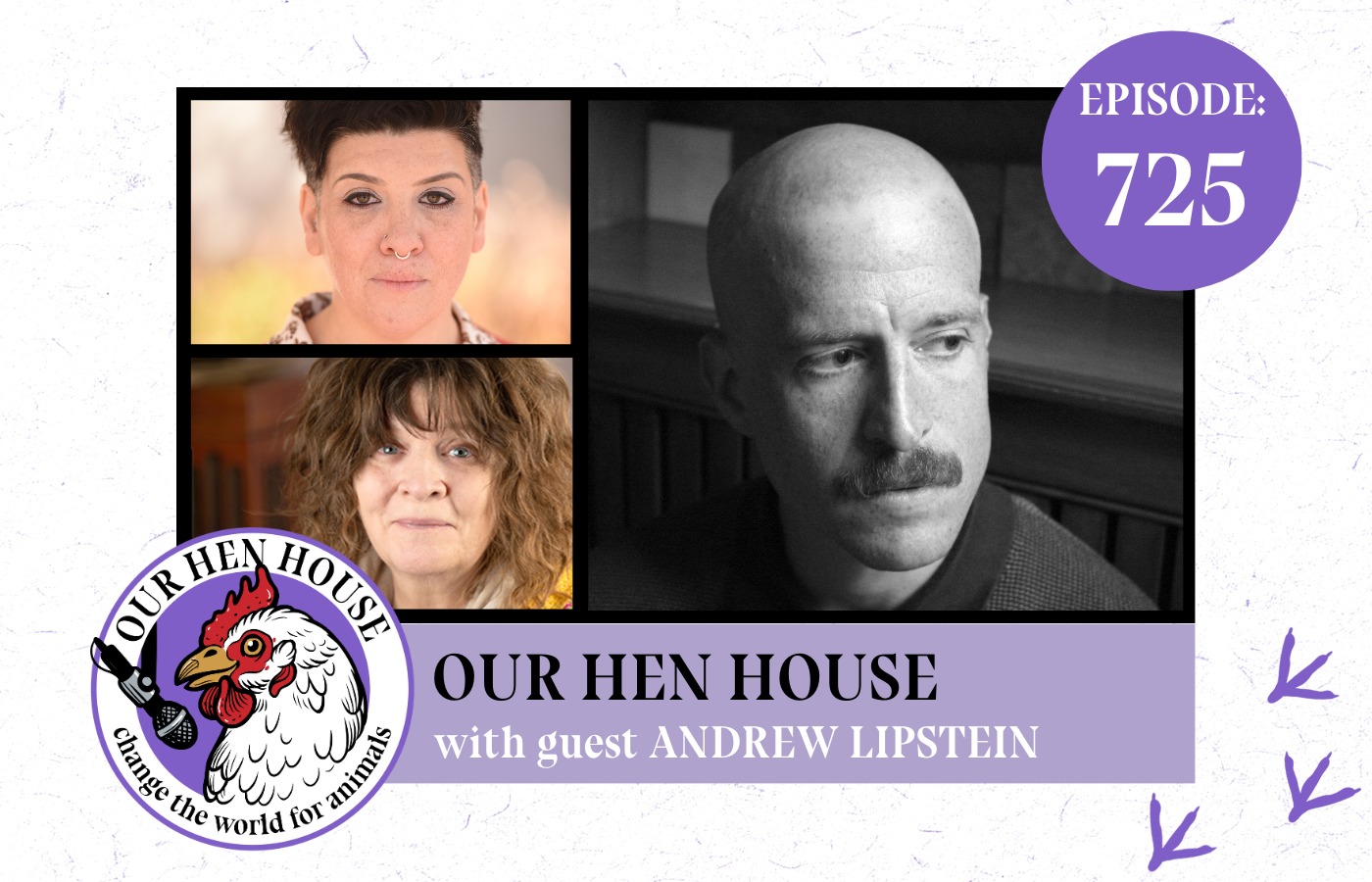
It’s not every day that you come across a book that has been reviewed in The New York Times with “vegan” in the title, but somehow Andrew Lipstein managed it. He joins us this week to discuss his latest novel, The Vegan.
ABOUT OUR GUEST

Andrew Lipstein is a New York-based writer. He is the author of Last Resort (2022), The Vegan (2023), and the forthcoming Something Rotten (2025).
RESOURCES

INTERVIEW TRANSCRIPT
Jasmin Singer: Welcome to Our Hen House, Andrew.
Andrew Lipstein: Welcome to me. Thank you.
Jasmin Singer: Welcome to you!
Andrew Lipstein: Smooth start.
Jasmin Singer: Yes! I think it's only gonna go uphill from here, man! I'm so excited to have you! I can't even tell you!
Andrew Lipstein: In your 14 years, has any guest ever welcomed themselves?
Jasmin Singer: Actually, that happened recently, that happened recently.
Mariann Sullivan: It did?
Jasmin Singer: Yeah, someone I was interviewing, I can't, I can't remember who, but yeah, it happened recently.
Mariann Sullivan: Maybe it's just like the new thing, clearly. It's the new style.
Jasmin Singer: We're trendsetters here, so, thank you for trendsetting right here on Our Hen House. I was just starting to say, Andrew, that when Mariann sent me the review in the New York Times of The Vegan, your book, and I plotzed, both of us plotzed, we couldn't believe it. We were like, wait, is it a book on how to go vegan, because, if so, I'm jealous, because I wrote a book like that. It did not make it into the New York Times. So, let's just jump in with that. Can you start out by just giving those who haven't read it yet a glimpse into the plot, or at least the beginning of it?
Andrew Lipstein: Yeah, happy to. So it centers on a hedge fund manager named Herschel Cain, who basically accidentally causes a friend of his wife's great harm during a dinner party and doesn't really feel guilt in a straightforward way for it. And, in a way, transmutes that guilt into a desire to be good in other ways in his life, including becoming the titular vegan.
That's basically the long and short of it, but of course, him becoming vegan is sort of just the beginning of his journey.
Mariann Sullivan: Yeah, no, and a lot happens after that, and a lot of it has to do with animals. And I want to cover all of that, there's a lot of other things going on in the book. There's a lot of stuff about hedge funds, and about, what is it, quant?
Andrew Lipstein: Quant hedge funds, quant trading, yeah.
Mariann Sullivan: We're not going to talk about that much, but it will touch on it. But before we get into all of that and all of the plot, I read something that indicated that your own choice to not eat animals was kind of similar to Herschel's in that it was a visceral thing. And I feel like this is a very personal story, and if you don't want to go into it, please don't.
I don't want to intrude. But if it's okay with you, can you just tell us if that's right? And tell us as much of that story as you're comfortable with. How you started this whole journey of not eating animals.
Andrew Lipstein: Sure, yeah, I'm happy to tell the story. I became a vegetarian about a little more than four years ago and it was very surprising to me. I think that morning I would have never guessed that I would become a vegetarian. I had thought about it like intellectually but never thought this is something that I'll ever do.
And I was just eating dumplings with my wife and looked at the meat in the dumpling and just thought I don't ever want to do this again. And since then I haven't eaten meat.
It didn't really occur to me at the time, and it has occurred to me since, that it wasn't a total coincidence. Two years before that, so basically six years ago now, my dad had a traumatic brain injury because he actually choked on meat.
And he is today, severely handicapped, and I don't know when that connection came to me. I sort of feel like it wasn't even until I was editing The Vegan or... I don't really remember the moment. But, it was one of those connections that felt both very obvious, and also like, too obvious, and too neat.
And I don't think that we ever make decisions in such a explainable way. And I don't really even consider my not eating meat a decision, because it's just something... and we can talk about this, and I'm curious about your own stories, but when people ask you, why are you vegan?
Or to me, why are you vegetarian? I often struggle to answer because there isn't like an answer that I could put into words. And I really like this idea of like having to explain morality because I feel like moral choices are the things that you can't put into words. They're not things you can build logical arguments about.
And my own experience becoming a vegetarian basically made that the ultimate unanswerable question. Because the person who asked that question wants to hear like, either the environment, either animal cruelty, my own health, something about factory farming, something about human labor, but there is no reason.
It's just, it comes before, for me, reasoning.
Mariann Sullivan: It's such an extraordinary answer. I mean, I've asked a lot of people that question, or a similar question, and I've never heard an answer exactly like that, or even close to it. Though I think for a lot of people, there is something of a visceral, just we don't know why, it's just a reaction, but almost everybody... like, I think mine and yours, Jasmin, it has to do with finding out what's happening to animals, and thinking about it, and making a decision, and then going back and forth a little bit, and struggling with it, and making a decision, no, this is the right thing to do, and I want to do it. And then gradually coming to actually really enjoy it, and that's pretty classic, but I've never heard of anybody, except for you and Herschel, for whom it was such like this lightning bolt kind of visceral decision.
I mean, I assume that that has something to do with why, I mean, you write, so you wanted to write a book, but you chose this particular topic as kind of an effort to come to terms with this decision and to understand it more or to decide not to understand it more?
Andrew Lipstein: Yeah, I mean, just like connecting my dad's injury to my vegetarianism, when I land on something that I want to write a book about, it's just strictly because I feel compelled to and I don't think to myself, This will be a good issue, a good plot, or a good character to write because it will help me work through something. It's just a visceral reaction like oh when I think about that idea I can't wait to write it and I think that is because I had a lot of and still do have a lot of unresolvable feelings about eating meat, not eating meat, about our relationship to animals, about what it means to be a good person.
And so I think when the idea came to me and I just thought like this is something I can spend a lot of time with that feels kind of limitless to me. And I think that comes from the unresolvable nature of the questions behind it.
Jasmin Singer: Well, just to jump in on that, Mariann, I totally agree with what you said about how like for you, and me as well, like going vegan was definitely, oh, I learned about what was happening specifically in the dairy and egg industries, but I was vegetarian long before that. As I know you were too and I think a lot of people here and I think that was more of a visceral thing.
I was 18 and I thought meat was icky, you know, icky was the word I used and so I stopped eating it. I didn't know what factory farming was. I didn't care at the time, you know, it's not like I cared or didn't, it just wasn't part of my world, at the time. So I think that that's really beautifully said.
Now, Andrew, did you write this book as part of your effort to come to terms with your own decision to not eat animal flesh?
Andrew Lipstein: I don't know if I ever felt I needed to come to terms with it. It was just once I decided that it felt like something that, I was going to do... maybe to seek to understand it more, but like... and I want to hear what y'all think about convincing others to not eat meat. But, you know, my wife, who's in the other room and is probably listening to me now, eats meat.
My son eats meat. My wife is pregnant with twins, they will eat meat, and never do I have the impulse to try to convince anyone else in my life not to eat meat. And I wonder if that's because I don't have a reason for it, and to persuade somebody else you need a reason. I mean, I feel like y'all would more easily call yourselves advocates and want to convince others, but maybe that's also because you have stronger reasoning for why you've gone down that path.
Mariann Sullivan: Well, I think that does make sense. I mean, having thought about it and really have these reasons, but I have to say that the last person, for most of us, I think I can safely say for most of us, family. Family's hard. Like trying to convince people close to you is actually very hard, for almost everybody, probably for a lot of different reasons. There are a lot of different family dynamics and for whatever. So, while yeah, I would say that almost everybody who listens to Our Hen House is an advocate and that's really what we do. It has to do more with being out in the world than focusing on trying to talk family into changing their habits. So it certainly is very, very lovely. And I envy people who just come to the same realization together. It's a great thing, but I don't think it's uncommon that that doesn't happen. What do you think, Jasmin?
Jasmin Singer: Well, I just want to kind of point out a couple of the comments we're getting in the chat here. Karen says, I don't try to convince others either. I think it is counterproductive and find such unreasonable defensiveness to meat and the choice to eat meat that I don't like going down that path for the tension it creates.
And yeah, so just relating to what Karen just said, I would agree with that. I don't think that the ethos of Our Hen House as a whole is to sort of like, bang people over the head with a seitan drumstick. This is one of the reasons we were very curious about your book because we were nervous about, like, is this just clickbait? And ultimately I felt like you really got into it in an incredibly nuanced way that a lot of times made me feel really, really seen as someone who does not generally have characters in books reflect my value system. And so there were a few parts in it where I was like, Did he steal my diary?
I mean, it was really, really beautiful. I wanna ask you the question that Thom just sort of alluded to here, and I'm not trying to put you on the spot.
Andrew Lipstein: I'm here to be put on the spot.
Jasmin Singer: Well, I'm not an angry vegan lesbian despite what they say about, yes, I am an angry vegan lesbian, but that's aside the point.
Why vegetarian and not vegan? Like, should we send you some care packages of cupcakes or something?
Andrew Lipstein: Oh, like vegan cupcakes?
Yeah, I would say about half the meals I have is vegan, which I know is no... there's not a reasoning at all. I'm a vegetarian. I'm not a vegan. It's funny when you were saying earlier that you became a vegetarian before you became a vegan, and it felt more visceral in that way.
There's something so visceral about eating meat that it is almost feels like a display of dominance and comes with all these unintentional like interspecies conflict, and all of these unintended significances.
Whereas, to me, drinking milk, or eating eggs, when I really think about it, just seems like perverse, as opposed to like, wrong. And I sort of think about veganism, I think, the same way I thought about vegetarianism before I became a vegetarian. It just seemed like something that I don't feel like I am compelled to do.
And I think part of that is because of the same blindness that I had towards vegetarianism that I think we all have towards all moral issues. I don't think that there's, not to like go all the way down the road of righteousness, but I feel like every one of us, whether you're a vegan, whether you give 50 percent of your week to charity, whether you do whatever, you have to be blind to certain things, to go on with your life. And to me, veganism is not something that I see as being morally correct. And I'm not saying I think it isn't, or I shouldn't. It's just to me, along the same lines of, why don't I give half of my paycheck if I can afford it to people who are starving? It's something I know I should do. There's just that, warm blanket of a threshold that I can't pass through.
Mariann Sullivan: Yeah, actually my next question was really related to that, but you might have just said that you can't answer that question, so I'll just try it. Because I got this from both the book and from the interview you've done, how to figure out, or the impossibility sometimes of figuring out what is morally required, and how there are balances.
There are things that are morally required, I think. That we all know, hopefully. Like, how does something go from being morally ambiguous? A good thing, I mean, I think we would all say it's a good thing, but not morally required, such as giving half of your income or, just living as some people do, as effective altruists sometimes do, living very simply and giving all of your money to the poor.
When does something go from being morally ambiguous, good but not required, to being morally required? Like, you know, not murdering somebody. There are lots of things that are morally required. Is it just whether it's against the law? I mean, that can't be right. It can't be like, if they change the law, change what's moral.
So, how do we do that? And why have we come to the conclusion that this is morally required and you've come to the conclusion that this is good, but not something that's... I need you to answer this because it's kind of the whole question.
Andrew Lipstein: Well, first of all, I don't think anyone cares about the law, right? Not that, not that we want to go against it, but like, uh, I mean, in all of
Mariann Sullivan: Well, I am a lawyer, Andrew!
Andrew Lipstein: I come from a family of law. My dad was a lawyer, my mom was a law journalist.
Mariann Sullivan: It's not, that's not the answer, clearly.
Andrew Lipstein: No, I mean, I have a very cynical answer, and I do want to underscore that it's one answer, and I don't think it's the answer. And I also don't think it's what the book is proposing, because I think there's a cynical way to read the book, and uncynical ways to read the book. But I think that we feel required to be good in sometimes, possibly always, if you want to look at the world in a certain way, to rid ourselves of negative feelings.
And I think when people become enlightened to a cause, often what happens is they become unblind to the guilt that they have to burden should they not do what they now see as the right thing. And I think when you feel morally compelled to do something, it's because you consider not doing it wrong, and with that wrong comes very tangible emotions.
I think when we don't do things that are correct, it's because we don't feel enough emotional cost for actually doing it. We don't feel any guilt. We don't feel like it degrades our own sense of goodness. So yeah I think we like to think of goodness as something that is a positive addition to our soul if you believe in that or who we are as a person, but I think another way of looking at it is when you become enlightened to something you are realizing the negativity you'll incur if you don't do the right thing.
Mariann Sullivan: It kind of leaves the sociopaths off the hook because they don't feel bad about anything. So for them, it's fine.
Andrew Lipstein: Well, that's why they're usually, if they want to be, somewhat successful in their fields because they don't have to, they don't have all those pesky, questions of integrity the rest of us suffer through.
Jasmin Singer: Totally. I just totally agree. And I feel like there are so many more sociopaths out there than we know about, but kind of switching gears, Andrew, what would you expect would be different about the way our listeners, who are by and large vegan and vegan because of animals, would take from the book rather than meat eaters and how they might digest the book, as it were?
Andrew Lipstein: Yeah, it's funny because the book is obviously not written for vegans, but I do feel like vegans, I think, would have the hardest time with it in a good way. I think the book would ask a vegan, to consider the moment that we were just talking about when becoming vegan went from something they didn't feel they needed to do, to when they needed to do it.
And why exactly that change took place within them. And something that's a common theme throughout the book is like language and reasoning. And I think over time when we make decisions, we have a story that we tell ourselves and other people. And we all do it, no matter what, like, why do you live in New York?
Why did you marry your spouse? Why did you decide to have kids? Why do you work in this industry? Why do you take up this hobby? We have very easy answers to that, that belie the actual truth of it. Which often isn't explainable to a stranger in even a few minutes. And I don't think anyone is ever done revisiting why they've made a big life choice.
And I hope the book makes vegans inquire within to, like, why exactly are they vegan? And if the answer is something that they could, like, publish an op ed on, to me that isn't a good enough reason, because it has to be personal to them, and what happened in their life that made that time right for them to make that switch.
Mariann Sullivan: Hmm. I think maybe it's just the way my brain works, but I just think of it more as that's just a decision I make like any other decision. Maybe I could write that op ed, you know, and that wouldn't be good enough. But, I found out what was happening to animals. It was terrible. It's beyond, I mean, as you know, because you put it in the book. Which was really, really great that you put all that stuff in the book so people would unexpectedly come across all this information about what's happening to animals. I found out what was happening to animals and it haunted me. I didn't know whether there was anything I could actually do about it, but I at least didn't want to participate in it, and so, I stopped eating them.
A lot of decisions about what you're going to do in life have to do with balance, how hard it is as opposed to what the benefit is. And as it turned out, it wasn't that hard, though it takes effort to get to the place where it's not that hard.
Maybe it's just looking back on it, it seems like it was a very easy decision. And speaking of the stuff that you put in the book, I know as part of your research, you spoke to Soul Eubanks. He's been on the podcast a couple of times. Can you talk a bit about that and what you knew before, what you found out, and how you decided about how much to put into the book?
How much information you wanted in there without it becoming like, a diatribe?
Andrew Lipstein: Yeah, I actually remember speaking to Soul. It was actually in the parking lot of the rehab center that my dad was in after he had his brain injury. And I remember coming away from that conversation thinking just how, logical he was.
It was not on the order of faith, that I think is how I consider it, and I think some other vegans and vegetarians consider it a matter of faith.
It was like, he was extremely even handed, and like, was also very empathetic to those who weren't vegans and vegetarians, and to me, it seemed like his veganism came from empathy in its purest form, and that empathy also enabled him to understand how other people think. Which I think is very interesting or ironic about some people who are vegans or have other causes that they're very big advocates for.
Which is that if ever you find yourself saying, I can't understand why other people do this. I can't understand how they could be so cruel. Like, the focus of that sentence. is the first few words, and it's extremely important. You don't understand how other people are thinking who don't agree with you, and that's actually your problem.
And when I spoke to Soul, I was blown away by how empathetic he was to people who didn't agree with him. And that obviously extends to, like, our whole country. And, you know, maybe there's not just easy two sides of things. But, I think we have a really hard time not making moral judgments about people who don't agree with our political thought when it comes down to our inability to be empathetic with the other side, because I think what's interesting about, especially the biggest political issues, is that they're moral on both sides.
Just to be totally forthright, I am liberal. I'm a democrat. I'm extremely pro-choice. I think it's extremely interesting that both pro-lifers and pro-choice rs, not a term but, are both making a moral argument. I think we like to think that we're often the moral side and the other side has their priorities wrong or they favor things like freedom or capitalism that are easy to blame on if you go too far down that road. But I find it so interesting when there's two opposing sides that are both moral because it speaks to the general moral relativism we have to fight with. And when we don't see what other people think that's actually our lack of empathy.
Jasmin Singer: You're making me think of, you're familiar with Peter Singer, the philosopher who wrote Animal Liberation?
Andrew Lipstein: I'm not.
Jasmin Singer: That's ok, he was like one of the top 100 People of the last century according to Time. So he wrote this kind of iconic book called Animal Liberation in the 1970s.
It recently came out with a re release. He's a very well known philosopher who happens to have put animal rights on the map, but he is philosopher famous as well. So Animal Liberation, for a lot of people, has kind of paved the way for the modern animal protection movement.
And he ultimately went vegan, the story goes, and we did confirm this when we interviewed him. He was sitting across from someone who was eating and didn't have animal flesh on their plate and Peter Singer said, why aren't you eating meat? And his friend said, I'm just uncomfortable with the way animals are treated.
And so to your point about what Soul said, you know, the I statement. And then Peter Singer went, huh, and then like wrote Animal Liberation and 50 years later, here we are. So, I don't know why that story kept coming into my head. And so just sticking with the idea of morality for just a moment, is eating meat morally wrong?
Andrew Lipstein: Are you asking my opinion?
Jasmin Singer: Yeah, I'm asking for your opinion, not for the opinion of our flock. But I'm just curious how you would fall on that.
Andrew Lipstein: I don't want to make it seem like I'm sidestepping the question. I will say eating meat is morally wrong to me. Going back to my earlier sort of loosely threaded rant about politics, I think that it's very possible that there are multiple moralities that are irreconcilable, unsquareable.
And both of them are as truthful as morality has to be. I don't think that there is such a thing as a moral truth because you could have two people doing exact opposite actions for moral reasons. I did Google Peter Singer and I see that his political party is the greens, not the green, but the greens, which makes me feel like he's just a salad fanatic or something.
Jasmin Singer: That's funny. It's because, I don't know, is that because he's Australian, Mariann? And maybe it's the Greens.
Mariann Sullivan: Getting to this question of is eating meat morally wrong? And obviously people take different positions and one of the most important things is to You know, we seem to have lost the ability to talk across issues. I mean, to not just toe the party line on lots of issues.
But the thing that makes Herschel's behavior so bizarre to people, I think, is mostly because he's... not just because he's come out on the other side, but because he's taking the issue seriously. And there are a lot of issues that people take seriously, and they can come out on different sides. But, I just wonder how you feel, but I just feel like, people don't usually argue with you about the morality of eating meat.
It's not usually a position, it's not like pro choice and pro life. They just kind of give themselves a pass. Like, this is an issue about which they kind of don't have to take a position. And I just wonder, do you think that the reason most people aren't vegan is because they think animals don't matter?
That doesn't seem right. I mean, people care about animals. I mean, not everybody, but you know, most people care. So, why is it that people kind of just don't take this issue as seriously as other issues?
Andrew Lipstein: I don't think it has anything to do with how seriously they take the livelihood of animals. I'm sure there's a stat out there about pet ownership and veganism, and I'm sure they're not nearly as correlated as you would expect based off...
Mariann Sullivan: No, not even remotely.
Andrew Lipstein: Yeah, just to go back to the idea of like things that we know are wrong but forgive ourselves for I think it's the same reason why we don't give so much of our money to charity. I think there's this idea that there's a weighing of pro and con, and Mariann you earlier said it's a decision like any other, and I did want to go into that because I don't feel like it's a weighing of pros and cons.
I think once you more or less see the light, not to use the rhetoric of religion, but I don't think there's like, if the cons were a little higher, maybe you wouldn't make that decision. Like if meat was more delicious, or like if it was cheaper, or like your favorite restaurant now only served meat, like I don't feel like it's like it's an equation.
Mariann Sullivan: Yeah, that's true. At least now it's true. I'm not sure in the beginning it's as true. Staying vegan is a much stronger impulse than going vegan.
Andrew Lipstein: What do you mean by staying vegan is a much stronger?
Mariann Sullivan: Like, right now, I'm vegan. Like, if meat suddenly became really, I mean, I always loved the taste of meat, so that's not an issue. Like, and if it suddenly became really cheap and was everywhere and they were giving it away for free. Yeah, I wouldn't change my mind. I mean, I wouldn't, no matter what happens, if I couldn't get vegetables ever, I still wouldn't stop being vegan, it would be very hard. But when I first went vegan, the weighing might have been a little closer, like, because it didn't happen all at once. It wasn't like a thunderbolt, as it kind of was with you. It was, you know, decisions I made, and if the pros and cons might have been weighed differently, but that's not that important a point.
Finish, the thought you were going to make.
Andrew Lipstein: I am wondering something though, Mariann, which is, I guess, you will probably, likely never undo your decision to go vegan, but it seems like we slightly maybe disagree as far as like how much of a decision it is, and I don't think it's a decision, and by decision I mean like a weighing of pros against cons, but to like challenge that in your world view, I'm curious like if we found out that, for example, mushrooms, fungi, are actually way more intelligent than we thought. I mean, a lot of people think fungi is like somewhere between plants and animals and how they operate and like how smart they are. If we realize that they feel pain, and they, through science, became more and more similar to animals, at what point would you stop eating mushrooms, and then, just before you answer that, what happens when we get there with plants as well? Like, at what point do you take back your eating of things that feel pain and are intellectual? And, does that feel like a decision, or does that feel like something that is Cause to me, that's like how that the only way that could actually be a decision as if like, it's actually something that matters, like your own survival, your own health. If you need to reclaim your own health by eating something that feels pain, like, is there a threshold for that?
Mariann Sullivan: Uh, yeah, welcome to our world, Andrew. Like, you're now in the vegan world, because there's a lot, really a lot of very high level conversations about insects. Not so much about mushrooms. I don't think there's a lot of people who think that mushrooms are sentient, but you never know.
Andrew Lipstein: Can I say though, I think the insect conversation lets you off the hook a little bit, because you don't go to your favorite restaurant and get served insects.
Mariann Sullivan: Well, that's coming. Believe me.
Andrew Lipstein: When you're vegan and you go to a restaurant with friends, you're always eating mushrooms or nowadays squash, right? So like, let's say it's mushrooms and not something that like 95 percent of the population finds repulsive on a base level.
Mariann Sullivan: Yeah, but I mean, the insect conversation has a lot to do with incidental, you know, we kill gazillions and gazillions of insects all the time for many reasons. But yeah, that's fine. I mean, yeah, like, that would be hard. You know, then you have to make decisions. Like, you have to survive. We're on this planet and this planet is designed in very cruel and horrifying ways, in many ways, and what we can try to do is reduce the harm we do. We can't reduce it to zero. I mean, people are always attacking vegans because they say, well, small animals are killed when vegetables are harvested, so you're not really vegan.
Well, of course you're not. You can't live on the planet completely innocently. That's not something that has been given to us. So you do the best with the information and the facts that you have, and there's a lot of conversations about this, a lot of conversations about, well, fish, people are pretty now settled that fin fish do feel pain and that's a problem, but you know, about seafood, about oysters, I mean, vegans talk about this shit all the time.
I don't know what I would do if I was caught in the problem of having to kill somebody sentient in order to live. I guess you start to think, as people are when it comes to insects, about different levels of sentience and what we really mean by sentience.
We haven't really had to do that so far because the animals who we eat are obviously not just sentient, but intelligent and have real lives and so we haven't gotten to that, but that you might start to think about that sort of thing. You might start to think about how you can limit your consumption of animals, but no, you know, even as now, they do kill lots of animals harvesting vegetables.
It's not possible to live on the earth innocently. Whoever made it up, and I'm sorry if there is actually somebody who made it all up, because I think it's a little psychotic. We're in a position of having to survive on a planet where all you can do is try to do the least harm, and veganism is kind of a, kind of a a way of doing that. It's not a perfect way. It's never perfect. It's never harm free and for people to pretend that it's ridiculous. And also, I do think there is a balance. I mean, there's a big difference between going back to, aside from, do you actually have to harm somebody?
But the difficulty in being vegan, like for me now, it's very, very easy to be vegan. But for a lot of people it isn't. Is it good activism? Is it even fair for us to criticize people who would have a very hard time living this way, who are working three jobs, who can't afford much good food, who have to work, you know, of course not, that is not what this is all about.
But, trying to make it easier for people to live the way they want to live, I think that's a really nice thing. And having this conversation with people who are struggling, who would like to not harm animals in their life and are struggling to do so and make it easier. That's a good way to live. All right, now I'm rambling. I've covered 12 different topics.
Andrew Lipstein: Can I ask you one more question?
Mariann Sullivan: Uh, yeah.
Andrew Lipstein: Just because based on what you just said, I'm very curious.
Mariann Sullivan: We are here to interview you, Andrew. Just keep that in mind.
Andrew Lipstein: I know, I know, This will be the last time. I did welcome myself. I
Mariann Sullivan: That's true. You did.
Andrew Lipstein: I welcomed myself, you have known what was coming. Would you eat meat if it meant that two or three people who currently eat meat didn't?
Mariann Sullivan: Well, you find those people and then I'll decide.
Andrew Lipstein: Oh no, come on, you have to answer the question!
Mariann Sullivan: Could I eat meat? You mean for the rest of my life? Well, it's kind, you know, it's kind of a hypothetical. Would you rather kill your brother or your sister?
Uh, you know, like
Andrew Lipstein: Also a good question to ask some people. You find out a lot about them.
Mariann Sullivan: You know, I probably the logical side of it would say yes, and the visceral side of it would say no. And I am honestly not sure which side would win. I mean, there is both a visceral side and a logical side. I probably would say no because I don't think turning two or three people vegan is really like... one person's veganism, two people's veganism doesn't have a huge effect on how many animals are killed for food. You have to turn a lot of people vegan to actually influence market choices. So, one person's veganism is not really making that much of a difference, but I don't know. And honestly, I do think it's kind of a dumb question.
Andrew Lipstein: You know, Mariann, I really enjoyed your answer and found it illuminating until the last bit, I have to say.
Jasmin Singer: Oh my God.
Mariann Sullivan: All right, can we get back to the book?
Can we talk about the book? Because I want to talk about this question I have about this relationship between guilt and intent. Because guilt is a big motivator for you. That's what's motivating Herschel, though I think there's also some fear in there, because it is against the law to drug people and then have them harm themselves.
But he didn't intend for her to hit her head. He just wants her to shut up. And so he didn't intend anything really bad. In his business, he doesn't intend to destroy the market. That's a knowledgeable side effect of what he's trying to do, but he really just wants to get rich. His intent is to be incredibly rich. And people don't intend for animals to suffer, they just want to eat. They just want lunch. Just because your motive isn't bad, or your intent isn't bad, doesn't mean you can't do big, bad things to get there if you're ignoring the implications. But you can't just run someone over even if your only reason is you want to get somewhere on time.
I mean, you have to think of not just what you intend to do, but the effect of what you're doing. Do you have this assumption that as long as you don't intend the harm, you're not really guilty? Because I don't think that's right.
Andrew Lipstein: Mariann, I have to say that you're saying now that effects matter beyond intent, but what you just said before, which you did call a stupid question, is that if you were to turn two people vegan and you gave up your veganism, to me that's effects. If you really care about effects...
Mariann Sullivan: But I made clear that I don't think it has an effect on the suffering of the animal, which is the only thing that matters.
It's too small.
Andrew Lipstein: Yeah, yeah, it's too small, but, and you know, not to like tweak the thought experiment, but we could get that number high enough to where it does make a difference, and then I'd be curious...
Mariann Sullivan: I think that changes the calculus.
Andrew Lipstein: But to me, intent, and your previous answer to the question, which I thought was really good, as I said, until the last bit, was, um, that there's an intellectual level, and then there's a more, I forget how you phrased it, but, uh, visceral, yeah.
For me, intent is the thing that ties your soul into the decision. We can forgive ourselves for everything but effect, which is really important, as you said, if there isn't intent. Because, you know, we just kind of dissed on the law earlier, that cares a lot about who caused something to happen, even if there wasn't intent, usually, because there's such a thing as negligence.
But for me, intent is the thing that gives you stake in the game on a soul level, on a morality level. That is when your own personal goodness can be sullied or bolstered, or done anything. Like that's when there's morality is at play. To me, when intent is taken out of the equation, it becomes one of these dry questions that I just asked about.
What decision would you make just based on effects in the outer world? We go from first person to third person when you're thinking about what happened, which is something that actually happens in the book. But for me, like intent, I don't think anyone does anything wrong to themselves when they don't have intent.
How many times do we tell ourselves to help us get through a time when we cause someone else pain by saying, But you didn't mean to, but I didn't mean to. It's both an incredibly stupid and useless thing to say, but at the same time, it really matters. And I think because it matters on the level of morality, and it doesn't matter on the level of third person, real world, how are other people living?
And that real world version can feel a little bit sterile, and a little bit dry, but to me, it's actually the most empathetic way to live. Because if you are not thinking in the first person and not caring about your own soul, and not caring about your own morality, that's actually achieving the type of empathy that some of the world's best religions try to push us towards.
Mariann Sullivan: I think I must have missed something because I feel like that means you have to be vegan.
Andrew Lipstein: How do you mean?
Mariann Sullivan: Well, if the good way to live is to look at your effect on others, not just on whether you personally had the bad intent or not. The effect on others of not being vegan is that animals suffer and die.
Andrew Lipstein: But, Mariann, I sort of feel like you just said the opposite, because you said that even turning two people vegan wouldn't actually make a difference in the real world, but what it does do is give your own soul...
Mariann Sullivan: Yeah, well that's a nuanced thing because I do think that being vegan in the world does matter, I mean as a practical thing. I think that it's hard to make the argument that you actually saving a chicken by having tofu for dinner. It's hard to make this direct comparison. But, as I think all our listeners know, being vegan in the world I think, in many different ways, even though the behemoth of animal agriculture is so enormous it's hard for one consumer to affect the actual output. In many other ways, being vegan influences, as we've seen, increases the amount of vegan food that's available, which increases the number of vegans. So it's more of a global thing, but I think it does have an effect.
But, do hear you that I do think that it's hard to argue that each individual's choice to eat has a direct effect on how many animals suffer and die. I kind of forgot where I started off on this, but yeah, do we have to look at effects or do we have to look at our personal, whether we had bad intent. And I think the law does look at both. I mean, it doesn't have to be intent though. I do think negligence is a problem. I think in the book, Herschel didn't intend to hurt her, he was negligent really, but I think he acted badly and I think he felt guilty.
Jasmin Singer: One of the most interesting things about the book for me was how you depict the animals, in particular the dog, and the way in which they communicate with Herschel. I'm afraid I'm very literal, and I just assumed that this was you, the writer, creating a character, i.e. the dog, and not Herschel, the character, having a delusion about what the dog is thinking. And I've since found out that this is not everyone's assumption, and what others assume, you're letting us witness another aspect of Herschel's madness. So which is it?
Andrew Lipstein: Yeah, I would say it's the second, but I wouldn't say it's madness. I think we often project onto animals. I think that a lot of pet ownership, to me, is, uh, as Vicki picks up her dog, as I see dogs in the background. I mean, I think the relationship of love we often have with pets is a spectrum between projection and a truer form of love.
You know, we were talking earlier about dog ownership and people who eat meat, like, how can you square those ideas unless you're delusional or crazy or, just contradictory in a way that's like blatant to others but not you?.
Herschel is totally projecting onto that dog and doing so, so the dog can give him what he needs, which is recognition of his guilt, which we normally get from other humans, but that wasn't available to him. So he did a sort of deranged thing and it worked. But crossing that bridge was something that opened up a bit of a Pandora's box for him.
But yeah, I wonder if there's a... I mean, I'm asking because y'all are the experts. I don't know enough about veganism, but is there a big debate in the world about pet ownership?
Whether it's right or wrong, or...
Mariann Sullivan: There is, but you know, it's one of those debates that goes on in the abstract because there are so many homeless animals. And I don't know of anybody who argues that pet ownership is so much of a problem that we should kill all of them instead of try to give them the best lives that we can manage.
I think most vegans have adopted animals, but yeah, I would say that there is a debate. It's not the top issue, given the horrors of what is done to animals, but yeah, that's certainly a question that comes up. Of whether we could possibly give them good lives, whether the lives they live are adequate, whether they're being bred into odd realities that are kind of halfway between what they were and who we want them to be, lots of different things. But as I say, it's mostly in the abstract because there's so many of them and they desperately need homes.
Jasmin Singer: Well, and it also depends, like, dogs are obviously domesticated, so I think there's a much different conversation to be had. Talking about cats, we did this to them, you know, we created their own prison, now we have to take care of them. And dogs who are by and large, I mean, unless you're talking about like a coyote, domesticated and really get a lot out of being in Vicki's lap, for example.
Andrew Lipstein: Mhm.
Jasmin Singer: And also, I would say that if a vegan was high, it was like 2am and they'd been hanging out all night, maybe they would start to talk about the idea of pet ownership as a word, or as a term. And they might get really heated about it.
Mariann Sullivan: Oh, yeah, owner is not a favored word.
Jasmin Singer: And also pet, with that same group of people who's high at 2 a. m., would also be like, what about the word pet?
I personally don't care that much. Like I get it.
Mariann Sullivan: Why do we have to be high at 2am?
Jasmin Singer: Well, I guess, you know, I'm projecting.
Although it's only 5 p no, I'm kidding. I'm not high yet. Anyway, let's move on if that's okay.
Mariann Sullivan: I have so much to talk about. And I just want to reiterate what Jasmin said that I kind of thought also that the dog was a character. I didn't think of the dog as just Herschel's projection. But one of my very favorite things about the book was the way you wrote the animals, because it's really, really hard to write animals.
I mean, they either end up being like in kids books that they're just substitute people. They talk like people and they're just acting people, or they don't talk at all and when you write about them, they're just sort of in the abstract. And I loved the way that you wrote the animals, that it was very vague, but you could imagine. It didn't overly project into who you thought these animals were, but it seemed very real to me. So even though I, I had it wrong and I thought that they were real, either way, whether they are a projection of Herschel's or real animals, I thought that was masterful. I really did.
And, you know, we haven't gotten to the ending yet and I have 10, 000 more questions.
Jasmin Singer: Yeah, a little announcement, for those of you listening, either when this airs or who are here right now with us. We are going to get into some of the spoilers now, or like the main spoiler, I would say.
If that's okay with you, Andrew, is that okay with you?
Andrew Lipstein: Yeah.
Jasmin Singer: Okay, so if you don't want to hear this, then listen to it after you've finished the book. Mariann, go ahead.
Mariann Sullivan: All right. I got this question from somebody, I won't say who it was, but I really think it's true. It does seem like people could easily take this book as indicating that veganism is this sort of mental illness that gets cured at the end and everything's fine. Do you think that that's something that people take from this?
Because he did kind of go crazy. He became vegan. He saw animals and then he got over his guilt and he was fine. As if it was just an episode of mental illness. Do you think that people read it like that from your conversations with people?
And is that how you meant it?
Andrew Lipstein: Short answer no. There's something about belonging to an identity group or having an identity and then always wanting or needing other people who have that identity to be the best people ever. We all have multiple identities and there are other people who identify as we do who are not perfect. 100 percent of people are people.
I don't think Herschel is indicative of what a vegan is. I don't think a large percentage of vegans become vegans because they've caused someone a great injury. I don't think people even become vegans because of one big event that gave them guilt. To me, the ending, you know, when he eats the meat at the end, he doesn't say, it tasted wonderful.
He doesn't say... I'm so glad I could eat meat again. I'm so glad I'm done with being a dumb vegan. That bowl of spinach and chickpeas and strawberries tasted like air. The last words of the book, I hope I'm not forgetting it, is it tasted fine. And to me, he had just come down from basically a spiritual journey.
And there was a combination of him sort of coming back to his reality of who he was. And because of that, he isn't experiencing that elevated life that he had just experienced. He's eating meat again, but it tastes fine to him. That's not a happy ending, you know, like if you're talking about a story where two people are rekindling after years of being apart and you said they embraced each other and they kissed and their lives were fine, that's not a happy ending.
Fine is not a word that we use for redemption. Herschel is in no way redeemed. He's back to earth, his earth, which is rationality, which is not needing to be a vegan, which is not caring about animals lives in the way that he thought he did, to me, that isn't saying what he experienced was wrong. I don't think he is necessarily better off for being off of that journey.
So the book is not saying that vegans are insane and thank God Herschel stopped being insane.
Mariann Sullivan: Yeah, and I didn't take it that way.
Jasmin Singer: Well, first of all, I just want to say that I have been vegan for 20 years and vegetarian before that. And if I ate meat right now, I would think it tasted fine too. Like it was never the taste of it for me. I could see, you know, in that way I was reading it and was like, Yeah, I mean it would taste fine.
I mean if we're just like really picking apart the word taste, but for me, that's not even what it's about at all because we have the taste replicated. For me the ending was not unsatisfying as an ending. It wasn't unsatisfying for me. It was really sad to me, though, because it was proof of a moral failure.
And it turns out that Herschel's veganism and his impulse to destroy his algorithm wasn't a recognition of his moral duty to others, but only a way of paying a debt. And once it was paid, in his mind, he didn't owe any moral duty anymore. Is that right? And do you think that that's how people see morality?
Andrew Lipstein: No, I think actually very, uh, uncynically, whatever the opposite of cynical is. To me, him eating meat is saying what he experienced isn't actually what veganism is. Because he was able to become not a vegan by what he ended up doing was admitting what he did to Franny and getting the form of redemption from her, he no longer needed to be vegan.
To me, that's the most uncynical way of looking at the book from a vegan point of view, is saying he was never a vegan.
Jasmin Singer: Fascinating!
Andrew Lipstein: Because if that could satisfy the moral urge, then he was never a vegan. That's one way to look at it.
Another very cynical way of looking at it is maybe vegans are people who just never found their redemption, like he did. That's not how I feel either.
Jasmin Singer: Okay.
Andrew Lipstein: But yeah, I mean, for me, sticking the landing of this book was to create as much moral ambiguity, for there to be always two ways of seeing it.
And I think those two sides I just said are kind of two polar opposite ways looking at the ending, which one says he was never a vegan because veganism is not this easy moral equation. The other way is maybe it is. Maybe people who are vegans haven't found balance to their own moral equation.
Jasmin Singer: That's so funny because when I finished...
Mariann Sullivan: I have to say, I think he was a vegan because he didn't eat animals.
Jasmin Singer: I disagree. I think I'm with Andrew on this. I think that it was indicative that he wasn't and also you just blew my mind open. So I have to think about that. But when I finished the book, Gretchen, if you're here, say something in the chat, but my friend Gretchen, who's a Flock member and might be here, we had a back and forth on text about it, and we both felt completely opposite about the end.
And I think we represented both of what you just said, I think. I could see a vegan reading this and being really, really upset about the ending, and I wasn't. I felt like he was, well, maybe that's just because of my worldview. I mean, I'm sure it is, but most importantly, Andrew, if it had ended with him staying vegan, would you have sold any books?
Mariann Sullivan: You wouldn't have.
Jasmin Singer: Yeah, there you go.
Mariann Sullivan: I'm just telling you.
Andrew Lipstein: I mean, talk about being cynical. The ending of a book isn't what sells books, it's other things. I think the ending could have been him staying vegan, as long as, honestly, it was done in a way that created as much ambiguity to me. To me, it wasn't a sure thing that this was the only way to create an ending that I would have found suitable.
But I do feel, honestly, extremely excited that you were able to disagree with somebody about it in a big way. To me, that's a sign of a success. Like, I don't want people to say, I spoke to my friend about it who read it too. We both agreed that this was the way to see the book. And we both really loved it and, like, it really spoke to how we feel about the world.
Like, you want to hear, me and someone who I have a predisposition to think similarly to because of something we believe in couldn't agree on this. Like, I love hearing that.
Jasmin Singer: Yeah, I totally agree. I have one more question as an author. I have a question about being able to sell a book called The Vegan because I have had to bend over backwards in meetings with editors about getting the word vegan in a title. And, tell me how that was greenlit because I'm taking notes.
I want to approach your editors next.
Andrew Lipstein: Well, I think there's two answers to the question. The first is that when I sold the book, first of all, I sold it to my editor who had already bought my first book. So he was already interested in what I was writing. But I actually sold the book under a different title. And the title of the book was Flashing Yearn, which is in the epigraph.
I think one of the reasons why the title works is because, not that it's ironic, but it is not... any title or cover that can make a reader think twice, or contradicts itself in some way, I think is useful. Like, the cover is of one anole eating another, like, obviously works against the vegan, and however the book was going to be presented was in a way that made it clear that this isn't just a book that is pro veganism or, like, about how great it is to be a vegan.
Yeah, I think especially for, for fiction, like, the title can only work if it works against the reader's expectations. So maybe if you were writing something that a reader would expect the word vegan to appear in, and not something about a quant hedge fund guy, the word vegan would be less expected.
Which isn't to say that I agree with whoever told you you don't want the word vegan in there, but...
Mariann Sullivan: Did you always know how it was going to end?
Andrew Lipstein: No, definitely not.
Mariann Sullivan: You know, you said one of the ways to take it is that Herschel was never truly vegan, and I kind of said, that's not how I took it. I'm still thinking about that, and I really don't. I mean, I think he went there. Like, he might have been a little, he was having an episode, clearly. He wasn't totally in his right mind, but he wasn't crazy.
And he totally went there, but like, it was a foreign place for him, and he left it. But, one of the things that struck me is that he was completely alone with it. Like, he didn't know anybody. I mean, there was his, you know, next door neighbor who was vegetarian, but that wasn't a real relationship, and that seems like a really big factor in, not just in veganism, but in morality in general, like, kind of groupthink.
If groupthink goes against, like, a certain kind of moral decision, it doesn't feel important. And I think that's something that animal rights advocates really struggle with alot. Do you think that had anything to do with the fact that he was just whirling around Manhattan, doing completely crazy things, completely on his own?
He didn't have anybody to talk to about this, but he had real thoughts about animals.
Andrew Lipstein: I think that aloneness was actually important for him. Because part of it was about, he had this extreme moral deficit, and he needed to feel morally superior because of it. I think a true vegan doesn't want to feel superior to other people, they want other people to feel like them, you know?
Mariann Sullivan: That's so true. That's well said.
Andrew Lipstein: If you're a real vegan, you hope that you don't have to feel morally superior, because you hope that the people around you are making that choice with you.
And this is, again, on the side of uncynicism, Herschel was never a vegan, this isn't what veganism is, his version of it, he needed to feel better than other people, and throughout the book he like, locates the moral failings of other people, because he needs to, because for him, he has to feel better than other people, and to me that's not a truthful version of advocacy or a moral choice of any sort,
Mariann Sullivan: So, what's he up to right now? Is he vegan?
Andrew Lipstein: He's he's not. He's not vegan.
Jasmin Singer: He might be having vegan food for dinner, though, or like ordering the bean curd on the menu and just being like, this isn't bad... hmmm.
Andrew Lipstein: Yeah, I love how non vegans or non vegetarians even always like, I had a mushroom burger. It actually didn't taste like shit. You know, like, it's always like, that's the bar.
Have you tried this tempeh thing?
Jasmin Singer: I know or the fact that like, you know, a non vegan or a non vegetarian has some vegan cheese and it happens to be terrible, because there are like a hundred vegan cheese brands and then they're like, vegan cheese is horrible, but then they'll have like, uh, you know, cow based cheese and they'll be like, Oh, I don't really like that.
And they won't have that kind again. They don't like throw all of dairy under the bus, it's just funny to me, but these are the kinds of things we find amusing.
So we will go into the Q& A in just a second for our bonus, but as we're concluding the main interview, Andrew, I just want to say thank you so much. I know that you said at the very beginning of chatting, I think before we even hit record, that you haven't had too many interviews where you're kind of deep diving on the vegan stuff.
So I hope it was painless enough for you, despite being told you had a stupid question. I hope that you had fun and that, um, and, and we really appreciate it. I mean, you're really quite the trooper for going there with us. So I just wanted to extend my gratitude to you and thank you so much for joining us on Our Hen House.
Andrew Lipstein: Thank you so much for having me. Thank you for your thoughtful questions. I mean, I honestly feel like we could talk for eight hours right now and I would, because I have as many questions for y'all. So I really appreciate your thoughtful questions and I wish we had more time to talk, but I'm very interested in what your listeners want to ask. Especially Thom, who's been chomping at the bit, it seems.
Jasmin Singer: Yeah, I'm a little worried about Thom. I'm worried about Thom. I'm just kidding. Um, yeah, Andrew, next time Mariann and I are in the city, let's like, go get some bean curd or something.
Andrew Lipstein: Yes, I do know all the great vegan places near me.
_____________________________________________

Thank you for listening to the Our Hen House podcast! We will soon be kicking off our end-of-year matching campaign, meaning that between October 30 and December 31, your donations will be MATCHED, dollar-for-dollar, up to $25,000! That means, with your donation, we are hoping to raise $50k total.
We can’t do it without you! The only way we’ll receive the matching funds is if we successfully reach our goal of raising $25k from our loyal supporters by the end of the year. So, if you like Our Hen House, if you believe in our mission to effectively mainstream the movement to end the exploitation of animals, if you find community and solace in our shows and resources, and if you believe in the change-making power of indie media, please make a donation today.
You can listen to our podcast directly on our website, or subscribe on Apple Podcasts or your favorite podcatcher! Also, if you like what you hear, please rate it and leave us a comment on Apple Podcasts!
Don’t forget to check out Our Hen House’s other podcasts: The Animal Law Podcast, The Teaching Jasmin How to Cook Vegan Podcast, and the Antiracism in Animal Advocacy Audio Series.
The Our Hen House theme song is written and performed by Michael Harren.
__________________________
This episode is sponsored in part by The Culture & Animals Foundation, which sponsors artists, scholars, and activists in our collective efforts to understand our fellow species more deeply and to further their rights. CAF provides annual grants, an arts prize, a lecture series, and a fellowship. Visit cultureandanimals.org for more information. The Culture & Animals Foundation: Think. Create. Explore. Celebrate.
__________________________
This episode is brought to you in part through the generosity of A Well-Fed World. A Well-Fed World provides the means for change by empowering individuals, social justice organizations, and political decision-makers to embrace the benefits of plant-based foods and farming. Learn more at awfw.org.