
 Apple Podcasts
 RSS
 Amazon Music
 Spotify
 YouTube
 PocketCasts
 CastBox
 Player.fm
 TuneIn
 Audible
 App not listed? Try this RSS link

Factory farms destroy lives, both animal and human. Jamie Berger joins us this week to discuss the making of the documentary The Smell of Money and the devastation caused to eastern North Carolina and its residents by this evil industry.
ABOUT OUR GUEST
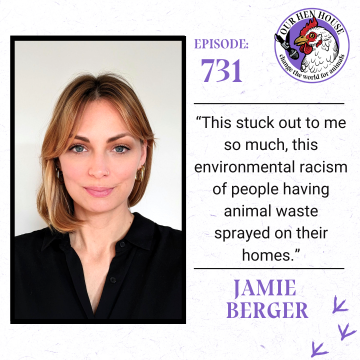
Jamie Berger is a writer and filmmaker born and raised in North Carolina. Her writing has been featured in Vox, The Guardian, USA Today, NowThis, The News & Observer, and more. Throughout her career, she has used writing and visual storytelling to draw attention to issues ranging from environmental racism to the climate crisis to other injustices wrought against people, animals, and the planet.
RESOURCES

- Continued Decline in US Meat Consumption is “Long-Term Industry Disruption” Creating Significant Opportunity
- Meat Consumption Is Rising — But Not in the Way You Think
- The Smell of Money website
- watch The Smell of Money trailer
- The Smell of Money on Instagram
- The Smell of Money on TikTok
- The Smell of Money on X
INTERVIEW TRANSCRIPT
Mariann Sullivan: Welcome to Our Hen House, Jamie.
Jamie Berger: Thank you. Thanks so much for having me.
Mariann Sullivan: Super excited to have you. I imagine some of our listeners have seen the movie, The Smell of Money, already but I'm sure most of them have not and I have to say that they have to soon. I've been waiting so long to see this movie because it has had a long time in theaters and it never just seemed to be in the right place for me to see it because I'm not in the middle of Manhattan anymore.
Finally, it has come online and we'll talk about that and where people can watch it. But, I've finally been able to see it and it is an amazing movie. It's very disturbing. I'm not going to lie to people that this is, this is not a lot of fun, but it's so good. And you learn so much about pig industry in North Carolina, which is not a fun topic.
Even though it's not fun, you have made it into a story that is about people and it has a through line. And I'm just curious when you started out, I'm assuming, and maybe I'm wrong, that you started out to make a movie about the pig industry in North Carolina and you had to make a lot of decisions of what that through line should be and what to focus on.
Can you tell us a little bit about that process? And do you start filming first, or do you know exactly where you're going right from the beginning? How does it all work?
Jamie Berger: Yeah, that's a great question. We had somewhat of a sense of the story that we wanted to tell. I think our approach really was to just start listening to people. So we went to North Carolina, started to make connections, get recommendations from the people we were speaking with about who else we could talk to, to kind of have them lead us in the right direction.
But to back up a little bit, the reason that I kind of already had a sense of the story that we would end up telling is that I had done my undergraduate honors thesis research on the North Carolina pork industry. I was born and raised in the state and like most people grew up eating barbecue, but didn't really know much about where it came from.
And I ended up learning about the environmental impacts of animal agriculture first in high school and then devoting most of my college studies to that topic. And like I said, did that undergrad honors thesis research on this and I looked at the industry from a lot of different angles.
So kind of unpacked its influence over the government, its rise in North Carolina, the kind of corporatization and consolidation of the pork industry in the state, looked at the history of labor rights organizing in North Carolina in the pork industry, of course the animal welfare implications, and it was this piece in part that stuck out to me so much, this piece of environmental racism, of people having animal waste sprayed on their homes, and this was about an hour, hour and a half, down the road from where I grew up, so not that far, but it felt like I was learning about a totally different world, and a practice that was just so egregiously, clearly unjust.
That experience of learning about that, doing that research propelled me into activism, made me a vegan, made me go into addressing factory farming as the goal of my career. So I had had that background when we started filming, and knew that the film would in some ways focus on that kind of element of it. I had already made connections with many of the people that we ended up interviewing. So, Elsie Herring, for example, I had an existing relationship with, Rick Dove, who's one of the Water Keepers, who we had met with.
I already had interviewed him, so, you know, I had some of the connections, some of the people, and knew, sort of, where to start. I knew who the major players were, so to speak, and then they kind of bridged the gap for us to other community members, other experts.
We just started our sort of listening tour back then and saw where it took us. I think one of the challenges was that there were so many layers to this issue, and I'm sure we can talk more about that. So, we definitely did get sidetracked over the years of filming, but we kind of ended up coming back to that core topic that I had envisioned we would from the beginning.
Mariann Sullivan: Well, it's both a topic that, as you said, it's deeply shocking. Talking about the spray and lagoon system, which is... there's many different aspects to the pork industry in North Carolina that this movie touches on, but as you point out, the heart of it is really what they're doing to people with this spray and lagoon system.
And just before we go any further, there are probably some people who are more familiar with it than other people, what it is, but can you just give us the basics of what that system is and what it means to the pork industry and what it means to their neighbors?
Jamie Berger: Of course. So in North Carolina, waste from animal factories, from factory farms, is held in these giant earthen pits that the industry calls lagoons, but they're truly just enormous open holes in the ground. So when the animals urinate, defecate, falls through the concrete slats inside the facilities and it's swept out into these big pits, they're the size of several football fields.
They're really best seen from the air because otherwise you can't even really get a sense of just how large these are. And then once that waste fills up in those pits, the industry has to do something with it. So the disposal method that they've come up with is to pump the waste out through these gigantic kind of industrial sized sprayers.
And then they spray the waste out over fields under the pretext of growing crops, but really it's just a cheap way of getting rid of all of this manure, and it's liquefied manure at that point, so it not only contains the feces and urine from the animals, but also all of the different kinds of industrial chemicals that are used on the farm, the pharmaceuticals, toxins, heavy metals, all different kinds of bacteria.
So it's just a slew of waste that's very toxic, very harmful and it's just kind of disposed into the environment. It's held in these open pits, and then it's sprayed into the air, and we know from research done in this area that it does travel. It can travel in the air up to several miles downwind.
It contaminates surface water, so streams and rivers nearby. Groundwater contamination is a big problem too, and all of this is happening in an area that, for a rural part of the state, is relatively densely populated. And most of the communities in this area are Black and brown communities. And so, this issue of environmental racism comes into play because those communities are the ones who are suffering the disproportionate harm of all of that pollution that I just talked about.
So, that's really the crux of the issue that the film focuses on is this practice of the lagoon and spray field system, as it's called, and the harms that that has to not only the environment and the surrounding ecosystems, but also the people who live in that area.
Mariann Sullivan: Yeah, it really is fascinating seeing it. Because these people live right there. I mean, it's right there. Also, they didn't just move there, they've been there for a long time. Can you tell us a little bit about that history and about the population of Eastern North Carolina?
I particularly, I was interested, I mean, you touched on in the film, the relationship between the history of slavery to who lives there right now and what their personal histories are.
Jamie Berger: Right. So the film focuses, largely, on a couple of people, in particular Black women who have lived on this land in that community for many, many years. One of whom is Elsie Herring, so she grew up in Duplin County, which is a county with the highest concentration of factory farms anywhere in the country and likely in the world.
She grew up there with her siblings on land that her grandfather had purchased after he was freed from slavery. So this is land that has been in her family for many, many generations. She was born and raised on that land, in that home that her mother had lived in for her whole life. And she went away to New York to study and to pursue her career, and then once her mother got sick and older, she came back to take care of her, and that's when she started to realize what had happened, where the pork industry, a factory farm next door, a factory farmer, had not only started spraying animal waste on her elderly mother's home, literally right onto her home, because there really is not much distance between them, as you pointed out, but also had taken land from her family.
So they had manipulated deed documents to quite literally steal land from Elsie's family, which is a common phenomenon for Black families in the South. And then, again, started spraying animal waste on her. So, in Elsie's story, and in general in the stories of the many other people who we connected with, is a story about the legacy of slavery in North Carolina.
It's this practice of exposing largely Black communities to this kind of harmful pollution is a modern day manifestation of that very same kind of system of thought, of the thought that Black people are less than and can be exploited in this way. And that shows up in the pollution, it shows up in the land theft, it shows up in the intimidation and the harassment that Elsie and many other community members have experienced.
That's really the piece of this that we narrowed in on that just blatant injustice of that history and how it's still happening, today.
Mariann Sullivan: Yeah. One of the extraordinary things about the movie is the obvious attitude on the part of these companies, farmers and companies, and I'll ask you to separate that out a little bit, but that they could get away with this. That they wouldn't be fought back against. That they were just dealing with victims and they didn't have to worry about dealing with fighters and they were wrong. But they also got away with a lot, no doubt about it.
You were able to get loads of interviews, but you were not able to get a lot of interviews from the other side. So how was that process? How did you try? And I thought you very cleverly substituted for it by finding speeches and trying to get the point of view of the other side across without probably being able to get a whole lot of interviews, though there was one really interesting one that you were able to get. I forget his name, Tom?
Jamie Berger: Yes, Tom. Butler.
Mariann Sullivan: So tell us a little bit about that process and what you were trying to get and what you were able to get to show the position of the other side, which I'm sure would much prefer that they were never asked about their position at all.
Jamie Berger: Right. Well, I think it was challenging, honestly, for us to get interviews from both sides. Again, because of the history of intimidation and harassment that people had experienced, and the fact that I and my fellow filmmaker are white. White filmmakers coming into a largely Black community saying we want to help tell your story.
That didn't initially go over super well, understandably, because there's just a level of trust that was not there. So even among people who are fighting this industry or who are concerned about its impacts on them, were reluctant to speak to us at first. So it took a long time for us to build trust with people.
We ended up largely focusing on people who had already been outspoken, who had already been kind of public figures and assumed the risks that they knew they would be taking by speaking up about this industry, but so many people were not willing to speak to us because they were so afraid. You know, we even had an interview with someone who had worked at a school and was concerned that the industry would cause her to lose her job if they found out that she spoke up because they're so connected to the school board and the school system.
Mariann Sullivan: I think all that fear is probably totally justified.
Jamie Berger: It really is. It definitely is. So, on that side of things we had the fear, the hesitation, the lack of trust to contend with, which we had to take our time with, have a lot of patience to address, and show that we were invested in this and we were going to keep showing up and we wanted to do this as right as possible.
I don't think there's a perfectly right way to create a film like this, especially white filmmakers, again, making a film about racism and I know we made mistakes, but... so that was on that side. And then, of course, like you mentioned, the industry was very reluctant to speak to us. We tried a number of different routes to try to get contact with them.
We had our executive producer, Kate Mara, reach out directly to them and that led us nowhere even. So like you observed, we ended up noticing that the public officials in North Carolina, the elected officials, were serving as a mouthpiece for the industry. And so they filled that role because they truly just repeat, in some cases, word for word, the very talking points that the industry wants them to say. So, that's kind of how we filled in that gap. We had footage of the North Carolina Agriculture Commissioner, Steve Troxler. We had footage of U. S. Senator, North Carolina Senator, Tom Tillis.
And they're all saying exactly, again, what the industry would want them to say. In some cases, even bold faced lies, like Tom Tillis says that residents moved into this area where factory farms were pre existing and then started to fight it, which is just simply categorically false, almost all of these people were there first and had had this land, as I said, in their family for many, many, many generations.
So, we were able to, I think, present that other side through the people who hold power in North Carolina, which I think underscores the fact that this is just such a deeply entrenched issue. It's so difficult to make progress on because the industry owns the government.
Mariann Sullivan: Some of the quotes you got were astounding. And I particularly did notice that one of, like, these people just moved in, which nicely juxtaposed with that whole history of this land, you know, was bought by these people's ancestors who got out of slavery, gathered together the money, got themselves some land, and this is what's being done to it.
So that was a really nice juxtaposition. Tell us about, I think his name is Tom Butler. Is that right? How did you find him?
Jamie Berger: Tom is such a wonderful, fascinating, interesting character. I had heard about him years before we started working on the film because he is truly the only hog farmer in North Carolina that I've ever heard of who is willing to be outspoken about the harms of his own industry. He's a real black sheep and he'll say that himself.
You know, he's been ostracized. He's been harassed and intimidated and had surveillance of his farm done on the part of the industry. And he's still raising pigs, but he has understood that the system that he's a part of is deeply harmful. And he's been outspoken about the fact that his own neighbors are suffering as a result of what he does on his own farm.
I think he, like many other farmers, got into this business after the decline of tobacco farming in North Carolina. Not understanding, not fully realizing what he was signing up for. He says in the film, and he said in many ways to us, you know, if I had known that I was going to be responsible for managing the waste, the amount of waste that's equivalent to what a small city produces, I would never have signed up for that.
And his experiences being in the industry, and again, he's very willing to talk to anyone about this, has not been good. He's been so exploited. He has not received a raise in over two decades. He has had to make his own investments in his farm to try to reduce the harm that he's causing to his neighbors.
At one point he was even making an effort to install a kind of filtration system that would allow you to drink the wastewater that comes out the other end. He was that committed to trying to reduce his impact. But at the end of the day, he realized there's just no way of fixing this system.
There's just no way of making this better. And so he's working to transition out of pork production, and he's working on converting his farms to be able to grow mushrooms along with his son, who's taking that on with him and going to improve it for future generations. But he was just such a wonderfully open, just uniquely open person to be able to reflect on that kind of harm that he's causing to very eloquently tie it in with racism and his own racism, and that kind of systemic racism in North Carolina, and understand that he wants to be a part of transitioning to something better, and being a model for other farmers to help them do the same.
Mariann Sullivan: Yeah, no, he was an extraordinary interview. It was startling to listen to him and it brings us back to the question, which I promised we would get to is, can you talk a little bit about... a lot of this movie is about Smithfield. I mean, Murphy Brown, which is now Smithfield.
I think everything is now Smithfield. What is the juxtaposition between these individual farmers and the huge multinational corporations, I mean, i. e. Smithfield. And, Smithfield, does it have its own pig barns, or is it all farmed out like, I think is more the case in the chicken industry?
Who's in charge here?
Jamie Berger: Most of the farms in North Carolina and elsewhere are owned by individual farmers, so they own the land, they own the buildings. There are some that Smithfield owns, but not that many, relative to the total. So most of these are what we call contract farms, contract farmers. So they sign an agreement with Smithfield, with the company, you know, the big company, whether it's Smithfield in the pork industry or maybe, you know, Tyson, if we're talking poultry.
And some of those other, they're called integrators, other big corporations. And they essentially say, okay, I will raise your animals for you and at the end of their time, I will turn them back to you. You'll slaughter them and ship them out. And essentially what that does is puts the liability for everything that could go wrong onto the farmer, and that includes the waste.
And again, as Tom told us, farmers who enter into that kind of agreement don't understand what it is that they're taking on. They're not educated, the company doesn't totally lay out exactly how they're going to deal with this enormous volume of waste. And I think many farmers kind of enter into that in desperation, honestly, because there are so few other opportunities in rural parts of America.
Again, in North Carolina, it was the decline of tobacco farming that kind of pushed farmers into the economic position where they had very few other choices besides going into this kind of production. And, you know, Tom told us, I think one of the things that really stood out to me that Tom said is that he'll go to an event, a gathering where people from Smithfield are present, where industry representatives are present, and inside the room there, all the farmers are kind of rah, rah, Smithfield, you know, they're very gung ho, and they're very supportive. But then he said, then you go out into the parking lot, and the story changes completely, and you hear from farmers how much they are suffering, how much they're buried under debt, and this is a common issue in the pork industry and the poultry industry as well, that these farmers are under mountains of debt.
I mean, Tom has about a million dollars of debt, and that is so difficult to come out of. And so even if they wanted to transition to something else, even if they wanted to do something else, it's very, very hard for them to do so. They risk losing their whole farm, they risk losing their land, if they make the wrong decision there.
So, we were very careful in the film not to vilify farmers. Of course there are some who fully understand what it is that they're doing to their neighbors and simply don't care. And I think those people do deserve to be criticized and deserve to be held accountable. But I don't think that's the case for the vast majority of farmers.
I think, like everyone, they're just trying to feed their families. They're trying to do right by the environment. And they're kind of put into the system in the same way that community members are. They're made to be complicit in this system that is so deeply harmful to people, to animals, to the environment.
And I think if they had any other opportunity to do something else, they would.
Mariann Sullivan: Yeah, and I think that's really become the tactic, for lack of a better word, of the animal rights movement. It may bring up emotions to think of what these people are doing to animals, but it's Smithfield who you have to go after, it's the big guys you have to go after.
And going after the workers or the small farmers or whatever, just is not going to get us anywhere. And I should add, I didn't realize that it was that much of a contract growing situation in North Carolina. And I think that in other places in the country, there are very big facilities owned by the big growers.
Certainly in Utah, I think in Iowa as well. The way the industry works, I guess, is mixed. It's interesting that in the South, which, you know, has long had a lot of financial problems and issues that it has become such a particular place for such an exploitative system of these farmers.
Going on to a different topic, but the one that is on everybody's minds. How did you make decisions about how to deal with the animal cruelty? You obviously care about the pigs and there's no implication here that you shouldn't care about the pigs, but the whole thing is fairly subtle.
A lot of it is done with visuals and there are a few comments about it, but you did not decide to focus on that issue. Tell me about that decision.
Jamie Berger: That's right. I think for me, having, again, learned about this issue when I was younger, before I was an activist, as I was kind of becoming an activist, I felt so strongly that this is an issue that we should look at holistically, that we should understand as interconnected in terms of, yes, it harms animals, but it also harms people, it also harms The environment, you know, community members, workers.
I saw it all as very integrated from the very beginning of my journey as an activist. And I always felt that even within the animal movement, which is where I have landed in terms of my own career, we often overlook the impacts on people. And I think that harms us in a number of ways. It makes us seem kind of short sighted and insensitive to many people who don't care about animals or don't know that much about what they go through.
And I think it also prevents us from forming connections, from forming kind of alliances with other movements that are working against factory farming. And I think the more that we can kind of make those connections, the more that we can work together, the more powerful that we're going to be to be able to reform the system and to create something better.
And so I always felt like this was a missing piece of this, even within the movement of people who care about factory farming, which is the animal rights movement. There just wasn't enough of a conversation about the implications of the system for people. And so I wanted to kind of fill that gap with this film.
And I also wanted to reach people again who may not ever be able to look a chicken or a pig in the eyes and feel connected with them. I mean, I hope that we can, as a society, get to a day where people can connect with animals in the same way that I do. But I know that's not where we're at right now.
So our hope with creating this film was that it would be a very human focused story that would allow truly anyone to connect with the people in the film, to look them in the eyes and say, I empathize with you. Nobody should have to endure this. These are fundamental human rights to access clean air and clean water in a safe place to live that no one should be denied.
And I think kind of striking at that common denominator of human to human understanding and in doing so broadening our conversation about how harmful factory farming is, bringing people in who might not otherwise care. I think that strengthens our movement. I think that makes us so much stronger.
It gives us so much more power. And we didn't want to completely leave the animals out. And so, as you mentioned, there are certainly moments where we draw in their suffering and try to, I think Sean did a great job of this, my co producer, did a great job of shooting this in a way that did kind of put the animals in your face in some cases.
I also really love that, it was actually Tom Butler who says, I think, the most kind of poignant point about animal sentience in the film, which is almost to more meaningful coming from a factory farmer himself where he says, if you take just 30 minutes and you spend some time with one of these pigs, they'll remember you. They're very smart. They know you. They're really social. They'll come back and greet you.
I really love that we were able to include that from this kind of unlikely messenger. And my hope is that those kinds of small instances of references to animal sentience will plant seeds with people who aren't vegan, who aren't part of our movement, and allow them to process that in connection with processing what this means for people and how harmful this is for people.
Mariann Sullivan: Yeah. Well, I think you really, really hit that sweet spot because, this has happened more in the past, I think, than it does now, but still, it's a problem, animal activists can sometimes get caught, in dealing with other people, feeling they're betraying the animals, they're asked to say something, or they're asked to participate in, I don't know, the family friendly ice cream social or whatever, there's so many ways that we can be asked to cross that line.
And you managed to like, not cross that line ever, not ever betraying the animals, but to very much broaden the focus while still saying, it's actually okay to care for the animals too. Like, that doesn't mean you're a fool. Like, it's okay. We can work together.
We don't have to agree on everything. And, of course, you were creating your own messaging. And I thought it was a really, really good job of doing that because people are going to watch it a lot more because it's about the subject that you talked about and that's the real goal here.
We talked already about the spray and lagoon system, but I wanted to come back to another question because sometime during the movie, there seemed to be an implication that there's a bigger plan here than just keeping the spray and lagoon system in business, and that their plan is to actually create a market for the waste, which sounds exactly right.
You know, that's definitely the direction in which all of these industries are heading. It's their whole plan for saying, we're not climate problems. So, I don't remember who it was, but as someone points out that they're delaying dealing with the system because they want our land.
So there was this hint of this bigger project here. Was that deliberate and is that what you think is happening? There's even more going on here than we realize?
Jamie Berger: I think in many ways, this is just, a huge corporation trying to colonize rural land. And I think that's what we've seen all over the place, all over the United States and elsewhere. It is this corporate capture of land. And I think it was Elsie who said that, and I think she's right.
I think these industries are likely hoping that, at the end of the day, there won't really be anybody left to fight them, that they'll just have free reign to be able to, essentially, just plunder the environment, the resources, and everything in Eastern North Carolina, and I think you're right to draw a connection between that and this move to generate more income from the waste itself.
The industry calls that production of biogas. We call it factory farm gas, but essentially it's capping the lagoons, putting a big tarp over it, essentially, and trapping the gases that are emitted and generating energy from that. And, of course, on the surface, if you look at that, as a total outsider, you might say, oh, that sounds like a great solution.
That sounds Like you said, very climate friendly, but really all it is is greenwashing. It's just a PR stunt. It doesn't do anything to address the underlying pollution problems. It doesn't do away with that lagoon and spray field system. It doesn't protect people from this pollution and it gives the industry a way to make even more money and entrenches them in the state of North Carolina and other places where they're developing this, because they're also investing so much in all the infrastructure to pipe that gas through communities, they're building pipelines in these very same communities that have been dealing with this for so long. And I think, yes, exactly like you said, it's just another way for them to plant themselves in this region, to cement their ownership of that area, and to just completely disregard and continue neglecting the health and well being of the people who live there.
Mariann Sullivan: The spray and lagoon system must be the best way to get rid of people anybody has ever imagined. If they didn't have people who, A, kind of have nowhere else to go, and B, are devoted, like, this is their historical land, and they don't want to abandon it, and they have a community, and they have no desire to leave and are actually willing to fight, they would be gone because who could live there?
It's just, it's that bad. One of the things we've heard about North Carolina, the pig industry is the risk of hurricane. And I guess it was during filming that really, really bad hurricane. I forget what her name was...
Jamie Berger: Florence, Hurricane...
Mariann Sullivan: came through and you had a lot of film of that.
Do they not see the possibility of increasing hurricanes and damage in that area? Which they're also creating, I might add, through their contribution to climate change.
Jamie Berger: Exactly. Such a vicious cycle.
Mariann Sullivan: But so far they're still sticking with eastern North Carolina, I guess. And, you know, the hurricanes came through, a lot of damage was done, a lot of pigs died horrible, dreadful deaths.
You know, and they just like put it back together.
Jamie Berger: Exactly. I mean, this has happened over and over and over in North Carolina. Growing up, I remember experiencing hurricanes there. It was a big deal. There was, even back in the 90s, some hurricanes that caused just unfathomable destruction. So much flooding. And this is something that, you know, North Carolinians are used to this.
This happens all the time.
Mariann Sullivan: If you look at a map of the eastern United States, you notice like North Carolina is kind of sticking out there.
Jamie Berger: Exactly. Yeah, so this is something that we have dealt with for so long, and as you said, it's only going to get worse. It's already getting worse. Hurricane Florence broke every flood record ever that the state had had. So, it is tremendously risky to have these kinds of facilities located in that eastern part of the state, the coastal floodplain.
But I think the fact that every single time after all of this destruction, the industry just rebuilds and puts the animals back in is a testament to the fact that there's no political will to change this. Politicians are seeing this happen to their own constituents over and over and over again and are doing nothing to address it because they're bankrolled, their campaigns are bankrolled by the industry. They're controlled by the industry. And so I think there's just this profit driven motivation that keeps them going, keeps them in business. And I think that there's a lot of kind of financial support that happens for the industry, taxpayer dollars go into those kinds of repairs and the disaster relief, so I don't think we'll see that change. I don't think we'll see hurricanes or other kind of weather events like that spark change until there's political change happening in a parallel way.
Mariann Sullivan: I mean, it really does seem like not an ideal place, but I guess there aren't that many places for them to go. That huge, huge facility in Utah is closing because they've no water. I mean, at least. They may have too much water in Eastern North Carolina, but no place is a good place to do this.
Jamie Berger: Right. I think it's really interesting that Smithfield a number of years ago was purchased by a Chinese corporation. And I think one of the reasons that we continue to see pork production happen in North Carolina is that it's cheaper and less regulated there than even in China. This Chinese owned company is saying well, actually we can still generate more profit by raising these animals in eastern North Carolina and then shipping the pork back home.
Mariann Sullivan: America has become the factory farm for the world. It's unbelievable, unbelievable.
Getting on it to a more personal level, there's really a lot of evil in the world, as we know. And animal advocates have to think about it a lot and educate ourselves about it a lot. But for a long time, you were really embedded in something very evil.
How do you manage that?
Jamie Berger: I think, this process of making this movie has been extraordinarily difficult for me, but I think there have been enough ups to the downs that I've been able to pull through it. I honestly wish that more animal advocates could have this kind of first hand experience of the industry that we're up against because it's so enlightening and I was in a place, where I had studied this, I had worked at animal protection organizations, I had seen it from afar, I had seen it from a very kind of institutional level, seen it as a whole system, and honestly, that was quite draining for me.
I think it led to feelings of burnout and kind of detachment and numbness. And it was actually being able to kind of literally get my hands dirty and to connect with people who are fighting this in a way that's very different from how animal activists are fighting this. People whose very lives are at stake and seeing their family's lives be at stake.
That was so meaningful to me and such an education, just such a wake up call to what we're really up against. Seeing the power of this industry firsthand, it's... there are no words to describe it. And, we know that on a very kind of rational level, I think, as animal activists, as vegans, but I think I got to understand that in a much more visceral way.
And I'm very grateful for that experience and really, truly just to be able to have had the opportunity to connect with people like Elsie and others who are so persistent, she had so much perseverance. She devoted her entire life to this. And being an animal activist, I've seen so many of my friends and colleagues burn out after just a number of years.
And so I think having somebody who is that motivated to keep up this fight for decades was just beyond inspiring to me. So anytime I feel like I'm teetering on the edge of burnout or feeling just so overwhelmed and so drained, I can think of her and remember the time that I spent with her.
This is a spoiler, of course, for the film, but she did pass away during the course of the production. and... I think too, just being able to now be in this place where we're showing the film to people. It's out in the world. People are really connecting with it, and most of our screenings have happened.
We've done over almost a hundred community and impact screenings, and those have all pretty much happened just because of word of mouth. People see it, and then they want everyone else to see it, and that's really, really rewarding. It's really amazing to finally see people watching it and using it as a tool for their own advocacy, and that's really what we wanted from the very beginning, working on this was for it to be useful, for it to be something that other advocates can take and use to build their own movements and educate their communities.
So, as much that's been draining and devastating as has been truly just meaningful and beautiful and amazing. So it's, it's all kind of balanced out.
Mariann Sullivan: I think the movie does bring some, I mean, obviously, it's not exactly the same, but it does bring some of that personal connection and that personal inspiration to everybody who sees it. And certainly, Elsie is an extraordinarily inspiring person, and she just does not give up. Totally even tempered, not a whole big emotional presentation, but she just does not give up.
All right, you've talked a little bit about the reception to the film, but I didn't ask you directly, so maybe you want to add something, and then of course tell people how they can see it now, because now things have shifted and people can see it online.
Jamie Berger: We've been really positively overwhelmed by the reaction to the film. I think, you know, as we were kind of speaking to earlier, we were careful not to make something that could be labeled a vegan movie, because I think that would have really limited the scope, limited our potential audience, and something that I've been so encouraged to see is just the huge diversity of the audience for this.
The people who are interested in this have so many different backgrounds. I mean, we've done screenings at universities, high schools, but also so many different churches, faith organizations are taking this on, farmers groups, public health professionals have seen it.
We've done a screening to EPA officials, which was amazing. So I think it's really reaching people who, again, might not otherwise have sought out a vegan film or been interested in that. And I think it's bridging a lot of gaps among those people, which I think is amazing.
I do see that it's having an emotional impact on people, which is also what one of our goals was, we didn't want to make something that people would feel like they're being bombarded with facts and information and kind of, talking heads.
I think there's a place for those kinds of documentaries. They're very informative and they can really help people just download knowledge, but that wasn't our goal with this film. We wanted it to be something that generated a very emotional reaction in people and we've definitely seen that in most cases. There are almost always tears.
People feel enraged. They feel so angry and so fired up and that's what we wanted. You know, we wanted people to feel fired up to do something about this. So that's the best that we could have hoped for in terms of the reaction.
It is available online now, as of December 12th, we released it on streaming platforms, so it's on Amazon, Apple TV, iTunes, YouTube, and Google Play.
So you can pay just five bucks to rent it, or fifteen to purchase the film. Right now it's just mostly in English speaking places, but we're expanding that. We have translations in Spanish and Portuguese, so it'll be available in other countries as well. We're hoping to do more translations of it, so just as this is a global issue, just as factory farming is everywhere now, we hope to be able to share the film with people all over the world, too.
Mariann Sullivan: Oh, that's great. That's great to hear. And you mentioned how powerful word of mouth has been in spreading the word, and I would just like to encourage everybody who does watch it to keep that word of mouth going because it's not like you sit down at the end of the evening and you turn on Amazon and think, what should I watch?
This isn't going to be at the top of people's minds unless they're told there's this great movie out there. You need to watch it. It's not going to be your choice, necessarily, if you don't know any reason To. So, definitely keep that word of mouth going.
And I'm just really excited about this movie and I'm really excited about you coming on the podcast and telling people about it. And I guess I would like to know, though you're still in the midst of promoting this movie and making it happen even more globally than it already has. Do you have any other plans for the future of additional filmmaking or different projects?
Jamie Berger: I am very much focused on trying to get people to see this film, still, as you mentioned. It's an uphill battle. It's not something that people are going to necessarily be excited to watch or to spend their Saturday evening viewing, so I appreciate you encouraging the spreading of the word about it.
We had so much footage, so many compelling interviews throughout our four and a half or so years of filmmaking that we collected that we were not, of course, able to fit into the final movie. And I would hate for all of that to go to waste. So I would love to, at some point, revisit some of that footage. In particular, we had a whole section of the film at one point about slaughterhouses and the impacts that they have on communities nearby and workers, and I think that would be something I would love to try to explore some more, in particular looking at the impacts that slaughter plants have on women, on immigrant women.
Looking at the kind of spillover effect they have in terms of higher rates of domestic violence and violent crimes in nearby communities. And of course then the pollution issues, there's a whole slew of other kind of pollution issues related to the slaughter plants themselves. You know, in the film we focus pretty much exclusively on the facilities, the factory farms, the CAFOs. So that's something that I would love to revisit. We had just incredible, heartbreaking interviews with a slaughter plant worker, and a rendering plant worker. Just stomach churning, heart breaking, and I think there's room to tell those stories too and I would love to figure out a way to do it that the final product ends up being a little bit less depressing, despite the fact that what I just described sounds absolutely horrific.
I think we need some more levity.
Mariann Sullivan: I can't believe you're planning on going to an even more horrifying and depressing topic, but uh, good for you because God, I mean, if we could just stop people from looking away, the world would change. So thanks for helping people do that, helping some people do that, and thanks for joining us today, Jamie, I really enjoyed this conversation.
Jamie Berger: Likewise, thank you so much for having me. This was wonderful.
_____________________________________________

Thank you for listening to the Our Hen House podcast! If you enjoy our podcasts, believe in our mission to effectively mainstream the movement to end the exploitation of animals, find community and solace in our shows and resources, and would like to show your support for vegan indie media, please make a donation today.
Subscribe to our show on Apple Podcasts or your favorite podcatcher, and don’t forget to leave a 5-star review!
Check out Our Hen House’s other podcasts: The Animal Law Podcast, The Teaching Jasmin How to Cook Vegan Podcast, and the Antiracism in Animal Advocacy Audio Series.
Join us in the Our Hen House Community, or follow us on social media! You can find Our Hen House on Facebook, Instagram, TikTok, or Twitter.
The Our Hen House theme song is written and performed by Michael Harren.
__________________________
This episode is sponsored in part by The Culture & Animals Foundation, which sponsors artists, scholars, and activists in our collective efforts to understand our fellow species more deeply and to further their rights. CAF provides annual grants, an arts prize, a lecture series, and a fellowship. Visit cultureandanimals.org for more information. The Culture & Animals Foundation: Think. Create. Explore. Celebrate.
__________________________
This episode is brought to you in part through the generosity of A Well-Fed World. A Well-Fed World provides the means for change by empowering individuals, social justice organizations, and political decision-makers to embrace the benefits of plant-based foods and farming. Learn more at awfw.org.