
 Apple Podcasts
 RSS
 Amazon Music
 Spotify
 YouTube
 PocketCasts
 CastBox
 Player.fm
 TuneIn
 Audible
 App not listed? Try this RSS link

Everyone who lives with an animal would think it rather obvious that they dream, but believe it or not, this is not an accepted fact in the scientific community. This week, we speak with David Peña-Guzmán about his book When Animals Dream: The Hidden World of Animal Consciousness.
ABOUT OUR GUEST

David M. Peña-Guzmán is an associate professor of humanities at SF State and co-host of the podcast Overthink. He specializes in animal studies, the history and philosophy of science, theories of consciousness, and 20th century French philosophy. He is the author of When Animals Dream: The Hidden World of Animal Consciousness, and co-author of Chimpanzee Rights: The Philosophers’ Brief.
- Overthink Podcast website
- David Peña-Guzmán on X (formerly Twitter)
- When Animals Dream: The Hidden World of Animal Consciousness book
RESOURCES
- Eating for the climate: exploring sustainability and food choices
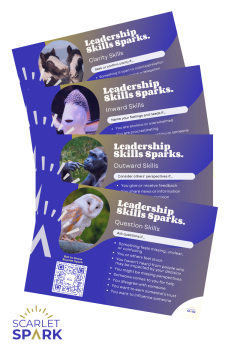
- Scarlet Spark’s Leadership Skill Sparks
- Scarlet Spark’s FREE Leadership Skills Workshops
- Scarlet Spark’s Leadership Tools
- Scarlet Spark website
INTERVIEW TRANSCRIPT
[00:00:00] Mariann Sullivan: Welcome to Our Hen House, David.
[00:00:04] David Peña-Guzmán: Thank you very much. I'm glad to be introduced to the pecking order.
[00:00:09] Mariann Sullivan: Yes, I promise I won't be too harsh with you. I'm really excited about this conversation. I'm excited about your book, and also I've seen a couple of interviews with you, and I just feel like you have a very interesting approach to the questions that, you know, you keep thinking that you've asked these questions a million times, you've thought about them, and then there are always new, new ideas.
And Dreams is really kind of a new idea. And you've taken two things that seem to be open to kind of unbelievable amounts of interpretation, and at least from my point of view, impossible to test, though you do talk about testing them. And that is, what are animals actually thinking? And what are dreams? I mean, just in general.
And then you combine them, like, does that make it doubly hard to figure out what you're talking about? Or, what do we actually find out about animals if we find out that they dream and maybe a little bit about what they dream.
[00:00:58] David Peña-Guzmán: Well, definitely, when I began working on this project about the dreams of other animals, it definitely felt like working on a mystery, within a mystery, because of course there are all sorts of questions that come up when we think about how can we know what's happening inside the mental life of another creature.
There are obstacles, there is language, there is culture, there are all sorts of things that really should lead us to believe that we will have a very difficult time figuring out what other animals are feeling, experiencing, thinking. And then if on top of that you go for one of the most labyrinthine forms of mental experience, which is dreams, it seems like the problem is compounded.
And so it was tricky approaching this topic, but it also made it very rewarding for me as a philosopher to ask questions and sometimes have to navigate this space between empirical research, and also some level of philosophical speculation. So that was a really nice and fun intellectual space to play in.
[00:02:02] Mariann Sullivan: For anybody thinking that this is a book of pure philosophy, it is really a combination of philosophy and science. And we can talk a little bit about what the relationship is between philosophy and science. I imagine that's a topic you've talked about. But just getting back to dreaming before we move on to the more general topics.
Now, we're not just talking about mammals, right? You are actually contending that really a lot of animals dream. Can you just talk kind of about the range? Obviously there's no hard and fast answer to this question, but I don't think there's a hard and fast answer to any of these questions.
So just take it from there.
[00:02:35] David Peña-Guzmán: Well, no, that's right. And that's just because nature is not interested in drawing clear lines. It's usually humans with our interest in categories that insist on clear separations between A, B, and C. And when it comes to other animals, and sleep, and dreaming, of course, we still have this long history of human exceptionalism that leads us to believe that only humans dream.
That's a position that a number of thinkers have defended, including in the past and in the present. And when you think about dreaming, once you start looking for signs of it, you realize that that's not a tenable position at all, because a number of other animals seem to display the same neural and behavioral marks that in human beings we accept as evidence for dreaming.
And so we're not only talking about humans, and we're definitely not only talking about mammals. So even what is sometimes called the mammalocentric theory of dreaming, is not quite up to date with what we know about what other species experience in their species- specific sleep cycles. In the book, I talk about species like birds, I talk about fish, I talk also about cephalopods.
In fact, the book opens with a scene of an octopus that was filmed dreaming. And one of the really wonderful details about octopuses is that because of their chromatophoric system, you can literally see the dream displayed on their skin. And so when you're already considering an animal like an octopus, that is from an evolutionary perspective, so distant from us, I mean, we're talking here about a really, really smart mollusk, an invertebrate that split from us millions and millions of years ago.
Then you're led to the conclusion that dreaming must be so important. That either it has appeared in very different branches of the tree of life, or it's so important that it's so ancient that it predates even the split between vertebrates and invertebrates. So either way, we're talking about a lot, a lot of animals that are implicated in this discussion.
[00:04:52] Mariann Sullivan: It is so crazy. The way you just put it that it's either like so important that it developed completely independently or it's so important that that it's been there forever through unbelievably, eons of evolution. I mean, those are the only two possible answers. It's crazy. And now, particularly about the octopus question, I think that was the example that you talked about how scientists have different interpretations of whether they're actually dreaming.
And to be honest, I've never given it much thought, but I believe that animals dream. I mean, anybody who has a dog, like, you know, they're lying there fast asleep. Their paws are running, they're, they're doing that little bubble bark, like...
[00:05:33] David Peña-Guzmán: Yeah, yeah.
[00:05:34] Mariann Sullivan: It looks just like dreaming. I mean, I imagine we all think that they're dreaming, but I've never given a thought to what it means.
But you actually make the point that some scientists actually shy away from concluding that animals might be dreaming, even though the evidence seems pretty secure. Is that right?
[00:05:51] David Peña-Guzmán: That's correct. I think there is a split that divides the kind of intuitions that people like you and I who live with animals or who have a long history of interacting with animals, and the views that we adopt in relation to other animals, we typically don't hesitate to attribute all sorts of mental and emotional states to animals, right?
We think that they feel, that they believe things, that they desire things, that they have interests, and that they have vulnerabilities of all sorts. However, in the scientific community, many of these, let's say, common folk beliefs about other animals tend to be viewed with a lot more suspicion, and they tend to be usually dismissed as non scientific, either as anthropomorphic projections where you take something that's really uniquely human and then you, unjustifiably project it onto other animals.
And in the case of dreaming, I think scientists, at least from within the standpoint of their discipline, they have good reasons occasionally to be a little bit hesitant about attributing dreaming to other animals, because as you mentioned a few minutes ago, this is a very tricky subject. Even in humans, we don't really know yet how to talk about dreams from a scientific perspective that fully explains everything that we know about, you know, why we dream, how we dream, the variability of dreams in humans.
And so if we're having all these difficulties in connection to ourselves, then how can we expect to speak positively and with any degree of certainty about what's going on with other animals? But still, the argument that I make in this work is that by now, I think the empirical and the philosophical evidence is so strong that we have really good reasons to move away from this hesitancy and to really begin working on developing an interspecies theory of dreaming that will allow us not only to know more about other species but also to come to understand dreaming itself as a phenomenon.
Because now we know that it's something that is not unique to humans, and that may be coextensive, perhaps not with the totality of the living world, but definitely with very large swaths of the animal kingdom.
[00:08:12] Mariann Sullivan: There's so much to unpack there and so I'm going to take some of it step by step, but I want to get to so many topics that this brings up. But the thing that struck me immediately was, once again, like we have to wait for scientists to catch up to things that we all know about animals. And I want to get into that a little bit more too.
Because you talk a lot about, about kind of the whole history of science and how we thought a lot of things... like 19th century science maybe was a little bit more advanced than current science. And we've gone through some really negative periods since then in understanding what's going on with animals.
But before I get to any of that, like, forgetting about animals, just tell us a little bit about the latest ideas about how, why any of us dream? Just kind a summary, because I don't really think I know a lot about... you know, I've heard people say we're processing things that happen during the day, like, but I've never really given it any thought.
And, and very sadly, like about 10 years ago, I stopped remembering my dreams well, which was kind of scary. And I, I don't have as much consciousness of dreaming. And I don't think about them as much. And I really don't know. So why do we dream? obviously we don't know, but why do we think we dream?
[00:09:28] David Peña-Guzmán: Yeah, well, it depends on who you ask, for this question, because there are a lot of competing theories about the function of dreaming. And some of the differences between those theories depend on the discipline of the person that you ask. So for instance, if you ask evolutionary theorists, you'll get a certain kind of answer that tends to foreground the evolutionary function of dreaming as a capacity in connection to an entire species, whereas if you talk to somebody who is trained in psychology, they might foreground more the function that dreaming performs in the life of a particular organism.
And so some of the main ideas that are floating out there in a research about dreams today have to do with things, of course, like memory. We know that dreams are involved in the consolidation of memories from the previous day, especially what happens in the, let's say, 16 to 20 hours leading up to the dream.
So when we're awake, we have all sorts of concerns and anxieties and things that weigh on us. And it makes sense that we process them in our dreams because in our dreaming, we start sifting through the phenomena and deciding what is and what is not important. And so there definitely is a connection between dreaming and memory.
But there is also a connection between dreaming and creativity and problem solving. There is a very long history, and many people have written about this in various books, of Scientists, innovators, mathematicians, physicists, sort of conjuring up solutions to very difficult problems that they were trying to crack in the waking world, and that they couldn't crack in the waking world, and suddenly coming upon a solution in the form of a dream. There are cases, for instance, of scientists figuring out the structure of some molecule or coming up with the proof to a particular kind of problem or dreaming a machine that they then create upon waking up that is an invention. And so there's something about dreams and creativity that speaks to this history, but that also speaks to our lived experience of dreams. Because the one thing that we all know about our own dreams is that they are bizarre and they are sometimes absurd.
And even in their bizarreness and in their absurdness, they are fundamentally creative. The brain is pulling things from very different areas of experience from the past, from the present, and trying to bring them together in novel ways that sometimes culminates in this problem solving moment that, you know, has the structure of a eureka insight.
And so that's very fascinating. So some people also foreground that. I'll mention just one other thing in connection to the function of dreams, which is the emotional side. Because, of course, also here, if we begin from the perspective of our own dreams, we know that we tend to dream about things that we care a lot about.
That can be things that we love, but also things that create dread and anxiety for us. And so our emotions are usually deeply tinged with sentiment and with feeling. And so a number of people have made the argument that what we're doing in our dreams is we're working through emotionally difficult scenarios, almost in a form of self directed therapy, whereby we are trying to.
Come up with a way of relating to a difficult or traumatic event in a way that takes out that emotional weight or that emotional injury that the event typically carries with it. And so a term that sometimes is used in this literature is a term from Sigmund Freud, who wrote a lot about dreams, which is that in dreams, we work through a particular kind of trauma in the same way or in a similar way rather than A patient works through early childhood trauma in a clinical setting with their therapist.
[00:13:39] Mariann Sullivan: Right. Yeah. And, and, can you relate that to what we know and how we know it about what animals dream? Talking about the trauma, I'm just thinking of what you wrote about the young elephants who had been through terrible, terrible trauma and suffered from terrible nightmares.
Like one could just imagine exactly that happening. I don't know whether they worked through it, but that really did remind me or make me think that the way that animals dream, at least the way some of them dream, really does sound exactly like what we do. But how do we know that?
They're dreaming. We can't ask them. How do we know it?
[00:14:14] David Peña-Guzmán: That's correct. cannot ask them, but we can definitely observe them and interpret some of the things that they do while they sleep and also upon waking up. And so in connection to the elephants that you're mentioning, We know that there are cases where elephants are deeply traumatized by events that happen in early childhood.
And before we enter into the discussion of dreaming, we have to also keep in mind that elephants have exceptionally good memories and highly social relationships. So they are animals that live in community and that remember one another individually. So these are creatures that thrive on strong emotional bonds with members of, of the group.
And when young animals, when young elephants are torn from the community, typically by human made violence, like Imagine poachers come into a territory where there are elephants and start killing the parents, the fathers, and the mothers, in order to take the tusk. In many cases, they don't bother to kill the young elephants because they're not worth it, because they don't yet have the ivory tusks.
And so what happens is that these young elephants become witnesses to a slaughter in which they watch, especially their mothers, get killed. In in very brutal and violent ways, sometimes with chainsaws, sometimes with machetes, sometimes with arrows, and all of these images that these young elephants are seeing get imprinted in their minds.
They become moments of primal trauma for them. And we know now from reports in rehabilitation centers for elephants in Africa, in particular, that when these elephants are rescued after these horrific events, many of them experience what we sometimes refer to as a deregulated sleep architecture, meaning that they no longer sleep in the same way that they normally should.
And the deregulation presents itself in two ways. One is that the animals don't sleep through the night any longer. These young elephants start waking up in the middle of the night and not just waking up in the way that you and I might wake up if there is a sound outside. Rather, they're waking up in a panic.
They are screaming and essentially freaking out because they are having a night terror connected to that primal scene of violence.
[00:16:52] Mariann Sullivan: I mean, that is such a familiar, like I mean, I haven't had a lot of nightmares, but that is exactly what happens when you have a terrible dream and you wake up in that panic.
[00:17:00] David Peña-Guzmán: Correct, and from a physiological standpoint, waking up in one of those nightmares is very different than waking up from just a slightly negative dream. The physiology is different, the neurochemistry is different, and it's not just that these animals are waking up in the middle of the night, unable to go back to sleep.
It's that then, and this is the second way in which that trauma manifests itself, then they go searching for their mother, unable to find her. And so they often develop very acute forms of psychiatric distress to the point that now researchers are using the term, non human PTSD or elephant PTSD to describe what's happened to these creatures.
And so it is the case that these animals are remembering. So here we see the connection to memory. They are storing this information, but they're also being traumatized by their recalling of that information in the context of sleep. And that's the simplest definition of what a nightmare is. A nightmare is when you recall a deeply traumatic event from past experience to such a degree that it jolts you out of sleep in a moment of panic.
[00:18:16] Mariann Sullivan: So a lot of what we know depends on our comparing what they do to our own experiences, which makes total sense, though frequently doesn't to scientists, but how much do we, I mean, there's so many different animals, so many different dreams and so many different possibilities. What might we know in the future? It's hard for me to imagine how you research this. So what might we know in the future? And what is it that we will never know? I mean, there's got to be a limit here. I mean, it's one of the hardest things, I think, for scientists to accept that sometimes you're not going to know everything.
And then you have to decide what to do with the knowledge that you've got, not just wait until it's all sewn up. But, so what might we know in the future? What research is going on or could go on? And what is your guess about what we're just going to have to live with the fact that we don't know this?
[00:19:07] David Peña-Guzmán: Yeah, so these are two really good questions. And so let me begin with the second one and move my way backwards to the first because I do believe that there are limits and that these limits, in fact, should guide our thinking about dreaming and about animals more broadly. In the book, I talk about how, in fact, the limits of our access to other animals may be the foundation of our ethical relationship to them.
So when we ask the question that is so central to ethics and to moral theory, which is why should I care about other creatures? Why should I take their interest into consideration? Or why should they be the subjects of dignity and respect on my part? My answer to that is because they represent a limit.
They represent a point beyond which our human desire for mastery and for knowledge cannot reach, or beyond which we cannot go. And it's precisely that inaccessibility of other beings, the fact that they represent a world onto themselves. That is the reason why we should take a step back and relate to them with dignity and respect and moral care.
And so for me, the limits are important, not just from a scientific and a philosophical perspective, but also from a fundamentally moral one. And in connection to dreaming, there is a lot that we may never know about other animals. In particular, we will never know how other animals experience their dreams, what those dreams mean to them.
And that's simply because that's a question of subjectivity and meaning. And we know that there is No scientific protocol, no scientific experiment that can even in principle give us access to that. Of course, we can know that animals have dreams and that their dreams mean a lot to them, but we will never have that insider's perspective on other animals.
Now moving to your first question, which was about what we might hope to know in the future, I think there are some interesting avenues, some of which are already being explored as we speak right now. One of them has to do with the scope of dreaming in nature. So I talked earlier about how it's not just humans and it's not just mammals, it's a lot of other animals that as well.
Unfortunately, we don't really study many other animals, when we think about doing psychological experiments or laboratory experiments. Typically, we choose animals that are A, easy to control, B, cheap to buy, and C, that according to our standards of scientific evidence, allow us to extrapolate to human beings.
And that's why most research that we have is done on animals. It's typically about rats and mice and flies. And so we know a lot from a scientific perspective about those animals, but nobody is really doing a lot of research, let's say, on giraffes, or on crocodiles, or on, let's say, orcas. And that means that there might be an opening for us to think about what it might mean to study other forms of life that are not amenable to scientific study in a laboratory.
And of course, I'm not advocating that we bring those animals into the laboratory, quite opposite.
[00:22:33] Mariann Sullivan: I'm really glad you added that.
[00:22:35] David Peña-Guzmán: Oh, no, no, no, yes, of course, I'm not suggesting that we should suddenly subject them to the same kind of abuse that animals endure in laboratory spaces, but rather that we can think of ways, non invasive, ethical ways to observe how other animals live, including animals that are not quote unquote ideal models for laboratory research, and some people are already doing that.
Since my book on animal dreaming was published, there have been new studies that have been published about dreaming in other species that I did not talk about at all in my book because that research did not exist. For instance, there's been some really interesting developments on spiders dreaming.
So that includes suddenly arthropods into the conversation.
[00:23:24] Mariann Sullivan: That is so crazy!. I mean, I, I just don't Know how to get my mind around the idea that spider's dream. It's kind of scary.
[00:23:32] David Peña-Guzmán: No, yes, well, especially because spiders typically feature in our dreams, in negative dreams that to do with phobias, but who knows, maybe we appear in their dreams as the source of their phobic experiences.
[00:23:45] Mariann Sullivan: They are much more justified than we are,
[00:23:48] David Peña-Guzmán: That's correct. You know, we do more horrible things to them than they have ever done to us.
And so there are questions here about which animals sleep and how they sleep. I've also been told, this research is not yet out, that there are a couple of researchers currently pursuing investigations into dreams in animals like worms, and trying to figure out whether even quote unquote simple animals still display some kind of reverberatory nerve activity when they enter into periods of sleep. Whether there's some kind of echo of nervous activity that could be described as dreaming.
So, I think this is one avenue, and another avenue is simply to appreciate the great diversity of forms of dreaming and sleeping that exist in nature. So far we've talked primarily about dreaming, and that is the subject of my research, but we also know that sleep itself is a universal constant when it comes to animals.
All animals sleep. And the thing about sleep in other animals is that it takes a massive variety of forms. There are birds that sleep while they fly, There are seals that change their sleeping patterns based on the season. Sometimes they sleep on land, sometimes they sleep underwater. We know that dolphins have unihemispherical sleep, which means that they sleep with only half of their brain at a time.
That's fascinating! That they sleep with half of their brain, but the other half of the brain is completely awake and alert and interacting with the environment. What kind of experience does that generate? We just don't know. And so, learning more about how other animals sleep might also give us a bit of a window into considering the many forms that dreams can take when they manifest in other species.
[00:25:49] Mariann Sullivan: Well, even beyond, there's so many questions now I have, I feel like I have to write them all down to go back to them. For one thing, all right, I want to bring up consciousness, but before I do that, I, for one thing, I, this comes up so often in my mind, that what you were saying in response to my second question, which you took first, about, what is our ethical, what is the ethical relationship when we run out of the ability to gather more information. That there's just stuff we will never know.
And I just feel like in the law, this happens all the time. It's a very well established concept that you have a burden of proof to prove anything. And, that burden is never beyond all doubt. The highest burden you ever have is beyond reasonable doubt, but most, most Facts are established just by more likely than not.
And, and it's because in law, you have to make a decision what really happened. I mean, you don't get to research for 25 years. You just have to make decision. This happened and that didn't. And sometimes you're wrong, but you know, you have to make a decision. And I just feel like, like when it comes to science, it would be helpful to have that concept of both burden of proof and the point at which the burden shifts.
So, you know, when you're proving a case, the plaintiff will make establish a certain number of facts. And at that point, the defendant has to disprove, you know, start bringing in evidence. At that point, the plaintiff wins unless the defendant starts to disprove. Now, I know that I'm going off on a tangent here, but it just feel like, in science, I don't know why they don't seem to have this concept, but correct me if I'm wrong, that when it comes to ethical implications of scientific information, there comes a certain point that we have a certain amount of information about what's going on with these animals, that the burden shifts.
And unless somebody can now disprove that these animals are conscious, or disprove that they're suffering, Then we have to accept that they are. And I don't know what my question is here, I think I just wanted to give a speech. Um, but is there any concept like that in science? And do we need something like that? A point where, okay, we know enough about what's going on with these animals to say, we, we have to change our behavior here until somebody, you know, disproves it and proves that, you know, they're just a rock and nothing's actually going on in there.
[00:28:10] David Peña-Guzmán: Yeah, well, I mean, so this goes to the heart of a distinction between what is descriptive and what is normative. So, of course, scientists see themselves as pursuing truth, and for that, you don't take a vote of a jury, to try to get a consensus view. Presumably, truth is truth, and that doesn't depend necessarily on the number of people that make a decision in favor or against.
[00:28:33] Mariann Sullivan: And it's not really scientist's job to make a decision about how we're going to behave because of this information. They can just keep trying to gather more and more information. Say, this is what we know.
[00:28:43] David Peña-Guzmán: Correct, and in fact I wouldn't want that to be the job of a scientist because when we are thinking about normative questions like how ought we to live, what rights do we have, how do we protect those rights, who is and who is not included in our moral circle, Those are not questions that you can resolve by doing more and more experiments of an empirical nature.
Those are questions that you resolve through dialogue and through reflection on moral and political values. And that's not something for which scientists are trained, and it's something in which science can play a role, of course. But it's ultimately a question of a political and a moral nature. So in that regard, I think it's unfair to ask scientists to take that burden, because it's not what they signed up for, and it's not what their tools and methods allow them to speak about.
But we do have to recognize that because we live in a culture that gives science so much weight and so much power, That when scientists speak about these issues in a somewhat cavalier manner, sometimes based on prejudices that they have inherited from their field, that they are also playing a more than scientific function.
So when scientists say, no, other animals don't have emotions, no, other animals don't have inner complex mental states, that they are going beyond what the science says, and in some cases, against what their own empirical findings suggest. So, often I like to talk about the difference here between data and interpretation.
Science is the is very good at generating data and often at organizing that data. Even with the most clearly presented data, there is room for multiple interpretations as to what the data means. So when you're looking at a dog and you observe that it's wagging the tail, that it is content that the human that they live with has shown up and walked through the door, You can interpret that in two ways.
Either the animal is just a beast machine that is playing out an innate instinct and it understands nothing of what's going on. That's one interpretation. Another interpretation is that the animal is happy to see somebody that they live with and that they care for. And unfortunately, those two interpretations can fit the observations, they can fit the data.
And so then we have to reflect on what our assumptions are that we bring to the table in order to make a decision and make a choice between those competing interpretations. And at least in my case, I lean to the second
[00:31:31] Mariann Sullivan: Yeah. And you're absolutely right that it isn't the job of the scientists to decide where the burden of proof shifts so that it changes our behavior. I just feel like, so often when I read, and you know, I felt this when I was reading your account of scientists who, didn't interpret this evidence of dreaming as meaning that these animals were dreaming.
Like, it just seems like you can't make that, Scientists do make conclusions, or at least when I read about them, or when I read what they've said, or when I read how their work is used, perhaps it's not always their fault. It does seem like there's a conclusion, as if until we can prove it, we don't have to act as if it's happening, instead of saying, well, we can't prove it one way or the other.
But when it comes to animals, that seems so seldom the way it's expressed.
[00:32:21] David Peña-Guzmán: No, you're right. And I think this is an important place to introduce the idea that even though scientists see themselves as rational subjects who are in pursuit of objective truth, that is also a myth that we tell about what science is and what it does, but in reality science is a concrete social practice that is embedded in relations of power, in relations of history, and in relations domination, especially when you're talking about the animal sciences. We're talking about institutionalized practices where we sacrifice and harm animals for the sake of knowledge in the abstract, whether that be fundamental research or more applied knowledge, that we then translate into, you know, pharmaceuticals or industry or whatever other application we might have.
But the bottom line is that there are also vested interests at play in science. And so when scientists adopt a position of agnosticism about the status of animals, about whether they have an inner life, that's not necessarily a neutral position. When you're a scientist and maybe the very viability of your practice as a laboratory practitioner depends on arguably you taking that position because one of the most important implications, of course, of attributing mental states and feelings and sentiments and beliefs to other animals is that once you do that, you cannot not have a discussion about the ethics of what we do to them, not just in a factory farms, to provide food for human beings. But also in laboratories, where we use these animals as sacrificial goats for the advancement of knowledge and human interests.
And so, we have to keep in mind that in some cases agnosticism is more political than it seems. And silence about the rights of other animals is not necessarily an objective position that is entailed by the data. It's something a little bit more complex.
[00:34:28] Mariann Sullivan: I don't see how it could be. We started out by saying that I don't understand how there are scientists who think that animals don't dream when, you know, if you've lived with an animal, like they're obviously dreaming. I mean, I guess it's not proven a million percent, but, or a hundred percent, what's the highest percent you can get?
[00:34:45] David Peña-Guzmán: Yeah, yeah, all the percentages, but you know...
[00:34:48] Mariann Sullivan: But it seems obvious!
[00:34:50] David Peña-Guzmán: Yes, and this is where we also have to keep in mind that there is often shifting goals, when we talk about other animals. We don't know with absolute certainty that other people are conscious. In theory, logically speaking, it could be possible that everybody I've ever met is a zombie or a robot or an android, that is devoid of an inner mental theater of sorts. But we don't really worry about that very much. And we don't expect people to prove that they are conscious before we extend to them the most basic forms of respect that they are entitled to. And yet with animals, we seem to raise the bar so high that animals simply can't meet it.
And then when they do meet it, we change the bar raise it even more. So here, I think it speaks to, again, that interaction between politics and knowledge, which form a kind of helix structure that's very difficult to untangle. There is no politics without knowledge, and there is no knowledge without politics.
[00:35:53] Mariann Sullivan: Yeah, well, this seems like a particular area where, there's this huge deviation because I mean, are there really scientists who doubt that animals are conscious? Like, does anybody really think that animals are not conscious?
What does that mean when they say that we haven't established that? I mean, nobody really believes that they're the only person who is conscious, but there are people who seem to like say that this is still a debatable question.
Whereas I think the vast majority of people totally believe that animals are conscious. I mean, I've been teaching animal law for a long time, and it used to be that I would spend time on this, like on Peter Singer's arguments about why animals are sentient, and actually, if you could tell me the difference between sentience and consciousness, that would resolve a big problem for me, because I've never really understood that.
But getting back to it, I find nowadays none of my students think that animals aren't conscious. That's not what's going wrong with our treatment of them, at least not nowadays. But do scientists really doubt that, or are they redefining consciousness to mean something more specific so there's some question is whether animals meet that barrier? And I just have to say, when you said androids, it just reminded me of the Philip Dick Book. Do Androids Dream of Electric Sheep?
[00:37:04] David Peña-Guzmán: Of, yeah,
[00:37:05] Mariann Sullivan: yeah,
Blade Runner. Yeah. it must be the connection between the talking about dreams and you saying androids, it just popped into my head.
Anyway, that's not part of my question!
[00:37:13] David Peña-Guzmán: No, that's an interesting connection, actually, because, I read that novel a little bit ago. And one of the things that is central to the book that never translates into the movies is that this dystopic world where humans live with androids, part of what makes the ambience so eerie is that there are no longer any living animals in that world. It's just humans and machines. I think that's actually quite significant because the absence of animals means that there is an absence in people's experience of the world that then leads to all these anxieties about is and not conscious. But anyways, that's neither here nor there.
[00:37:55] Mariann Sullivan: It's, it is so interesting though. And I don't think it's just accidental that that got to be too difficult a concept to put into the movies. Which wanted somewhat simpler story.
[00:38:07] David Peña-Guzmán: Yeah, no, and I think there's a kind of, existential impoverishing that you see at work in that dystopia. That is a direct result of the fact, imagine that a, a world without other animals would be a very, very sad, depleted, flat world. And I think this goes back to the point that I, I made earlier about the fact that other living forms represent a limit, and that enriches our experience of the universe around us. The fact that it's filled with gaps and with points of mystery for which we will never have a complete answer, and that we will never be able to explain away using the latest methods of science.
But when we talk about scientists, I think there are a number of things that are happening there. Of course, there are some scientists that do truly believe that animals are empty machines, maybe really complex dishwashers made of flesh?
[00:39:07] Mariann Sullivan: Really!? There's still people who think that?
[00:39:10] David Peña-Guzmán: At least they do on paper.
[00:39:12] Mariann Sullivan: No. Of course. Yeah. And they're usually employed by the industry or whatever. But.
[00:39:16] David Peña-Guzmán: Yeah, and so I don't want to foreclose the possibility that there may be some individuals who truly believe that, but I think what often happens, and this speaks to norms of professionalization and professionalism in the scientific community, I think what often happens is that there are certain norms of what is considered real evidence, and what is not considered real evidence, in the sciences that pushes particular scientists, that are trying to get a job, that are trying to make a name for themselves, that are trying to publish, to direct their research in a particular way.
And whenever their research points in a direction that the community finds uncomfortable or speculative, they sort of push it to the side. Because one of the things that I've discovered when I've talked to scientists at various conferences. is that when they give a paper and they present their research, they do take that role of the objective scientist who is only reporting data that doesn't point to anything fishy going on in other animals.
But then when you take them out for a cocktail or for a coffee after the conference, most scientists are filled with stories and anecdotes of things that they've seen in the laboratory, things that they've seen in the field, and they will tell you, you know, that's really fascinating, but I can't publish about that because it would be the end of my career.
I would be that guy who is suddenly writing non-scientifically or going beyond the boundaries of accepted scientific discourse. And so what happens is that either there is just a division in the personality of the scientists, where they have their professional self and their private self, or in some cases a certain kind of cognitive dissonance, which is something a little bit more serious, which is that sometimes scientists accept competing beliefs that are incompatible with one another, and they just live with that tension without being able to resolve it.
And so that can lead to maybe a certain kind of compartmentalization, where when they see animals in their home that they live with, they fully attribute consciousness to them. When they see a similar or a comparable animal in the laboratory, they don't.
[00:41:33] Mariann Sullivan: And, and cognitive dissonance, which is something I think we all think about a lot because it's, kind of our explanation for not just what scientists are doing, but for what everybody's doing. Because most everybody we know would never do a bad thing to an animal. I mean, this isn't true of everybody in the world.
Obviously, there are the sociopaths and, you know, there are just people who don't care. But really, a lot of people would never do something bad to an animal. And yet they continue to participate in practices that cause enormous harm to animals. I think that cognitive dissonance is the term that we kind of say, Oh, it's cognitive dissonance.
But I have to say, I never can go far enough into that question to arrive at an answer that really is in any way satisfying. It just doesn't seem possible. You know, I think it's beyond cognitive dissonance.
[00:42:22] David Peña-Guzmán: Okay, so is it because you don't think that the term cognitive dissonance captures the full...
[00:42:28] Mariann Sullivan: I think it might be part of it. It's almost a tool people use. I don't really know. I mean, you know, I'm neither a psychologist nor a philosopher, so I don't really know. But, but it does bring up, you know, that's like the fundamental question that we all face is, why?
Why people, most of whom care about animals, I would say the vast majority of people actually would not be cruel to an animal. So why is our world so unbelievably, staggeringly cruel to animals?
[00:42:56] David Peña-Guzmán: Yeah, and perhaps we can think of other terms that maybe could do that explanatory work a little bit better than cognitive dissonance. Perhaps we could speak about All of us being, in a certain kind of bad faith about our relationship to animals. Perhaps we could talk about the fact that we cultivate an active ignorance about what happens to animals where we want to be ignorant and we go to great lengths to protect our ignorance.
And this is something that I've seen, especially in the classroom as a teacher.
[00:43:25] Mariann Sullivan: For me as well.
[00:43:26] David Peña-Guzmán: Yeah, you know, whenever I have students watch disturbing material about what happens in especially factory farms, many students will say, I don't want to know. It's not that they don't want to know because they're not interested.
It's that they don't want to know because they already know, but they want to maintain that illusion of ignorance because that illusion then allows us to continue with our everyday practices. And so, yes, there is something perhaps darker, that we are all guilty of, not just scientists, I include all of us that live in a speciesist society.
And that has to do with the fact that we cut off our own existence from the rest of nature and instrumentalize nature. Sometimes in simple, but sometimes in the most brutal ways imaginable.
[00:44:19] Mariann Sullivan: Yeah, I'm not even sure it's just nature either. Just in order to exist, we really have to cut off a lot of our awareness of misery. I mean, when you think of what's going on around the world, which we all know about everything that's going on around the world right now, we know about all of the wars and all of the death and all of the suffering, we could all, you know, sell everything we own and donate all of our money.
And we could do that. But of course, we're not going to do that. So where is that line drawn, you know, between where we are obligated to relieve the suffering of others and not? And I think with animals, most people draw it in a peculiar place because there's a much more direct contribution to what's happening than, you know, we, we can feel very, very much that those animals are actually very connected to us. It's just one life away. We're actually eating the dead body of the animal who suffered. and you know, the sacrifice that would have to be made is so minimal. People like to think it's much harder, even nowadays when it's so easy to not eat them.
People really want to think it's hard, like they come up with all these medical reasons and it's just not. It's not that hard. It's hard to make that argument anymore.
[00:45:30] David Peña-Guzmán: And I think there are two dimensions to that desire for finding a reason why we can change. One of them is that, for better or worse, and indeed it is for the worse, our very y identity is tied up with carnivorous practices. So, sometimes that can be cultural identities, personal identities, they get bound up in all kinds of complex ways so that people sort of assume from the get go that if they were to change their relationship to animals, they would have to also sacrifice some other aspect to their identities, which I don't think is true, And still it really weighs heavily on individuals, but even beyond the question of identity, there is also the problem of structuralism.
A lot of these problems are structural, they are collective action problems, in the face of which particular individuals can feel not just impotent, but completely defeated. And sometimes thinking about a problem of such magnitude can have this disastrous effect of depoliticizing us. Because we throw our hands in the air and come to the conclusion that nothing I say matters and nothing I do can make a difference.
And unfortunately that's the case for most of the problems that we need to be tackling today from the abuse of animals all the way to climate change.
[00:46:48] Mariann Sullivan: Yeah, absolutely. in today's world, that really is It may not be the only reason that people don't do something, but it is a reason that they can just not think about the entire problem. Maybe if they thought through the problem, they would feel that there was some connection to their personal behavior and what's happening in the world, but it's kind of pretty hard to make that argument.
I mean, it's very hard to say what is actually having an impact on the number of animals who are suffering just by one's own personal eating habits are. But I do think that, at least subconsciously, it provides an excuse, for sure. A really good one actually, it's actually a really good excuse,
[00:47:29] David Peña-Guzmán: Yeah, usually the subconscious forces are usually the most powerful ones, precisely because they lie right outside of the field of mental access. And, to connect this slightly back to the topic of dreaming for a hot second,
[00:47:44] Mariann Sullivan: Please do, because I have taken us away from it.
[00:47:47] David Peña-Guzmán: No, I was just going to mention, because your reference to the subconscious made me think of it, that one of the things that I have really loved about exploring the inner lives of other animals through the topic of dreaming is that dreaming is itself connected theoretically and philosophically and scientifically to the concept of the unconscious.
And so thinking about other animals as dreamers has also allowed me to think about them as Individuals and beings who are equipped with an unconscious of their own. And that, to me, is a very fascinating way of thinking about animals, because it points to the idea that there might be layers or depths to the animal mind, some of which might be accessible to the animals themselves, but some of which might be inaccessible even to the animals on their own terms, in the same way that our own conscious is inaccessible to us.
to us. And so the idea that other animals are strangers to themselves is something that I find really enriching in terms of just painting a picture of other animals that moves us away from that image that we have inherited. from the 17th century and from the scientific revolution, which is that animals have nothing going on inside, because whenever you interact with an animal, you're just getting innate reactions that are just modeled after a basic reflex.
And in fact, there is something much more complicated going on, which To such a degree that we might talk about animals having unconscious desires, unconscious beliefs, some of which, as in the case of nightmares, for example, might erupt in the most unexpected ways and make an appearance in the life world of that animal.
Because the thing about the unconscious is that, of course, it pushes. on the conscious. It's kind of like that zombie hand that comes out of the ground. And so the unconscious is never fully unconscious. It occasionally pierces through the veil of conscious awareness. And I think that's what happens in especially the case of nightmares for other animals.
[00:50:06] Mariann Sullivan: Yeah, from the way, from your description of those baby elephants and what's happening there, that sounds exactly like what's happening. Maybe this is a totally wrong take, but as you were talking about it, it seems like we've come from thinking that animals were completely, all they had was an unconscious to accepting, no, they actually are operating consciously within the world to like, coming kind of full circle. There's now, there's now the combination of the unconscious and the conscious, just as there is in humans, that their brains work similarly to the way that ours do. And, you know, we wanted to think that there was no conscious, there was only an unconscious.
[00:50:45] David Peña-Guzmán: Yeah, you're right. And it's interesting here, because of course, when we think about the unconscious, and talking about animals as unconscious, of course, that takes us back to that way of thinking about animals as machines. there are two different concepts of the unconscious we should differentiate between.
One is what is sometimes called the the passive unconscious, which is simply all those things that are happening in our minds and bodies, behind the curtain that never have access to. So think about the fact that, like, my blood is circulating all over my body, my neurons are making all kinds of connections that I can't experience.
I don't feel my neural connections. All of that is unconscious, but it's completely passive. It's information that is not essential. Whereas what I'm talking about here is what is sometimes called the active. And that is the kind of unconscious that is below the threshold of conscious awareness, but that again, to use that metaphor of the zombie, pushes against the surface from below, and sometimes comes into our conscious world in the most unexpected ways.
And that kind of unconscious, which is the concept of the unconscious that we inherit from psychoanalysis in particular, that doesn't risk reducing animals to machines, quite the contrary. That kind of unconscious no machine could ever
have.
[00:52:11] Mariann Sullivan: Yeah. Absolutely. I mean, and that's, that's where the dreams get done. Yeah.
[00:52:15] David Peña-Guzmán: Yeah, and this is the kind of unconscious that is tied to trauma, that is tied to the concept of repression, and that is tied also to the Freudian concept of the return of the repressed, which is that sometimes we experience things that are so dramatic and traumatic that we push them very far below as a way of protecting ourselves, but their force continues to be operative and they push back against us and they don't let us forget them.
[00:52:44] Mariann Sullivan: It is extraordinary to think of that going on in every, in every mind on this planet. Not just human minds.
[00:52:53] David Peña-Guzmán: For people interested in this, I might recommend, recently there was a book published called The Animal Unconscious. This is by a French philosopher, Florence Bourget, and it is a really fascinating look at other animals, as equipped with precisely this kind of active Freudian unconscious, with all of the accoutrements that that entails, like repression, the internalization of social norms, the concept of shame, the concept of guilt, and so on and forth. Unfortunately, the book is only in French at the moment, so, we may have wait for the translation, but it's a wonderful little book.
[00:53:32] Mariann Sullivan: So you mentioned, a few questions ago, you mentioned, you know, 17th century. And I think we were talking a little bit about kind of Cartesian attitudes towards animals. But then we had 19th century, and you talk about this in the book, where the whole Darwinian era and all of that kind of science that really seemed to be going down this powerful path of understanding other animals in this amazing way.
And then it just ended with behaviorism. Can you talk a little bit about that? Cause I'm not very good at describing that. And also, can you talk about like where you think we are now? Kind of an overview of, not just scientific, but scientific philosophical thought about how science should be looking at animals,
[00:54:12] David Peña-Guzmán: Yes, certainly. When we think about science, I think a lot of people often have an image of science as this wheel that turns progressively and advances continuously. And this is the myth of scientific progress that we get precisely from science that has had an interest in being seen in that way.
[00:54:30] Mariann Sullivan: That's what they tell us.
[00:54:31] David Peña-Guzmán: Right, that's the notion that At every moment in time, we are doing better than right before and a lot better than a long time ago, because we're getting closer and closer to approximating truth in some way. But if we look at the history of science, we see that often there are moments of insight where the entire scientific culture accepts certain questions, certain problems as worthy of pursuit, but then abandons them in favor of a new set of problems.
And what we see is not necessarily linear progress, but rather just shifts from one set of questions to a different set of questions. And the thing about questions is that questions can be interesting even long after some people have deemed them uninteresting. They can be rediscovered. And I think that's what's happening now, that we are rediscovering the appeal of some questions that were front and center in the 19th century, especially in the second half of the 19th century when Darwin's theory of evolution revolutionized our way of thinking about the natural world.
Because at the time, natural scientists were not invested in the idea that animals are really machines with no inner world. Quite the contrary, at the time, many natural scientists were working with almost magical understandings of other animals. You know, other animals, there's a magical element to the fact that there are these other subjectivities in the world that we're trying to understand, but that are so different from us.
A sense, maybe not of magic, Perhaps a better term here is wonder. A lot of natural scientists at the time really looked at nature as a source of wonder. How beautiful is it that there is order in the natural world? How beautiful is it that we can imagine the evolutionary past of other species? The 20th century took a lot of that wonder out of science, and I do think that we are in the process of potentially rediscovering some of that. And that has to do, and perhaps this is a cynical answer on my part, I think that has to do with a generational shift and a cultural shift that I believe is happening In the animal sciences, but that is happening slowly, like all generational shift happens.
I have met and I have talked with a lot of young scientists who are entering the field and are still inseparable to the norms of publication and research and discourse that we talked about, but that are interested in pushing the boundaries of those norms. And in doing science in new ways, which means ways that are perhaps less reliant on invasive and injurious methodologies. Ways of describing animal experience that are more open to concepts that previously were seen as problematic, like animal desire, animal belief, animal emotions.
And so I do see a wave of scientists that are entering the field that really want to move away from the accepted way of doing science, but of course they are junior scientists and they're going to have to navigate a difficult professional terrain, of making a name for themselves, getting grants, getting funding, in this new way.
[00:58:06] Mariann Sullivan: I mean, I assume there's not a lot of money in this, compared to the amount of money in, you know, figuring out how to grow pigs bigger.
[00:58:14] David Peña-Guzmán: Oh, of course. I mean, there is a lot of money for scientific research, that's just because you're speaking to a philosopher. You know, we have no... nobody's out there giving grants to philosophers. So by comparison, I see the sciences as being pretty wealthy, but you are right that even within the sciences, the patterns of funding tend to go in politically charged directions.
And that is usually directions that have a clear, applied dimension, rather than research that is purely theoretical. And applied dimensions that, of course, have an industry component.
[00:58:51] Mariann Sullivan: This not only doesn't have an industry component, it's kind of information the industry kind of doesn't want.
[00:58:57] David Peña-Guzmán: Yeah, that's correct. And so, I'm hopeful, actually, about this shift in the sciences, and I'm optimistic also because these young scientists are also people who are more interested in interdisciplinary ways of thinking about animals. These are scientists who are good at their work, but they're also interested in reading the social sciences, the humanities, philosophy, legal sources.
And so they are taking a much more, I would say, comprehensive look at what it means to think about other animals. And that means that they're not only asking for new methods, but they're also asking different kinds of questions. And so that's something that we'll have to wait to see how it unfolds. But I think for the time being, it's fair to say that most scientific research that happens that involves animals, treats animals as objects of research and not as subjects in their own right.
And that's something that I, as a philosopher, I'm hoping I can contribute to changing in, you know, however minimal way I can. through writing precisely about the subjectivity of other creatures.
[01:00:09] Mariann Sullivan: Well, in spite of that very last thing you said, this is actually a really hopeful note. And you know, I didn't mean to sound like just because there's no money in it, that it's not going to happen because people do seek the truth and people do care. And, it's very exciting to hear that that much positive work and interdisciplinary work is going on in the sciences, at least from your observation.
So, I think that's a good place to leave it. I kind of hate to leave. I'd like to talk to you all day. Because this has really been a fascinating conversation, David. Thank you so much for joining us.
[01:00:41] David Peña-Guzmán: Thank you for the invitation. It's been lovely.
[01:00:43] Mariann Sullivan: And before I go, just tell people how they can find, well, I assume they can find your book on all of the usual outlets.
So just remind us of the name of the book and where else people can find you. Oh, and I didn't even get to ask you about your podcast. So just briefly tell people about that
[01:00:57] David Peña-Guzmán: Yeah, thanks. No, thanks for the opportunity. I host a philosophy podcast with a colleague and friend of mine, Ellie Anderson, who works at Pomona College. She's also a philosopher like me. And we have a podcast called Overthink, which is geared towards a popular, general audience, and it's a podcast where we take philosophical ideas and we connect them to everyday life.
And you can check out our Instagram and our Twitter, but if you want to get in contact with us, you can check out our website, which is overthinkpodcast.com.
[01:01:29] Mariann Sullivan: And remind us of the name of the book so people can order it.
[01:01:33] David Peña-Guzmán: Of course, the book is called When Animals Dream, The Hidden World of Animal Consciousness, and it was published with Princeton University Press in 2022.
[01:01:42] Mariann Sullivan: Thank you so much, David.
[01:01:43] David Peña-Guzmán: Thank you very much.
_____________________________________________

Thank you for listening to the Our Hen House podcast! If you enjoy our podcasts, believe in our mission to effectively mainstream the movement to end the exploitation of animals, find community and solace in our shows and resources, and would like to show your support for vegan indie media, please make a donation today.
Subscribe to our show on Apple Podcasts or your favorite podcatcher, and don’t forget to leave a 5-star review!
Check out Our Hen House’s other podcasts: The Animal Law Podcast, The Teaching Jasmin How to Cook Vegan Podcast, and the Antiracism in Animal Advocacy Audio Series.
Follow us on social media! You can find Our Hen House on Facebook, Instagram, TikTok, or X (formerly Twitter).
The Our Hen House theme song is written and performed by Michael Harren.
__________________________

This episode is brought to you in part through the generosity of A Well-Fed World. A Well-Fed World provides the means for change by empowering individuals, social justice organizations, and political decision-makers to embrace the benefits of plant-based foods and farming. Learn more at awfw.org.