
 Apple Podcasts
 RSS
 Amazon Music
 Spotify
 YouTube
 PocketCasts
 CastBox
 Player.fm
 TuneIn
 Audible
 App not listed? Try this RSS link

We all wish for the superpower to understand what animals are communicating. This week, we are joined by biologist Mickey Pardo to discuss his work studying animal communication and social cognition in animals ranging from elephants to woodpeckers.
ABOUT OUR GUEST

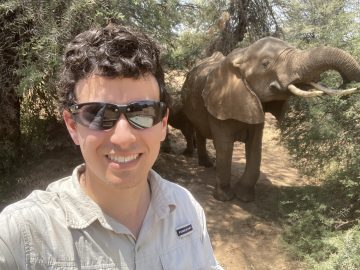
Mickey Pardo is a biologist specializing in animal communication, animal cognition, and wildlife conservation. He earned his PhD from the Department of Neurobiology and Behavior at Cornell University, where he studied vocal communication and social cognition in Asian elephants and Acorn Woodpeckers. He then completed a National Science Foundation postdoctoral fellowship at Colorado State University, where he studied vocal communication in African elephants and made the discovery that elephants have names for one another. He is currently a postdoctoral associate at the Cornell Lab of Ornithology, where he is using audio recorders and AI to non-invasively monitor threatened bird populations in Southern California. Mickey regularly volunteers with Anonymous for the Voiceless and is an organizer with Pro-Animal Future, which is seeking to ban fur and slaughterhouses in Denver, CO, through ballot initiatives. He is also assisting the Nonhuman Rights Project as an elephant behavior consultant and has recently signed up as a mentor for Animal Activism Mentorship. Mickey has published multiple pro-animal op-eds and has a relatively new YouTube channel where he discusses studies on animal cognition and makes a scientific case for animal rights.
RESOURCES
- NEWS: Casar Introduced a Farm Bill Amendment to Hold Companies Accountable for Illegal Child Labor in Meat Packing Plants — Republicans Blocked It
- NC will pay $885K in attorneys’ fees after unsuccessfully defending “ag-gag” case
- Mickey Pardo’s website
- Mickey Pardo, PhD on Youtube
- Mickey Pardo on X (formerly Twitter)
- Mickey Pardo, PhD on Instagram
- Pro-Animal Future website
INTERVIEW TRANSCRIPT
[00:00:00] Mariann Sullivan: Welcome to Our Hen House, Mickey.
[00:00:02] Mickey Pardo: Thanks so much. I'm really excited to be here.
[00:00:05] Mariann Sullivan: I'm super excited that you're here. And, like I was saying before we started recording, we so seldom get to talk to anybody who actually does work with animals because so frequently they're really not on the same page as we are about what our attitudes towards animals should be.
But before we get to that, can you just tell us like a little bit about yourself? And a little bit more detail than was in the intro on the kind of work that you do. I mean, and not all the specifics, we'll get into that as the interview goes along, but just give us the gist. I think you're a behavioral ecologist.
Can you tell us what that is?
[00:00:37] Mickey Pardo: Yeah, so behavioral ecology is basically the study of how and why animals behave the way they do in their natural habitat. So it's trying to understand animal behavior from an evolutionary perspective, as opposed to say, pure ethology, which is maybe a slightly older way of studying animal behavior where the behavior is looked at in isolation, as opposed to looking at that behavior within its evolutionary and ecological context.
[00:01:04] Mariann Sullivan: That's really interesting. You specifically, it seems, from the things that were mentioned in your bio, you study communication. Is that right? And, can you tell us generally what that means, like, and what it entails to how you would study communication amongst animals?
[00:01:17] Mickey Pardo: Sure. So it's a really broad field and it can mean a lot of different things.
But basically, when we talk about animal communication, we're talking about generally understanding how animals communicate with one another, rather than what some people might infer from that name, which is that we're trying to communicate with animals ourselves. That's not really the goal.
The goal is to understand how animals communicate with each other and why they communicate with each other in the way that they do. So my background is primarily in vocal communication. So understanding how animals communicate with sound, but of course animals communicate in many ways besides just sound, they communicate with visual signals, olfactory signals, vibratory signals, in some cases, all sorts of different ways of communicating. And the communication can be intentional communication, where animals are actively trying to inform somebody else, but more commonly, and this is true of humans as well, most communication is actually something that the individual communicating doesn't even think about. So, for example, when we blush when we're embarrassed, that's a form of communication. We're providing information about our internal state that other individuals will see and use.
We don't intentionally do that, but it's still communication, and the same thing is true of animals as well. So, for example, strawberry poison dart frogs that have bright coloration advertising their toxicity, that's a form of communication to predators. But the frogs don't choose to have that coloration, they're just born with it, but it still falls under the big umbrella of animal communication.
But my specific interest is more where animal communication intersects with cognition. So understanding that more intelligent, intentional aspect of how animals communicate with one another.
[00:03:04] Mariann Sullivan: Wow, there's just so much there, and it is really interesting. You know, I hadn't thought of it, but when you mentioned that a lot of times people think it's a study of how we communicate with animals. And I feel like that's almost like how maybe I used to think of it. Like doing the work with the chimpanzees and the sign language.
It's like teaching animals how to communicate. It just seems like maybe there's been an evolution in the way at least some people think. That, no, it's not about us communicating with them. It's about them.
[00:03:33] Mickey Pardo: I mean, to a certain extent that is a very anthropocentric perspective. Like, okay, let's see how smart animals are by trying to teach them human language as opposed to trying to understand them on their own terms.
Generally speaking, biologists tend to be more interested in animals, in terms of how they fit into their ecosystems, whereas psychologists tend to be more interested in their behavior from the perspective of what it can tell us about humans. And both of those fields have their place, but I've always been more fascinated about animals from their own perspective.
[00:04:04] Mariann Sullivan: Yeah. No, I agree. I wasn't criticizing that research like so much as commenting on it seemed like evolution of the way we think about it. All right. So I'm sure there are plenty of behavioral ecologists in the world and, not that they're all dying to come on Our Hen House, but we also wouldn't be invited to Our Hen House because they're really not, well, you know, they're not on the same page as we tend to be about animals.
So few scientists are. So can you just tell us a little bit, I won't put words in your mouth, can you just give us a little bit of what your point of view regarding animals is and how it evolved?
[00:04:35] Mickey Pardo: Sure. I always loved animals. Ever since I was a little kid, I've wanted to work with wild animals, literally for as long as I can remember.
And I mean, I wasn't raised vegan, obviously, most of us weren't. But when I was probably around 16, I kind of realized there was a contradiction in the way that I was thinking about animals, where I think I actually came to a point of view that was very pro animal rights and anti speciesist before I became vegan.
And then I realized that my point of view was not consistent with my actions, so then I went vegan as a result. But I think I kind of always had in the back of my mind, like it just doesn't seem right to me that we should value a human life more than the life of another sentient animal. Like what's so special about humans that we always assume that we matter more?
And it never really sat right with me and I guess I kind of came to terms with that when I was a teenager, but, yeah, that's basically my philosophy. I believe that all animals that are sentient essentially deserve equal consideration. That all of their lives are equally valuable, their suffering matters the same, and it doesn't matter if they're a human or a non human, they should all be given that same degree of moral consideration.
[00:05:53] Mariann Sullivan: So, in thinking about how to do this interview, it's almost like I was interviewing two people, because you have your academic, though it's the same kind of work, you're looking at the same things, there's your academic work, and then there's your, I guess I could call it your activism work, where you talk more about the animals who are really the most abused, the ones in agriculture, the ones in research, and whatever. And, they are not the subject of a hell of a lot of official research, the kind you do for Cornell and whatever.
So how do we find out more about who they are? What is the process like, you put that in your videos, like, looking at studies and whatever. But how do we get that information so that we can convey it to people and maybe, you know, try to change their points of view?
[00:06:32] Mickey Pardo: Yeah, that's a good question. I mean, there actually has been more research on the cognitive abilities of farmed animals than most people might think, especially chickens, actually. There's a reason why I chose chickens for my first video. Chickens have actually been the subject of a lot of research on communication and cognition going back decades.
And it's kind of a shame that people don't really appreciate or understand, or maybe they do, but they just don't care, how complex and intelligent chickens are. Some of the other animals that are farmed or exploited by humans, we maybe understand a little bit less in those terms.
Like a lot of the research, for example, like if you go on Google Scholar and search for studies on the behavior of mink. Almost all of it is applied research, aiming to increase production on fur farms. But for chickens, people actually have studied quite a bit about their behavior, and it's really fascinating.
But yeah, I mean, I think we just need more studies like that. And I'll give that with a caveat of non invasive studies, because sometimes studies that are trying to understand how intelligent and emotionally complex animals are end up doing some pretty horrific things to them in the process, in a way that's not very self aware or not very, I guess I should say morally self aware on the part of the scientists.
For example, a lot of the research on pair bonding in prairie voles or empathy in rats does some pretty horrific things to the animals in order to understand something that's really mostly of academic interest.
And it's primarily of academic interest because it's cool to see how similar these animals are to us, yet people are harming them in pretty terrible ways in order to do that.
[00:08:07] Mariann Sullivan: Yeah, in order to figure out whether they have empathy.
[00:08:10] Mickey Pardo: Right.
[00:08:11] Mariann Sullivan: All right. I do want to get into some conversation about science and everything that's wrong with it.
But before we do that, let me back up a second and let's talk about chickens because you really whet my appetite. Well, I shouldn't use that expression, should I? You really intrigued me. Like I want to know, what are some of the cool things about chickens that you might know and I don't?
[00:08:34] Mickey Pardo: Oh man, I don't even know where to start! Okay, so one thing that a lot of people might not realize is that chickens are precocial species, which means that they develop much more quickly. When they're born, they're already capable of doing a lot of things that other species that are altricial, which is the opposite of precocial, take a lot longer to develop.
Humans are an altricial species, so our babies are basically just useless blobs that take a while to kind of develop their cognitive abilities, whereas chickens are born, I mean they still have learning and development to do as well, but they're born more highly developed than humans are. And so, it turns out that chicks, when they're just a day or so post hatching, can actually perform arithmetic much better than a one year old human child can.
So one study, and I talked about this in one of my videos, but one study presented chicks with two opaque screens and they put different numbers of balls behind the screens and then they would move some of the balls from one screen to the other so the chicks could see the balls moving between the screens, but they couldn't see them once they actually were behind the screens. And the chicks were motivated to go with whichever screen had more balls behind it because they had imprinted the chicks on the balls.
So they basically allowed the chicks to form this kind of emotional attachment to the balls that they would normally form to their mother. And previous research had shown that when chicks do that, they want to be near as many of the balls as possible. So they already knew the chicks were going to be motivated to choose whichever screen had the most balls if they could figure out which one was which.
So, like, let's say, for example, they put three balls behind the left hand screen and two balls behind the right hand screen. The chicks would go to the left hand screen, because it's got three as opposed to two. But then if they move one of the balls from the left screen to the right screen, the chicks would choose the right screen, because now it has more balls.
But if they started with four on the left and one on the right, and they moved one from the left screen to the right screen, they would still choose the left screen because it's still got more.
[00:10:37] Mariann Sullivan: Oh my god, they're doing math!
[00:10:39] Mickey Pardo: So they understand, exactly, they can do arithmetic in their head, with numbers at least as big as five.
I say at least as big because they only tested them with five balls. But what's interesting about that is human infants, I guess I shouldn't even say infants, I don't have kids of my own, so I'm not sure what you call a one year old baby, but they're not really an infant at that point, I think. But a one year old human child can only do it up to three.
After the number three, they just like can't keep track of that anymore. And rhesus monkeys can do up to four, but chickens surpass both human, human children and rhesus monkeys at this task.
[00:11:18] Mariann Sullivan: That is crazy. I want to get more stories about what makes animals amazing, but I don't want to lose the thread on my rant about science.
There seems to be this attitude among scientists. I just interviewed David Peña-Guzman he's not a scientist, he's a philosopher, but he also deals with science and particularly the science of dreaming.
In that interview, like he was talking about, and it's something I've always had the impression about, that scientists seem to think that if you can't prove something one way or the other, you can act as if it's just not true, at least when it comes to animals. Like, as if, because we can't prove that they suffer, we can act like they don't.
Maybe it's not all scientists, but it just feels very different from the kind of burden of proof issues you get in policymaking or law, where you have to actually make a decision based on weak evidence. You do your best. But with science, it seems like until you can prove something, it's not true. And I don't know, am I wrong?
And if you can't prove something, this just seems so important in all these scientific questions, if you can't prove something for sure and figure out what's going on in the mind of an animal is what you do, but obviously it's hard to do it for sure. It's hard to prove that any of us can say what another person is thinking even for sure.
So if you can't prove something, don't you have to act in a way that would do the least harm if it were true, rather than just saying, well, we can't prove it, so we can pretend it's not true. I guess I'm talking about behaviorism and the effect it's had on science, and the effect that that science has had on what the hell are we doing to these animals.
Was that a question, and was it incoherent?
[00:12:58] Mickey Pardo: No, I think I understand what you're asking. There's a little bit of nuance to that, I think, because, obviously, you're going to get different attitudes from different scientists.
[00:13:06] Mariann Sullivan: Of course, I'm being unfair, I realize.
[00:13:09] Mickey Pardo: Some people think about it in different ways than others, but yeah, there is a lot of truth to the idea that in the field of animal behavior, and this is true in science in general, right?
We tend to go with Occam's razor, right? The simplest explanation is usually true, unless you have reason to believe otherwise. So in the field of animal behavior, generally an explanation that attributes greater cognitive complexity to an individual is usually the more complex explanation because cognitive complexity, right? Complexity is right in the name. Usually it's going to involve an inference of more stuff going on in their brain than a simpler explanation. So usually, if the simpler explanation will suffice, we usually go with that as the most plausible explanation for the phenomenon, rather than inferring a much more complex explanation.
And in and of itself, I don't think there's a problem with that. But when it comes to using that information to make moral decisions, I think it does become very problematic. Because there's a difference between saying we don't have enough information to know that animals have a particular capability and saying because we don't have enough information to know, we can safely assume that they don't and therefore we can do whatever the hell we want to them.
[00:14:29] Mariann Sullivan: Is behaviorism dead within science?
[00:14:32] Mickey Pardo: No, I don't think it's dead. It's changing, but I think there's still very much an undercurrent of that.
And some people adhere to it more than others do. I think now the study of animal minds and the study of animal emotions is growing. There are a lot of scientists who specialize in that. Whereas, a few decades ago, that would have been beyond the realm of what people would consider something that you could scientifically test.
So you mentioned, like, do people think that if we can't prove something absolutely, then we can just assume it's not true. Well, I think that's where the nuance comes in because generally in science we say we can't prove anything. Proofs are reserved for math.
All we can do is falsify hypotheses or accumulate evidence in support of those hypotheses, but some evidence is stronger than others. So, for example, fish and the question of whether fish feel pain. There's been a lot of work on this, especially recently, and there's sort of two camps.
There's the people who believe that there's overwhelming evidence that fish feel pain. There's people who believe that there's no compelling evidence at all. And there was a review paper that I think came out last year, a couple years ago, that kind of tried to take a middle ground. And their conclusion was basically, we don't have absolutely conclusive evidence at present, but it's prudent to kind of err on the side of caution and treat fish as if they do.
Whereas another review paper, which was very much from the camp of there's no evidence that fish feel pain and they're not conscious at all, they had a very bizarre viewpoint. And they actually did talk about the ethics of fish welfare and their attitude was because we don't have, in their view, conclusive evidence that fish feel pain, we should treat them as if they don't. They were primarily thinking about this from a sort of selfish anthropocentric view. Like, if we assume that fish feel pain, which in their view is unsupported, then we might put protections in place to safeguard the welfare of fish, and that could have negative economic implications for humans, or put some restrictions on what humans can do to fish.
And they saw that as a more negative outcome than the negative outcome of causing harm to potentially sentient individuals.
[00:16:48] Mariann Sullivan: That is so interesting.
[00:16:49] Mickey Pardo: Yeah. Needless to say, I disagree with that view very strongly. What was interesting is that the paper that was taking kind of a more middle of the road view, which said that maybe we don't know a hundred percent for sure, but there's certainly enough reason to be cautious and act as if fish do feel pain. They kind of pointed out that even if we knew that fish feel pain, it actually wouldn't have any major negative economic effects, because people would keep exploiting them anyway. And they presented data to show that even in countries that have put welfare protections in place for fish, it didn't decrease the amount of fish killed for food, which they said, you know, depending on your perspective, you may find this encouraging or discouraging. I find it very discouraging.
[00:17:32] Mariann Sullivan: I find it like ghoulish.
It's like, well, humans are so horrible, we should factor that into our decision.
And they're so horrible that even if we prove that, fish feel pain, they'll still consider to abuse them. So it's fine if we find... like, that is the most bizarre reasoning. I think maybe scientists should be in charge of getting the information, but maybe not in charge of deciding what we do with it.
[00:17:55] Mickey Pardo: Yeah, I agree. And I'm not sure that scientists always are in charge of deciding what we do with it. You know, think about it this way, right? Like it's completely uncontroversial that pigs feel pain, but the stuff that we do to pigs is so beyond the pale of what anybody should consider doing to a sentient individual, and nobody cares.
[00:18:14] Mariann Sullivan: I agree that they're right. I do agree that they're right. It's just like, it's a weird argument. I mean, yeah, obviously they're right. It wouldn't stop anybody from doing anything. But still, you know, like they don't want us to make that conclusion. At some point, maybe it will make a difference that all of this information gets through. What about getting this information through?
Like, why is it so hard to get it across to people? We tend to think that people just don't care, but is it really true? Like, people really don't understand that chickens are real. How do we get it across that these animals are real? I assume from your video on YouTube, from that project, that you think science is a good way of communicating that to people?
[00:19:00] Mickey Pardo: I think it's one way of communicating it to people. I think it's the way that I personally am best equipped to communicate it because that's my background. But I actually think in terms of convincing people to care more, maybe personal stories is actually a better way than science. I think a lot of people respond more to that, and that's why, you know, I think it's important in addition to communicating the science, it's important to give people stories of individuals that they can relate to because most people tend to relate to that better than just numbers and statistics.
I don't know, this is just my personal opinion, but I think that part of the reason why people are seemingly indifferent to what's done to farmed animals is because they don't have any experience with those animals as individuals, in the same way that they do with dogs and cats. I've often felt that one way, perhaps, to get the public to care more is to have more things like the documentary, My Octopus Teacher, for example, except with farmed animals.
Right? Because, just anecdotally, it seems like a lot of people saw that movie and then said, oh, I'm not going to eat octopus because they had this kind of connection with an octopus. They saw, oh, they're really incredible, complex, interesting creatures. I think if there were documentaries like that about chickens, for example, or if there were more social media accounts of people with pet chickens in the way that people have social media accounts about their dogs or their cats, doing interesting behavior, people might identify with those animals more and therefore care about them more.
[00:20:31] Mariann Sullivan: I noticed that in your videos you kind of do pair scientific information with stories from sanctuaries. Do you think sanctuaries are an important part of this puzzle?
[00:20:41] Mickey Pardo: I do, yeah. I think if we can leverage sanctuaries to tell those stories in more effective ways that reach more people.
And then what I'm trying to do is take those stories that help people connect to animals and then combine it with the science and my own scientific background to explain that this is not just some sort of Disney fantasy attributing human characteristics to animals. This is actually grounded in real empirical data.
These animals really are intelligent, sentient individuals. And so when you have this emotional experience of seeing an animal and being like, Whoa, wow, they're so smart. You're not just imagining that, it's actually true, but I think we still need that kind of experience with an individual animal that you can get from interacting with them at a sanctuary, for example, or just from other people being able to tell the stories of individuals at sanctuaries.
[00:21:33] Mariann Sullivan: When you use the story along with the science, but when you use the science, I mean, some of it is based on invasive research, right? Do you have qualms about that? And will it limit our knowledge of what's happening to animals if we can't do invasive research?
Or is it just that that's what's there, so you might as well use it?
[00:21:51] Mickey Pardo: It's more the latter, that that's what's there, so I use it. I feel the same way about invasive research on animals that I feel about things like the hepatitis B vaccine, for example. Hepatitis B vaccine was developed in part by horrific experiments that were done on mentally disabled human children, where a doctor intentionally infected children in a home essentially, with hepatitis B in order to study how the disease progressed.
And it was one of the things that led to the development of the hepatitis B vaccine. Now, obviously, I don't think that kind of research is ethical, nor do most people nowadays, and we shouldn't be doing it. But, given that the Hepatitis B vaccine has already been developed, I don't see any reason to not take it in protest.
You're just putting yourself at risk for no good reason, right? You should definitely give your kids the Hepatitis B vaccine, but that doesn't mean that we need that kind of research, right? If that research exists, we might as well use it, but I certainly don't think we need invasive research on animals in order to understand them better.
Not doing invasive research may limit our ability to understand them in some ways, but so what? That's knowledge that we just won't get until we develop better technology that can allow us to study them noninvasively. If you want to understand the inner workings of the brain, for example, it's pretty hard to do that non invasively in many cases, but okay, so we just won't understand that until we develop better ways of studying it.
There are just certain lines that we shouldn't cross, especially when that knowledge that we're gaining is purely academic and has very little real chance of leading to any practical benefits.
[00:23:28] Mariann Sullivan: Yeah, do you find that a lot of scientists would disagree with what you just said?
[00:23:32] Mickey Pardo: I think a lot of scientists have the attitude that any advancement of human knowledge is worthwhile to the point that it's acceptable to harm and kill non human animals in order to attain that knowledge.
And I think that's fundamentally wrong from an ethical perspective. You could have an ethical debate about it if you're like, well, what if we kill, you know, a hundred animals and save two hundred people? Like from a utilitarian perspective, that would be acceptable, because you're advancing the greater good, but often that's not really the trade off at all.
There is a lot of science that has absolutely nothing to do with any likely practical benefits. And that's not really the point of the science in the first place. The point is to advance knowledge, for a lot of studies, just for the sake of knowledge and people...
[00:24:20] Mariann Sullivan: Or for the sake of having a dissertation topic.
[00:24:23] Mickey Pardo: Absolutely, but lot of scientists will argue, oh, well, we don't know what benefits may come from fundamental research. Which is true, a lot of major practical benefits have come from research that no one anticipated those benefits. But still, there are a lot of studies where, there's no real, realistic chance that this is going to have a major transformative practical benefit, especially a lot of the research in my own field, right?
Let's take prairie voles. Studying, prairie voles are often studied to understand the neurological mechanisms of pair bonding. The chance that that is going to save millions of lives is pretty small.
I won't say it's zero because you never know, but there's no real reason to believe that that is going to save lives. And if you asked the scientists who study that, do you believe that your research is going to save lives? And you really press them on that, I am willing to bet the most, if not all of them, would say no.
And yet they're doing objectively really harmful things to these individual prairie voles, mostly just because they're interested in how pair bonding works in the brain. I don't mean to single that out, that's just one example. This is absolutely rampant throughout biology, a lot of studies are being done simply because people are interested in it.
And scientists have the attitude that if you can gain any kind of advancement in human knowledge, then whatever you're doing to animals is worth it.
[00:25:47] Mariann Sullivan: It really does make you question, especially like funding, and that so much of human genius and human effort is going into things that, you know, even you're saying, it's just an abstract advancement of human knowledge when there's so many things we actually need to know about.
But let's talk about your academic work, because we haven't gotten to it and I want to spend some time on it because it's really fascinating. And you are managing to study animals in a way that you're finding out really a lot of things, really a lot of important things and not doing invasive research.
So tell us what you're currently working on.
[00:26:22] Mickey Pardo: So currently I'm working on a much more applied project than I've done in the past. It's actually not specifically related to animal behavior. What I'm doing is using audio recorders to passively monitor bird populations in Southern California. The use of audio recorders to monitor wild animals is a growing technology, it's facilitated by advances in artificial intelligence, which allow us to process really large quantities of audio in a reasonable time frame. So it allows us to sample animal populations on a much wider spatial scale than we could do if we actually had to send out people into the forest to count the animals with their eyes or their ears. So, what I'm doing is putting out recorders in Angelus National Forest in Southern California, and I actually just got to California to start doing that. So that's what I'm going to be doing over the next two months or so.
Then once we have all this collected audio, we're going to run it through a machine learning program called BirdNet, which can identify over 3, 000 species of birds, just from the sounds that they make.
So we'll be able to figure out which birds were present at each of the sites that I sampled, and then we can run occupancy models, which is a type of statistical model designed to assess the presence or absence of animals at different points across the landscape to see how those populations have responded to things like wildfire, for example.
So we're sampling the burned areas and unburned areas and seeing how the bird occupancy differs between those.
[00:27:52] Mariann Sullivan: So this doesn't really use your interest in how they're communicating with each other. It uses more of your skills that you've gathered in detecting those communications.
[00:28:00] Mickey Pardo: Right. Exactly.
[00:28:01] Mariann Sullivan: And, I would assume this, if it has to do with fires, it has something to do with climate change and tracking populations of wild animals, is that right?
[00:28:09] Mickey Pardo: Sure. I mean, it's not explicitly connected to climate change other than the fact that wildfire regimes are changing, partly because of climate change, although that's not the only factor that influences it, of course.
So one goal is to understand how a particular wildfire in Southern California from 20 years ago impacted bird populations up to the present day. But more broadly, and I think this is actually the more interesting application of the work, is that we're trying to develop a protocol for sampling birds using recorders in river habitats, especially like birds that live along the banks of rivers and streams. We're trying to develop a protocol that can be transferred to other locations as well.
So we're working very closely with the U. S. Forest Service, and their hope is that they can take our protocol that we develop and further apply it to bird conservation throughout California. And also we're partnering with some organizations in Africa to try to bring a similar protocol to other ecosystems around the world.
So the idea is that if we can figure out statistically powerful ways of sampling animals using audio recorders, then this technology can continue to be used to monitor threatened animal populations and facilitate conservation. And it has the benefit of being much less invasive for the animals than, for example, trying to catch them in order to figure out how many there are.
[00:29:28] Mariann Sullivan: Yeah, that could be so powerful. I mean, especially as climate does create unpredictable influences. I mean, we don't even know what's going to happen to animals and the need to track them seems so particularly important.
But your prior work, it was on elephants. You, you have this really wide range of species that you work with, don't you?
Like, like you tend to think of scientists as specializing in like this specific species of newt, and nothing else, but you really, you really cover the whole waterfront. Can you tell us a little bit about your work with elephants?
[00:30:01] Mickey Pardo: Sure. Yeah. So I've kind of bounced back and forth between elephants and birds.
In my previous position, I was studying vocal communication in African elephants, and I was addressing a question that had actually been something that fascinated me since my first year in grad school. Originally, I wanted to address it in grad school with Asian elephants, and it didn't really work out.
So I ended up working on birds instead, and then I went back to this project. Basically it was trying to figure out if elephants have names for each other, or something like names. And the reason I was interested in this... or, well, I mean, I was interested in it because it's just objectively interesting.
[00:30:35] Mariann Sullivan: Yeah, it's just, I really want to know.
[00:30:37] Mickey Pardo: But, part of the reason I thought that elephants might have names is because elephants are among the few species of mammals that are really good at learning new sounds. In captivity, elephants have demonstrated that they can imitate sounds made by other species, or even abiotic sounds.
And we have absolutely no idea why. And it's weird because not very many mammals are capable of doing this. Like, we think about parrots, and some songbirds like minas and starlings, and lyrebirds being capable of imitating sounds really accurately. But there are not very many mammals that can do it, but elephants can, and we have no idea why.
[00:31:18] Mariann Sullivan: I have never heard of it. Like, they can actually imitate? Like, I can't even think of sounds that elephants particularly make other than, like, trumpeting.
[00:31:27] Mickey Pardo: Yeah, it's funny. Everybody knows the trumpet because that's the sound that's most popularly associated with elephants.
But actually, trumpeting in elephants is a little bit like yelling for humans. It's just a noise that they make that expresses their emotion. It's not, in my opinion, where the most interesting communication happens. The most interesting communication in elephants, in my view, is in their rumble vocalizations, which are by far the most common calls that they make.
And these rumbles are low frequency calls, they're very low pitched, but they can be quite loud. They are extremely variable, they're produced in almost every context. and that, I think, is where all the interesting stuff is going on. It's almost like if an alien came down to Earth and was studying human communication, they might say, oh, well, humans make several sounds.
They make screams, they make crying noises, They make laughter noises, and they also make this other noise called speech. Right? Like, that, to me, like, the rumbles in elephants are analogous to the speech in humans in the sense that that's where a lot of the really interesting stuff is going on. So anyway, the reason I thought elephants might have names is because of their vocal learning ability, their ability to imitate sounds and learn new sounds.
And we know that in dolphins, which are also very good vocal learners, one of the things they use that ability for, is to imitate the signature whistles of other dolphins. So dolphins have, in bottlenose dolphins at least, and some other species of dolphins, every individual has their own signature whistle, which is like a stereotyped pattern of a whistle contour that they make and it announces their presence and their identity to everybody else.
And occasionally, dolphins will imitate the signature whistle of someone else, and it seems that they do this in order to get the attention of the individual they're trying to address. In other words, calling them by name. But they couldn't do this if they didn't have this vocal learning ability. So I thought, well, maybe elephants do something similar.
Maybe that's why they also evolved this complex vocal learning ability. So I wrote a grant to try and study this. I got funded and so I went to Kenya, and I was studying a population of elephants that my postdoc supervisor had studied for many years. So we knew all of the individual elephants in the population.
We could identify them just by sight, just by looking at the shape of their ears and their tusks. And I recorded calls where I knew who made the call, and I knew who they were addressing, based on the behavioral context. So just by observing the context, I was able to figure out, in some cases, who they were addressing.
And then I took all these calls where I knew who made them and who they were addressed to, and I tried to train a machine learning model to guess who a call was addressed to, just from the acoustic structure of the call. And I found that the machine learning model was able to learn much better than chance which individual a call was addressed to, just from the sound of the call itself.
So that suggested there was some information in the calls that identified the intended of the call. And then I also did an experiment where I played back calls to the elephants, and so I found that elephants would react much more strongly to calls that were originally addressed to them than to calls from the same caller that were originally addressed to someone else, which indicates that they can tell just by hearing a call whether it was meant for them or not.
So that kind of allowed us to infer that these calls contain something like a name that identifies the intended recipient of the call.
[00:35:02] Mariann Sullivan: That is so cool. I can't believe that you were responsible for discovering that. That's just amazing. It seems like a lot.
[00:35:09] Mickey Pardo: I can't believe it either.
[00:35:12] Mariann Sullivan: It seems like a lot of what's going on, at least in your work, or maybe other people's too, is just that the technology also has improved so dramatically that we're finding out more and more about what's going on with animals.
[00:35:23] Mickey Pardo: Yeah, absolutely. especially for acoustic monitoring, the advances in technology have been huge.
Because it allows us to process these large data sets that, if you just had to have a poor undergrad student sitting there and slogging through it, it would take them forever.
[00:35:39] Mariann Sullivan: Oh, even aside from that, just like the ability to really distinguish between sounds and stuff, I'm assuming, has a lot to do with technology.
[00:35:49] Mickey Pardo: Well, actually, that technology has been around for For at least 20 years. So the type of machine learning model that I've used is not anything particularly fancy. It's, it's called a random forest and it's been around since at least the early two thousands.
[00:36:02] Mariann Sullivan: Now, you've done some other, we can't go through all of the work that you've done.
You did another really interesting, maybe we'll get to that in our bonus segment, but because I really wanted to get to another aspect of the topic, kind of bringing, like I feel like we've kind of done two interviews and your life is kind of on two tracks, all about animals, but in different ways.
And do you feel like your academic work, even though it's focused on wild animals and specific species and specific elements of those species and communication, that it has, relevance to all of the animals who are trapped in human hands?
[00:36:35] Mickey Pardo: I think so. Yeah. Even though I don't personally study those species, my background is in behavioral ecology.
It's in trying to understand the behavior of animals in general. And a lot of the same principles apply to all species of animals. You know, in fact, a lot of the principles apply to non animals as well. You know, you can study behavioral ecology of plants, believe it or not, and humans too, you know, it, it also applies to us.
So I think the principles of understanding how animals behave is absolutely relevant to farmed animals and lab animals. And, because I have that background, I'm able to understand and digest the research that other people have done on those species. And that's what I try to do in these videos that I've started to create recently, where I'm not talking about my own research for the most part, I'm talking about the research of other people. But because of my background, I'm in a good position to be able to digest and understand that research.
[00:37:28] Mariann Sullivan: Yeah, I wish more biologists were not only in a position to, but eager to, uh, eager to extend it beyond, you know, the animals that they're specifically studying.
You would think biologists would be really avid advocates for animals, but you, you know, you would think veterinarians would be too, and they're not, by and large. Why do you think this is, and do you think there's a way to turn it around? I mean, these are people who have spent, like, devoting their lives because they're so fascinated with animals and yet, like, they don't seem to get it.
[00:37:59] Mickey Pardo: I think part of the reason is because of the culture of the way that people are educated. So I've known a lot...
[00:38:06] Mariann Sullivan: We've had vets on who have said, I mean, word for word, exactly the same thing.
[00:38:10] Mickey Pardo: Well, yeah, and I've talked to some vets about this as well, like I've talked to Crystal Heath about it.
[00:38:14] Mariann Sullivan: Yeah, sure.
[00:38:15] Mickey Pardo: You know, I think it's very much the same thing. People go to school, and their attitudes are then shaped by what they learn. Personally, I've known a number of people who went into to science not wanting to do invasive experiments on animals, not necessarily because they had like a strong ethical stance against it, but just because it bothered them on an emotional level. Yeah, they were kind of taught that that's sentimentalism, that they need to do this in order to advance scientific knowledge, and so they're trained to kind of compartmentalize that compassion and ignore it, and I think the longer people do work that harms animals, the more desensitized they get to it, until it feels normal to them.
I think one way, you asked, you know, what do I think we could do to change it, I think one way to change it, is to encourage more people who already firmly care about animals, and that's not going to change for them, to go into biology, because I think part of the problem is that a lot of students who are vegan, or who just really care about animals and don't want to hurt them, avoid biology because they don't want to be put in the position, right? And I think what we need is more people who go into biology, but have the confidence to stand up and refuse to do things that harm animals.
The more people that do this, the more universities will have to reckon with it. And, the more biologists we'll ultimately end up with who don't want to keep doing things the way that we've been doing things for a long time. They want to do research that is more ethical with regard to the animals and develop alternatives, right?
To... you know, we accept already in biology that there are certain lines we can't cross no matter what kind of knowledge we could gain from it. I mean, can you imagine how much knowledge we could gain from just taking a certain segment of the human population, deciding, You are the others, and we don't care about you.
And then just experimenting on them and cutting up their brains. We could learn so much about human anatomy, it would be far more effective than studying model organisms that are very different from humans. We don't do that because we understand that that's wrong. There are certain lines that should not be crossed.
And unfortunately, in the past, we have done those kinds of experiments on humans, but we don't do them anymore because we know that that is an ethical line we shouldn't cross. And if we accepted the same about sentient non human animals. Yes, it would have some negative effects on the scope of what we can study, but then we would just have to find other ways of getting that knowledge because we accept that there are just certain things you shouldn't do.
And I think the more biologists we have who go into the field of biology who already have that ethical perspective, the greater the chances of changing the system from within.
[00:40:52] Mariann Sullivan: Yeah, I totally agree. People say sometimes, well, we wouldn't have all this human medicine and all these drugs.
It's like if we had decided 10, 000 years ago that we weren't going to do these things to animals or 2000 years ago or whatever, we wouldn't have not thought up anything. I mean, you know, we have brains, we would have gone in a different direction, but presumably we would have come up with something. I actually, when I was in ninth grade, I took biology. And I've told this story on the podcast before, my friend Jeannie and I, like rescued our mouse and set him free in Hubble's pond where he probably instantly died. But you know, we were doing our best. And like, ninth grade, we were expected to actually kill our own mouse.
[00:41:34] Mickey Pardo: Wow.
[00:41:34] Mariann Sullivan: Like, I am interested in animals. I always have been. Maybe I would have developed some kind of interest in science, but that was it for me. And then we had to dissect a fetal pig. I mean, it was horrifying. It was like a horror show to go to that class every day. I hated it so much, but I'm fascinated by animals. So many kids might go in a different direction if they weren't turned off at such a young age to biology.
[00:41:58] Mickey Pardo: Yeah, but I think what students need to do is to have the courage to tell their professors, no, I won't do this. And it may sometimes have negative repercussions for you. There may be certain classes you can't take. You may get a lower grade because you won't do that assignment. I was lucky in that I was able to avoid that kind of thing, because I didn't have any required classes in college where I had to do dissections.
And of course the issue with dissections is not like for me, it was never about squeamishness of not wanting to cut up a dead animal. It was about the fact that where they're obtaining these animals from, these are not animals that died of natural causes, they're killing them so that people can cut them up and learn about their internal anatomy.
I avoided taking classes that would have required that, but I didn't actually have those classes required as part of my major, but a lot of students may not have that luxury, but I think what they can still do is, and especially the more students that do this, you can go to the professor and say, look, I don't want to do this because I am not okay with how these animals are obtained, the fact that we're killing animals for the purpose of this lab.
And, the more students that do that, the more universities will have to reckon with it and put alternative options in place if they're not already in place.
[00:43:12] Mariann Sullivan: Yeah. And I do think that things have progressed from the many, many, many years ago that I was there. There are organizations and at least students have some support these days, but I think you still have to be extremely motivated, you know, like, really, really want to do this in order to go up against the system like that.
So I imagine that these fields are losing a lot of talented people just because they're not as driven, but they still might make important contributions. But do you think things are changing?
[00:43:40] Mickey Pardo: I do think things are changing, but I don't think they're changing as fast as I would like them to.
I do think there is growing awareness of the fact that we do have to treat animals with at least like some degree of ethical consideration. I think the problem is that scientists, like the rest of society, are very much a product of their time. And I think a lot of scientists believe that now that we have IACUC committees established by the Animal Welfare Act, that we're doing everything ethically.
It always pisses me off when people talk about something being ethical or unethical, as if anybody can really be an objective arbiter of that, but especially in the context of animal research. They think that because they're following the guidelines of the Animal Welfare Act, in having their protocols approved by the IACUC committee, they're doing everything right, that they're behaving in an ethical manner, and it's just objectively not true. The Animal Welfare Act provides minimal protections for animals, and the IACUC committees will assent, at least in my experience, They'll essentially rubber stamp anything as long as you can show that you're going to gain some scientific knowledge from the experiment, and there's no other way to do that particular experiment.
What they don't interrogate is whether that experiment is worth doing in the first place. And, a lot of the time, you're pitting an animal's life and welfare against gaining knowledge, essentially just for the sake of having that knowledge. The chance of it leading to any practical benefits for humans or other individuals is very, very low, in most cases, at least in my field, in the field that I've experienced, and yet that's not taken into consideration at all.
So what I think we need is more people who already care about animals to enter the field because otherwise it's not going to change. People who haven't really thought about animals very much, or don't have a strong sense of ethical obligation to them are very easily shaped by the culture of the field, and then they're made into people who end up harming animals a great deal.
[00:45:37] Mariann Sullivan: Yeah, the story is so similar to the story that Crystal Heath told about what happens in veterinary schools. And yeah, people who care about animals have to get involved in all of these professions.
I, I really hope to see that happening. I don't want to end on a dark note. So I'll just say that you're the proof of the pudding here. Like, you are not only deeply caring about animals, you went into it caring about animals, but you have managed to do such cool research. I mean, this must be a lot of fun.
[00:46:04] Mickey Pardo: It is. Yeah, it's been pretty incredible. The experience of field work has a lot of highs and a lot of lows. Yeah, one of the highs for me actually was, I rescued a sunbird that was injured. And I think it may actually be the first time that I successfully rescued an animal and they survived, so that was pretty exciting.
[00:46:21] Mariann Sullivan: What and where is a sunbird?
[00:46:22] Mickey Pardo: So this was in Kenya. I think he was a black bellied sunbird, but yeah, sunbirds are basically like the old world version of hummingbirds.
[00:46:30] Mariann Sullivan: Oh, a tiny little bird.
[00:46:32] Mickey Pardo: Mm hmm. They're tiny little birds.
They primarily feed on nectar. They don't hover like hummingbirds do, instead they perch on the flower and drink from it, but they're convergently evolved with hummingbirds, and they occupy a similar ecological niche. And somebody in our research camp found him, and he was like, getting beaten up by a gang of white browed sparrows, which are a larger species of bird.
I don't know how he ended up on the ground in the first place, but he was kind of injured and basically couldn't fly. And so somebody picked him up and just brought him to the kitchen and was like, I found this bird. And then someone was like, Oh, Mickey used to work with birds. Here, you take him.
I don't know what to do with this. So I was, I was like, frantically texting the vet. We had a vet in camp, but she was away working somewhere else that day. So she wasn't there. I was like, I don't know what to do. And she's like, calm down, you're doing fine. I just fed him sugar water, it's very convenient that they eat nectar.
I kept him in a box and kept feeding him and eventually he was able to fly away, so.
[00:47:32] Mariann Sullivan: That is a perfect story with which to end. A story of rescue. I love that. I like to think of him out there today, flying around in Kenya.
[00:47:42] Mickey Pardo: I hope so.
[00:47:43] Mariann Sullivan: Because of your work there. Thanks so much for joining us today, Mickey. This has really been fascinating.
[00:47:48] Mickey Pardo: Yeah, thanks so much for having me.
_____________________________________________

Thank you for listening to the Our Hen House podcast! If you enjoy our podcasts, believe in our mission to effectively mainstream the movement to end the exploitation of animals, find community and solace in our shows and resources, and would like to show your support for vegan indie media, please make a donation today.
Subscribe to our show on Apple Podcasts or your favorite podcatcher, and don’t forget to leave a 5-star review!
Check out Our Hen House’s other podcasts: The Animal Law Podcast, The Teaching Jasmin How to Cook Vegan Podcast, and the Antiracism in Animal Advocacy Audio Series.
Follow us on social media! You can find Our Hen House on Facebook, Instagram, TikTok, or X (formerly Twitter).
The Our Hen House theme song is written and performed by Michael Harren.