 Apple Podcasts
 RSS
 Amazon Music
 Spotify
 YouTube
 PocketCasts
 CastBox
 Player.fm
 TuneIn
 Audible
 App not listed? Try this RSS link
How can we do the most good for animals with the resources available to us? This week, we are joined by author and vegan bodybuilder Robert Cheeke to discuss the answers to that question in his most recent book, The Impactful Vegan.
ABOUT OUR GUEST
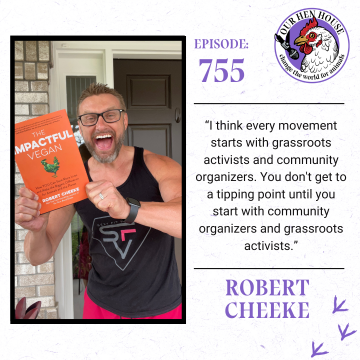
Robert is the author of Vegan Bodybuilding & Fitness, Shred It!, Plant-Based Muscle, the New York Times bestseller, The Plant-Based Athlete, and his latest, The Impactful Vegan. Robert founded Vegan Bodybuilding & Fitness, maintains the website VeganBodybuilding.com, is considered one of VegNews magazine’s Most Influential Vegan Athletes, and is known as the “Godfather of Vegan Bodybuilding.” He tours the world, sharing his story of transformation from a skinny farm kid to a champion vegan bodybuilder, and regularly contributes to Forks Over Knives, The Center for Nutrition Studies, Vegan Strong, The Vegan Gym, and No Meat Athlete. Robert lives in Colorado with his wife and two rescued Chihuahuas.
RESOURCES

- Sipsworth novel
- Simple Heart Podcast: How the Law Covers Up Animal Cruelty w/ Mariann
- The Impactful Vegan website
- Vegan Bodybuilding & Fitness website
- Vegan Bodybuilding & Fitness on Instagram
- Vegan Bodybuilding & Fitness on Facebook
- Robert Cheeke on X (formerly Twitter)
- Scarlet Spark’s Leadership Skill Sparks
- Scarlet Spark’s FREE Leadership Skills Workshops
- Scarlet Spark’s Leadership Tools
- Scarlet Spark website
INTERVIEW TRANSCRIPT
[00:00:00] Jasmin Singer: Welcome back to Our Hen House, Robert.
[00:00:03] Robert Cheeke: Thank you, Jasmin.
It's so great to be here.
[00:00:05] Jasmin Singer: My gosh, I feel like I've known you for 150 years, but I can't like tell you from where. I just know at various points. In our lives, we have been in the same room giving each other a hug.
[00:00:19] Robert Cheeke: Yeah, I think just because we've all been in this movement for such a long time. I like to say I've been vegan since the late 1900s. And so I've, I've seen a lot of people.
[00:00:28] Jasmin Singer: Okay.
[00:00:29] Mariann Sullivan: Oh, I'm gonna steal that!
[00:00:31] Jasmin Singer: Can I just say that I was interviewing someone recently, like, not for Our Hen House.
And it was a young woman. She was, I think, 18. She was a student at Cornell, and I was interviewing her about this like product she created. This food product, which was vegan. And we were talking about her family because her family's from the Middle East, and she said, Well, my parents came here in the late 1900s, and I nearly died.
Because at least when you're saying it, you have like, a hint of irony, but she was dead serious. I was like flat on the ground.
[00:01:05] Robert Cheeke: Yeah, back when we had dial-up internet.
[00:01:07] Jasmin Singer: Yeah, seriously.
[00:01:08] Robert Cheeke: Yeah, it's good to see you both. Mariann, good to see you again. Jasmin, good to see you. And Vicki as well. Thanks for setting things up. So awesome to be here with you all today.
[00:01:15] Jasmin Singer: Well, since last we spoke, you've gone from being an award-winning bodybuilder and author on that topic to writing on effective animal activism. So let's start there. Tell us about that journey from Award-winning bodybuilder to writing about animal activism.
[00:01:34] Robert Cheeke: Yeah, well, I've always been vegan for the animals since the late 1900s, when I was raising animals on a farm. And I would bottle feed baby calves before school, ride the school bus, go to school, eat fast food with my friends, come home, hang out with the many different animals on the farm, and then through the 4 H program in summertime, I would take my little dairy calves, Tim or Betsy, or four Cornish cross chickens and I would sell them to be turned into someone else's meal.
And that didn't sit well with me as a teenager. And I'm very, very fortunate that I have a wonderful older sister who became vegan in the early nineties, and she organized this animal rights week at my high school. And I thought, okay, you know, somewhat rolling my eyes, just out of respect for my older sister, I'll go check this out.
And I went to the auditorium and I watched videos of large-scale factory farming and animal testing. And mind you, some of these are like black and white videos back then. And reading black-and-white pamphlets about veganism, what we might call propaganda.
But that resonated with me. I already grew up on a farm and had animals as pets and in fact, farmed animals, animals that we typically eat. I was raising that had first names that were friends of mine and who trusted me. And that's the part that hurt the most, is that I violated that trust. I broke that trust.
I mean, I was the best friend to these animals. Like, I was their best friend and I made the decision that it was time for their life to end and for them to be turned into food because I wanted some money as a teenager because that's the program that I was in. Both of my parents were in the 4-H program.
Both of my parents grew up on farms. My parents both worked in the animal science department at Oregon State University. In fact, my father was a professor of animal science for 30 years before he retired. He wrote 15 textbooks on how to raise animals for food production. I was in that industry, but my older sister led by example and said, you know what, there's a more compassionate way to live.
And so I set out to do that. The only problem is, Jasmin, I was a five sport athlete in high school with aspirations of getting bigger and stronger. And I wasn't so sure I could build my body without animal protein. There was no internet, very few books, not a lot of resources, just what I had in my circle of friends and in my community.
But, I stuck with it, I had the ethical underpinnings. I always understood my why, I always understood why I became vegan, and I never forgot that, and still to this day, I've never forgotten that. And I decided I would put it to the test, I would have to essentially carve out a new path, and create something on my own.
And so, I learned a little bit, not a lot in the early days, not a lot. I learned a little bit about nutritional requirements and needs and calorie density and nutrient density and protein and sports supplementation, and I started lifting weights. And sure enough, I got bigger and stronger and bigger and stronger.
And even though all the television commercials I watched said milk does a body good, and that's what you have to do. I took my own approach with a plant-based diet and ethical vegan lifestyle. And I went from 120-pound long-distance runner farm kid to a 220-pound champion vegan bodybuilder, and won multiple bodybuilding championships, created veganbodybuilding. com back in 2002, over 20 years ago now, and I've been on a speaking tour for 20 years. Along that time, I wrote a bunch of books and filmed a documentary, and visited, I think, five different continents. But to answer your question very specifically, I always had effectiveness on my mind. I always wanted to be an impactful vegan.
What's the most common objection to veganism? Aside from, I don't care. It's a concern about getting enough protein. I wanted to put that to rest and unequivocally show that I could build my body without animal protein, and that's precisely what I did.
And as I had published four books, over 1, 200 pages, on how to build your body on a plant based diet, including a book that became a New York Times bestseller, and a number one international bestseller, and translated into nine languages, that's The Plant Based Athlete, I just didn't have much more to say.
I've been talking about it for 20 years on tour, writing magazine articles and articles for various websites and platforms, and tons of interviews. And I thought, you know what? It's time for me to go back to my roots. It's time for me to share with others how I used my strengths. Fitness as a vehicle to promote veganism, my skills as a writer to promote veganism, my acumen as a speaker on tour as a way to promote veganism and reduce animal suffering. And I realized that we all have what I call a strong V. We all have our variety of skills, talents, resources, other strengths, network, generosity, and volunteering that we can call upon to help reduce animal suffering.
And so, I was back at the farm I grew up on, by myself, harvesting walnuts under these trees that were planted the same year I was born in 1980, reflecting hours and hours and hours a day as I was doing this walnut harvest. And I thought, you know what?
I need to write a book about effectively reducing animal suffering, given all my 30 years background. But also, I wanted to take the same approach that I took with my New York Times bestseller by interviewing dozens of world leaders in that category. So I set out to go interview Gene Bauer and Bruce Friedrich and Vicki Bond and all kinds of wonderful people.
Brenda Davis, Chef AJ, people who have been in the movement for decades, Dr. Michael Klaper, many others, and learn what's really working out in the real world as far as reducing animal suffering on a measurable scale. Years later, and over a thousand pages later, we distilled it down to about 270 of the best pages for the material that is now in a hardcover book that comes out on June 25th.
[00:07:25] Jasmin Singer: Wow, that's so exciting. Congratulations. Mazel Tov. What a wonderful moment for you and for everyone to have access to that. Mariann, we talk about all the time how the movement has changed.
[00:07:37] Mariann Sullivan: Yeah, I mean, I do think that it has changed a lot and not everybody who has been in it for a short period of time has that perspective, but I know you do, Robert, and it's really professionalized in a lot of ways.
The organizations are much more professional, I think, than they used to be. There's a lot more money that's come in. But you still really believe in the power of the grassroots activists, don't you?
[00:07:57] Robert Cheeke: Yeah, absolutely. I think every movement starts with grassroots activists and community organizers. You don't get to a tipping point until you start with community organizers and grassroots activists.
Because, as I write about, I'm not a scholar, but I study a lot of psychology, listen to countless hours of psychology podcasts and read up on that. And I share a lot of those examples in the book, that there's influencers and celebrities and such that are very rarely early adopters. They look at the different movements that are going on before they adopt a viewpoint, or make a stance on something, and share that with their audience.
And so, what we need is a lot of different people doing grassroots organizing in many different ways. And then we need that to branch out and reach out to those that have wider reach and greater influence, and have them join the fight, and help get us to a tipping point where it has a measurable impact on society.
You've both been around this movement a long time, like me. And you've seen how the food has changed, as far as non-dairy beverages that were available or alternative proteins or plant-based meats as far as what's available in grocery stores, in restaurants, what people enjoy, what the mainstream are willing to accept, even with the green premium, a little bit higher price point and all of that, and a little bit more elusive and harder to find.
We've watched the impact of our actions as far as the reflection they've had on supply and demand in the food system. as far as what the impact they've had on all kinds of things, from the interior of vehicles, to clothing, to testing on cosmetics, and all of that. And it has been a long struggle, and it continues to be a struggle, but it started with very passionate, hard-working people who believed in reducing animal suffering and found ways to promote that, that would resonate with a larger audience, and that led to a lot of the changes that we've seen in the vegan industry, in the plant-based food industry, in the animal rights movement at large.
And it has been able to bring in those wealthy donors who were able to put some serious money behind the movement to get some growth in alternative food space where you can walk into a grocery store almost in anywhere America today and go to a dairy section and see about half of that is plant-based alternative products.
That did not exist a couple decades ago. Those options were few and far between. And the reason I mentioned the food being so important is because when you look at the numbers, 99. 99, I'll say it again, 99. 99 percent of animal suffering is in the food system. That's just the way it is. We don't go buy six purses a day, or six pairs of shoes a day, or six wallets a day, or six belts a day.
But we sit down to eat, either a larger meal or a smaller meal, about six times a day. We vote with our fork. We vote with our purchase power. And we do that with eight billion of us, or at least seven billion of us, nearly, who have access to adequate calories. And then that's why so much suffering is wrapped into the food system.
It's something we do all day long. So if we can affect the food system and create some serious change there on an individual level with changing supply and demand and voting with our dollars and on a community level, getting our community involved, and then lobbying for legislative changes and getting mass change happening at the public school level, at the government level, as far as dietary recommendations and all of that, we start to make some serious progress.
And those are the types of conversations that I write about in The Impactful Vegan. How we can have these conversations and how we can take these actions that have historically led to the growth that we're seeing right now.
[00:11:42] Jasmin Singer: Yeah. Well, it's nice to hear you talk because it can get really hard, I think, for a lot of our listeners, and for us, especially when you've been doing this work for so long, and you see the ways that things are changing, but you also see the ways that they're not.
And so, I guess, on the subject of effective altruism, which is something you talk a lot about. How does your approach to effective altruism differ from some that are more widely known?
[00:12:16] Robert Cheeke: Yeah, so effective altruism is doing the most good with the resources that we have. I got turned on to this idea years ago from Peter Singer's book, The Most Good You Can Do, and that led me to William McCaskill's book, Doing Good Better, and some other books, like, How to Be Great at Doing Good. And they all had these ideas, in this case, it was reducing human poverty in the most effective ways.
And so, understanding how far the U. S. dollar stretches. You can either impact a handful of people in the Western world, or a whole lot of people in other parts of the world who quite literally have to walk six miles each way just to get clean water. I just talked to a friend who had just returned from Kenya no more than a week ago, and he met people there who only eat once per week, or only eat twice per month. We can all agree that there's different levels of suffering, and people suffer to much greater degrees where there's higher levels of poverty.
And so the effective altruism movement tries to figure out, using a scientific and honest reasoning approach to reduce that suffering to the greatest degree.
And so a lot of those books were focused on reducing human suffering, and using dollars to do that. My approach is to reduce Animal suffering in the most effective ways, and specifically reduce farmed animal suffering because they suffer in the greatest numbers and in the worst degrees.
And so, I wanted to look at that and realize the good that we can do with our donation dollars, but I also wanted to acknowledge the fact that we don't all have financial resources to call upon.
That's why I created the acronym The Strong V, which I've already mentioned. There's other ways that we can open up our hearts and use our inherent or learned skills and talents and resources and network and all of that to make a big difference in the world around us.
And so the way that I differ from traditional effective altruism is that I understand that sometimes just trying to do the most good, just whatever is calculated as the best action we can take for reducing suffering is too big of an ask for a lot of people. And I would much rather that people do something for animals rather than nothing and so that's where I differ from effective altruism. I named my own form of it as effective vegan altruism. And I also focus on farmed animals and other animals too, of course. But that differs from focusing on reducing human poverty and alleviating human suffering. But as most of us know, and perhaps all of us here know, that when you reduce animal suffering, you often reduce human suffering as well, just because they're so intertwined. Exploitation is exploitation regardless of species.
Those are some of the ways that I differentiate, and I also have what I hope is a very positive and uplifting approach. There's a lot, as you said, Jasmin, to feel a little bit down about. I mean, there's so much suffering going on all the time.
How do we stay motivated? But we can also look to Germany and the UK that had their lowest meat consumption on record in history or ever since they started recording back in the 1970s. There are certain areas of the world that are doing things really, really well, and where a lot of progress is being made, and we can look to those examples and apply those strategies and techniques ourselves.
And as I say, we can go from being a vegan who spares approximately 365 animal lives per year, which is great, I mean approximately one per day through our dietary and lifestyle choices, or we can be a highly impactful vegan and spare over 10, 000 animal lives per year, and I explain precisely in the book how to do that.
[00:16:02] Mariann Sullivan: But when you talk about that, aren't you talking about cage free campaigns? And I'm not against cage free campaigns at all. And I know they've been a huge focus of the Humane League and other organizations, and a lot of money has gone into cage free campaigns from Open Philanthropy, for one example. And I don't think there's any argument at all that getting chickens out of battery cages, is job one for this movement. I mean, there's just nothing more brutal in the world. But, you know, we all know the cage free systems are also pretty brutal. And, this isn't in opposition to those campaigns, but I just kind of wonder, like, you talk a lot about theory of change.
What is the theory of change there? Is getting chickens out of cages going to lead to getting them out of being eaten completely? Do you see a through line there?
[00:16:45] Robert Cheeke: Yeah, that's the difficult part because I actually have much more of a vegan abolitionist mindset as far as, like, my personal viewpoint.
But we also have to look at the bigger picture of an animal rights movement that's been around for 60 years or so, that has not made as much progress as we would like. And we have this rapid growing human population, we're expected to have maybe 10 billion people by 2050. And there's been 11 peer reviewed research papers that suggest that animal agriculture is going to go up anywhere from 62 percent to 142 percent at the current rate, which is astronomical and devastating even just to think about.
And so I believe we have to find progress where we can find it. I know it's cliche to say, we have to meet people where they're at, but we really do. If you look at psychology, if you look at behavioral change, if you look at how we adopt and change our behaviors, it's usually through small incremental changes.
We don't have success with big overhauls in our lifestyle. That's why New Year's resolutions do not work. In fact, you're very likely to have the same New Year's resolution for 10 consecutive years before you admit, you know what, maybe this isn't for me, it's just not working.
We also have high levels of vegan recidivism. People who become vegan for a while and go back, for all different types of reasons. But a lot of that has to do with perhaps not acclimating to it and finding the foods they like, finding the taste, cost, and convenience that's on par with what they're looking for. And we have to understand that we are not our audience, you know, you are not your audience, and whatever inspired you, or me, or anyone else here today to go vegan, or be compassionate, or to see animals as individuals, that's not necessarily the same reasons that others resonate with. Though, in general, we're advocating, or at least my book and the dozens and dozens of people I interviewed, are advocating for, in some cases, bigger cages, in some cases, no cages at all, but the jump from cages to no cages is just a big jump for general society. And we've seen that in so many aspects of adoption of various tenants of the vegan lifestyle, or even behavioral traits within the vegan lifestyle. Human nature is to be slow to move toward these things.
It's very unfortunate, but it's because of a lot of things, including the social cost, and our peers wanting to not to be the odd person out and to feel like we belong and have sense of community and all of that. And, and that can be difficult with a vegan lifestyle.
And so if we can essentially normalize it or make it as mainstream as possible, like we talked about with the Humane League interview in the book that when you survey the general public, most people do care about animals, even if they still put them on their plates, there's a cognitive dissonance there going on, of course, but if there is an option for better conditions, they would vote for that, at least they claim that they would. And if their actions support that, then that's where we make some progress. And so I think we just have to be, it's hard to even say, to be patient in an industry where billions of animals are suffering every single moment of every day, but we also have to look at what the data and evidence suggests actually works.
And so I've tried to take that approach to listening to the 99%. Let me give you one example here, almost everybody listening, my guess is that most of us, if we're vegan, and people ask us why, we say for animals, for health, or for the planet. But when you talk to the 99%, those three reasons are not even in their top 10. They're looking at taste, cost, convenience, culture, religion, heritage, preferences, all kinds of other things that form their decision making. And it's usually just whatever tastes good and that's cheap where I can feed my family.
And so I think we have to pause sometimes. And Paul Shapiro said this really nicely in a story that I told in the book, that oftentimes vegans think that if we just had better stats, or better numbers, or more logic, or all these things to share, that we could just win arguments with omnivores or non vegans.
But he said we can't just win arguments. We have to win them over and winning them over means addressing their concerns. If they're still concerned about protein, we got to talk about it. If they're concerned about taste, cost, and convenience of food, something they're going to do six times a day, we need to talk about it.
And if that means we have to make some concessions on our way to total liberation, I think that's something we have to do because a total liberation approach for over half a century hasn't moved the needle that much. And there are animals suffering right now that if you got them a little bit more space or a little more freedom or a little bit more relaxation, I know they would appreciate that even if it's not the finish line or end destination that we're all hoping for.
[00:21:44] Mariann Sullivan: Yeah, I totally agree. I mean, I'm not against those kind of campaigns, and I kind of wonder, because I really do believe that the goal should be a vegan world, but the route to there is obviously complicated. And I've heard people say, but maybe people are reluctant to say it in public, that one of the great things about cage free campaigns is that it's more expensive.
It costs the industry money and it's going to make chicken more expensive and then we have the competitors now coming online. The Good Food Institute and, all of the new products coming online, whereas when I think we all got started in animal advocacy, it was kind of quixotic to think that this could happen. I don't think it is anymore. I mean, I think the industry is vulnerable in a lot of ways, and if we can make their food more expensive, our food less expensive, and our food delicious, as you pointed out, there are many other reasons that people choose foods. It's not, unfortunately, just taste, cost and convenience, as Bruce Friedrich says. There is more to it than that, but those are big elements. Those are really big and we are well on our way to meeting them. But we have to make their food more expensive.
What I feel like they're doing is externalizing all of those costs onto the animals through the animal suffering. And they're treating animals in ways that are just reprehensible. And if we can get them, even just through as minor a change as cage free, to spend more money, I mean, at least I think that's the theory of change. I'm not sure I'm totally on board with it, but I think that's the theory of change.
And I think it's legit. And you had mentioned that you spend a lot of your time now talking with non vegans. I mean, We're not your basic audience. So what is that like? Who is your audience? And what motivated them to listen to you? To want to have this conversation? And what is your message to them?
[00:23:33] Robert Cheeke: Yeah, well, I've been very fortunate that I built my body on a plant based diet and became this champion vegan bodybuilder and wrote some popular books and created some sort of reputation, notoriety and all that kind of stuff. And so I've taken that on the road. I created what I call the Vegan Strong Method and I created this vegan strong tour that I've been on for over half a decade now, where I go, I mean, I infiltrate the largest fitness expos in America.
These are not VegFest with 5, 000 people. Some of these fitness expos have a quarter million people there, the average is probably around 25, 000. These are pretty big. These are fitness enthusiasts who are really interested in health, wellness, fitness and bodybuilding and all of that.
So what's unique about those individuals? Well, number one, they eat more animals per capita than pretty much anybody on the planet because they hyper focus on animal protein as their goal. I gave an example in the book that most people probably wouldn't even believe. I talked about a large male bodybuilder could eat something like five chicken breasts in a day, dozens of egg whites, five whey protein drinks, salmon, and all kinds of other stuff.
[00:24:41] Mariann Sullivan: It's unbelievably disgusting.
I just have to submit that right at this moment. I'm feeling a little nauseous.
[00:24:47] Robert Cheeke: Yeah, but that's the reality of this fitness industry and even the professional sports industry and sports culture. And so I go into that and I recognize what people are eating. They're focused on protein.
[00:24:59] Mariann Sullivan: I guess I shouldn't ask like anything about whether they go to the bathroom ever?
[00:25:03] Robert Cheeke: Yeah, not all that often. It's a celebration, perhaps, like, Independence Day or something, fireworks going off, and, uh, Yeah, it's not all that common. And a lot of people in the bodybuilding industry don't live very long. I mean, that's also combined with anabolic drugs, steroids, also hundreds of grams of animal protein per day.
And so what I did was I went to go challenge that status quo, and so I assembled a team of champion vegan athletes and so we speak their language. We're in the same community. You're a champion athlete, I'm a champion athlete. You did it by eating animals, I did it by eating plants. Let's have a conversation. Let's show you.
And so then what I did, which I'm really proud of, I love this aspect of the vegan strong method, I personally recruited product donations from over 125 plant based companies. And then I would take these products from X number, maybe 20 different companies per show on the road.
And I would distribute anywhere from 5, 000 to maybe 15, 000, 25, 000, uh, plant based products or product samples per show. And so this is a one to one exchange ratio. People that are normally consuming whey protein drink, we gave them a plant based protein drink. People who are normally consuming animal based protein bar, we gave them a plant based protein bar. But furthermore, we didn't just want to devalue everything and give out free samples. We wanted people to invest into buying plant based food and sports nutrition and sports supplements.
So, we would bundle bunch of products. We made it an insanely good deal. Nobody could say no to it. We would make this tote bag with over $100 worth of plant based protein powders and, other sports nutrition products and oftentimes coupons for like free plant based burgers or things like that.
And we would sell it for about $20. And what we found is that we sold as much as $10, 000 worth of these products to a 99 percent non vegan audience in a single weekend, which not only helped us fundraise to go on tour for all these years to all these fitness events and meet the mainstream, but what we did was we replaced about 125, 000 meals per year that would have been animal based, based on a 99 percent non vegan audience, that were now plant based. And furthermore, we turned many people on to plant based nutrition, plant based products.
And many people that actually became vegan themselves after meeting a bunch of champion vegan athletes and decided, yeah, I could do that.
And then came back and saw us a year or two later at the same festival in that city and said that they're now vegan.
And we're able to impact them. And even on another level, many of these people are highly influential. They have a significant influence on their community, and here we are, to the tune of 125, 000 plant based product samples per year, introducing them. Even if that's all we did was replace 125, 000 meals that would have been animal based, that is a win for reducing animal suffering.
And I arranged all of that. In fact, I'm still doing this. If I were to turn my camera around, it would be absolutely insane, the amount of products that I have here in the basement. I'm still traveling week after week after week, distributing plant based products to a non vegan audience, making an impact on the food choices that people make for their families.
That's, again, playing to my strengths and leveraging that strong V, where I have the background as a champion vegan athlete, I have the connections to all these companies, I have the resources from the donations that come in, that I'm able to deliver these to the masses. And then I've been able to engage with tons of celebrity fitness people over the years.
Many people have seen the photo with me and Arnold Schwarzenegger where I'm wearing my vegan shirt and I'm flexing next to him, and all kinds of champion, really mainstream personas, people with millions of followers on social media or legitimate world class athletes that I've been able to inspire or encourage to go more plant based simply, again, through my tools like my New York Times bestselling book or other work that I do.
[00:29:12] Jasmin Singer: Well, that's amazing that you can still do that without getting jaded and without feeling like it's just not working because I think it can be really challenging when you do this work for so long and yet you seem really hopeful and I'm letting that rub off on me. I definitely go through ebbs and flows of that, of like hope and despair and hope and despair and hope and despair.
And I know, you can choose hope and all that stuff and I do day in and day out, but I want to talk about results. Because results are, a mixed bag, right? Like, sure, there's a lot more vegan food. I think that that is really worth celebrating. I'm constantly mind boggled by how much more is available than there was in the late 1900s.
But in the Faunalytics study that you quote, they offer results, but point out that evidence of what is the most effective type of advocacy is still very limited. And this is the subject that really enthralls me. And so what I want to know from you is, do we run the risk of focusing on small studies and abandoning other types of activism that are harder to measure by using limited information to all start doing the same thing?
Like, aren't we afraid of a monolith here?
[00:30:41] Robert Cheeke: I think we have to look at, the results around us, the evidence around us. So even within our own selves, look back at your advocacy over the decades, look back at your friends work and other colleagues and professionals in our space and what has worked and what hasn't.
And I think we also need to listen and continue to listen and talk to people. We all know plenty of people, family, friends, co workers, I mean, the world at large that does not see the world the way we do. They don't have a shared value system. And what is it that's going to encourage someone to overhaul their entire worldview?
To get people to completely overhaul everything they believe about the world and about consumption and exploitation and all of that is a tall order. And so I think we look for the victories that we can get. We look for the low hanging fruit, we look for the progress that we can make, if it means bigger cages or more plant based menu items or whatever, we've got to take some of that because it's very difficult.
Many of us have tried our entire lives. And we still haven't been able to persuade our loved ones, or our parents, or our children, or our siblings, to see the way the world that we do. Even though we maybe grew up in the same household, or in the same town, or had the same educators, and lived in the same society.
Yet it's still very hard for people to let go of this position that they feel they're entitled to. A position of privilege and of power, and of dominion, and all these things. I think we have to just look at, what does inspire people to create change?
is it this tactic? Is it that tactic? And, I think there's a lot of truth in the Faunalytics evidence because they did surveys thousands of omnivores to find out what most inspired them to change their behavior, not just change their thoughts. Like, oh yeah, that's a good point. I'm intellectually on board, but I'm still going to eat whatever I want or contribute to whatever harm I want.
It looked at what would change their behavior, and to me, that always goes back to leading by positive example. We listen and look for opportunities where people will be inspired by that example and will actually create measurable change within their lives. And I think we still have to just keep trying different things. I mean, we are in a world now that I don't know that we even thought that we would be in.
Where there's 1, 400 companies worldwide working on alternative protein solutions, cultivated meat and precision fermentation and other approaches to get animals out of the food system.
[00:33:17] Jasmin Singer: Did you say 1400?
[00:33:18] Robert Cheeke: Yeah, yeah, I quoted 1300 in my book, but it's up, I think it's up to 1400.
[00:33:23] Jasmin Singer: Wow, I had no idea it was that many. That's incredible.
[00:33:26] Robert Cheeke: Yeah, most people know like some of the plant based ones like Beyond Meat or Impossible Foods but there's 1, 400 of them that are all working to displace animals from the food system and create a complete change. And I think there's also a lot of validity to, you did mention Bruce Friedrich earlier from the Good Food Institute, I think there is a lot of validity to the fact that people will change their food choices when presented with something that's an alternative that is still tasty and affordable and convenient without the gross factor of like, oh, that's from animal cells. I mean, they're eating slaughtered animals.
People are not unaware of how animals got on their plates. And I think when presented with an alternative option, even if it's meat made out of animal cells without the excessive, unnecessary cruelty of our traditional, industrialized factory farm system, people will say, yeah, if it tastes good, I'll eat it.
And I think we, we need to be patient until we get that opportunity where there's not this green premium anymore. We pay for a green premium, but not a lot of other people will. And so I'm glad there's 1400 companies working on bringing the price down, bringing the taste to be on par, making it normalized, where you can walk into any restaurant and have these, more compassionate choices readily available.
And perhaps we're heading that way. There's so much in the unknown in food technology and innovation. And I'll tell you, I interviewed about 40 people for the book, and almost all of them agreed when I asked a certain question about a vegan future, that innovation and technology was going to be part of that.
This is certainly not mine, but I got this from Paul Shapiro, and who knows where he got it from, but I give a talk pretty much every weekend. And so I started my talk in Vancouver, B. C., a couple days ago, by asking, so who here came here on horseback? No hands were raised. And who is heating their home with whale blubber right now? Again, no hands raised. And the point is, it wasn't because we cared about exploitation of horses.
It's because we invented the bicycle and the automobile. It wasn't that we all just were up in arms and we have to protect the whales and we care about whales. No, we got kerosene and we heated our houses and we're fine. And I think that's going to be the future. I think we have to look at it that way or else it gets very, very depressing. Given the more than half a century we've been trying to get people to care about animals, it just might be innovation in food technology that leads us to a more vegan world.
[00:36:07] Mariann Sullivan: I have to add something to that, just based on an interview that I just did. And I can't remember who I did it with, so sorry whoever it was. But, talking about the horse. And they, I mean they really studied the history of animal activism, particularly in the, 19th century, the actual 19th century, and talked about how, I mean, obviously, the internal combustion engine and steam engines was an enormous factor in getting horses out from under.
I mean, the horses were just, you know, The most abused animals. They're why the ASPCA was founded. Like, they were everywhere and they were horrifically abused. And that was very important. and that was what I came into the interview thinking. And they said that, you know, that's not that that was irrelevant.
It was a necessary factor, but two other things entered into the fact that even when cars were invented, people were not adopting them. People weren't buying them. It's kind of like electric cars today. It's like, people had to be pushed to change what they were doing.
And the two things that they pointed out, which I think are so telling for today's world, one was a disease that ran through the horse population of the United States, killed so many horses, and just shocked people. And I just see that happening right now with bird flu. The fact that the industry is also demonstrating that it is completely unsustainable, even if you don't care about animals in any way whatsoever.
But the other factor which they think was enormously important, which I really love, was Black Beauty. Black Beauty was an enormously popular book, just like, unprecedented, and people were astounded by it, and it wasn't a children's book, it was read by adults, and people were astounded because it was spoken from the point of view of the horse, and people had just never thought in that way before, and they put all of these three factors together. I mean, obviously, as Paul pointed out, without the invention of the internal combustion engine, Black Beauty would not have mattered.
We'd still be using horses for everything. But it was the combination of, the harms of the industry, the invention of the new technology and this work of art that awakened people in some way. And I think that, it's very telling for today's times.
[00:38:17] Robert Cheeke: Yeah, I'm glad you brought that up, Mariann. And also, it gets us to that tipping point that I was talking about earlier, where maybe there were lots of reasons why we stopped exploiting horses when we did. But we have to think that the bicycle, the automobile, the combustion engine, all these different things were, major contributors to that.
[00:38:35] Mariann Sullivan: Absolutely, not even contributors, like it wouldn't have happened without them. It's all of these things together, but one on its own. It's not going to happen.
[00:38:43] Robert Cheeke: And this is true in so many other ways. I also got to tease my Canadian audience, and I asked who's using a BlackBerry today?
Which was my favorite phone , but nobody's using one anymore. Why? Because we wanted to touch the screen. We wanted to do that. We wanted to change the way we live. I mean, I don't know where you're going next.
But I doubt you're gonna pull out a big paper map and just hold it in front of the window and try to figure out where you're going.
[00:39:07] Mariann Sullivan: Well, those are the good old days, especially when you were driving on your own.
[00:39:11] Robert Cheeke: Yeah, but GPS took care of that. But my point is, and I hope this point is landing, that I wish people would become vegan for the animals, for compassion, to live and let live, to understand that everyone, regardless of species, has a desire to live a life free of fear, pain, and suffering. I wish that were the case.
But it's unlikely to happen. But, in all these scenarios, if we could list so many others, we change our behavior based on new technology, new advancements.
[00:39:41] Robert Cheeke: And I think food, and farming can do the same. And as my father pointed out, he's an expert on this stuff. I mean, he's an animal science professor.
There's crops like alfalfa. That's very, very common to feed to cows that uses so much water. It's just unsustainable.
[00:39:55] Mariann Sullivan: People talk about almonds in California. It's alfalfa in California that's killing California. It's not almonds.
[00:40:02] Robert Cheeke: And then of course, we already talked about bird flu and all this other stuff that unfortunately can wipe out millions. Millions of animals that get wiped out because of this and it affects people as well.
And animal protein and byproduct consumption is on the rise. But I don't see that as a loss, like, that the vegan movement is losing. It's a human population growth thing that is the biggest contributor to that. And so that's where we need some of these changes in innovation and food technology and all of that.
[00:40:30] Mariann Sullivan: Absolutely.
[00:40:32] Robert Cheeke: To make serious changes where we've got, I don't know, something like 180 million kids in the public school system, just in the United States that are eating a lot of things like chicken nuggets, cow's milk, fish sticks. We can start to change some of that. We really can. Then you start to impact large swaths of people. We can do some stuff here on a large scale when it becomes unsustainable from a production standpoint. I mean, look what happened during the pandemic. Just the distribution of food. When the ships were all stopped, and you couldn't transport things on giant cargo ships across the world, and people were just running out of food and all these things.
It just, the system can be disrupted that quickly.
[00:41:14] Jasmin Singer: Yeah, back when we did episode, I think, 50. Which was one of the times Peter Singer was on, he, that was in 2010, I think, and he talked about cultivated meat as basically our only hope, and just to see how far we've come at this point, I know you have a front row seat to that, Robert, and I really appreciate not only the work you're doing now, but just the work you've been doing since then, because you're showing that like, we as advocates can change as the landscape changes.
And I think that that's something we should hold on to. People who are listening to this, who care about changing the world for animals. And so I feel like I could talk to you forever, but I want to make sure we have time to get to a Q and A with the flock. So would you mind telling our listeners how they can find you and get your books and support your efforts?
[00:42:11] Robert Cheeke: Yeah, well, I first want to say a message of gratitude. Thank you for hosting me. It's so good to be back and so good to see you through this technology, computer screen. I also want to reiterate, and I mean this 100 percent sincerely, this is, The Impactful Vegan, the best work I've ever done. Like this book is so, so good.
And we had a team of five editors. I think only maybe one of them was vegan, and they loved it. All the non vegans loved it. It changed their thoughts. It changed their behaviors. It changed their actions.
So I just encourage people to get it. And it's also an altruistic book by nature. I'm donating the proceeds from the book sales to the most effective animal charities in the world, including multiple international charities. We're feeding a vegan meal to hungry children in 65 countries with every purchase of the book through my partnership with Food for Life Global, which is now Food Yoga International.
I'm working with Dharma Voices for Animals, working out in Southeast Asia where the U. S. dollar stretches so far. And so please go to impactfulvegan. com, impactfulvegan. com. That's where you can find all the stores to order, the Amazons of the world, and the little boutique bookstores of the world.
And where you can also download a free sample chapter plus the introduction. It's a 31 page free sample, so you can see if this book is for you, and what it's all about. And you can also, get some pre order bonuses and all that. But most importantly, I hope people will read it and apply what they learned.
[00:43:35] Jasmin Singer: Thank you, Robert, so much. We will link to all of this in the show notes and please come back again sometime. We so appreciate all you're doing.
[00:43:44] Robert Cheeke: Absolutely. Thank you so much for the opportunity today.
_____________________________________________

Thank you for listening to the Our Hen House podcast! If you enjoy our podcasts, believe in our mission to effectively mainstream the movement to end the exploitation of animals, find community and solace in our shows and resources, and would like to show your support for vegan indie media, please make a donation today.
Subscribe to our show on Apple Podcasts or your favorite podcatcher, and don’t forget to leave a 5-star review!
Check out Our Hen House’s other podcasts: The Animal Law Podcast, The Teaching Jasmin How to Cook Vegan Podcast, and the Antiracism in Animal Advocacy Audio Series.
Follow us on social media! You can find Our Hen House on Facebook, Instagram, TikTok, or X (formerly Twitter).
The Our Hen House theme song is written and performed by Michael Harren.