
 Apple Podcasts
 RSS
 Amazon Music
 Spotify
 YouTube
 PocketCasts
 CastBox
 Player.fm
 TuneIn
 Audible
 App not listed? Try this RSS link

Interested in keeping chicken poop out of your garden? If we want to overhaul the food system, we are going to have to start from the ground up, literally. This week, Meg Kelly of the Veganic Summit joins us to share her tips and tricks for converting your garden, or your farm, to a veganic wonderland.
ABOUT OUR GUEST

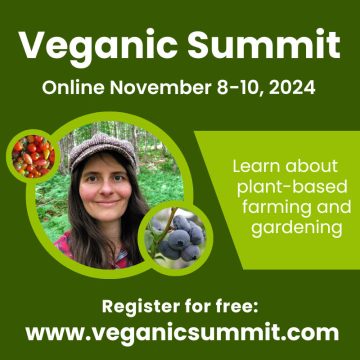
An avid gardener, Meg Kelly has been growing food veganically for 15 years in backyards, on balconies, and in the countryside and is an outspoken advocate for veganic growing. In 2008, she co-founded the Veganic Agriculture Network to promote organic food production that uses fully plant-based fertilizers without any animal byproducts. She also teaches the Learn Veganic online gardening course to empower people to grow their own fruits and vegetables at home using sustainable vegan techniques. Meg is organizing the upcoming Veganic Summit, a free 3-day online event about veganic gardening and farming happening from November 8th-10th, 2024.
RESOURCES
-
- Animal Rights Are Women’s Rights: Why British Suffragettes Went Vegetarian
- First Human Cases of Bird Flu in California Confirmed
- Are plant burgers better than beef? Here’s how to decide.
- Veganic Summit website
- Learn Veganic gardening course
- Free veganic gardening guide
- Learn Veganic on Facebook
- Learn Veganic Instagram
- Veganic Agriculture Network
- Scarlet Spark website
- Scarlet Spark’s Skill Sparks landing page
- Scarlet Spark’s free leadership skills workshops
- Scarlet Spark’s leadership tools
INTERVIEW TRANSCRIPT
Jasmin Singer: Welcome to Our Hen House, Meg!
Meg Kelly: Hi! It's wonderful to be here.
Jasmin Singer: We've been really excited about you joining. There's been a lot of enthusiasm in The Hen House. So, thank you for doing what you do and for sharing the wealth of knowledge today.
We know you have this incredible, I have to say, really, truly remarkable-looking free online event coming up, the Veganic Summit, which is November 8th to November 10th. And we want to talk about that in more detail. But first, let's talk about veganic gardening and farming in general. So, first of all, while most of our listeners probably already have some familiarity with the term, maybe you could start out just telling us what is veganic gardening and farming.
Meg Kelly: Yeah, so veganic is vegan and organic. So oftentimes, fruits and veggies are either fertilized with chemical fertilizers or with animal byproducts. So those animal byproducts can include things like blood meal, bone meal, feather meal, and fish emulsion. So, as you can imagine, these are just the remnants of factory farming.
They're the remnants of slaughterhouses and the fishing industry, and they're frequently used to grow both conventional veggies and organic veggies. So with what we do with veganic is basically we're taking some of the principles of organic agriculture, and we're taking it one step further by using entirely plant-based fertilizers and also some mineral fertilizers too, but we really have that concentration on plant-based fertilizers, and we try to take the good side of organic where we're concentrating on soil health, we're concentrating on sustainability, but we completely veganize it so that it aligns with our ethics.
Mariann Sullivan: Can you go into more depth about the plant-based fertilizers? What are they? What are easy to use? What are some of the more sophisticated ones? What are your favorites? Cause I think this is a really hard piece of this whole story.
Meg Kelly: Yeah, so one thing that's really cool is that there's a lot of different ways that we can fertilize veganically.
There's not just one way to do it. One of the easiest go-to ones is going to be to make our own compost at home. If you go into a garden center and you buy a bag of compost, it might be plant-based, you know, it might be made out of veggie scraps and leaves and grass and things like that, but there might also be things like composted shrimp residue or composted manure.
So even if you buy a bag of something called compost, you don't really know if it's plant based or not. So one of the easiest things we can do, especially when we're starting out, is to do some composting at home. It can be as simple as taking two handfuls of autumn leaves mixed with one handful of your veggie food scraps, letting that decompose together in that ratio, just two parts autumn leaves to one part food scraps, have that in a pile or in a bin.
It'll decompose down, and that's a really, really easy fertilizer that you can use in your garden. There's also some products that we can buy veganically. So there are things like alfalfa meal and soybean meal. Both of those are legumes, and legumes are always really high in nitrogen. Alfalfa in particular, is a really well balanced source of nitrogen, phosphorus, and potassium, which are three key elements that we want when we're growing plants.
So if somebody's starting out, and they don't really have any fertilizers yet and they want something really simple to use, you can get some alfalfa pellets. Sometimes they're basically sold as food for horses or food for rabbits. You have to look for 100 percent alfalfa because if there's other stuff in it, it might be animal products or oils that don't break down very well.
And I can just add like a handful of alfalfa pellets or alfalfa meal in the hole when I'm planting a tomato, or if I have a container garden on a balcony, I might put in a cup of alfalfa pellets and mix it in. I'll also be mixing in some compost, too. So those are some really easy things. If we want to get a bit more sophisticated, we can actually grow our own fertilizers, which is a really fun thing to do because, I mean, basically it means it's free, it's as sustainable as possible.
We can grow our own fertilizers locally on our own land. So just as an example, clover is really, really cool, because clover actually has the ability to take nitrogen from the air and to put it into the plant. So if you grow a bunch of clover, like if you have a clover lawn, or you grow a big patch of ornamental clover, you could chop that down and add it to your compost pile, or mix it in with your soil, or add it on as a layer on top of the soil, and it's going to break down and feed your other plants.
Oftentimes farmers, for example, they'll use techniques like that, because you can imagine if a farmer has 20 acres or 100 acres, well they're not going to be able to make necessarily enough compost to be able to cover that whole field. So they'll actually do things like grow clover to feed back to the soil so that they're growing their own fertilizers.
Mariann Sullivan: Wow. You know, one of the things that always gets in my way, I think, it's like you talked about there has to be the balance of nitrogen and the other two things, which I don't know what they are.
Meg Kelly: And potassium and phosphorus.
Mariann Sullivan: Like, I, you know, I am a traditional, good little girl who tries to get everything right.
And sometimes, like, I get in my own way. Like other people just like, you know, throw stuff together and their backyards are full of tomatoes. So I'll just say like, how careful do you have to be? How exact do you have to be? How much do you have to test your soil to see what's needed?
Or do you just like try things out? Or is it a combination?
Meg Kelly: I mean, it's a combination up to a point. But for the most part, I would say try things out. Your plants are going to let you know.
Mariann Sullivan: They are so forgiving. It's amazing.
Meg Kelly: Yeah, I mean, if you have a plant that's getting a little bit yellow, especially if it's early season and it's yellow and it's stunted and it's not growing properly, that's usually a sign that you have a lack of nitrogen and that you're going to need to get something else in there, like, alfalfa meal or compost.
If you have a plant that, kind of goes purple on you, well then that's a sign that you're lacking phosphorus. So sometimes your plants will just look a little bit off colored, but sometimes we can go too far in the other direction. If, for example, you go all in with fertilization and you just dump on 10 times as much as you need, you can end up with plants that get too much nitrogen, so you might end up with a tomato plant that has these amazing leafy greens and it grows tall and it goes It gets bushy, and then it doesn't really grow many tomatoes, because you've just pumped it so full of nitrogen, that it just concentrates on making leaves.
But I would say those are a little bit exceptional. We can look at the application rates. Oftentimes, the application rates are fairly simple, like I'll kind of give two or three handfuls of compost to a tomato plant, or I might give a tomato plant half a cup of alfalfa meal or something like that.
But yeah, we can look up application rates, and for the most part, your plants will let you know if there's, if something's up, if they need a little something. If ever we have plants, you know, we want to give them a little bit of an extra boost. One thing that we can turn to that's veganic that's pretty easy is kelp, basically liquid kelp.
So sometimes people are looking for an extremely like simple, easy, off the shelf solution for something that they can give their plants a little boost with. If you get liquid kelp, you can just follow the manufacturer's instructions. Usually you need to water it down very significantly and then you can water your plants with it and that'll give them a little boost of micronutrients.
But one thing that's really, really cool about Veganic is that basically we're fertilizing plants with plants and most plants have about the same nutrient needs. They tend to have similar needs in terms of nitrogen and phosphorus and potassium and all that stuff. So if you take all of your kitchen scraps and you compost that down with a bunch of leaves, honestly it's going to have the nutrients in about the right ratio that plants need.
Maybe some plants will like a little bit more of this or a little bit more of that. But in general, if you're making your own compost, you're going to have about the right balance anyway.
Mariann Sullivan: That's the kind of advice I need. Cause you know, you go on the internet and everybody says something, I mean, there's a million gardening advice things and everybody says different things and it's all very complicated.
I need easy advice.
Jasmin Singer: Can you use legumes to make fertilizer?
Meg Kelly: Yeah, for sure. So there's different ways you could use legumes as fertilizer. So again, legumes, they're really, really, really cool, because they can actually get nitrogen from the air. So basically all around us there's nitrogen, every breath you take, you're mostly breathing in nitrogen. And that's one of the elements that plants need in order to grow. But most plants can't get it from the air. It's just not in the right form for them to use. But legumes, they can actually take nitrogen from the air and like put it into the plant.
So then you can feed those legumes back to your garden. So for example, soybean meal is sometimes used as a fertilizer in veganic growing. So that's basically just kind of after soybean oil is made, that's kind of a leftover by product that can be used in your garden. If ever you just had a bunch of old beans hanging around in your cupboard? Well, could you put those through, I don't know, a coffee grinder and put them in your garden and mix them with the soil? Sure, you can if you want. I mean, that, that would work. It wouldn't be the typical way of doing things, but if you ever just had some old beans hanging around, you could.
But you can also, for example, plant a bunch of beans. Like, you could plant some peas or some beans. Let them grow until maybe they start flowering, and then you can actually cut them down and let them decompose, and that will actually feed your garden.
Mariann Sullivan: Wow. Let's take a step back because we didn't really cover this, but, I mean, obviously for all of us we know, like, there's a big advantage of veganic growing in that you don't, like, abuse animals in the process, but there are a lot of other advantages too, aren't there?
Meg Kelly: Absolutely. One of them is just food safety, because when we look at sometimes there's recalls on things like spinach and lettuce because there was E. coli or salmonella or things like that, oftentimes that's from manure contamination. So as you can imagine, if we're starting with a bag of alfalfa meal or soybean meal, well, there's much less likely to have, like, bacterial contaminants in that compared to if you have a bag of manure.
So that's one of the concerns with some of the animal based products is the bacterial contamination, heavy metals, and things of that nature. And then from an environmental perspective, I mean, as we know, the level of animal farming that's currently happening is causing, you know, significant environmental destruction.
And so right now we have a situation where our fruits and vegetables are being tied back to a system that's environmentally destructive. And so if we want to move toward a future that's not only vegan, but also one that's sustainable, well, we need to set up systems where we're growing fruits and vegetables in a way that doesn't rely on a completely unsustainable system. You know, even as a gardener, you know, if you are gardening veganically, it's going to have a smaller ecological footprint compared to using animal products. And for farmers, of course, if they make that switch over to veganic growing it really significantly reduces the ecological footprint and also just the the amount of land that's used, because, you know, if you have tons of manure being spread and that manure came from somewhere else, well, that's associated with an enormous amount of land use that was used in order to produce that manure.
So, you know, if we want to get to a future where we have an agricultural system that's on significantly less land so that we can start rewilding areas and bringing them back to natural ecosystems, veganic is something that's going to really help with that.
Jasmin Singer: Do you focus solely on vegetable gardening or do you also do flower growing?
Meg Kelly: I grow flowers mostly for the pollinators. So in my veggie garden, I will put certain flowers like nasturtiums or marigolds that can be beneficial to my veggies and that can also attract native pollinators and help support our native pollinator populations. But, uh, yeah, you certainly could just have a veganic flower garden, without any problem.
If for example, you have a perennial flower garden, you know, where you've just got flowers that, you know, they're there for years and years and they keep coming back, you can actually use things like wood chips. So for example, if there's some tree branches being cut down in your neighborhood that are being chipped up, you could put those wood chips into a perennial flower garden, no problem, and you can put wood chips around fruit trees and around fruit bushes and, and things like that, and they do really well. I don't always recommend putting wood chips in a veggie garden because it can actually make it so your plants don't have enough nutrients for a while.
So if you ever decide to add wood chips to a veggie garden, just leave them there for a year or so to decompose before you start to plant veggies again, but in a flower garden, they can work really, really well.
Mariann Sullivan: So are you getting the woodchips as mulch, or to avoid weeds, or actually to provide nutrients to the plants, or both?
Meg Kelly: So if you use woodchips as mulch, yeah, so a few things it's going to do, it is going to cut down on weeds, it's going to keep moisture in, and it will eventually break down and improve the soil quality. So around perennial plants, you can add woodchips, no problem, and then if you have annual plants like lettuce and tomatoes, they don't like it quite as much.
They'll like it after everything's decomposed, but not while it's decomposing. But if you're in a veggie garden with your tomatoes and lettuce and things like that, you can add other types of mulch that, that play well with veggies. So for example, you can add some autumn leaves or some straw, kind of on the soil at the base of your, you know, lettuce and tomato and carrot plants, and that will help keep the weeds down and, uh, help keep the moisture in.
Mariann Sullivan: Yeah, speaking of weeds, could you define the word weed, because I find it's kind of a moving target.
Meg Kelly: It is. I mean, I'm using it as a little bit of a shorthand because we all kind of collectively understand what we mean when we're talking about gardening, but it is a bit of a problematic term. So in this case, we'll just refer to weeds as the plants we weren't intending to grow and we're not exactly thrilled that they showed up.
But you know, a lot of those plants are actually pioneer plants and pioneer plants are plants that are just really, really good at going into damaged soil and kind of repairing the soil. So, one thing I actually like to do is to always have my soil covered. And I usually do no dig gardening where I'm not actually digging the soil every year.
And I actually get less weeds that way. whereas if somebody is digging their soil every year and the soil is completely exposed, that's a prime target for weeds to set in because that's exactly what these plants do. They're just really, really good at going into bare soil and kind of covering it.
So if you put something like a layer of autumn leaves on your ground, on the ground in your garden, uh, you're going to get far fewer weeds popping up.
Mariann Sullivan: Wow. Well, actually, I mean, not that this is all about me, but let's basically, I'm sorry, everybody, but this is all about me. I moved into this house with this tiny little backyard that the person before the person who owned it before me had, it was a very elderly person who did not take care of it for years and years and years.
And so the backyard is basically, you know, Just, I mean, it's unbelievable, like, it's tiny, but all of these really stubborn plants, some of which, you know, I looked them up on the internet, and, and the article is like, oh my god, oh my god, you must eradicate this plant immediately, this is the worst. And they are mostly, like, very invasive, just, you know, really bad plants.
So how do you start with something like that? How do you prepare ground that really has been allowed to let go, and which is full of, you know, just really Really stubborn, and by invasive, I don't mean just weeds that I don't want, but you know, all those plants that are identified as being non native and will kill everything else, that sort of thing.
How do you start with a garden like that?
Meg Kelly: Well I think you've done the first, right step, which is to identify them and see what you're dealing with, because there are certain types of plants that we're not thrilled about having around that are very easy to rip up, and we just need to go in there with a trowel and get them out.
But there's some that are, really, really, really, really difficult to get rid of and, you know, if you're in a situation where you have several like that, then that can be especially tough. There are some plants where we kind of just need to accept that we can't get rid of them. Some of them we're able to get rid of by cutting them down multiple times or really digging deep to get the roots out. Sometimes those root systems are very extensive. They might, you know, go for several feet wide. So it is good to identify them. Try to find what it is and what other people recommend for getting rid of it.
It's hard to have a blanket solution for it. But, a couple of things that can be done in some cases, One is, if ever you feel like at the moment it's a bit of a lost cause, you can go with container gardening. I mean, you can just plunk containers right on top of your lawn and grow in them and just say, okay, this is one way to keep the weeds out.
Other things that you can do is you can take things like, autumn leaves or wood chips and pile them on like a foot thick. And just leave them there for like a year to decompose, and if you basically drown out the sunlight, there's a good chance that what is underneath is eventually going to die off.
Now that can depend, because if it's something that has an extensive root system that's several feet wide, and it's popping out on either side, it might not help. So it kind of depends. And then, I mean, you can do things like put tarps down, too. You could, for example, put a tarp, leave it there for several weeks or months or a year or two if you need to.
That's one way that people can sometimes get rid of ones that are a bit more stubborn. If you don't like the idea of a tarp visually, you can always put the tarp down, plunk some wood chips on top of it and then put a picnic table there for the next couple of years or something and just, you know, let things decompose underneath and then give it another go.
Jasmin Singer: Hmm. What about, you're making me think of, like native versus non native plants and I'm just, curious where you come down on that.
Meg Kelly: It's a great question. I mean, I think the one thing we want to be really careful of is not adding non native plants that are likely to get out of control and be difficult to deal with and that might spread into our neighbors yards or that might spread into wild settings.
So there have been some big problems with people, you know, especially with ornamental plants, with people buying ornamental plants that end up, you know, spreading out that don't have any kind of, you know, native animal species here that eat them because they're, they're plants from other areas of the world.
But I think in other cases, when we look at something like tomatoes or peppers, that's not native here, but they grow well, and they're delicious. So we might as well grow them and eat them, and they're not going to get out of control and take over wild settings. So I would say, you know, as long as, it's something that you can, you know, control fairly easily, I would say go for it if it's something that you enjoy eating.
That being said, there's a heck of a lot to be said for concentrating on plants that grow natively in your setting. you know, even if it's, variations of it that have been kind of selectively bred to have, you know, better yields. For example, where I live, strawberries and blueberries and raspberries grow wild.
And so, you know, we have nicer varieties that have sweeter raspberries and bigger blueberries and stuff like that. But I know those are plants that are really, really, really well adapted. Whereas where I live up in Canada, Tomatoes aren't well adapted. I mean, I've got a nice tomato harvest this year because for some reason we haven't had a frost already in October, which is a bit exceptional, it's not something we can count on most years.
but those tomato plants had to be started while there was still snow out, indoors, with lights, which on one hand, is a wonderful thing because it means we can grow tomatoes here. And so I love the fact that we have that ability, and that's an option that we have. But if I had chosen things that were better adapted for my climate, like potatoes and beans and carrots and lettuce, those are things that you can actually grow from seed outdoors.
So there is something to be said for, favouring more plants that actually grow really, really well in your climate, because it just makes gardening a little bit easier if there's things that, you know, are just, you know, Super well adapted already.
Mariann Sullivan: Where in Canada are you?
Meg Kelly: I'm in Quebec, in the Quebec City area.
Mariann Sullivan: Oh, beautiful, yeah. I mean, we're in Rochester, so we're not exactly in Canada, but we're not too far. We're about as far north as you can get and still be below the border. Can we go into that a little bit more, because another thing I've always been enthusiastic about native plants for, is attracting wildlife.
And are native plants key to attracting beneficial wildlife?
Meg Kelly: Yeah, for sure. I mean, it's a wonderful thing if we can add areas of our garden that are there just for wildlife. so that can involve, you know, adding native wild flowers, for example, because there are a lot of native pollinators that have essentially co-evolved with certain, native, wild flowers.
I would also suggest for anyone who kind of wants to help, you know, increase biodiversity in your area and support pollinators, to really concentrate on getting some flowers in, that. bloom really, really early in the season and others that bloom really, really late in the season, because those are kind of the two extremes where often there aren't food sources available for pollinators.
So if you go to a garden center and ask them for some native plants that bloom early or that bloom late, those are great to put in. And there are other things too that we can do to help attract wildlife. as an example, I like to sometimes leave little trays of water outdoors, just so that the pollinators can kind of, you know, land in there and just, you know, drink a little or that birds might come by.
Oftentimes we have environments now that have kind of been stripped of almost all of their natural features. Oftentimes, you know, wetlands and rivers that were there before, you know, have essentially disappeared and been replaced with concrete. So there's a lot that we can do in our gardens to, to help support wildlife too.
Jasmin Singer: That's great.
Mariann Sullivan: How about wildlife that people don't want? I mean, there's a lot of animals that, you know, want to share the bounty. Can't blame them, but, what are good veganic ways of trying to deal with that?
Meg Kelly: So, that can be a little bit tough. One thing that I like to do personally is essentially, Approach gardening with the idea that I'm making a certain space more biodiverse than it started and I'm going to end up eating something from it too, but I try not to get too attached to each individual tomato and each individual lettuce plant that's there, because, you know, there are a lot of animals around where, frankly, we have destroyed their habitats completely.
And, you know, if you can imagine if you were a squirrel or a groundhog and you came across some nice lettuce, you'd probably want to be eating it too. So I think if we approach it with a little bit less attachment to the outcome, it actually ends up being a much more relaxed experience than if we kind of have that, you know, end up getting that attitude of like, oh, those, you know, nasty squirrels or whatever.
I mentioned putting out Water sources. That can actually sometimes be helpful for reducing damage from other animals, because if you imagine, again, if you were a squirrel or a bird and you were incredibly thirsty, and there just weren't water sources around, well, you might munch on a cucumber, basically just to get water.
So that's one thing that can be done. And sometimes of course, there are certain harvests that we just really really want to protect. And fair enough, if there's certain things that you know we've grown, and we've grown it to eat it, or we're trying to be self sufficient, there are things that we can do. Sometimes, People will use essentially like a fleece that can be put over certain plants that might keep certain insects off.
and you can use netting. So, for example, if someone has a blueberry plant and they don't want the blueberries to be eaten by the birds, you can cover it in netting. I've even seen people that have essentially built cages around their garden. Uh, or, you know, Of course, you can put up a fence.
Some people live in areas where there's deer, and sometimes the deer can eat almost everything. So in that case, putting up a deer fence can make a lot of sense. And in cases like that, you know, if, for example, we have a fence around our garden so that we can hold on to those harvests, we can also plant apple trees outside of it so that the deer still have something to eat.
So we can think of ways that we can do that. Another thing that we can do sometimes is just plant a few things that Wildlife tends not to eat. I mean, if someone's in a situation where you're getting a little frustrated because you've lost a bunch of your harvests, well, if you plant things like oregano and sage and mint and thyme, nobody's going to eat them, you know, so there are some things like that, or mustard greens.
I've planted mustard greens and nobody ever comes along to eat them. So there are things that we can do if we want to try to reduce those issues.
Jasmin Singer: Okay, I don't know if this is going out on a tangent, but I have a lot of leaves falling on my driveway right now, and my front yard. And there's someone I know who's, like, main mission come autumn is to tell people not to ever rake.
And I really want to not rake because I just am lazy is why. But I also don't want to bother my neighbors. You know, I live in a city. So like very close together houses. Can you just shed some light on this for me? Like is raking destructive? Is it like a revolutionary act to not rake?
Meg Kelly: Basically there are certain critters that, you know, enjoy making their homes under fallen leaves.
So if you go out into a forest environment, there are going to be so many organisms that are making their homes in those leaves that are going to be laying eggs or kind of hibernating underneath and, and so on and so forth. When we rake up leaves, we're basically taking away habitat.
I saw a little comic recently about, you know, somebody seeing some fireflies and saying, I haven't seen any in a long time, and then basically just raking their habitat away. And so, you know, there, there are organisms like fireflies that we might not see as much if we're raking.
So what I would say, if you have sort of neighbour issues? Well, you can always be a trendsetter, just, you know, sometimes you can put a sign out on your front lawn. Oftentimes, when people are doing something a little different and other people don't understand, some people will have signs on their front lawn that say, hey, this is a pollinator garden, you know, or you can put out a sign that says, We're leaving the leaves for biodiversity, or something like that, you know, in the same way that if someone does a front yard vegetable garden, you know, you can put up a little sign and it can just be something that's informative.
And then people understand a little what's going on, but some people live in areas with, you know, homeowners associations that can really kind of crack down on, on anything that's a little bit different. In cases like that, you can keep some of those things to your backyard, where other people just aren't looking as much.
And for something like the leaves too, I mean, you can leave part of your yard unraked and part of it raked. I do want to give a special shout out to leaves, because leaves are absolutely amazing and they're so useful in veganic gardening. So even if you leave your yard unraked, other people are going to be raking their leaves, and they're going to be throwing out, like, bags and bags and bags of leaves at the street corner in the upcoming weeks.
This is one of the most useful materials for veganic gardeners. You can actually make something that's similar to a compost pile, but just with leaves. You can just collect a whole bunch of leaves, make them a little bit damp, make a huge pile, especially if you've got like a back corner of your yard, just put a big pile of them there, And just leave them there for a couple of years and they will break down until there's something really, really similar to soil.
So that's incredible. You can also use them as a mulch in your garden, basically covering your soil with a couple of inches of autumn leaves. And you can also use them as a compost material to offset your food scraps by adding two parts leaves to one part food scraps in your compost bin. So the next few weeks, when you see other people throwing out leaves, you can really see this as a resource that you can go and collect and make the most of. Because, you know, if it goes off to a landfill or wherever it might be going, that involves a lot of transport, it might not end up coming back, so you can really make use of these local materials.
And one thing that's really, really, really cool about leaves is basically, I consider leaves to be an ethically mined source of minerals. Because oftentimes in gardening, people will say, okay, I need some phosphorus, I need some potassium, and they'll basically buy like a bucket of rock powder, and that's coming from somewhere where it was mined.
And as we all know, mining is usually, you know, it's got a pretty big environmental impact. Whereas trees, what they're doing is they're sending down these roots really deep in your neighborhood, under your feet, and they're pulling up little bits of nitrogen and potassium that are right there in the bedrock.
They're putting it into the leaves, and then when those leaves fall, you can just collect them and use them in your garden. I mean, the only thing you have to do is be a bit patient, because they might take a year or two to break down, but that's much, much, much faster than the rate at which soil is built out in natural environments.
So, two years is not long to wait to build new soil, you can do it directly with the leaves in your neighborhood. So, that's my big shout out to people, is go around collecting other people's leaves.
Jasmin Singer: What about like mowing the lawn? Is it kind of the same vibe? Like don't mow the lawn?
Mariann Sullivan: I mean, it's going to really get you in trouble.
Jasmin Singer: We're trying very slowly to like replace and we have a small front yard, very small, but we're trying to like replace chunks of it with like, you know, not grass so that it's a non issue. I mean, Mariann and it looks beautiful. I mean, it also looks beautiful, but I, hate, I hate the idea of mowing.
Mariann Sullivan: I actually just hate mowing.
Meg Kelly: Yeah, I mean, I think what you're doing is the right thing, which is replacing the lawn with something else. If you just have a lawn that just grows really, really, really high, that's actually fine, but it's probably not going to fly as much with your neighbors. So if you start replacing that with even ornamental grasses, with, you know, perennial flowers and, and things like that.
You can also get things like oregano and mint and thyme in there that are edible, that actually can, can work really nicely, especially for front lawn settings, I just recommend to do your best to make it aesthetic. So that way, it'll fly better with your community.
But, yeah, I mean, if you can get away from mowing, all the better. And, you can also replace your grass lawn with a clover lawn. There are certain types of clover, like dwarf white clover, that actually just grows about as high as a lawn might before you cut it, so you could just have basically just clover that you never bother mowing.
Uh, one of my last lawns was just clover and we never mowed it at all. I might've got maybe about I don't know, six or eight inches high? And then it just made some flowers, and then there were all of these pollinators visiting it.
Mariann Sullivan: That sounds delightful. It's probably much prettier than grass too. We have to get to farming and we're like, well, we've only talked about gardening, but before we leave gardening, I want to ask about, container gardening, because I imagine a lot of people listening, they don't have a yard, if they're gardening at all, or it's, it's just a small patio or whatever, but they're trying to garden in containers.
Can you just talk about some of the issues and challenges for successful container gardening in a veganic way?
Meg Kelly: Yeah, I would say one of the biggest challenges is just finding soil that's actually veganic. Uh, in the U. S., you have a few more options than we have here in Canada. One thing I didn't mention earlier is that we actually have a guide to 20 veganic materials for your plant based garden.
You can get that for free at learnveganic.com/materials, where we go into more detail about some of the materials we've mentioned here today. But when you get that guide, it also gives you some of the commercial options that are available because they're really, really hard to track down.
In the U S for example, there's a company called Good Dirt and they actually make vegan soil products. But, when you buy soil, you oftentimes just don't know what's in it. You don't know if there have been animal products that have been added to it. So we can go to garden centers, we can ask the question, we can go to landscaping companies and see if they have anything that's kind of soil that just hasn't had anything else added to it yet.
Because sometimes they'll make their own mixes. And their own mix might involve, like, putting in composted shrimp residues or something like that. So you've got to ask around a little bit. Sometimes we just have to use our best judgment, make our best guess, use what's available even if it's not perfect.
And then, do everything veganically from that point forward. So sometimes the soil that we originally get, we either might not know what's in it, or we might actually know it's not quite perfect. But at that point, we can actually work with veganic fertilizers, so we can kind of treat it veganically going forward.
Our favourite two things really to use for container gardens are compost and alfalfa pellets, both of those are things that are really easy to add. You can actually compost on a balcony if you would like to. We, uh, have composted before basically in a flower pot, where we put a bottomless bucket inside a big flower pot, and so we had a ring of dirt around the outside where we could grow a few little plants, and then in the middle we were composting. So it's not going to make a lot of compost, it can't handle a lot of food scraps, but there are ways that even in a setting like that. You can also get tumbler composters, which are basically ones that are kind of off the ground on little legs and you can spin them.
And so if you have something like that, you can put that essentially on a balcony or on a concrete walkway or something like that. So there are ways that even in a setting like that, you could compost if you'd like to, but otherwise, I would suggest really going with alfalfa pellets or alfalfa meal and kelp meal and, uh, liquid kelp.
Those are really the easiest things for someone who's in a balcony setting.
Mariann Sullivan: All right, so as I said, I mean, we have more questions on gardening and I'm sure other people do too, and maybe we can do some of them in the bonus content, but we need to talk about farming too, because this isn't just about gardeners.
I mean, obviously we wanted the whole world to go vegan, not just us, and we'd all love to see veganic methods adopted by commercial growers, but it just seems like, wow, that would be really difficult to pull off. But the fact is the world can't go vegan unless we learn how to grow food in vegan ways.
So, so I know there are people doing veganic farming. We've had Jimmy Videle on and, and he's actually doing veganic farming up there in Canada as well. Can you just talk about what are some of the challenges faced by people who are attempting to go veganic as farmers?
Meg Kelly: Yeah, I mean, I would say one of the big challenges is that there's very little education available.
When people go to kind of, you know, college for farming or if people take farming courses, it's basically, you know, treating animals as kind of a default way of doing things, either by adding animals or by adding manure and things like that. So if you pick up a farming book, if you go to a farming conference, that's really what people are learning, to the point where there's a lot of skepticism around whether veganic is even possible.
I would say one of the other barriers is that, you know, farmers they already have a lot of risk. There's a lot of risk around, you know, is it going to rain this year? Is there going to be a drought? Oftentimes the profit margins are very, very slim. Oftentimes people are working largely on a volunteer basis in order to keep their farms going.
Most farmers, very frequently have other jobs off the farm to make ends meet. And so for anybody to kind of, take that risk of changing what they're doing. It can be a little bit scary. So if somebody has been using manure for years and it's worked for them, I've spoken with, you know, numerous people who have made that transition from farming with manure to farming veganically.
And, you know, I've asked them, you know, what was their takeaway from it? And some of them have said, it was easier than I thought it would be and it worked better than I thought it would. And I think this is oftentimes... many of the same challenges that we face when we're thinking of going vegan where we might wonder, you know, will it work?
Will I know how to do it? And it can be a little bit scary to make that change even from, you know, a social standpoint when everyone who you know is doing something different. So I think making that switch for farmers involves many of those same apprehensions plus the concern about that financial risk that they might be taking.
So some of the things that we really need is we need more, grants and subsidies and things like that to help farmers make that transition. We need more education available for farmers that's actually veganic oriented. One of the reasons why we've created the Veganic Summit is because that way we can bring together, you know, farmers who have already been farming veganically successfully for decades so that other people can learn from them, because really it can be quite hard to find this information otherwise.
One thing that's been really exciting in the past couple of years too is there have been a couple of new books that have come out. You mentioned Jimmy Videle, he's got his Veganic Growers Handbook for small scale farmers. There's Helen Atthowe, who put out a book recently called The Ecological Farm, and she has amazing techniques for growing your own fertilizer.
So we're heading in that direction, but I think up until now it's largely been People experimenting. I sometimes compare veganics today to veganism in the 1970s, where everyone was sort of making their own tofu and you couldn't go out and buy a veggie burger. So everything was just, okay, let's figure out how to do it.
Let's just, you know, improvise and see what we can create and oftentimes a little bit in isolation and veganic kind of looks like that right now. So that's one of the reasons why we're trying to bring people together more, and create more of a movement, because there are people who have developed fantastic techniques that are absolutely replicable but, you know, it's a question of getting that info out there to more people so that they understand that they can do it too.
Jasmin Singer: I know a lot of people talk about reduced yield as an obstacle for organic growers. Is that an issue for veganic growers as well?
Meg Kelly: So yields are an interesting one because there are so many things that are going to determine whether someone has increased yields or decreased yields. As you mentioned, Jimmy Videle, who's up in Canada too, he has compared his yields to other situations and has found that his yields are actually very, very good and very competitive And one of the reasons for that is because he's actually farming on a fairly small scale, so they have almost no waste, and they're very attentive to making sure that they make the most of the yields that they have.
I know that, for example, I've spoken with some farmers who have, you know, when they talk about yields, it's interesting to talk about all the different things that we can consider. Because I've spoken to some farmers who said, okay, my yields were less. But my expenses were less. So in the end, that can be okay.
Or someone else who said my yields were a little bit less, but we had far less need for farm workers, because we were doing things in a way that, you know, just didn't involve, you know, weeds didn't need to be picked as much and so forth, you know. So I mean, these are questions where it has more to do with does your farm work as a whole rather than did you get more yield or less yield.
Mariann Sullivan: What's a success story of somebody who's doing this like at a, you know, at scale? I mean, obviously not huge scale, but, you know, not a small holding, just real farm that's actually really succeeding at growing veganic. I mean, not a real farm, obviously, small farms are real farms too, but, uh, you know, something big..
Meg Kelly: One of the best success stories is Ian Tolhurst. Uh, he's in the UK, and he's growing on about 20 acres. He actually started on what is really quite poor quality agricultural land, so lots of rocks, just very like low grade land that just isn't considered good for growing vegetables.
And he has been doing this for nearly 50 years, developing techniques that are plant based for maintaining fertility. And he has really managed to significantly increase the quality of his soil without really bringing in any materials.
So he's using this technique, it's called green manures, which sounds kind of gross, but there's nothing gross about it. Green manures is just that idea of growing plants in your field that you're going to feed back to the soil, so that it will feed kind of the next generation of plants. So he has, um, significantly improved his soil and he's done tests of his soil compared to the neighbor's soil and it's, he's really managed to improve it.
There was a study done at his farm that showed that it was 90 percent more efficient than typical supermarket produce. That's partly because he's selling locally, he's avoiding packaging, you know, he's, he's putting a lot of different efforts in place to reduce the ecological footprint of his farm.
But one of the main things is the fact that he's not importing a whole bunch of manure and other animal products.
Mariann Sullivan: That's really inspiring. I mean, it does seem like maybe it can be done. All right, let's talk about the veganic summit. I promised we would get into more detail. We told people like when it is but let's get into details.
How, how you can sign up for it, how you can get online. And also, is it going to be both for gardeners and for farmers?
Meg Kelly: Yeah, so the Veganics Summit is for everybody who's interested in veganics. So whether you're starting your first garden, or whether you've been gardening for years, whether you're interested in starting a farm, or whether you already have an established farm, we actually have talks that are suited to different levels, because we really want to create a summit where everybody who's interested in this topic is welcome, and every day you'll find something there that's for you.
So yeah, it's a free summit from November 8th to 10th, and people can sign up at veganicsummit. com. We also have a paid upgrade as an option if people want kind of Q& A's with speakers and things like that, but to watch all of the talks, it's, it's totally free. We've got some amazing speakers this year, just to go on that idea of something happening more large scale.
Uh, we've got some farmers this year who are growing quinoa and popcorn, they're growing sorghum to make a sorghum syrup that's similar to molasses.
Mariann Sullivan: I had sorghum for breakfast this morning, I just want you to know that.
Meg Kelly: Awesome. and this farm too, it's in Switzerland, it's a veganic farm in Switzerland.
They're growing spelt and they're making their own pasta. So they have veganic pasta that they make directly on the farm. So that's really cool. But we also have, you know, some talks that are designed for new gardeners and everything in between. One talk I'm really excited about this year is we have Helen Atthowe, who's this incredible veganic farmer.
She's going to be talking about fruit trees and orchards. So if you're interested in planting, you know, apple trees, plum trees, cherry trees, she's going to be talking about the methods that she uses for that. And we also have Jimmy Videle talking about, how to be a resilient grower in the face of climate change.
Because, you know, even if we're trying to do things that reduce our environmental footprint, well, we still have this context around us where it gets hot, it gets cold, there's frost coming at weird times, there might be some new insects moving in that we didn't have before. So he's going to be talking about ways in which we can kind of adjust our growing practices to try to respond to that, ways that we can kind of protect our crops, even if things are changing.
We've got a wonderful, wonderful lineup of speakers this year.
Jasmin Singer: That's so cool. How did you get involved in this, by the way? It's just like such a, I don't know, it's still niche, though I think that it has the potential of going mainstream. How did you get involved in this?
Meg Kelly: About 15 years ago, I was interested in doing some volunteer work, and I'm, I'm based in Quebec, but I'm an English speaker, so I was having a little bit of trouble finding some volunteer work I could do in English.
And I became best friends with a guy named Stéphane Grosleau, and Stéph has been so interested in veganics for, you know, 20, 25 years. He studied organic farming, but he had to learn a lot of non vegan techniques in his organic farming course. So he went over to Europe, and he basically spent about six or eight months going around to veganic farms in England and mainland Europe.
And then when he came back, he really wanted to start a network in North America. And so when we started getting talking, I realized, Oh, we really need to change our food system and we really need to get this information out there. So he and I teamed up and, at first he was the one who had all the info and I was the one who was able to write it all down.
And so we created the Veganic Agriculture Network back in 2008 and that was the same year I started gardening. So I've been gardening for the last 15 years and the cool thing is I've always been gardening veganically. I never had to make that transition. I just started veganically from the very first year.
And yeah, it's been a really fun ride, both in terms of the activism side of it, but also just in terms of learning how to grow my own food and in a whole lot of different contexts. But it is still extremely niche. I would love to see the day when it's not niche anymore and then and where there's much, much wider uptake.
Mariann Sullivan: Now, I know you mentioned before that you had a resource available, and that's like a guide, but did I also read that you do a course?
Meg Kelly: Yeah, we have a veganic gardening course called the Learn Veganic Online Gardening Course, it's a seven week course that we offer in February and March, and basically the goal with that course is that we want to empower people to grow veganically in any context they might find themselves in for the rest of their lives.
So we cover kind of container gardening on balconies, we cover techniques that work well in backyard garden settings, and We cover techniques that work well in larger settings if somebody's out in the countryside or has a bigger piece of land. We just go through quite a variety of veganic techniques in that course, so that way people can identify the ones that fit with their situation, that fit with the resources that they have available, that fit with their aesthetic and lifestyle.
So it's an awesome experience because it really brings together people from around the world who are interested in gardening veganically. And that's something that's so hard to find because oftentimes people are in situations where they might either be the only veganic gardener in their neighborhood or they might just not even know if there are any others.
So it brings together a lot of people who are interested in veganism and gardening and, we're all able to kind of approach gardening through that lens of, of veganism.
Mariann Sullivan: Yeah, that, I think that's great because it really is true, like that really struck home with me when you said it's like going vegan in the 70s. You go into a garden store and you ask, If any of their products are vegan, and they look at you like you're crazy, I mean, they just have no idea.
I mean, and these are people who presumably have heard of veganism, but they have never associated it with gardening products, even though that's what they sell.
Meg Kelly: Yeah, I mean, I went into, I mean, it's very, very, very rare that I go into garden centers. Almost everything that I fertilize my garden with is just stuff I found in my neighborhood, you know, some leaves, some ornamental grasses, some clovers, some, you know, hosta plants that other people are throwing out in the fall, whatever, I'll just compost it all down. So I almost never buy any fertilizers. The funny thing is, we actually started buying stuff like alfalfa meal because we were teaching the course, and we realized we needed really easy solutions to give to people who weren't quite there yet with some of the other techniques.
But most of the time, we don't really buy much of anything in order to do our gardens but occasionally I'll end up in a garden center and I mean, it is like, honestly, it's boxes of blood meal and bone meal and, you know, there'll be boxes of chicken manure that will say things like about how it's helping the environment.
And these are like, it's really, really, really weird, but oftentimes these products are allowed in organic, even if they came from a totally non organic setting. You know, there can be scenarios where it's like factory farm chicken manure with like antibiotics and pesticides, and it's like the eggs or the meat wouldn't be considered organic, but for whatever the heck reason, the poo is considered like acceptable for use in organic agriculture.
And that varies a little bit from country to country and what's allowed and what's not allowed, but it's, it's It's kind of weird like, it's also kind of a way that there's all sorts of contaminants that end up in organic, and organic doesn't always represent what we think it does. So I think, you know, that's one way that, we need more consumers involved, too, is for consumers to realize that oftentimes the food that we're getting doesn't even represent quite what we thought it did.
And if we make that switch to veganic, we end up with something that's actually, you know, much more true to the spirit of organic.
Mariann Sullivan: Yeah, absolutely. I mean, it's disgusting, obviously, to be growing, growing your vegetables in chicken shit, to be blunt.
Jasmin Singer: Yeah, no kidding. Well, wow, Meg, thank you so much for everything that you're doing.
Like, what are you most excited about right now that you're doing? I guess it's the summit, right?
Meg Kelly: I am so excited about the summit. I'm pre recording some of the interviews right now, and it's just amazing to see the level of expertise that's going to be shared at the summit. Last year, we had 1, 300 people signed up for it.
This year, we're trying to reach out to a much wider group of people, because if we want veganics to grow, we need to have events like this. And the one thing I love about it too, with the Veganics Summit, is just how it brings the international veganic community together. Some people who are, you know, working on things like policy change, and, people who have been farming for years, alongside a whole lot of people who are just curious about veganics, who are just discovering it.
And honestly, for anyone who hasn't started gardening yet, it is such an exciting adventure to undertake. So, you know, if you're just even curious about veganics, I would suggest that you come to the Veganics Summit, so that you can get some, some tips for getting started. But yeah, that's what we're most excited about this fall for sure.
Jasmin Singer: Thank you so much. I know our flock has some questions for you, so hopefully you can stick around for our bonus content, but can you just reiterate your website and how people can find out more about your work?
Meg Kelly: Absolutely. So for the course and the free guide, you can go to learnveganic.com and you can also find us on Facebook and Instagram with Learn Veganic so you can keep up with what we're growing in our gardens and get some Veganic tips.
And for the Veganic Summit, you can go to veganicsummit.com to get your free pass.
Jasmin Singer: Thank you so much Meg. We so appreciate it and we look forward to hearing how the summit went. We really appreciate you.
Meg Kelly: Yeah. Thank you so much for having me here today.
_____________________________________________
The Veganic Summit is a free online event from November 8th to 10th, 2024. You’ll learn how plant foods can be grown using techniques that are both vegan and organic, without any chemical fertilizers or any animal byproducts like manure or bonemeal. If you’d like to start your own veganic garden or learn about sustainable plant-based farming, sign up for the Veganic Summit today at https://veganicsummit.com/
_____________________________________________

Thank you for listening to the Our Hen House podcast! If you enjoy our podcasts, believe in our mission to effectively mainstream the movement to end the exploitation of animals, find community and solace in our shows and resources, and would like to show your support for vegan indie media, please make a donation today.
Subscribe to our show on Apple Podcasts or your favorite podcatcher, and don’t forget to leave a 5-star review!
Check out Our Hen House’s other podcasts: The Animal Law Podcast, The Teaching Jasmin How to Cook Vegan Podcast, and the Antiracism in Animal Advocacy Audio Series.
Follow us on social media! You can find Our Hen House on Facebook, Instagram, TikTok, or X (formerly Twitter).
The Our Hen House theme song is written and performed by Michael Harren.