
 Apple Podcasts
 RSS
 Amazon Music
 Spotify
 YouTube
 PocketCasts
 CastBox
 Player.fm
 TuneIn
 Audible
 App not listed? Try this RSS link

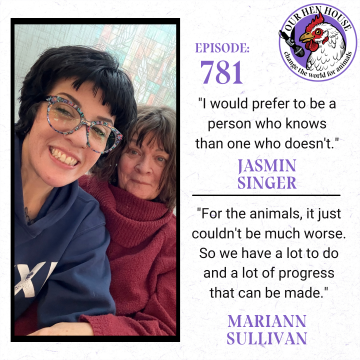
In this special year-end episode, Jasmin and Mariann reflect on Our Hen House’s journey through 2024 while looking ahead to 2025. From discussing standout interviews and emerging food technology to examining media coverage of animal issues, our hosts provide their unique perspectives on the state of animal advocacy. Their candid conversation balances hope with realism, offering insights into how activists maintain resilience while working toward progress.
Key Discussion Points:
• Memorable guest interviews from 2024, including sanctuary founders and whistleblowers
• Analysis of cultivated meat developments and state restrictions
• Media coverage of animal agriculture and food innovation
• The growing impact of local animal advocacy initiatives
• Reflections on maintaining activist energy and hope
To Our Amazing Listeners:
As we wrap up another year of changing the world for animals, thank you for being part of these crucial conversations. Your engagement and support help keep these important discussions going.
RESOURCES
-
- Steve Wise remembrance
- The Goat Conspiracy episode 772
- Lancaster Farm Sanctuary on episode 767
- Tom Harris on episode 769
- Tom Conger on episode 730
- Patch Plays on episode 744
- Animal Policy Alliance episode 748
- Jim Mason on episode 747
- Animal Law Podcast episode 115
- Cultivated Meat Is Now Available In Hong Kong
- US has first severe bird flu case. When should we start to worry?
- How did Elphaba become wicked? There’s a hidden message people keep missing.
- King Charles Gives Up Red Meat Following Cancer Diagnosis
- You’re being lied to about “ultra-processed” foods
- The Year Dairy Milk Won — or Did It?
- US animal lab from which monkeys escaped accused of widespread abuse
- Backyard Breeding is Now Illegal in NYC!
- Veganuary website
- Meat-eaters more likely to be disgusted by meat after taking part in Veganuary, study reveals
- Castillo Animal Vegan Vet
- Daniela Castillo on episode 720
- Animal Place website
- Kim Sturla on episode 154
- Devil’s Island
- John Yunker & Midge Raymond on episode 768
- Pakistan’s International Animal and Environmental Rights Conference
- Tickets for Pakistan’s 1st International Animal and Environmental Rights Conference
INTERVIEW TRANSCRIPT
Jasmin Singer: Welcome to Our Hen House and happy new year.
Mariann Sullivan: Happy New Year! Happy New Year!
Jasmin Singer: This is Jasmin Singer.
Mariann Sullivan: This is Mariann Sullivan.
Jasmin Singer: And this week, if you spoke like that in real life, I would stop doing the podcast immediately and we would lose all of our listeners.
it
Mariann Sullivan: Wouldn't be a problem because nobody would listen.
Jasmin Singer: So this week it's just us and that's exciting because every so often we devote an episode to our two favorite people, which is us.
Mariann Sullivan: And you said it was exciting too!
Jasmin Singer: We're so excited. We're thrilling. We call this the Hen Report, but do you want to know something funny? Apparently you were talking to Moore yesterday, and she was like, what are you doing today? And you said preparing, and then you said what this is. But she kept hearing Henry Port.
Mariann Sullivan: Henry
Jasmin Singer: Henry Port. She, and she was like, are you interviewing
someone
Mariann Sullivan: who's Henry?
Jasmin Singer: Who's Henry Port? Anyway, so our guest is Henry Port and he's really a mover and a shaker, but during our Hen Report, we try to get, you know, Like up to date, more or less on the news, which is, you know, good, but usually bad. It's serious. Sometimes it's frivolous.
Mariann Sullivan: was, I'll tell you, it was a little bit of an effort that had to be made to not make this, like, overwhelmingly depressing.
Jasmin Singer: Well,
Mariann Sullivan: it is New Year's, I don't want to, like, you know, get everybody down, but, uh, you know, it's a
tough world out
Jasmin Singer: Every week you get people down. I mean, we used to call, we used to call ourselves Indefatigably Positive, and then one day we stopped calling ourselves that, I think.
Mariann Sullivan: I'm sorry. I think we do our best.
That's, That's weak.
Jasmin Singer: Well, alright, this is the last episode of 2024. How do you feel about 2024 ending?
Mariann Sullivan: I'm a little nervous about 2025, I'm gonna be honest.
Jasmin Singer: Why would you say that? No, I'm kidding. Don't, don't go on and on. Well, I was thinking, you know, there is a slogan that is look back, but don't stare. And with that in mind, let's chat a little bit about Our Hen House in the past year. And then of course, there is looking forward and we'll get through it together.
Mariann Sullivan: You know, when you've been doing animal rights for a long time and really focusing on this issue, you know, you're used to, being a little difficult to keep your spirits up,
and to working on that, and to coming up with ways to do that. So that is not a new thing.
Jasmin Singer: You brought that up like years ago when COVID started and it actually really helped me to think of things like in that way, like we're used to accommodating terrible catastrophes.
Mariann Sullivan: Yeah. We live, we live in catastrophe, and the rest of the world just turns a blind eye to a lot of it, and we don't. So, so, you know, we're better at this, I think. We're more resilient.
Jasmin Singer: Yeah. There's a new book out about why some people choose to be blissfully ignorant. I was really excited about the book and then I heard an interview and I was like, alright, maybe it's not actually for me, but just the thought of it...
Mariann Sullivan: it is a compelling question.
Jasmin Singer: And I, begrudgingly will say that I would prefer to be a person who knows than who doesn't.
Mariann Sullivan: There, there are probably things that we pretend we aren't seeing, and
because we pretend that at a subconscious level, we actually don't even know it.
But I really don't know how people maintain this, like, illusion that there's not something going terribly wrong on factory farms.
Jasmin Singer: There was an article that was in the New York Times the other day, well, it was the column The Ethicist, and it was, it was about whether or not to have kids, and I just, I'm not currently stating whether or not, I'm not going to go there right now, okay, but I just want to say that within the process of exploring the question of whether or not to have kids because of climate change, one thing that the article did that was very good, that I give serious props to, is that they actually talked about adoption as an option, which is very infrequently brought up when this topic is brought up.
So, hats off to them for that.
Mariann Sullivan: And if adoption is brought up, it's brought up, like, in the context of, like, babies, like, without a whole lot of thought of adopting children, Older
Jasmin Singer: children. Right. Exactly. But there was also this really annoying con and I don't have it in front of me. I didn't know I was going to talk about this, but it just occurred to me. There was this really annoying part of it that was talking about how, you know, it's sort of a nod to having hope to have a kid.
And I was like, dude, that's, in my opinion, the most self centered thing.
Mariann Sullivan: That's unbelievable.
Jasmin Singer: I mean, you, you cannot put a child or any individual on this earth knowingly without giving thought to that individual's experience. And,
Mariann Sullivan: just crazy, too, because, though it actually makes sense when I look at the world, but it's saying that because people have children, that they're more hopeful, and so you should have children so that you will be more hopeful, even though there's no reason to be hopeful and you're actually putting those children at risk.
is that what, is that what, is that what they're saying?
Jasmin Singer: yeah, yeah, well, and even if you're not sure, and also for the person who wrote in with this question, like, clearly they're not sure. They wrote to the ethicist, like, err on the side of how you can get your needs met, whether it's a need to be a parent or what, without foisting, as Mariann Sullivan would say, foisting your noxious spawn upon an innocent earth. I was quoting
Mariann Sullivan: That was in a dark moment.
Jasmin Singer: Yeah, but you've said it hundreds of times since that
Mariann Sullivan: I have a lot of dark moments.
All right, where do we, can we get out of this
Jasmin Singer: yes, I saw, no, I know, I'm
Mariann Sullivan: for no reason whatsoever? Happy New Year!
Jasmin Singer: Yeah, okay, so let's look back at the last year starting with something sad Which is this year was the year that the great Steve Wise passed.
Mariann Sullivan: I really miss him.
Jasmin Singer: I know I was thinking about you the other day, and he was a big cheerleader of your work He was the first guest on the Animal Law podcast, but other than that he was just a real luminary and
Mariann Sullivan: And, he was a very, very kind person.
Jasmin Singer: He was, so that happened this
Mariann Sullivan: But the work of the Non Human Rights Project continues.
Jasmin Singer: It does, it does, and it's an incredible
Mariann Sullivan: He started something that did not die with him,
Jasmin Singer: Love that.
The Hen Report, which is what we're doing now, or Henry Port has become a regular guest on our Hen House, how do you like it? Do you like doing the Hen Report?
Mariann Sullivan: It makes me nervous because it makes me feel like I should like be really, really on top of all the news, and get everything right, which I guess I always feel like a little bit doing the podcast, but it does feel like more of a responsibility. But yeah, basically my favorite part, well, I'm not gonna say my favorite part, I do love many of the interviews, but the part I enjoy doing the most, I think, is when we just chat about what's going on, it's,
I like doing this.
Jasmin Singer: We were nervous at first because of what you just said, but also because the kind of foundation of Our Hen House was really built on our guests and we didn't feel like it was really built on us. I mean, I know that we're important to the process, obviously, but it is a little bit scary to like, take that leap and say, okay, it's just us for the
Mariann Sullivan: Yeah, well, it's just us, but we're talking about articles that we've read, so we're actually stealing content from, from the world.
Jasmin Singer: thieves. Yep.
Well, I'm enjoying it, but that's mostly because 15 years ago. It's the same as today. I love having access to your brain. And so when I'm
Mariann Sullivan: That sounds a little gruesome, but yeah,
Jasmin Singer: It does. It really is really gross actually. But when I'm interviewing people, I'm more or less being selfish because I want to have access to their brain.
During Hen,
Mariann Sullivan: it's so much fun, like, interviewing
Jasmin Singer: I know it's
Mariann Sullivan: get to ask questions so you don't have
Jasmin Singer: that you want, and you get to ask questions that you genuinely want to know the answer to. So we were looking back at some of our guests from the past year, and you and I both decided that it is not possible, nor is it fair to say, favorites, so, we're just going to mention a few that really stood out to us when we were
Mariann Sullivan: A variety.
Jasmin Singer: Yeah, so, why don't you start?
Mariann Sullivan: All right, actually we don't do a lot of sanctuary interviews, but we had two sanctuary interviews that we loved. Maybe we should be doing more of them. Our interview with Nicole Schoenemann from The Goat Conspiracy in Indiana really stood out in my mind.
Jasmin Singer: Yeah, totally. And,
Mariann Sullivan: I guess to some extent because it was one of those transformation stories about how the goats got her to go vegan.
Jasmin Singer: Mm hmm. I love a transformation story. I think we have done a few of those recently and they're endlessly inspiring and moving. I loved the interview with the Lancaster Farm Sanctuary folks, Sarah Saluzzo and Jonina Turzi, a lovely couple.
Mariann Sullivan: Who both have Z's in their last name.
Jasmin Singer: Yes,
Mariann Sullivan: That doesn't happen every day. But they said many, many things that were much more interesting than that. Yeah. That was a great interview, and they're both really, really smart. They never stop working, and they care so deeply. I loved that interview.
Jasmin Singer: I did too, Now you, liked, you talk about this one quite a lot, the Tom Harris
Mariann Sullivan: I really loved that interview. it was about his book, Your Neighbor Kills Puppies, and really about the SHAC campaign and the time he did in prison in the UK because of it. And so, I mean, that's a story that I'm somewhat familiar with, and, you know, it happened a while ago,. I mean, I knew it would be good, but I didn't know it was going to be as compelling as it was.
I found him a very compelling person. I often think of something he said on the podcast, of when you get down. He was a person who did not seem to, like, live in depression. Even, you know, when we asked him, like, was prison really hard? And you expect somebody to really talk about how terrible it was. He was like, Yeah, it was fine. You kind of settle in, you know, you get your routine. Like, he was just such an even tempered person.
But he, he said something about, thinking about, like, the climate and the end of the world and, like, just everything, that what you live for is just moments of joy.
Like, that's what you live for, and I always remember that. Like, we all have access to moments of joy. And, you know, we don't know what's gonna happen, and when you get in a dark place, and you're worried about the future, you really don't know what's gonna happen, and thinking about it gets you nothing. But noticing, like when you're walking the dog, that it's an utterly beautiful morning, and the snow is in the trees, and it just, and the birds are like, chirping around as if they're not freezing. Like, it's just, beautiful and it's just a moment of joy and take that moment
That is what life is about.
Jasmin Singer: That resonates with me more than when people say practice gratitude. Like, you know, that's no shade. Like if people, if that resonates with people, great. But this is maybe it's semantics, but the moments of joy to me resonates more than like practicing gratitude. Also. So from Tom to Tom, I had a Tom interview that I also really liked, which was Tom Conger, and he talked about AI and it was really on the advocacy side,
Mariann Sullivan: and very practical
Jasmin Singer: And they're super practical. I know there's some discussions going on out there about, like, AI and animals in different capacities, but Tom Conger was specifically discussing, like, how activists can make great use of
Mariann Sullivan: Yeah, with great clarity I have
Jasmin Singer: I really, really love that. And another creative kind of interview that I loved because of my propensity towards the theater was Grace Howarth and Anastasia Buntz.
They are from Patch Plays, which is the vegan troupe that is producing theater that is specifically focused on, the lives and deaths of animals. So it was just a charming, charming interview and they were incredible young women.
Mariann Sullivan: no, I love to hear about those kinds of efforts that people are making like the, like activism that gets outside the box. Some activism that is kind of inside the box, like really trying to use legislative efforts and others to change policy was our interview with Gabriel Wilgen from the Animal Policy Alliance and that was so compelling that we're actually planning on doing more interviews, not just with Gabriel, maybe with Gabriel, maybe without Gabriel, but with people around the country who are like working on local change because you know, Congress is really, it's not happening these days, and even state legislatures, it's really tough.
But people are creating animal policy changes, so I love that somebody is trying to coordinate all of that and give people resources and help in making those things happen locally.
Jasmin Singer: Yeah. I'm super, super excited about that. I, can't wait to see what that brings in 2025. And then of course the one and only Jim Mason, another really strong.
Mariann Sullivan: Oh God, I love him.
Jasmin Singer: mm
Mariann Sullivan: If you're not familiar with Jim, I mean, Jim Mason has been doing this longer than most any of us, and if you're not familiar with his book, An Unnatural Order, you need to be.
Jasmin Singer: Yeah. Well, we'll link to all
Mariann Sullivan: It's about the history of humankind and how we got where we are for better or actually worse.
Jasmin Singer: Well, it's almost the 15th anniversary of Our Hen House, which is in January and you know, we've mentioned this before we might mention it again next month, but we started Our Hen House in Philadelphia
Mariann Sullivan: On a weekend trip, and the coldest weekend that has ever existed, every time I think of that weekend, I just think of like how cold it was.
Jasmin Singer: Yeah, and it's exciting. I mean 15 years
Mariann Sullivan: and vegan pizza. and founding Our Hen House, too.
Jasmin Singer: Right. And founding Our Hen House. And so,
Mariann Sullivan: There's something to be said about getting away.
Jasmin Singer: yeah, I agree.
Mariann Sullivan: being in a new place, like, to get your creative juices flowing, like, you can't, like, go on your email, you can't go on social, like, well, you could go on social media, but, you know, you're just sitting there in Philadelphia, and,
Jasmin Singer: On the
Mariann Sullivan: you start, like, I think, it forced us to really focus on what we wanted to do next.
Jasmin Singer: am a big fan of The Geographical Solution. When I was writing Fabulous Vegan, I took a train across the country, which was, by the way, a very short trip. It was only like four or five days. And I wrote a significant amount of the book on the train. I love, and you know, it's possible that I just, need that psychologically, like I'm not sure it does much logistically, but there's something to me exciting and motivating about being away to start a project, so I agree.
And, by the way, you have also, had quite a week in terms of animal law related. So let's first talk about why I came over to make sure that no dogs were howling in the background the other day. Tell us about your CLE.
Mariann Sullivan: CLE, yeah. I thought you were going to ask about the Animal Law
Jasmin Singer: I'm, I do, I want to ask
Mariann Sullivan: I was asked to do a CLE, which is a Continuing Legal Education program by this, fairly new company, I think, called SproutEd. I knew nothing about it. So I was like, yeah, okay. Like, and then when it came I was like, oh god, I have to do
Jasmin Singer: but that's your process. That's what
Mariann Sullivan: is, that is my process. Yeah.
Say yes, and then want to kill yourself. But it was, the way they do it is crazy, like they sent all this equipment, like really elaborate equipment, a computer, and, camera, and, backdrop, and then they sent this local guy over to set it all up, and then it was done live. I chose to, focus on companion animal stuff, because I think that I figured that would be more popular. And so I did a little intro on what animal law is, a little intro on companion animal law, and then I focused mostly on the question of tort recovery when your animal is, injured or killed, which is a very fraught subject, within the law. And, like, it was so much more work than I thought it was going to be, but it was fun.
Jasmin Singer: Yeah, you sounded amazing. I eavesdropped as I was babysitting the dog who just slept the entire time I
Mariann Sullivan: Yeah, the cats, the cats never came downstairs and caused any trouble. I had, you know how you have images? I mean, doing things live is, like, this is all recorded. If we fuck up here, like, we can take it out. But doing things live is hard.
Jasmin Singer: Yeah, totally. Well, you did a great job. You know, I was telling a friend of mine about it, and she was like, Oh, can you ask Mariann for me about, and she started telling me about like a vet malpractice thing, and I guess I just wonder like, do you get questions like that all the time? Just like, oh, I have a cat, and can I ask you
Mariann Sullivan: Well, not all the time, because I don't really talk to anybody other
than you.
Jasmin Singer: That's right.
That's true.
Mariann Sullivan: But yeah, lawyers and doctors, you know, get asked a lot of questions. And I would say, if anybody knows you do animal law, the question you're most likely to be asked about is vet malpractice.
And that is not, no shade on vets, most of them are great.
Some of them are not, and even when they are, you know, feelings run high. I mean, when your animal dies, feelings run high. So, and legally, there's some things that can be done, but not much.
Jasmin Singer: Well, and on the subject of Animal Law, you did have an Animal Law
Mariann Sullivan: I did
an animal law
Jasmin Singer: come up. Tell us about it.
Mariann Sullivan: All right. So, this is about the stuff that's going on in Florida about Upside foods, which makes cultivated meat. I know some of you don't like cultivated meat. I know. but you know, it's a really big issue, and, I think it's a really important issue, and Florida has banned it.
Also Alabama, I think, and some other places are thinking of banning. Florida it's actually a crime. It's not just, it's not just like you get fined or something for selling it. It is a crime to produce it or sell it in Florida.
Um, yeah, and so it's, you
Jasmin Singer: That's fucking
Mariann Sullivan: it's crazy.
It's crazy.
Uma Valetti, who of course has been on the podcast, who heads up Upside Foods, decided to sue Florida and his, I didn't have Uma on again, but I had Paul Sherman on, who is the lawyer who is handling this case.
He was so skilled at talking, like really, really informative and smooth. He works for this organization called the Institute for Justice. It's a not for profit law firm, and it's very libertarian. It's not an animal thing, though he has done other animal related work, I think, on labeling. So it, you know, libertarians, like, our interests may collide at some point, and some not, but he was so good. And he said, and this was really a lesson to me, he said that they get media training all the time. Like, of course they should. You know, they're doing law, they get interviewed, like, every lawyer who is doing animal law should have the benefit of media training. I
Jasmin Singer: a lot of people should have, a lot of people beyond
Mariann Sullivan: Anybody who's doing animal rights, really, because you end up having to talk to people, or to the press, or to somebody, and you want to be able to communicate.
There wasn't anything, like, smooth about it in the way that it was fake or phony, it was just, you know, He was able to convey everything with a great deal of clarity.
I mean, all of my guests are like, you know, they're really, really good. But he was particularly skilled at it, I think. So that was fascinating. I don't often interview people outside the animal law world. Occasionally I do. And it was just, It was really interesting.
And the issues in that case are really important.
And obviously, this is hugely important. If a whole bunch of states start doing this and setting different standards all around the country, it's going to kill this industry before it starts.
Jasmin Singer: I want to give a piece of advice to anyone whose ears just perked up about media training, which is that the most important thing I can tell you as someone who has interviewed thousands of people, probably, is to be able to make your point in a succinct and conversational way. Because that is the number one thing that I would say. It is the difference between us telling Vicki after the interview is done, it is the difference between us saying phenomenal and like super smart person, very long winded.
And that is not easy for the listener who is listening to that.
Mariann Sullivan: I'm getting really self conscious because I feel we're just rattling on and on and on.
Jasmin Singer: That's hilarious. All right, let's talk about cultivated meat.
Mariann Sullivan: Well, yeah, we're already talking about cultivated meat. And it's actually in the news as well. This was some Plant Based News. apparently this is not brand new news. It's a couple of months old.
I think it's now available in Hong Kong. I mean, it's been available in Singapore and in, you know, allegedly in someplace in the United States. I don't think it's actually sold at retail anywhere in the United States yet. But, But, it has been served in various places, but it's also now available in Hong Kong.
If you happen to be in Hong Kong and you want to try cultivated meat, you will be able to. This is like from an Australian company that is called VOW and they are marketing it in, Hong Kong, which is exciting news for me. I know some of you hate cultivated meat. I'm sorry.
Jasmin Singer: You already mentioned that, but I think that Our Hen House listeners are super smart and I think that even when people don't like something, whether it's a product or a concept, I think people realize that not everything is for everyone. That's kind of the
Mariann Sullivan: Yeah, and also there's the whole question of whether they're going to be able to produce it without harming any animals, which is important to a lot of people, but this is certainly a huge piece of the puzzle, or hopefully will be a huge piece of the puzzle, of how we get the animals out. There was also I wanted to bring in a few rising anxieties into this conversation as well. And one of them was about this. This is from the Meat Your Markets column by Matt Graves, on Meatingplace. com. Get it? Meat Your Markets on Meatingplace. Get it?
Youth be warned, no more cattle. This is a fascinating article. 100 years from now, he says, do you think there will be a cattle to beef industry as we know it today? I don't. The only thing left will be nostalgic rodeos with how it used to be. Well, two things wrong with this. Well, only one thing wrong with it. Nostalgia for rodeos? Seriously? Abusing animals just for the hell of it? But fascinating in that he thinks beef is over. Well, not over, but at least a hundred years from now and you know, hopefully a lot sooner than that. He thinks it's gone. All the land, time, effort, money, etc. to raise cattle, and humans willing to work in such an industry, will be directed to other endeavors. No more cowboys or cowgirls. No more Yellowstone. No land planted with corn or that water sucking grass of alfalfa. No more feedlots. No more processing plants.
That's one of the many, uh, euphemisms they have for, slaughterhouses. And he thinks it's because of cultivated meat. He's not sure that cultivated beef is going to catch on. I think that's an open question. But it's still just way too expensive to do all the things to transform a live beef animal, that's what they call them beef animal, they're animals made of beef, into edible chunks of protein.
Jasmin Singer: Wow.
Mariann Sullivan: This is the thing that scares me about this article, which otherwise, I mean, this is on Meating Place. These people are devoted to the cattle industry. They never say shit like this. He says chicken will keep growing in consumption volume, but you cannot imagine people not eating beef, can you? Well, that's really scary because obviously if they're going to do cultivated anything, we want them to be doing cultivated chicken and you know, the harms of chicken to humans are less dire than the harms of, cattle. There's not the same climate change issues. I mean certainly it's a lot, lot better to use cultivated, than live chickens for about a billion different reasons, but, he sees the chicken industry as surviving, even with live, live animals.
I hope he's wrong on that, but on the rest of it, from his mouth to God's ears, or whoever's in charge of whether we kill all these animals. And he just suggests to people in this industry that they get on board. Don't be fooled by those who say non cattle beef will be too expensive or just as environmentally intolerable as today's beef. Don't be romanced by the aura of raising, gathering, branding, feeding, harvesting, and carving cattle into beef. These people have a very weird idea of romance, I have to say. But he's against it, even if he does think it's romantic. He says this industry is in a death spiral.
Jasmin Singer: Hmm. Well,
Mariann Sullivan: That's, that's from Meating Place.
Jasmin Singer: In no uncertain terms.
Mariann Sullivan: anxieties, I don't think I've ever seen anxieties raised any higher than
Jasmin Singer: Although, I really like this other Rising Anxieties piece that you pulled out from USA Today, mostly because of the headline. It's just, it's a good one. This is a bird flu story, but we're not gonna go on and on about bird flu, because,
Mariann Sullivan: No, I just wanted to talk about this article, because we talk about bird flu every week, and you know, like we're either all going to die or we're not, and we don't know.
Jasmin Singer: well, we are. We do know we are
Mariann Sullivan: it's true, it is true. The thing I thought was fascinating about this particular article was really just the headline. US has first severe bird flu case and you know, they're talking about the one in Louisiana where somebody is very very ill with bird flu When should we start to worry?
Seriously, when should you start to worry? Like we're not worried yet? Like we should have started to worry at least two years ago. Probably 50 years ago
Uh, maybe, you know, during the, the last bird flu pandemic in 1918, when millions of people died all over the globe, which was from birds, including my grandfather, I have to say, uh, well before I knew him.
I was not alive in 1918. I just want to assure everybody that. So yeah, I think we should start to worry, like, pretty soon, Eduardo and Adriana,
Jasmin Singer: I've been, honestly, this is, I know everything that we go through is a Don't Look Up moment, but this just, it feels so Don't Look
Mariann Sullivan: It it really is. you know, climate change, it is not explainable why people don't pay attention to it, but, you can't understand it. But compared to bird flu, when we were just through a pandemic three years ago, like that rattled the entire world. It's unbelievable. It's unbelievable.
Jasmin Singer: Yeah, I know.
Mariann Sullivan: Like, this, this incident more than anything else has made me feel like humans are, just the craziest species on the face of the earth.
Jasmin Singer: This is what did it? This particular
Mariann Sullivan: Well, I've always thought, I've always thought that, but you know, like, this one is bigger.
Jasmin Singer: Let's change the subject, because it's just, depressing and I want to pull us
Mariann Sullivan: I know I kinda, I kinda keep promising we're not gonna do Doom and
Jasmin Singer: Just stop promising. Well, okay, something we have been promising and finally we can live up to it is that in the last week we finally saw Wicked, the movie, which just to be clear we have seen the Broadway play Me many times and
Mariann Sullivan: I only saw it once.
Jasmin Singer: Well, I saw it many times.
Many years ago, we spoke about it on the podcast. I'm sure we could dust that episode off, but like, obviously we've been talking forever about how this is an animal rights story. And by the way, our friend, Michelle Kutryk, she told me that the book is even more so, so I'm going to get that book, like, in the next couple
Mariann Sullivan: I understand the book is very weird and dark and, um,
Jasmin Singer: I'm excited. I like weird and dark. That's why I get along with you. But anyway, so this, I mean, there have been stories that have covered it. It is crazy to me how it is being positioned as a hidden message. In fact,
Mariann Sullivan: Well, that's what this article in Vox said.
How did Elphaba become wicked? There's a hidden message people keep
Jasmin Singer: missing.
It's not hidden, folks. Neither is bird flu. Open your eyes. Like, this is about animals. It's not an allegory. It's not a metaphor. It is about liberating animals. That
Mariann Sullivan: like the whole plot. It's not like, it's not like a tiny part of the plot. It's like the whole story revolves around that issue. And people keep saying, people like, you talk to people, even animal people, sometimes you tell them that you saw Wicked or something, and mention that it's an animal rights theme.
And they're like, really? And they've seen it.
Like, And people who aren't animal people, like, totally, like, I don't understand it. It's, it's mysterious.
Jasmin Singer: Super mysterious. So, yeah, I mean, there are a few places
Mariann Sullivan: want to say it lived, it totally lived up to my expectation, to my
Jasmin Singer: Phenomenal, phenomenal.
Mariann Sullivan: Only thing that I hated about it was that we have to wait another, like, apparently 11 months before we see the rest of it because it's in two parts.
But the fact that it's in two parts. The fact that it's in two parts made it, them able to go into a lot more detail and, to develop the plot a lot more. I don't know, like, it was very easy to follow the, but the plot had a lot of, like, different aspects to it that, you know, they had to rush through kind of in the stage production.
So there was that. I thought it was beautiful. I loved the aesthetic, vision of, whoever did this. It's very elaborate. It's a very, very elaborate production.
Like
Jasmin Singer: it, it is starring not one, not two, three,
Mariann Sullivan: Yeah, it's crazy.
Jasmin Singer: Okay, we've got Cynthia Erivo, we've got Ariana Grande, and we've got Jeff Goldblum.
Mariann Sullivan: It's crazy.
Jasmin Singer: like, can you imagine their craft services at the
Mariann Sullivan: Oh, yeah, I bet it was really,
Jasmin Singer: bet it was good! Yeah, I mean, this is like, listen, I will admit, I have a terrible memory for, like, things that should fall under the umbrella favorite, like, whenever I listen to a song, if I really, really love it, I'll be like, I think that's my favorite song, and I'll forget about every other song I've ever heard.
I want to say that, that I think this is one of my favorite movies. I also really like What's Up Doc with Barbra Streisand, but I digress. I do tend to forget movies I've seen, so I will say that I'm caught up in the moment. However, the fact that this is about a misunderstood person, which I feel, I know most of us feel misunderstood.
I, you know, I know that many of us, like me, were bullied kids or whatever, or just maybe you weren't, but you felt misunderstood by society
Mariann Sullivan: I
Jasmin Singer: reason.
You weren't a bullied kid, but you have often felt misunderstood. So,
Mariann Sullivan: Well, people frequently don't understand what I'm talking about, it's
Jasmin Singer: And you would say it's because they're wrong, and I would say, and I would say it's because I'm inferior and need to go to therapy, I mean this is the difference between you and I fundamentally.
Mariann Sullivan: I, I have been through much neurosis in my life. Don't, don't cheat
Jasmin Singer: Oh, believe me, I
Mariann Sullivan: from my despair.
Jasmin Singer: aware. Because
Mariann Sullivan: All right, what, like, like,
Jasmin Singer: this is not only,
Mariann Sullivan: you started out this whole podcast by saying people should have media training so they don't dilly dally about
Jasmin Singer: Say that, let me, the point is that it's not only about animals and animal liberation, but it's also about someone who cares so much that she even says at one point, Do you think I don't know that my life would be so much easier if I didn't care this much? It's about someone who is misunderstood and it's because she has
Mariann Sullivan: Misunderstood because of her compassion. for animals, I mean, and, and beyond that too, like, you know, there are other things going on, but, that's the fundamental thing in the middle of all of this, is there compassion for animals who are being mistreated.
Jasmin Singer: One of my favorite lines in it, other than that one, which I just misquoted, is, If it's so good, then why is he trembling? And it meaning, like, the system of caging animals for their own good. Then why is he trembling? And, you know, it just reminded me of that story that you told a few months ago about a
Mariann Sullivan: I mean, there's an animal rescue in the movie, like an actual rescue, an actual animal, and people do not understand this is about animals.
Jasmin Singer: A few months ago, you told us a story about how a vet came over to your house and was giving some kind of a shot or something to Lulu, your dog, and, something happened with Lulu and, you know, she reacted and the vet said they don't feel things the same way as us.
They
Mariann Sullivan: know, it was, she was a Vet tech.
and she really, she really should lose her
Jasmin Singer: Then why is she trembling so much? It's just the fundamental thing.
Mariann Sullivan: A vet tech said that to me,
I, I, It's
Jasmin Singer: Totally bananas. All right, let's move on, but you guys, if you haven't seen it yet, go see it for realsies.
So let's, let's switch gears from Wicked to King Charles. I know you like to talk about King Charles because it makes you feel like you're in
Mariann Sullivan: I, first of all, when you say King Charles, doesn't it make you feel like you're living in the 1600s or something? It just sounds so odd.
Jasmin Singer: King Charles? You have to say it like that. Every time you say it, say King Charles.
Mariann Sullivan: I try not to do fake British accents because it's just embarrassing. Um, and you know, there might be some people from the UK who are listening who would be rolling their eyes.
Jasmin Singer: Or they're ours. No, I'm kidding. They don't roll their rs.
Mariann Sullivan: Yes, King Charles, uh, this is from Plant Based News and it has to do with, the fact that King Charles has apparently given up red meat because he, of course, has been diagnosed with cancer.
I think it's prostate cancer. And, you know, he understands that eating more plants has many health benefits. And, you know, he's very into it, and he's totally fine with it. And the article does point out that he owns a number of animal farms, including beef and dairy. So what is this, like, my subject? Is that what he calls them?
My subjects should get cancer, even though I would prefer not to? Like, what the fuck?
You know I'm sorry if you're from the UK, you don't agree, or if you're not from the UK, which makes it even more likely that you would be one of those people who follows the British Royal Family for reasons that escape me, but, I don't know the fascination with them, but they do own really really a lot, and apparently that includes beef and dairy farms, even though they understand that they cause cancer.
Jasmin Singer: Yeah, I don't really have anything to say about that because I think it just speaks for itself. But I will say that this article that I want to talk about also from Vox, by Marina Bolotnikova, who's just an incredible journalist and activist, this article has been getting around, hasn't it?
It's called, You're Being Lied To About Ultra Processed Foods, and
Mariann Sullivan: Thank God somebody wrote this.
I'm so grateful to her because this whole discourse around ultra processed foods and how, when we're talking about, I mean, when people hear the term ultra processed foods, I bet what they think of is Beyond Burgers.
Like, that's, that is how this whole discourse has been used.
It has been used to denigrate plant based foods, which things like Beyond Burgers and other plant based meats were basically completely absent from the study that all of this brouhaha has been based on. Just 0. 2 percent of the calories across the sample came from meat alternatives.
What they were talking about when they were comparing the health status of people who ate, ultra processed foods and who didn't, the, what they were talking about was, breads, pastries, buns, and cakes, and biscuits, or, you know, or cookies as we call them here. Like, foods that are obviously bad for you.
Like, crap, total crap. Like, the meat industry is just so much more talented than they should be. Because they have managed to take this study, or these studies, I mean, obviously a lot of people are considering, what is an ultra processed food, and it, they've managed to to take them, somehow make them about Beyond, and actually put that in everybody's heads.
I mean, even the term ultra processed, as other people have pointed out, it's not a useful term. I mean, a lot of these foods that are labeled as ultra processed really are very unhealthy foods, but it's not a useful way to look at food. It's more complicated than that. Like there's processing and there's processing and so the whole study was flawed.
But the idea that the meat industry managed to make this about Beyond and Impossible makes me crazy. And thank God, Marina Bolotnikova, who does, of course, extraordinary work at Vox, like thank God she is out there going into these issues which nobody else covers with any kind of intelligence. So I highly recommend, I can't, talk, about the whole article because it's pretty long, but I highly recommend reading it. And, you know, like ultra process is supposed to be like industrial processes that, including dyes and flavors and emulsifiers, certain kinds of sugar, like the crap. The crap that you get in the worst part of the supermarket.
Jasmin: I guess that is sort of like, uh, rising anxieties, would you say? Like, in a way.
Mariann Sullivan: I guess.
Jasmin: Well, okay, from I guess to definitely, this article in Eater, I would say this is definitely rising anxieties, right? It's called the Year Dairy Milk Won,
Mariann Sullivan: This article, it'll just make you insane. I don't even know whether I should talk about it?
Jasmin: Talk about it.
Mariann Sullivan: In 2024, we watched tradwives, milk cows, bought milk perfumes and generally thought way too much about raw milk. Like, I did not realize that's what we were doing in 2024, but you know, that's because I don't read Eater or other things.
This is by one Bettina Macalintal. And she manages to write this whole article without really mentioning raw milk.
Jasmin: I just have to say, her name is very close to Milk a Lentil.
Mariann Sullivan: All right,
Jasmin: I'm just saying. Go ahead, Bettina
Milk a Lentil,
Mariann Sullivan: Is a thing, you know, one of those things that I missed. Maybe you missed it too, so now I'll tell you about it just so you can lose your mind like I, I do. And apparently whole milk, I guess I sort of knew this, has been pushed a lot this year. I've tried to avoid knowing anything about tradwives, but, you know, I do know what the term means, and it's upsetting. But she manages to write this whole article, and talking about the, you know, how popular raw milk has been, and how it's been rising, because of the distrust in food processing in the federal government, and, and, hardly even mentioning, here it says here, bird flu has recently been detected in raw milk.
Yeah, yeah, it's, It's really kind of a problem. Like, nobody should be drinking raw milk. That's the article they should be writing about it. She talks about RFK, like, how much he loves raw milk, and that dairy milk has become a kind of cultural flag among conservatives, having to do with the trad wife moment, and some babe on Instagram making mozzarella cheese from scratch. Like, what? What?
Jasmin: Yeah.
Mariann Sullivan: What is happening?
Jasmin: Well. Okay, let's keep the what is happening vibe...
Mariann Sullivan: She does enter with, talk about this like movie that's coming out, or maybe it's already come out, called Baby Girl. And it centers, I, I swear this is what it says, it centers on a CEO played by Nicole Kidman, who's struggling with her own desirability and begins to explore the submissive fantasies she's hidden her whole life, after meeting one of her company's new interns. And at one point, as part of this new dynamic, she publicly chugs a big glass of milk. Like, can you think of anything less sexually exciting than a big glass of milk?
Jasmin: I mean, paging Carol Adams!
Mariann Sullivan: If you want to have sexual fantasies about submission, go right ahead. That's not real life, people.
Jasmin: All right, well, unfortunately, this next story is apparently real life, and I guess I just want to say this is a very heartbreaking story, but we'll move through it quickly. This is from The Guardian, and this is sort of a follow up story to something we chatted about probably about a month ago or so.
Mariann Sullivan: Yeah. no, it's really bad. I'm sorry, but I just, like, it is a story of heroes, and really animal rights activists, and I don't want to leave it out, and it has to do with the monkeys that escaped from that lab in South Carolina, owned by a company called AGI. A lot of them escaped, over 30.
Most of them were recaptured in cute little stories. It was talked how they, you know, they went back to the lab as if everything is fine. I think, the latest I heard was that there were four that they did not recover. But now apparently it's come out that the USDA is investigating a lot of allegations concerning the treatment of the animals there, which is just Oh, it was 43 Monkeys, sorry, which is absolutely horrific. They're accused of abuse and neglect, and I won't go into the details, but there's just something about this story that, the details are really horrible, that is so moving that these animals like, rescued themselves. They got out, and what happened? You know, there were all these cutesy little stories, and people were rooting for them, and it's all cute.
And then they just got put back.
Jasmin: Yeah. It is a a
Mariann Sullivan: But, you know, we're not the only animal activists out there. The animals are doing their best.
Jasmin: Let's talk about something good now, because there has been, I think, a pretty fantastic move that is brand new to New York, and I know you posted about this on your Blue Sky, or as my app calls it, Blue
Mariann Sullivan: It's pro, it, it's progress. I mean, it's about companion animals, and of course, you know, more likely that we'll make progress for companion animals than others. But New York State, Passed a statewide ban on sale of cats, dogs, and rabbits, which is very exciting, and it finally got signed and put into law, and also New York City now, and I think this is really important because of an interview I did earlier this year about what happened in L. A. They are banning private sales by unlicensed breeders in New York City, and you know, the one of the problems that arose in, in California, was that when they banned the sale in pet stores, it just goes underground and these backyard breeders and others, just start selling privately. So it looks like they're trying to be on top of that you know, it's just, when people are evil, they find so many ways to do bad things. Like people doing evil things just seem to have more energy than the rest of us. Have you ever noticed that?
Jasmin: No, I don't know about that. I'm not sure I agree with that. I think that, um, people I know have a lot of energy to save animals, and I think, you know, sometimes I wish I had less energy. Moore was talking about this new, like, meditation app she has, and it sort of has, like, a hypnosis element to it, and you could do meditations slash hypnosis on various
Mariann Sullivan: Hypnotize yourself?
Jasmin: Basically, like, to end or start certain behaviors, you know, like, binge eating, for example. but, one of the ones
Mariann Sullivan: you tell, like, somehow mistakenly, like, tell yourself
Jasmin: do the opposite.
Mariann Sullivan: squawk like a chicken or something, then do you do
Jasmin: That would, probably. I don't know why you QUACK
Mariann Sullivan: sounds
Jasmin: Squat Why you would SQUAWK I don't know why you would SQUAWK Think that. Gah! Uh, yeah. Well, anyway, so the reason I brought that up is because one of the hypnosis things you could do is, like, become a doer. And I was like, oh, for the love of God, let me do the opposite meditation.
Like, let me just chill out a little bit. So do I think that people doing evil things have more energy? I don't know. I think they're
Mariann Sullivan: Like, look
at Elon, Elon Musk, or any of
Jasmin: Must I?
Mariann Sullivan: Who like like why, why, you know, why are they so driven for power, whatever it is that drives them, and where do they get the energy to like, do it all, just like, like, why can't they just, well, it's not just privilege.
I mean, if, like a lot of people, if they have privilege, they just kind of chill out and, you know, don't do anything useful.
I mean, useful is probably the wrong word there, uh, but don't do anything, just, you know, go on vacation or whatever. But some people are just so driven. And many of them are not driven to do anything good.
Jasmin: Well, that's just, yeah, that's human nature. That's a capitalist society that we live
Mariann Sullivan: I'm not sure it's capital, I mean, I think it goes beyond
Jasmin: I think it all goes back to capitalism.
Mariann Sullivan: of that, but I, I
Jasmin: It's an expression of the patriarchy. I think capitalism and the patriarchy are basically are what is wrong with everything. And that's, I mean, you know, spoken like a true
Mariann Sullivan: You're starting like a little bit of a conversation, but, yeah, yeah, well, I, I just don't know whether capitalism is the cause of bad human behavior or just the way in which humans behave badly. It's like a technique more than, it's just human nature that is the problem.
Now I'm getting dark and we promised we were going to be bright because it's Happy new Year and, and things are going to be better in 2025. They are.
Jasmin: Oh my god. Alright, well, maybe in January, because, you know, Veganuary is coming up, and it's a really big campaign. I mean, I remember when I was in the UK a few years back, it was, like, everywhere! I mean, absolutely everywhere. Yeah, so, if you're a new vegan and you want to kind of get counted for Veganuary, or if you want to ask people to support you by going taking part in Veganuary,
Mariann Sullivan: vegan yet, though, it's unclear why you're listening. But thank you. I'm really glad to have you.
Jasmin: So I just, veganuary. com is the, is thankfully, that's a very good
Mariann Sullivan: Or, if you know people, you know, obviously, uh, if you know people who are toying with the idea of veganism, definitely point them to Veganuary. There's lots of resources available. It's not just a UK thing.
Jasmin: No, it's, it's big in the U. S. now, too, but yeah, anyone at all.
Mariann Sullivan: don't have this article in front of me, but there was recently an article, I think, in The Guardian, talking about how, and this is so obvious, but nobody seems to know it that when you change what you eat,
Jasmin: Yes.
Mariann Sullivan: actually change.
You don't miss meat for the rest of your life. People just think they can't give anything up because they'll miss it for the first day. They think that'll just go on for the rest of their life, but that's not what happens. If you actually stop doing something for a month, you do not want it as much.
Jasmin: It's called Meat Eaters More Likely to be Disgusted by Meat After Taking Part in Veganuary Study Reveals. Yeah, and we're gonna put all of these in the show notes. There's so many things we're putting in the show notes, and I know Vicki works hard to make that all look pretty,
Mariann Sullivan: So look at them.
Jasmin: Reward her behavior
Mariann Sullivan: at them. Don't, don't overlook the show notes.
Jasmin: The way, so with Veganuary coming up, that means we are at the end of the year, and so as we're recording this, we are in the last week of the year. And I just first of all, want to thank people who have taken part in our end of year campaign, which is just such a big moment for us because it's when we do the rescued lion's share of Did you see what I did there?
of our fundraising for the year. There have been times, and I think this year, might be one of them, where it has been, like, down to the wire.
Mariann Sullivan: whether we're going
Jasmin: like, we're staring, yeah, like, we're staring at our computers at, like, 11. 45 PM. I mean, it's
really,
Mariann Sullivan: Well, one of the reasons for that is a lot of people who donate money, that is how they celebrate New Year's, they do it on December 31st, which is really, really wonderful and moving and a little stressful.
Jasmin: ha! But thank you, it's a good stress,
Mariann Sullivan: I mean, it's only stressful if you have a matching campaign that ends on December 31st. But, you
Jasmin: Exactly. Well, so thankfully, our Flock members, many of you have renewed your Flock memberships. Thank you. A lot of you have joined the Flock. So excited to have you. Looking forward to seeing you at Flock Friday. And then, of course, we have our Barnyard Benefactors, and I just want to I want to say an extra special thank you to our Barnyard Benefactors who donated at a higher level.
And we did offer our Barnyard Benefactors the opportunity to have like a shout out to an organization or something that they care about. And so we have a few really cool ones that I want to briefly mention. So, Daniela Castillo, she was our guest on episode 720, which was also a truly fantastic one, because we need more vegan vets in the world. Like, why isn't every vet vegan? I mean, it's really, it's insane. It's crazy. It's like pediatricians eating children for dinner.
Mariann Sullivan: It's actually exactly like that.
Jasmin: I know, it's
Mariann Sullivan: Not like a weird, bizarre analogy. That's exactly like it.
Jasmin: And in medical school, they, like, test on children without the children's consent.
Like, that's, exactly. But thankfully we have people like Daniela, who is just a wonderful human, and her business is called Castillo Animal Veterinary, and it
Mariann Sullivan: It's in L. A., right? Did you say it was in the Valley?
Jasmin: It is in the San Fernando Valley, in North Los Angeles, and you could go to Castilloanimalveganvet.com. Castilloanimalveganvet.com is where you will find out more about it. And I know that she's had a bit of a challenging journey. You know, she's really going up the down staircase here as a vegan vet, so support her work if you can.
And then we have an announcement from an anonymous donor who, when we offered this person an opportunity to shout out any place that they wanted, they chose Animal Place, which made me remember our incredible, yeah, Animal Place, speaking of California, is also in California, and you and I went there years ago.
Mariann Sullivan: Long time ago, but it really indelibly etched in my memory. Really well, I think it was Christmas time, too.
Jasmin: You're right, it was, and we,
Mariann Sullivan: Of somebody playing Dona Nobis Pacem with film of the animals at Animal Place.
Jasmin: That's right, you're right, wow, good memory, I don't know why you never know where your keys are, but you can remember that. But, Kim Sterla was a guest way back on episode 154, and you know, we're going to link to it, because why not, because it's a really great episode.
Mariann Sullivan: Yeah, they do great work.
Jasmin: Animal place.
Mariann Sullivan: They do particularly great work. I love their program that helps dog and cat shelters move towards veganism.
Jasmin: Yeah, totally. So another announcement for also a former guest of ours, Devil's Island is the book. And it was written by John Yunker and Midge Raymond. And John and Midge came on to Our Hen House to discuss it on episode 768. And I, related to why don't we have more of dot, dot, dot, why don't we have more folks like John and Midge?
You can learn more about their book
Mariann Sullivan: It's really good. I mean, if you're in the mood for a book that, it's kind of a combination of, like, murder mystery, adventure, kind of a combo, but,
Jasmin: we'll link to
Mariann Sullivan: then, you know, like, then it involves sensitivity towards animals.
Jasmin: Oceanviewpub.com, and we'll link to this as well, so make sure you check that out, and we'll link to their episode too.
I mean, I just want to go back to Mariann to like challenging you on saying people who have the most energy seem to be doing evil work because these folks are not. They have plenty of energy, plenty of drive, and are doing Dog's work, as it were.
So, wow, this is the end of the year. We're at the end of the year. Five! Four! Three! Just kidding...
Mariann Sullivan: We're not that close.
Jasmin: How do you feel right now? How are you feeling?
Mariann Sullivan: I feel a little sad, really.
Jasmin: Why?
Mariann Sullivan: New Year's always makes me a little sad. I think it's a, I think one of the reasons that it's a holiday that where the traditions are to go out and get drunk and really party hard is because there's something very poignant and sad about the, passing of time.
Jasmin: Well, and Auld Lang Syne is a
Mariann Sullivan: It's a very sad song.
Jasmin: Yeah.
Mariann Sullivan: I think it's a poignant holiday, but, you know, It is hard to say that 2025 is going to be better. But for the animals, it just couldn't be much worse. So we have a lot to do and a lot of progress that can be made.
Jasmin: But we're gonna make it together. We're gonna be in it together. So I just want to say to those of you listening, as we look back, but don't stare, thank you for being with Our Hen House on this journey. And I think that there's going to be a lot of inspiration and indeed hope in 2025. So Happy New Year!
Mariann Sullivan: Happy New Year!
_____________________________________________

Thank you for listening to the Our Hen House podcast! If you enjoy our podcasts, believe in our mission to effectively mainstream the movement to end the exploitation of animals, find community and solace in our shows and resources, and would like to show your support for vegan indie media, please make a donation today. Between now and December 31, all donations will be TRIPLED up to $20,000! Contributions of any amount will go towards our fundraising goal and are hugely appreciated. Our Hen House is a 501(c)(3) nonprofit organization, so it’s tax-deductible. Thank you for helping us create quality content!
Subscribe to our show on Apple Podcasts or your favorite podcatcher, and don’t forget to leave a 5-star review!
Check out Our Hen House’s other podcasts: The Animal Law Podcast, The Teaching Jasmin How to Cook Vegan Podcast, and the Antiracism in Animal Advocacy Audio Series.
Follow us on social media! You can find Our Hen House on Facebook, Instagram, TikTok, or X (formerly Twitter).
The Our Hen House theme song is written and performed by Michael Harren.