
 Apple Podcasts
 RSS
 Amazon Music
 Spotify
 YouTube
 PocketCasts
 CastBox
 Player.fm
 TuneIn
 Audible
 App not listed? Try this RSS link
Sebastian Joy, founder of Kickstarting for Good, shares his innovative approach to transforming our global food system. Sebastian, who went from leading a tiny vegetarian society to helping build a worldwide movement at ProVeg International, reveals how mentorship has helped launch initiatives raising over $500 million for plant-based innovation. With candid stories about developing B12-fortified toothpaste (when everyone said it was impossible!) and creating the rapidly expanding AVA Summit, Sebastian offers a masterclass in strategic thinking for animal advocates.
This episode explores:
- The three essential pillars for any successful nonprofit initiative
- How Sebastian’s incubator is helping launch the next generation of vegan advocacy organizations across six continents
- Why we need both alternative protein companies AND nonprofits to create lasting change in our food system
- Why we should be working with governments to help farmers transition away from animal agriculture
- How strategic networking and mentorship can multiply your impact for animals
ABOUT OUR GUEST
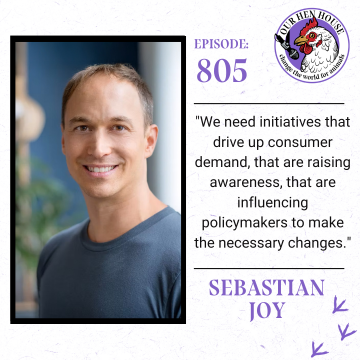
Sebastian Joy is a globally respected changemaker and serial social entrepreneur. He is the founder of Kickstarting For Good, a groundbreaking incubator for nonprofits, which helps impact entrepreneurs working to fix our broken food system.
Having had a lifelong passion for creating high-impact initiatives, Sebastian spent two decades at the forefront of the food-change movement as the founding president of ProVeg International, one of the world’s leading food awareness organisations. Under his leadership, ProVeg expanded into more than a dozen countries with over 200 employees, worked with governments and corporations to shift food systems, and launched countless initiatives that have influenced millions of meals and helped shape global food policy.
Sebastian is known for both his strategic vision and for building cross-sector bridges – from public institutions and corporations, to grassroots communities and fellow NGOs. He was a lecturer in social entrepreneurship at the Berlin School of Economics and Law, and is a regular speaker at international conferences on sustainability, food innovation, and systems change.
Supported by a hand-picked team of experts from the movement, Sebastian is now channeling his decades of experience and relentless energy into mentoring and launching the next wave of mission-driven charity entrepreneurs. He currently lives in Berlin, Germany, with his wife Melanie Joy, a celebrated psychologist, author, and founder of Beyond Carnism.
INTERVIEW TRANSCRIPT
[00:00:00] Jasmin Singer: Welcome to Our Hen House.
I'm Jasmin Singer.
[00:00:03] Mariann Sullivan: I'm Mariann Sullivan.
[00:00:05] Sebastian Joy: And I'm Sebastian Joy.
[00:00:06] Jasmin Singer: Yes. That was awesome. Let's keep that, that was so good. Sebastian. first of all, thank you for joining us, we're big fans of your work. Sebastian Joy is a globally respected change maker and serial social entrepreneur who founded Kickstarting for Good, an innovative incubator helping impact entrepreneurs transform our food system. Following his two decade leadership of Pro Veg International, which expanded to over a dozen countries under his guidance.
Wow, that's amazing. A former lecturer in social entrepreneurship and regular speaker at International conferences, Sebastian is now dedicated to mentoring the next generation of charity entrepreneurs, combining his strategic vision and talent for building cross-sector partnerships to create lasting systemic change.
First of all, there's so many things in there I'm curious about, but I just wanna touch on that mentorship thing for a moment because I think that that is such an incredible gift that, I'll just say activists of a certain age, and you know, I'm calling myself that, I'm 45, so I mean anyone over 40 I'll say, just kind of being a mentor to younger activists.
It's such an empowering, emboldening thing to do. What's your relationship like with mentorship? Tell me more.
[00:01:24] Sebastian Joy: Yeah, no, I just really love giving all the experiences back to the next generation. There's this saying that I've learned a lot from the mistakes people have made who took my advice. So, you know, having done that for a number of years, I've learned a lot and I think now it's just really, yeah.
Very inspiring to tell the next generation of change makers how to make it better than we did before.
[00:01:46] Mariann Sullivan: Yeah, and there's lots to be done that hasn't been done yet, and you're most well known, of course, as Jasmin pointed out in your bio, as the founder and longtime president of ProVeg, which has had an enormous influence on the movement worldwide. But today we're gonna be talking to you about this new or relatively new venture, Kickstarting for Good. Can we just start off with just a brief description of what Kickstarting's mission and strategy are, and then we'll get into details?
[00:02:12] Sebastian Joy: Yeah. So Kickstarting For Good is the world's first incubation acceleration program that helps impact entrepreneurs start new nonprofits or impact initiatives working to transform the global food system. So that's basically to reduce and replace the numbers of animals that are being eaten.
We've actually had at ProVeg International, the ProVeg incubator for about seven years, and that has been a for-profit incubation program. So we've helped incubate over a hundred startups, you know, typical alt protein startups that have raised collectively over $500 million so far. But then we also recognize that there's much need for more nonprofits and other, what we call impact initiatives to basically complete the ecosystem as a whole. Because, you know, as we've seen before, companies like Impossible or Beyond Meat or whatever, as important as they are, they alone don't suffice to create a more plant-based world.
[00:03:09] Jasmin Singer: I mean that number was astonishing. How much did you say? 500. What did you.
[00:03:13] Sebastian Joy: Uh, 500 million. I mean, that's basically in investment capital that they have raised.
[00:03:17] Jasmin Singer: Yes. that's just phenomenal.
[00:03:19] Mariann Sullivan: I feel like a few years ago, we really did think, and The Good Food Institute has based its philosophy on the idea that we did just have to come up with the meat substitutes. But what you're saying is that either you've always thought there needed to be more, or as the movement has grown and developed, you've seen this new opening that it's not just making the food. something more is needed. And of course, charitites have always been there, but you want them to get bigger and better.
[00:03:43] Sebastian Joy: Yes, exactly. I think it's basically, I think the pendulum has swung both ways in the last 20 years. Obviously the movement started off as, you know, being very much charity driven. You know, I started off at PETA and other animal charities that were pushing the envelope.
And then maybe like 10 years ago, there was more hype around alternative proteins. You know, we all remember when Beyond Meat had their big IPO, which was the biggest in history, and everybody was thinking, oh my God, that's gonna be the solution. And it's actually often the case in social movements that it's often started by nonprofits and then the for-profit companies take over.
Like if you think about, you know, electric vehicles, initially it was only the idealists who pushed for electric vehicles, but then it became a much bigger industry. And now probably nonprofits are not that important anymore when it comes to popularizing electric vehicles. So I think a lot of people thought also in the vegan movement, that would be the case.
But, you know, given that a lot of the alt proteins companies have been struggling in the last, last few years, they actually also have been pointing out it's probably not enough to only have these companies. We need more initiatives that drive up consumer demand that are, you know, raising awareness that are influencing policy makers to make the necessary changes and all of that.
So that's basically what we have been doing.
[00:05:01] Jasmin Singer: Can you tell us your thoughts on what you call the three pillars of successful nonprofits and how they work together?
[00:05:10] Sebastian Joy: Yeah, like what we say at Kickstarting for Good, our philosophy is basically what we call the V, we built these triangles and they usually consist of having a very impactful idea, identifying great talent to actually implement those ideas and then connecting them with the necessary funders to basically get started and really make the initiative a success.
[00:05:31] Jasmin Singer: Hmm.
[00:05:32] Mariann Sullivan: Yeah., I really love the as it was pointed out, I guess on your website, talking about the three pillars being idea, funding, and talent. And it said, if you can gather two outta the three, the third will follow. And at first I didn't understand. I was like, well, which two?
And then it occurred to me that any two, like if you can come up with two you get the third one.
[00:05:49] Sebastian Joy: Exactly. Yes.
[00:05:53] Jasmin Singer: So tell us more about the successes.
Tell us about of Kickstarting's success stories and, and maybe some you have high hopes for.
[00:06:01] Sebastian Joy: Well, obviously, you know, we've just discussed that we are gonna meet at the AVA Summit, you know, at the big conference. So that's something that we have launched a little over two years ago. So obviously, you know, I have been going to the US Animal Rights Conference for quite a while, but, you know, people have been, you know, getting increasingly unhappy with it.
And then, you know, also when Covid hit, the event ceases to exist and lots of people have said, oh my God, it would be great to have such a conference again. And at the same time, you know, I was thinking it would also be good to have like even a global event series because obviously the Animal Rights conference in the US was always very focused on North America.
So, you know, I basically spoke with a former employee of ProVeg who I was still in contact with, like Julia Reinelt, who's now leading the AVA Summit and basically spoke to her 'cause she had already organized events for ProVeg before, but then she took a job in the corporate world, but she wanted to come back to the movement.
So I basically had a few conversations with her and convinced her that would be a great opportunity to actually launch this new event series that we had conceptualized also together with Michael Weberman, who has been involved in the Animal Rights conference before.
We also did like a survey amongst, I think over a hundred stakeholders within the movement. Like, what kind of conference they envisioned. We also spoke to some funders and then, you know, basically in the end we announced the date. We came up with a name, you know, we called it the Animal and Vegan Advocacy Summit, you know, short AVA Summit or some people also called it AVA, usually say Ava Summit.
And yeah, and then in beginning it wasn't really clear how many people would actually come, but you know, we pulled some strings and we were able to convince Peter Singer to give the keynote address, which got, you know, more and more people excited.
And yeah, the first event was already quite successful. We still had a significant financial loss in the very first year. But still people really like the event. So it actually has been growing ever since. And now they actually have expanded to Latin America. So they had an event in Brazil.
They had several events in Asia. They are going to have one in actually Africa for the first year. And they even, you know, now playing with the idea to have another one in Europe. So basically within, you know, less than two and a half years that event series has grown to, I think roughly 2000 global participants from 50 different countries.
I think their revenue is at over $2 million per year now. So yeah, it has been actually, you know, very successful and you know, people really love it and you know, people obviously in the movement like it, and it's kind of like it has become the place to be. And yeah, we are very happy about how that all unfolded.
[00:08:33] Mariann Sullivan: I'm really excited about the AVA conference and sadly, I'm not going to be there, so I don't know why I'm excited, but Jasmin's gonna be there And lots of people are gonna be there and I'm gonna hear all about it, as is everybody. 'cause Jasmin will be reporting on it to our audience. And I had no idea it was that big.
I mean that the whole conglomeration of conferences that it encompasses was that big. It is very exciting 'cause I think it's so important for people to meet each other. I think it really important part of my becoming an activist that I was able to go to those early animal rights. As flawed as they may have been, they really meant a lot to me. I'll never forget the first time I went to one. And you're in a, this huge room or huge stadium, it was at the time. And everybody there gets it. There's just nothing like that for animal activists, I think in particular, to feel that you have, you know, found your people. But of course that is one of the projects of Kickstarting for Good, but I mean, there's a whole host of other things and on many continents. So, I know it's a big question, but can you just pick out a few and tell us a few other projects that you have been helping people with?
[00:09:39] Sebastian Joy: Yes. I mean, maybe I can also share a few from the earlier stages when we got started, like with ProVeg, 'cause that's actually what set me on this trajectory where I really realized that, you know, maybe that's something that I'm meant to be. So basically, I became vegan and also started to become an activist about 20 years ago.
And, you know, I started off being at, a year at PETA. I did a traineeship there and then I decided to, you know, get a master's in nonprofit management. So I did that. I worked a bit at a global consultancy company, you know, one of the bigger ones, but then just got more passionate about really dedicating my life to animal rights and transforming the global food system.
And there was this very small organization called, you know, basically the, the German Vegetarian Society, which had already been around for a hundred years, but they had like a staff of 2.5 people. And, I basically had to consult them as part of my studies. I got a master's in nonprofit management and as part of that, you know, we were able to pick a charity to help them, you know, professionalize. So I was working with this German Veg society, which was very, very old fashioned as many of these societies are. But they were open to modernizing and then they basically asked me if I wouldn't come on board, you know, join their board.
And eventually I became their CEO, which sounds kind of fancy, but you know, if you have a staff of 2.5, it's not much of a CEO role. So I basically had to, to do a lot of myself and yeah, then we basically started to grow, but we didn't have much budget, you know, there was really not much to do, so we always had to come up with ideas that wouldn't cost any money.
So, one idea we had is, wouldn't it be great if, I mean, we were organizing things like VegFest and stuff like that, but we also thought about, you know, professionalizing that. So the idea was could we maybe create something like a trade show, like a consumer trade show for the vegan movement?
We spoke to a few companies and initially they were not really interested because they said, oh, there are all the other consumer shows out there. But we thought we were really onto something. So we reached out to a number of trade show organizers and, you know, one of them was actually really interested.
So then they launched this, what was called Veggie World. So that's basically like a, you know, a consumer face... I think in the US you have the, what you call the um, Plant-based World Expo or what's it called? The, the New York event. So we already did that as like, you know, kinda like 15 years ago, I think the first one we had, I think in 2010 or something like that.
And yeah, lo and behold we got tons of media. I mean the first one was really tiny, I think we had 20 companies, which is ridiculously small for, for a trade show. But we got, you know, there was some controversies around it and then the national media showed up and anyway, so we have been growing ever since.
And then, eventually that event series grew up to 19 locations. So literally we had in, in London, in Paris, in Warsaw, even several events in China. So that has become quite a global powerhouse. I mean, obviously with covid it had to downsize again. So that was a bit unfortunate, but it became like really, really like a very powerful event here.
So somewhat similar with the AVA Summit, but more on a, on a consumer and more of a product featuring perspective. But there were also stages and we actually, as an organization, we didn't have to put in any money because, you know, we also didn't have any money. But it, you know, grew into this really big powerhouse.
So that's actually, I think when I started to realize, hey, maybe that's an interesting way to actually create change in society. And then there was another example. So, back in the days, like 15 years ago, vitamin B12 was still kind of like a a bit of an issue within the vegan movement because especially in, in yoga, people are more reluctant to taking pills.
Like if you say, Hey, I'm on a healthy diet, and then people, oh, what do you do? You know, oh, I, I take, you know, supplements for vitamin B12. So that's something, you know, that was a bit frowned upon. And also I have ADHD, so I'm easily tend to forget things, so I would also often, often forget to actually take my vitamin B12 pills.
But, when I would take them, it would say on the package that you should actually leave it under your tongue because the B12 is actually being absorbed through your mucus membrane. So one day I was brushing my teeth in the morning and I thought, oh, I actually have a lot of toothpaste in my whole mouth.
And I, I thought about, oh, I probably need to take my B12 pills soon. So then I had the idea, Hey, what about if we put actually vitamin B12 in toothpaste? Then I wouldn't have to remember taking my pills and, you know, every, you know, usually people.
[00:14:05] Mariann Sullivan: This is such a good idea.
[00:14:06] Sebastian Joy: Yeah. So, so that was an idea.
And so I shared that idea with a number of people who said that that's a crazy idea. Like, why would that work? Like, you know, if that would work, many others people would've done it. But anyway, I did some more research and, you know, more and more information emerged. This actually could work. So again, similar like what we had done with that trade show event, we reached out to a number of toothpaste companies and were like, you know, we were a tiny organization back then, but, you know, they did not necessarily know that. And basically making a case why this is like the next big thing to actually fortify toothpaste with vitamin B12. And lo and behold, you know, again, we got a couple of companies reaching out to us, quite interested. And then actually we developed a toothpaste with vitamin B12. Again, like we didn't have to put in any money because we also didn't have any money, but we were able to, to make it happen. Actually, interestingly, obviously we also wanted to do a study to show if the toothpaste actually works, but it's like, it's quite expensive to run a study with all the tests, like a really clinical study.
And know, and usually when you have people participate in the studies, people get paid to participate in a study. But we try to turn this around and saying, Hey, we have this extremely innovative product, but it can only come to market if we have enough proof. So we actually found several hundred vegans who were.
Who were willing to actually pay their own kind of like lab testing to, to participate in the study and only with that, we were actually able to get the study off the ground and there were several peer reviewed papers who were published in journals and showing actually that the toothpaste works.
And that's then, you know, led to the success that it has. And it's been selling in Europe ever since.
[00:15:45] Jasmin Singer: That's amazing. I need to get that too, by the way.
Okay. So let's imagine that I have an amazing idea that will change the world.
[00:15:55] Sebastian Joy: Yes.
[00:15:56] Jasmin Singer: I want to know what your best advice is about how that idea can attract funding. And let me just tell you that I want to create, pockets for women's clothes that all you have to do, like the pocket has, like fabric glue on it so you don't have to know how to sew.
'cause I don't know how to sew. And it just comes in a pack of two pockets and you just put it on the clothes and bam, you have pockets. I know it's a terrible idea, but let's pretend it's a good idea.
[00:16:27] Sebastian Joy: Well, this is actually really funny 'cause I mean, my wife Melanie, she always complains why women clothes don't come with pockets.
[00:16:32] Jasmin Singer: Exactly.
[00:16:33] Sebastian Joy: So.
[00:16:33] Jasmin Singer: I, I try to go out of my way to only get things with pockets, but I was shopping at the Goodwill the other day and like there was a cute cobalt blue dress. I look very good in cobalt. I'm just telling all of our listeners and viewers, it's my color and no pockets. So I was thinking, what if it was like cute, like cute patterns?
You pop it on. By the way, small little shout out to the Pockets Project, which is a very small boutique clothing company. So let's say I have an amazing idea that's gonna change the world.
[00:17:03] Mariann Sullivan: But It's a charitable idea, it's not a business.
[00:17:05] Jasmin Singer: Alright. Okay.
[00:17:06] Sebastian Joy: We can talk later.
[00:17:07] Jasmin Singer: Okay. Okay. Okay. What is your best advice about how that idea can attract funding?
By the way, you could put brochures in the pockets, Mariann, you could put like say no to veal brochures in the pockets. It's activism.
And so what about someone who's listening to this, who actually has a, a good idea?
[00:17:25] Mariann Sullivan: But an idea for a charity. They're hearing right now about Kickstarting for Good. It's helping charities get going. I have an amazing idea for a charity. How do I hook up with them? Or what is it that they can tell me? And I think you actually have an upcoming program for people?
[00:17:41] Sebastian Joy: Yes, exactly. So basically the reason we have created Kickstarting for Good is to make it easier for people to create new, impactful charities or other kind of initiatives. So we have an incubation program. We have it once a year, it goes for about 15 weeks. And, we basically help people to really, you know, refine the idea, to maybe develop what we call a minimal viable product. To develop like a pitch towards funders or other stakeholders that they wanna engage in. Obviously a lot is about vetting the ideas 'cause you know, I always say, I have lots of ideas and many people have lots of ideas, but usually 99% of the ideas that we have are not really worthwhile pursuing.
So a lot is actually also about identifying what makes a really good idea, that makes it really worthwhile, that it actually should receive the funding that it needs to come into fruition.
[00:18:28] Mariann Sullivan: And what would be an example of the kind of, I mean, in the Kickstarting program,
[00:18:33] Sebastian Joy: Mm-hmm.
[00:18:33] Mariann Sullivan: the kind of, or one that's already happened, or one that you've heard about that you're intrigued by, that might be coming up?
[00:18:39] Sebastian Joy: Mm-hmm.
[00:18:40] Mariann Sullivan: Somebody has this new idea for a new charitable endeavor and really doesn't know how to get started, but thinks it's a great idea.
What would be an example of something that you would look at and say, yeah, that is a pretty good idea! One that's happened that you have funded or one that you are hoping you will fund?
[00:18:56] Sebastian Joy: Yeah, I mean there are a number of examples, you know, initiatives that we have launched. One is what's called the Farm Adaptation Network. So that's basically people who wanna help farmers transition to move away from animal agriculture to plant-based products. Obviously there are already some of those initiatives around, you know, like Transfarmation Project or you know, certain of these project. But that's basically like a more international version of a network that is creating blueprints about how on the one hand, how farms can transition, but also how to do the necessary policy change to make that happen.
So that's, for example, one of the examples. Another one is what we had in our first cohort. It's Reporters for Animals International. And they have been founded by two people who have been doing a lot of, you know, animal investigations. Like, you know, for example, like undercover investigations who are going into CAFOs taking pictures and leaking them to the media or working with nonprofits and they recognize that there are
several hundred of these, you know, investigative journalists all over the world, these, you know, animal investigators, but they don't really have a support network. So when it comes to, oh, how do you get the best media attention? Or how do you find, you know, customers in terms of, you know, nonprofits who wanna pay you to do that kind of work, or how do you attract the best funding?
What's the best technical equipment you're using? You know, sometimes you know these people, they go at night, they need night vision goggles, they need security cameras or whatever. So they basically created like this network that is now supporting these, you know, investigative journalists all over the world.
They have an event series because obviously it's a very special need. Like, for example, these people, you know, if they go to the AVA Summit, it's not really fulfilling their needs because, you know, there's not that many topics that literally talk about investigations on factory farms.
So that's, for example, like this, uh, this important network. Mm-hmm.
[00:20:50] Mariann Sullivan: That makes so much sense. And these, I mean, these are people who do such hard things and it's such isolating work. The idea of, of networking them in any way. I mean, not just to improve the value of their product, but to keep them sane. It seems very vital. I'm interested too, in the farming transition that was listed as one of your,
[00:21:07] Sebastian Joy: Mm-hmm.
[00:21:08] Mariann Sullivan: areas. And I feel like, from what I've heard, the ones that have been started have ended up being very, very prohibitively expensive, or at least some of them have. Is there anybody working on some way of helping farmers transition that can actually scale and isn't going to be just a matter of investing, you know, money that probably won't be available forever in helping individual farmers? I, I don't know exactly what my question is, but I think it's such an important, vital part of this movement. And from what I've heard, it's really, really difficult.
[00:21:38] Sebastian Joy: Yes, that's definitely true. And I think as a lot of the examples that have done before, it's more like, you know, often on a very small scale. It's not necessarily financially sustainable. Like, you know, I don't know if people say that they had a farm and they turned it into a farm sanctuary, that is now, you know, living off donations, you know, that's not something that we can scale on a global level. So, yeah. So one idea of the farm adaptation network is also to work with policy makers because, you know, we recognize usually people are very fond of farmers, governments put a lot of subsidies into supporting farmers. And there are some examples, like especially in Europe where governments have stepped in, for example, if farmers wanted to transition from conventional agriculture to organic agriculture, you know, because they recognize, hey, this needs to be subsidized. So we are quite hopeful that we are able to, you know, work with governments to support the transition for farmers, from animal farms to plant-based farms.
Like for example, the Danish government, they recently launched this plant-based action plan where they had dedicated, I think at this point it's a hundred million euros or dollars that they wanna dedicate to, you know, help society shift towards becoming more plant-based. And a significant part of that is dedicated to go to farmers.
So yes, it's very much about finding out how exactly we can make it economically viable. And what exactly would be the models, like, you know, which farmers should be transitioning from what kind of animal farms to what kind of plant-based farming?
[00:23:06] Mariann Sullivan: Yeah, that just seems so powerful. I love to hear about that.
I mean, right now, as you may have heard, we're a little concerned about our governmental involvement in anything here in this country, but I had heard something about that Danish program, and especially since Danish has such a powerful pig industry, I love to hear that that sort of thing is happening and that there actually is support for those transitions because it is the kind of thing that just needs governmental support. That's a big project. All right. Another word that, and that I saw in your list of areas that you're interested in is meta fundraising, and I wanted to ask you about it 'cause I have no idea what that means.
[00:23:42] Sebastian Joy: Well, meta fundraising basically means how can we raise more money for our movement as a whole? So it's meta in the sense that it's not only about, you know, one organization trying to raise money for itself, but how can we maybe think a bit bigger and raise money for the movement as a whole?
[00:24:01] Mariann Sullivan: Yeah, it's kind of like the way, um, I dunno whether you agree, but I don't know. 10, 15 years ago, I did not see effective altruism coming and that has brought,
just unbelievable amounts of money into this movement because those are people who, looked at it kind of from a different direction and saw the same things and, and actually brought a lot of funding in.
[00:24:20] Sebastian Joy: Yes, exactly. I think the EA movement has been fairly successful in establishing several, you know, meta fundraising entities that are now being able to raise money for the movement as a whole. Like for example, like in Germany, also in other countries, there're these effective giving platforms or nonprofits that are literally just, you know, saying that they advise people who want to donate about how to donate effectively.
And one of their usually core, you know, one of their offers is animal charities that are seen as being high impactful and they were able to raise, you know, 10 millions of euro so far that have been going to our movement.
[00:24:55] Mariann Sullivan: We've been talking to people about artificial intelligence, but the conversations have been... we haven't gotten into it deeply, and conversations have been kind of like fears of it, you know, the many harms that could occur to animals and, and also how it's kind of animals are being overlooked
[00:25:09] Sebastian Joy: Mm-hmm.
[00:25:10] Mariann Sullivan: you know, worrying about AI intelligence.
It's like, hello, there's other intelligent beings here. But you are, the way you put it down as one of your goals is that artificial intelligence has potential to be improving advocacy. How do you see the future there?
[00:25:27] Sebastian Joy: Yeah, so we actually incubated two AI nonprofits. So in the first year, like, you know, 2023, we incubated Open Paws. It's an organization founded by Sam Tucker, and he's now helping a lot of other charities to implement, you know, how to utilize AI to just become more effective, you know, like, I don't know, doing some automated outreach or helping nonprofits to integrate AI into their work stream so that they can, you know, do the work that they're doing in a more impactful and cost effective way. And another, another organization that we just launched a few months ago, helped launch, it's Electric Sheep, and they have also like a fellowship program and a boot.
And, and a bootcamp, where people who are maybe interested in AI but maybe not so much interested in animals yet, or the other way around, that they can actually learn how, you know, really get up to speed about how to utilize ai for the good of animals. And also how can we have an influence on the big AI development researchers or labs to also consider taking animals seriously.
Because if you actually look a lot into the mission statements of these big AI labs, they say, oh, we want AI to be serving all humanity. Instead of actually saying that they wanted to serve all sentient beings, which is obviously quite a big difference. Um,
[00:26:47] Jasmin Singer: Mm. Mm-hmm.
[00:26:48] Mariann Sullivan: Yeah, so you are looking at AI from a bunch of different directions,
[00:26:51] Sebastian Joy: yes.
[00:26:52] Mariann Sullivan: mean, obviously it's hugely important and it would be nice to get ahead of it. Yeah.
[00:26:57] Jasmin Singer: You kind of started touching on some possible harms from ai. Does that concern you?
[00:27:03] Sebastian Joy: Yeah, definitely. I mean, there's so many ways this can go in, in different directions and I think, yes, I guess, you know, whether it's just people with lots of powers, you know, the incumbent or meat industry, just utilizing it to, you know, basically, further their own agenda, or automating certain systems that are not really helping animals.
So there are many ways this can go, you know, quite badly for our cause, but obviously there's also lots of great opportunities. So I think it's really important that we really stay ahead of this recent development. I mean, you know, some people like say that's, you know, similar to when the internet was invented or social media became popular. I think it has been, you know, proven quite important for our movement to be on top of these things and really, you know, be out there and communicate about our cause. And I think AI is no different in that sense.
[00:27:50] Jasmin Singer: And what about social media? Because speaking in terms of like communicating effectively or, you know, really seizing a trend, seizing an opportunity to help animals, social media is certainly, it could be something that we do terribly wrong, or it could be something that can change the world.
What are your thoughts on social media and how we can use it to help animals?
[00:28:13] Mariann Sullivan: Now that we have leaped into the future and are on YouTube!.
[00:28:14] Jasmin Singer: We're, yeah. Welcome to 2011.
[00:28:19] Mariann Sullivan: We're trying! So who else is trying?
[00:28:23] Sebastian Joy: No, I think that's, that's a very good point. And actually one idea that we are exploring for this year is, like a conference series and a training academy for content creator, like, you know, basically people who are using social media professionally because there are, as we know, thousands and thousands of vegan and plant-based content creators and social media influencers out there.
But often they're not really connected. Often they're not really, you know, they might maybe be using approaches that are actually creating, more harm than good because, you know, that's often how the algorithm works. And so I think the idea is to create a training academy for existing and aspiring content creators.
Just that they become more impactful, better connected, that they support each other. And this could be, you know, become maybe similar to the AVA Summit, like a global event series that's active, in many parts of the world because obviously social media is a global phenomenon. So I think, you know, if we can basically increase our effectiveness in that area, I think that could be widely important.
And I think actually we have lost a lot of ground. I mean, I remember, I think when social media became popular, I think a lot of vegan activists and advocates were extremely successful, but it seems that the pendulum has swung a bit back and it's a bit more like the, you know, people who are maybe more pushing keto diet or carnivore diets or all of that.
I think they have actually gained a lot of ground. So I think it's really important for us as a movement to, you know, get back into the game and start winning again in that arena.
[00:29:50] Jasmin Singer: Do you follow the Korean Vegan on social?
[00:29:54] Sebastian Joy: No, not, no.
[00:29:55] Jasmin Singer: You gotta do. That's your homework.
[00:29:58] Mariann Sullivan: You know, I don't either, is she the best?
[00:30:01] Jasmin Singer: Just amazing.
Marianne and I sort of struggle, but not really, with the fact that we're not foodies at all. Like, you know, we frequently talk about the fact that Our Hen House is not like, it's not a vegan podcast.
Sure. We're of course we're vegan. Our guests are vegan, but it's an animal activism podcast. And I think that on social, like 90, I'm making up this stat completely, but 98% of the influencers in this space are talking about food. And obviously food is what people first associate with veganism.
When you talk about veganism, they're not necessarily thinking about the reason why. I mean, you just brought up keto and paleo and whatnot. And, you know, that's tough. I mean, how... I don't expect you to have the answer to this, Sebastian, but how do you move beyond food and advocate for animals using social media in a way that isn't just giving people trauma from showing horrible videos? I don't know if you have any thoughts on that. And I know I'm once again going a little off topic, but it's your fault 'cause you made me think of it.
[00:31:02] Sebastian Joy: Well, it's, it's actually a good point, and I think our level is usually to try to stay one level higher than that. So I think it's not, you know, I don't see it as my job to kind of like identify the best strategies in that regard. I mean, obviously I'm, I'm happy to share my opinion, but I don't think I'm super qualified in that regard.
But I think that, like for example, when you mentioned like there's this Korean Vegan, cause there are amazing content creators and influencers out there, and I think it's really important to create some kind of entity that can identify these amazing people and then maybe replicate their success stories in, you know, whatever their approach is in many other countries.
So like, you know, there are. You know, you know around 200 countries in the whole world and there are amazing people all over the place. And I think if we are able as a movement to always identify something that really works well and then, spread this kind of information in different markets, I think that can be extremely powerful.
And, you know, 'cause there are people who are being very creative in terms of getting lots of attention by maybe having ethical arguments in a funny way. Or, you know, like we had this one participant from our last cohort. She's from Sia-pu vegan, so it's like a, a nonprofit based out of China, Shanghai.
And, you know, obviously communication is a bit more restricted in China in terms of, you know, the social media, but what they did actually is they started a debate society where they have different topics around veganism that are publicly being debated and then being put online because, you know, if anything is framed as a debate, it's quite easy in China to still get lots of attention because you know, you can say way more things if it's actually part of a public debate, and that's actually their way of really getting the message out there and getting million of views.
[00:32:49] Jasmin Singer: I realize I, I left the Korean Vegan thing hanging. I just wanted to say what Joanne, who runs it does, is she uses stories from her life and from her family members, her ancestors. And as she's talking about them in this beau, she's just a beautiful orator, right? She, she's making a sandwich. Like, you wouldn't think these two things go together and, and yet it's just like,
[00:33:12] Mariann Sullivan: And she probably is the most successful vegan, at least in the States.
These are all such fascinating ideas and it occurs to me that Pro Veg has really just become an organization, I mean, pro Veg being the parent organization of Kickstarting for Good, that has a global reach, that is deliberately sought to have this global reach so that we can learn from each other. I've, I've always kind of thought that we're kind of a nation unto ourselves. You know, like drops yourself down anywhere in the world and you'll find somebody who gets it about animals. Probably only one person, unfortunately. But there'll be one person. I mean, we're everywhere. And there's, the idea of bringing us all together in these ways is so powerful. And there's definitely more topics that I wanna ask you about, might have to wait for bonus ' cause what I really wanna get into is, there's, you have an upcoming accelerator. You're both an incubator and an accelerator, I
[00:34:03] Sebastian Joy: Mm-hmm.
[00:34:03] Mariann Sullivan: right?
[00:34:04] Sebastian Joy: Mm-hmm.
[00:34:04] Mariann Sullivan: Both people who have an idea and also people who have already started but need some help getting going,
[00:34:10] Sebastian Joy: Mm-hmm.
[00:34:10] Mariann Sullivan: You have a program coming up, can you just kind of walk us through like what it's like to be a participant?
[00:34:16] Sebastian Joy: Yes. So we have the Kickstarting for Good incubation program for people who want to work on, you know, food system transformation. Applications are still open until May 23rd, so I think that's a few days after that episode drops. Please be quick and apply. If you're a few days late, you know, please just shoot us an email, but otherwise we'll have a program coming up the next year. And so the program, you know, as I mentioned, it's around 15 weeks long. Most of the program happens virtually, you know, people can work from home. We require that people spend around 20 hours per week, so that means they can still have a normal job if they, you know, can work on the weekends and in the evening. So that's important to us because not everybody's maybe ready to give up their job immediately if they don't even know if it's going to work.
And then we fly people into Berlin in early September. So they come to Berlin for one week and then, you know, the whole cohort meets, it's probably, it's going to be between 20 and 25 people who are all working on, you know, various ideas. Then we spend one week in Berlin. And then we also try to match people 'cause we have found it's often good if there are at least two people who are working on an idea. So if two people maybe have a somewhat similar idea, like for example, oh, we wanna support social media influencers or content creators, or I want to work on, I don't know, AIs for animals. So, you know, we, we try to match the co-founders together and then they're basically like, you know, as a team, working on a certain idea. And, and that's basically what we call an initiative. So if we have the teams combined with the idea, it's what we call an initiative, then we have a mid program review.
So that's basically decides who makes it into the second half of the program because you know, only if the idea is ripe enough to actually really be able to, you know, launch and being able to pitch for funding makes sense to commit. So, so that's gonna happen in early October, and then people come back for another five, six days in Berlin in November.
And then actually, you know, we teach them a lot about fundraising, about, you know, how to set up their website, how to do all that. And then the final day is a pitch day. So where they basically get in front of a lot of funders and foundations and basically present all the work that they have done.
You know, this is exactly what we plan to do. This is the research that we have done. This is the minimum viable product that we have developed. This is how we will know whether we will be successful. This is our theory of change. Our mission and vision, and this is why we are the best people to basically implement this.
[00:36:49] Mariann Sullivan: Oh, I
[00:36:50] Jasmin Singer: That's so cool.
[00:36:52] Sebastian Joy: Yeah. Thank you.
[00:36:52] Mariann Sullivan: What language is everything in? Is it in English
[00:36:56] Sebastian Joy: Yeah. Yeah, it's, yeah, everything is in English and it, yeah, it's quite an amazing experience. I mean, you can see some videos on our website, kickstartingforgood.org, where past participants have spoken about it. I think it's just that, all the support that we provide. We have over 40 mentors, you know.
Lots of movers and shakers from the vegan movement, from, you know, Dr. Michael Gregor to Tobias Leonard, the author of, you Know, How to Create a Vegan World, to my wife, Melanie Joy, you know, Bruce Friedrich and many others who have been in the movement for a long, long time who are willing to spend some of their time mentoring, you know, our participants. It's also quite amazing just to be in the same room with so many other people who are mission aligned and eager to start a new initiative or nonprofit. Because obviously often it's a very lonely process and there are many challenges that comes with it.
How do I register a 501? Or, you know, how do I raise my first money? Or how do I hire my first staffer or I dunno. Interpersonal issues if maybe the two co-founders have different personalities, how do you navigate that? How do you maybe start small? Like, you know, we generally encourage people not to come up with a $500,000 starting budget, but how can they actually create something with, you know, a much smaller budget, but then show traction and see, hey, this is really much needed, so that actually then, you know, they can raise more money later down the line.
[00:38:22] Jasmin Singer: Mm-hmm.
[00:38:23] Mariann Sullivan: great. It's so much great strategy and I just love the idea of the people getting together. There's so much,
Creating
that synergy is so powerful, and I mean, this may be obvious to people, but I think we should say, I mean, these, these trips to Berlin are funded.
[00:38:37] Sebastian Joy: Yes, exactly. Yeah. So yeah, so we have provided stipend. Yeah, we cover the flight costs and hotel accommodations. So yeah, people don't have to pay anything that week out.
[00:38:46] Mariann Sullivan: So Sebastian, are you the reason that the food in in Berlin is so good?
[00:38:51] Sebastian Joy: Uh, well, I, tried to do my share, but I think we have have a lot of amazing vegan activists for many decades in Berlin who have really helped make that.,
[00:39:00] Mariann Sullivan: It is excellent, excellent food. I was in Berlin a couple of years ago. I was just, on a different level.
[00:39:05] Jasmin Singer: I am going to go to Berlin for my 50th, which is in four and a half years.
[00:39:12] Sebastian Joy: Oh, nice.
[00:39:13] Jasmin Singer: up. I have like a hundred dollars saved up so far, so I'm,
[00:39:15] Sebastian Joy: Okay,
[00:39:16] Jasmin Singer: I'm well on my way, but I am very excited, uh, to, because yeah, I've only
[00:39:22] Sebastian Joy: Well you can apply Kickstarting for Good and then maybe we, we pay your ticket and accommodation to come.
[00:39:27] Jasmin Singer: That sounds perfect. That's a great, that's a win-win. I've only ever had a layover in Berlin, and as Mariann knows, because we were on our way to Basel, there was a key chain at the airport in Berlin that said Jasmin, and it was spelled the way I spell it, which has no e and the, it's, it's extremely unusual to spell it with no E here, but apparently that's how you spell it in Germany.
[00:39:48] Sebastian Joy: Yes.
[00:39:49] Jasmin Singer: so. I just wanna go back to, I mean, you know, food is fine, but I want the, I want to get more of those key chains basically.
[00:39:57] Mariann Sullivan: I don't actually remember this.
[00:39:59] Jasmin Singer: Okay.
[00:40:00] Mariann Sullivan: as much of an impact on me.
[00:40:01] Jasmin Singer: I had a friend, our friend Lydia, who was actually having a layover in Berlin, and I asked her to go look around the air. She, she texted me from the airport. She's like, I don't see it.
Oh, well. Anyway, so Sebastian, can you please reiterate for our listeners and our viewers, how people can find you online and support your efforts?
[00:40:21] Sebastian Joy: Yes, our website is kickstartingforgood.org, so, you know, very, very easy. And I'm, I'm also quite active on LinkedIn, so if people wanna find me Sebastian Joy, I'm always happy to connect on LinkedIn there as well. We have obviously also have a LinkedIn channel with Kickstarting for Good, where we keep people updated.
We have a newsletter where we know always talk about our alumnis, what's coming up, and you know how much success they've had, how much money they have raised. And you know how to get engaged with the community as a whole.
[00:40:49] Jasmin Singer: Wonderful. Well this is super inspiring. I love the energy that you bring to everything you do, and I also really appreciate how much you're just planting seeds everywhere because you're giving all of these people their own handfuls of seeds, and then they're planting a billion seeds, and it's very cool.
It's super cool to be chatting with you, Sebastian, thank you so much for joining us today on Our Hen House.
[00:41:11] Sebastian Joy: Of course. Thank you so much being here.
[00:41:14] Mariann Sullivan: And everyone, thanks to you for joining us today. And remember to subscribe on YouTube if you're watching us on YouTube. And if you don't watch us on YouTube, subscribe on YouTube anyway, because we need people to subscribe on YouTube. Hit the like button.
And, you know, if you would like to support us, we would love that. Just go to ourhenhouse.org/support.
_____________________________________________

Thank you for listening to the Our Hen House podcast! If you enjoy our podcasts, believe in our mission to effectively mainstream the movement to end the exploitation of animals, find community and solace in our shows and resources, and would like to show your support for vegan indie media, please make a donation today. Our Hen House is a 501(c)(3) nonprofit organization, so it’s tax-deductible. Thank you for helping us create quality content!
Subscribe to our show on Apple Podcasts or your favorite podcatcher, and don’t forget to leave a 5-star review!
Check out Our Hen House’s other podcasts: The Animal Law Podcast, The Teaching Jasmin How to Cook Vegan Podcast, and the Antiracism in Animal Advocacy Audio Series.
Follow us on social media! You can find Our Hen House on LinkedIn, Facebook, Instagram, TikTok, Threads, or Bluesky.
The Our Hen House theme song is written and performed by Michael Harren.