 Apple Podcasts
 RSS
 Amazon Music
 Spotify
 YouTube
 PocketCasts
 CastBox
 Player.fm
 TuneIn
 Audible
 App not listed? Try this RSS link
The fearless founder of Animal Recovery Mission takes no prisoners in his quest to expose the darkest corners of animal exploitation. Richard “Kudo” Couto, a former Miami Beach real estate developer turned undercover investigator, joins us to reveal how his organization infiltrates illegal slaughterhouses, exposes factory farm abuses, and challenges corporate giants like Coca-Cola’s Fairlife. From Miami’s underground horse meat trade to dairy industry horrors, Kudo shares breaking news about ARM’s ninth Fairlife investigation and explains how his team of tough-as-nails investigators risk their lives to document animal abuse that others won’t touch.
This episode explores:
- How ARM’s investigations have led to over 1,000 felony prosecutions, targeting organized crime networks involved in illegal slaughterhouse operations
- The shocking truth behind Fairlife’s “humane” marketing claims and ARM’s ongoing legal battles with Coca-Cola
- Why ARM’s sanctuary serves as both a haven for rescued animals and rehabilitation center for investigators suffering from PTSD
- How ARM’s international work exposes animal sacrifice practices in countries like Bangladesh, Nepal and India
- The connection between masculinity and animal protection, challenging traditional notions of strength
ABOUT OUR GUEST
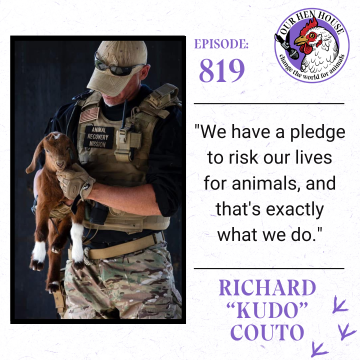
Richard “Kudo” Couto founded the Animal Recovery Mission (ARM) in 2010 after retiring from Miami Beach real estate development. As a leading undercover investigator, Kudo exposes the most violent animal abuse operations worldwide.
ARM has conducted record-breaking investigations resulting in over 1,000 felony prosecutions, including the largest dairy farm and animal agriculture investigations in history. Their work has shut down 75+ illegal slaughterhouses and numerous animal fighting operations across the globe.
An Emmy Award-winner, Kudo collaborates with the FBI, DEA, and environmental agencies to ensure justice for abused animals. His investigations have been featured in documentaries and news stories worldwide, most recently exposing Coca-Cola owned Fairlife milk’s dairy operations throughout the United States.
INTERVIEW TRANSCRIPT
[00:00:06] Mariann Sullivan: Welcome to Our Hen House. This is Mariann Sullivan and I am truly thrilled today to welcome the legendary Kudo, AKA Richard Couto and those are spelled differently of the Animal recovery mission or arm to Our Hen House.
And he, he came to animal protection from a somewhat unusual background, I think, as he founded ARM in 2010, after I see in your bio retiring from Miami Beach, real estate development. Now his undercover investigative work is legendary and known for exposing some of the most violent animal abuse operations worldwide, resulting in over a thousand felony prosecutions. including, his very, well-known investigation of Fairlife Dairy farms and a lot of.
Illegal slaughterhouses fighting operations. I did warn him not to get into too many gruesome details, but he lives with the gruesome details, so, the work he's doing is just incredibly valuable. before I get to that, I just wanna remind you, for those of you who don't know, our Hen House now has four podcasts.
Rising anxieties comes out on Tuesdays, the Hen report on Thursdays, and the long form interview, which is what we're in now on most Fridays, the Animal Law Podcast on the last Friday of the month. And, of course we're on YouTube. Please subscribe and like, But now let's get to this interview because I have really a lot of questions.
Welcome Kudo.
[00:01:28] Richard "Kudo" Couto: Thank you so much and yes, I'll, I'll keep it light. we do some violent operations, so I'll, I'll keep it on the down low a little bit for you
[00:01:35] Mariann Sullivan: I think it's an ongoing problem with, anybody interested in what's going on with animals. and one of the reasons I think that people don't know about it is 'cause they can't bear to know about it, which is ridiculous. alright. But let's just take a step back.
For those who aren't familiar with arm, can you just briefly tell us your mission and then we can get into the details?
[00:01:53] Richard "Kudo" Couto: Yeah. You know, at first our mission was just basically horse-oriented and, and illegal horse slaughter in the greater Florida, Miami area. And then we. we opened our eyes a bit, wider, and widened our scope to basically dealing with the issues that no one else will deal with, whether it's private groups. Governments. and if they are being dealt with, we will deal with 'em such as factory reform investigations, but just put a different spin on it. so we do pride ourselves on doing anything and everything a little bit differently to get a better result and a different result for the animals.
[00:02:30] Mariann Sullivan: You have been getting great results. One of the things you're really good at is getting some good press but let's, start with that horse slaughter work since, I mean, as you said, that's what you began with, and I, as I understand, it's still a pretty important part of the work that you do. I didn't know that illegal horse slaughter took place until I heard about your work, but it seems obvious that it would because horse slaughter is illegal in this country. It's expensive to ship them to Canada and Mexico. So actually it's not very surprising. But how do you find these places? They're generally pretty hidden, right?
[00:03:01] Richard "Kudo" Couto: They really are. It is, a, an underground market and world. Mainly in the state of Florida. although they are now spread out like a hand throughout the United States, and unfortunately the market for horse meat is growing now in the greater Miami area. It's something that I got into back in 2008 when I was a board member with the SPCA. When I was still a real estate developer and the underground illegal horse meat market in Miami was so incredibly number one, lucrative selling horse meat for up to $40 per pound, but also sought after. So people were eating and are today eating this meat for medicinal purposes, right? They think that it cures, blood disorders, um, certain cancers that it helps with side effects from chemotherapies. a lot of. Cuban males are actually eating horse meat for the libido, thinking that it's stronger than Viagra, which is. Part of the reason why so many people are so desperate to get their hands on this meat so desperate that they will actually break into barns in the middle of the night all over the state of Florida, and now unfortunately all over the United States.
And they'll slaughter pet horses in their stalls in the middle of the night and harvest the quote unquote edible meat. And they're selling that on the black markets from anywhere from seven to $40 per pound.
And what the engine is there is the illegal slaughterhouses and those are the catalysts for this industry. So what ARM has been focusing on to get to those horse killers is going undercover in illegal slaughterhouses. And unfortunately all the animals are, Looking at a very violent ending for meat in these facilities. Everything from pigs, goats, sheep, cows, um, your typical quote unquote meat animals in the United States, but it's really the horse meat that is popular and that lucrative.
[00:04:59] Mariann Sullivan: Yeah, I guess it, I mean, this is the last moment in the world that I would wanna say anything that sounds vaguely anti-immigrant. So please don't take it this way, but the United States is kind of unusual in that. the traditional culture has something of an aversion to horse meat So it kind of makes sense since it's a totally illegal meat that it would've grown up in immigrant communities who come from countries where it was considered fine.
I, yeah, and I guess I knew, but I had kind of forgotten that these weren't just horse slaughter places. They were Slaughtering other animals, but they were mostly illegal. Right. and is there a big difference between what goes on at these places doing illegal slaughter and actual legal slaughter, which is really Not so great either.
[00:05:44] Richard "Kudo" Couto: Yeah, the first question, these places are all illegal. None of these places, these farms, if you wanna call them, that have any type of oversight by the USDA by the FDA, by any local governments, by environmental departments. No one is looking at these. They're also not paying taxes. they are really organized crime. So we actually are dealing, once we stop an investigation, we take it to law enforcement. We usually take it to underground organized crime units that specialize in working with, well, people like us, investigators like arm. These are catalysts. Again, not for just selling other meats, but also these people are selling drugs at a large scale. they're selling, guns, um, firearms, they're doing home invasions. these are sheer criminals. They're also running some of the largest illegal animal fighting operations in the United States, if not the world, specifically in the greater Miami area. All types of, of illegal activity.
However, these people can make a dollar. They are. And as far as the immigrant, subject, these are specifically Cuban, Americans. So, these are the people that in the. I, I guess I would call it the mountains in Cuba. They think that horse meat has elixing powers, very similar to Asians eating a bear claw or bear bile. Right? They think that it, that is a cure all for them, which is why they're
[00:07:09] Mariann Sullivan: Or you know,
[00:07:10] Richard "Kudo" Couto: of getting,
[00:07:10] Mariann Sullivan: or many American men eating steak.
[00:07:15] Richard "Kudo" Couto: that, that, that too. Yeah. but that's why we're
[00:07:17] Mariann Sullivan: Every culture has its own like fantasies about, uh, about the,
[00:07:21] Richard "Kudo" Couto: does. And very, and very rarely are they true.
[00:07:24] Mariann Sullivan: yeah. All right, so this sounds insane. All right, so I guess This is how you got into animal fighting as well as illegal slaughter. you find these places and then you work, from what I understand pretty closely with law enforcement from what you just said. So why is it I mean, why do they need a private organization to find these places? Is law enforcement just eager to jump on board but not doing the investigations?
[00:07:48] Richard "Kudo" Couto: Yeah, law enforcement are not trained, nor are they even funded to launch these investigations, nor do they even care. So law enforcement aren't going to treat a crime against an animal similar to You know, drug enforcement going undercover with, let's say certain cartels or large drug syndicates or, you know, going undercover with an auto theft group, they'll focus on that, but they won't focus on animals being brutalized and tortured and that's fine because we're here.
So as long as they will actually take our ca... Well, it's not fine, but as long as they'll take our cases and we'll do the work. Okay. The problem here, and this is something that everyone should know, even if you're in a state like Florida and you're in one county and you have an amazing relationship with, let's say, that sheriff's office or prosecutor, one county over it is literally like going into a brand new country, you have to make relationships over again. And unfortunately, even though state laws and statutes are in black and white, everyone sees statutes differently and they read them differently. And you also have, you know, one sheriff may be incredibly ethical.
And say, wow, these animals are being brutalized. This place is being shut down. The next sheriff for the next town could care less about animals nor that case, and they also don't want the workload. A lot of government workers do not want to work, so they will talk themselves out of taking a case such as ARM will develop for them to make themselves feel better.
Right? They get the round table, they'll talk themselves out of it. They feel better about themselves, and they let the crimes continue. And that's where the media comes into play and podcasts such as this. And we'll get into that. But that's really the problem. If law enforcement took all of these cases, things would be very, very different, but they don't.
[00:09:33] Mariann Sullivan: Yeah, I think that's the same absolutely everywhere. And with any kind of animal abuse, there's law enforcement that gets it, that cares, that wants to do it. And, and I mean, it's like people, I mean, some people get it about animals and some people don't. And that's really true from what I've seen in just getting any kind of cruelty case investigated. It sounds like this work is very dangerous, like insanely dangerous. These sound like dangerous people, especially when you're talking about cartels and drugs. So how dangerous is it and who's doing it? I mean, in addition to yourself.
[00:10:05] Richard "Kudo" Couto: Yeah, it's dangerous. and that's something that I figured out back in 2009, 2010, when I was shot at, you know, 20, 30, 40 times, chased with axes and sledgehammers. All of these things contributed to an eyeopening experience of what I was getting myself into, which at the time I did not know that organized crime was running these farms, how lucrative they were. And where there's a lot of money, especially when one one organization, the Animal Recovery Mission, is their singular threat, and that is true, then they will do whatever they can to get to you.
So I, you know, there was one year that I actually moved addresses and physical homes over seven times. They were getting my information. I didn't know how. Well it was because my name was on my utility bills and they had friends within the electric company and the phone company, the cable companies. That's how they were getting my information. So, I had to go a little bit deeper into more of black sites, which is what all of ARM's compounds and properties are right now. They are strictly black sites. Our properties are not listed, and very secretive. And that's for a reason to protect not only our people, but our animals as well.
But the majority of investigators at ARM are ex-law enforcement, ex-military contractors, state department workers, operatives, military special forces, as well as just regular straight civilians. And by the way, the civilian actually, are stronger, better investigators globally. Your housewife with three children at home is a better investigator after she's trained a bit than special forces and ex-law enforcement. It's incredible. But if you think about a mother's schedule and how they can multitask and stay calm, I believe that's a big attribute onto why they're so incredible in the field.
[00:11:57] Mariann Sullivan: That's interesting. I mean, it would be obvious that, I think women would be under less suspicion though... like, do they go in as buyers? What would be their excuse for why they're there and why they're looking around?
[00:12:09] Richard "Kudo" Couto: Well, we go undercover in a host of different ways. You can go in as customers if the farm is open to the public. If we can get their phone number. If not, then we're gonna have to go in, we'll infiltrate in the middle of the night and we'll document their log books and their phone numbers, their customers, and then go in as a referral, saying that we're a friend of a friend, one of their good customers. We'll meet these people at a gas station or a bar or at the grocery store. We'll track and follow them and have a quick casual conversation about meat. If they're in the meat area and they say, oh, Well, guess what? I have a farm.
We produce meat. Why don't you come by and grab a pig? That's really how these relationships start. And once we're undercover for a while, we want the biggest charges that we possibly can. So unfortunately documenting a few pigs or goats being killed, which is very violent by the way and violates state law, it's really the horse meat that these people are really gonna see prison time for. And the narcotics and the firearms. So.
[00:13:12] Mariann Sullivan: You talked about getting cooperation from state authorities, but what about Federal authorities?
[00:13:17] Richard "Kudo" Couto: Federal authorities. We work very, very closely at times with the USDA, the FSIS division of the USDA, which is the Food and Safety Division of the USDA. They're in charge of investigating and ensuring that our food supply is safe. We will take cases to them. We've shut down many farms with them.
So I have been trained and I actually have trained USDA investigators myself at our compound. Now they are onboard when we bring them an illegal facility and we work very, very well together. They're not on board when we bring them a legal facility like a dairy or a slaughterhouse or an egg facility that's investigated or overseen by their department. Then that's where we have a serious breakdown.
[00:14:05] Mariann Sullivan: Fascinating. Yeah, I wanna get into that. I just wanna ask you one more question I think about the illegal slaughterhouse and organized crime kind of side of what you do, and then get in more into the, specifically the Fairlife. But there might be other uh, uh, legal facilities that you investigate as well. And that is a fascinating insight, the difference in federal interest for people who are probably doing much the same thing to animals.
But I do want, I do have this one more question about media. You seem to be very good at getting media. And I'm just curious as to how, to some extent, I guess that seems obvious because your stories are, you know, they're exciting. I mean, I mean they make a good, it makes
[00:14:44] Richard "Kudo" Couto: Yeah.
[00:14:45] Mariann Sullivan: But what are your relationships with the press and how do you cultivate that and how do you get that?
[00:14:50] Richard "Kudo" Couto: How we really started before I even went public with illegal horse laughter in Miami. When I was with the SPCA, I looked at it because nothing was happening and I said, the only way we're going to have traction here is if we get the press on our side, and have these elected officials and elected sheriffs and attorneys start doing their jobs.
So it was a slow process, but I really did it through illegal horse slaughter, because a lot of people love a big, beautiful thoroughbred off a racetrack, and seeing them butchered alive and seeing that meat being sold underground in.
[00:15:22] Mariann Sullivan: no, it horrifies
[00:15:23] Richard "Kudo" Couto: Yeah, abso absolutely. But that is how I brought horse slaughter into all of our and other investigations, because finally we had that following from the greater press. And on a national scale, so the CNN's, the Fox Newses, ABC, CBS and, and really globally.
And they just started to wrap their arms around our work in the Animal Recovery Mission. Everything that we did was legal and held merit. We were truthful and walked the line. and they knew that, so they trusted that our, investigations were legit. And that's important too.
So that was really the catalyst on why we've gotten so many felony and misdemeanor arrests, close to a thousand, if not possibly over, because of the relationship with the press. Law enforcement and government would've never done this work if they didn't know that we had the backing of the press and that's what they are today fearful of. They're not fearful of the Animal Recovery Mission. They're feel fearful of the people that are doing the stories on the investigation if they do not take it and make arrests.
[00:16:31] Mariann Sullivan: It does seem like getting press. There's a great logic and I, I really like the fact that the horse slaughter, as horrific as it has been, was this key to your getting a lot of this press because so many people care about it and then you get the other animals brought in. But it feels like the work you do against Fair Life and we mentioned this at the beginning of the interview.
Is really different. And you mentioned that you had a you know, much different relationship with the Feds because of it. And for those who aren't familiar with it, can you tell us about your work against Fair Life? I think it started with the Fair Oaks investigation, but it's gone on since there.
So can you just give us like the story of how that came about since it was kind of a different project for you and what you've done since then?
[00:17:15] Richard "Kudo" Couto: Yeah, investigating Dairy Farms, number one is near and dear to my heart, and everyone at ARM's because of the brutality in the dairy industry. Bar none. It is some of the worst in the world, right? In as far as animals go, Fair Life had a campus they were using to educate the greater public on dairy consumption and how incredible farms are, and that's a place called Fair Oaks Farms in Indiana.
It's really an amusement park geared towards educating the public on the incredible-ness, if that's even a word, on the dairy industry. So I went out to see what it was all about and I took the Dairy Adventure Tour and it was incredible. And, uh, the cows looked well cared for and yada yada yada. And, that's what the public was seeing.
I knew that that's wasn't the reality of the dairy industry. So we launched. The largest dairy investigation in history on Fair Oaks Farms and on Fair Life owned by Coca-Cola. And the brutality that stemmed from that investigation... and by the way, Coca-Cola and Fair Life, well it's in the name Fair Life, right?
Saying how incredible they are to their cows, how they, they just love them, they're part of the family. Everything is animal, animal care, awareness. Um, and that's nothing. Nothing true in that statement investigation, and we showed the public that. And what were they charging a premium to the public for Fairlife and we showed a very different side And a different story there, which After our investigation led to the largest settled class action lawsuit in history of animal agriculture. So they had to pay out $21 million, but also adhere to a host of restructuring for the animals for animal welfare, by the court and overseen by the court.
Put cameras in all areas where there are interactions with animal and people. Cameras throughout any and all areas of the dairy overseen by veterinarians, um, and managers. An animal care advisory council was set up by Coca-Cola. All of these little areas where Coca-Cola now is using as a catalyst to promote their product once again and say how incredible they are because of the investigation that ARM did in 2019. Which there was widespread media and widespread havoc, by the way, on not only Fair Life, but on Coca-Cola.
Everyone was canceling their contracts with Coca-Cola and Fair Life Milk. Right? Just about half of the retailers in the entire US were wiping their shelves clean of Fair Life saying they would never sell the product ever again. And this was a new acquired company for Coca-Cola.
So, and they were investing billions into it. So they knew that they had to change that reputation, and that's how they were doing it by all these different areas that they're gonna make improvements on. Well, we wanted to see if those improvements were actually put in place. So we went undercover in 2023 and one of the same exact farms that we went undercover in 2019.
And what did we find out?
[00:20:25] Mariann Sullivan: And just let me make clear, they own a lot of different farms, right? Or they do business with a lot of different farms. Are the farms privately owned and then they buy the milk from them?
[00:20:35] Richard "Kudo" Couto: You got it. You got it. But what's different with Fairlife is that they have so much influence on these farms. They can tell them to handle their animals properly, to train their employees more. They have to adhere to guidelines and oversight, by the way.
So Fairlife and Coca-Cola will send their people to do unannounced audits and inspections whenever they want. So they have a very different relationship with their supplying dairy farms. Right? They're more controlled by Coca-Cola than any other dairy in the world. What we found in 2023, the crimes against the animals was worse than in 2019.
Well, how can this be? And they adhered to all of these different changes, right. So now what is Coca-Cola doing? We just investigated two other dairy farms in Indiana because they just built a monstrous plant now in Goodyear, Arizona, right outside of Phoenix, right? Miles from Phoenix.
We went undercover in two supplying dairy farms there. The crimes were so incredibly horrific, not just to the animals, but to the environment, to the employees. It was incredible. And what did they do? They did adhere to all of these changes, and I'm talking about the supplying dairy farms, which was Butterfield Dairy and Rainbow Valley Dairy. And we were undercover there for three months.
And in 2023, when we went undercover, Fair life denied taking the dairy from that facility. What Fairlife is now doing is deny, deny, deny until we have to finally admit that we were in the wrong. Why are they doing that right now? And I'm talking about this because we have a new investigation coming out next week that we're gonna get into, but the more that they deny, the more that they can actually push off media so that news stations will be actually scared to do stories on this particular investigation because they think it's false.
They think that Fair Life actually isn't taking this product, but actually they're lying. Right. But in Arizona, they did admit to taking the dairy farms, but they also said that they were gonna cut ties. Never take the milk. Never take the dairy ever again. So what did we do? We hired private investigators.
Private investigators that went out and followed the milk trucks because their milking delivery schedules that were always during the day, were now at the darkness of night, at 2:00 AM at 4:00 AM. Why were they doing that? We wondered. So our private investigators, who were actually ex-law enforcement detectives in Phoenix, followed the milk trucks.
Where did we follow them to? To Fair life.
They never stopped taking this dairy. These investigations were released a mere three months ago. So what did we do when we stopped that investigation? We went undercover and sent our investigators into New Mexico. So Fairlife has a host of supplying dairy farms in the greater Roswell area, and once we were hired there, the crimes began, misdemeanor and felony crimes towards the animals in these Fair life supplying dairies began five minutes after we were undercover there. Five minutes. The brutality was so incredibly over the top. They were actually taking babies out, chaining their back legs and taking them out of mothers when the mothers were not in labor. Think of... if there are mothers out there, think of what the pain and agony that would do to your physical body and your baby. But these supplying Fair life dairy farms wanted that baby out of the mother so fast to put her on the milking line because that is money in her utter. And those babies, by the way, so everyone understands, in a dairy farm wherever, if, if it's Fair life or any other dairy, those babies are ripped from that mother the second they're born.
They don't waste a minute to separate the mother and the baby. So right there is inherently cruel. And the mothers fight, and scream, and chase after their babies. Dairy cows, and cows in general, are actually better mothers, and there's a greater connection between them and their offspring as a human being mother to their baby.
And these mothers are artificially impregnated and they're forced to give birth every single year of their life, just to have that baby ripped from them.
The brutality is just over the top.
[00:25:06] Mariann Sullivan: Is there any involvement from law enforcement? Or is your goal here mainly just to get attention and to get press regarding this? I mean, 'cause these are in violation of the law. They like to pretend that the laws don't apply to them, but if you can find somebody to charge them, I think it is illegal.
[00:25:23] Richard "Kudo" Couto: Sure,
[00:25:23] Mariann Sullivan: So what's the plan? What do you do with the information?
[00:25:26] Richard "Kudo" Couto: We do get a lot of arrests. So our packet was just sent to the Roswell Sheriff's Office. And we haven't heard from him yet. He's had it for two weeks. So what's going on? We're not certain. The packet that we gave, the investigation that we gave to Arizona, in Phoenix, the Department of Agriculture in Arizona has just stated it's an ongoing investigation, although they're not gonna be making arrests because ARM isn't a credible organization and they don't believe our footage is credible. Remember we have up to a thousand felony arrests with law enforcement. You can't get more credible than that, along with a staff of ex-government workers. Right?
Um, we're hoping that that changes in Arizona. We're hopeful that charges are gonna, are gonna come down in, Chavez County by the Chavez Sheriff's Office in Roswell for the farm we were undercover there from Coca-Cola. Which by the way, comes out at the beginning of this coming week.
No one knows about this investigation yet. Okay. It's gonna be a bombshell. But mainly our main focus on dairy farms is education. So how much do we really care and expect actual arrests? It's really probably gonna come down to the smaller the ranch hand that's gonna be arrested. What difference is that gonna make?
The difference is people need to understand they are in control of this industry. You don't have to buy this product anymore. The dairy industry is taking a tumble right now because of the plant-based milk world, right? People are starting to understand that it's healthier, better for the environment, and then there is no animals involved in plucking an almond off a tree and making an incredible tasting product with it.
The dairy industry no longer has to exist, and that's what we're trying to push onto basically the buying power public is you are in control.
[00:27:21] Mariann Sullivan: Have you considered, and you don't have to answer this if, if this is private information, but, um, lawsuits, 'cause it really does sound like Fair Life is doing some serious consumer deception about, you know, their welfare practices that are being violated and there have been an increasing number of lawsuits in the animal area for deceiving people about the care that is being given to the animals.
It sounds like the information you're gathering might might really be useful in that area, given that it's Fair life and they do do a lot of PR.
[00:27:53] Richard "Kudo" Couto: Well, funny you brought that up. The day that we released the investigation in Arizona, we also dropped a second class action lawsuit on Fair Life and Coca-Cola for again, deceiving the public again for their animal care tactics and selling their product for a premium. Right? So now they're looking at that. Well, that class action was just updated and now the New Mexico investigation is tied into that very large class action lawsuit that Coca-Cola and Fair Life are gonna have a very, very hard time with.
Fair life is just gonna have a, a very hard time with the amount of lawsuits that are going to be handed down to them, stemming from these new investigations by ARM. and they should be.
[00:28:37] Mariann Sullivan: Yeah, that's really good news. And just on a personal note, I wanna mention I live in Rochester, New York, which is upstate near Lake Ontario. And Fairlife is just opening a huge facility. And dairy production in New York is, with the support of the governor, uh, being expanded.
[00:28:55] Richard "Kudo" Couto: Yeah.
[00:28:55] Mariann Sullivan: Probably to service that facility largely. And,
uh, you know, anytime you wanna visit,
[00:29:01] Richard "Kudo" Couto: Mm-hmm.
[00:29:01] Mariann Sullivan: You can stay at my place
[00:29:02] Richard "Kudo" Couto: I appreciate that. We, we know about the facility. We know about the facility. Yeah.
[00:29:06] Mariann Sullivan: the road and I could just...it drives me insane, but that's on a personal note. Let's get back to you. All the topics you have to talk about are fascinating and deserve an even deeper dive, but I don't want, I know that you've expanded internationally and your scope is really interesting, the things that you have chosen to do, and so I really don't wanna skip over that.
Can you just talk a little bit, I think you've do done some work in Nepal and Bangladesh perhaps, is it? Can you tell us about that?
[00:29:33] Richard "Kudo" Couto: Yeah, we just actually got out of Bangladesh mere days ago, so we were there for about two weeks. Bangladesh, in Nepal, and in India. We focus on the Hindu religions. They sacrifice millions and millions and millions of animals, right? As well as some of the Muslim religions.
And this was just their new year, and we wanted to cover in Bangladesh, in the capital of Bangladesh where they sacrificed basically in front of us, well over 10 million animals. And that was specifically cows, water buffalo, goat, sheep. But May...
[00:30:04] Mariann Sullivan: This is that huge, that huge like event?
[00:30:08] Richard "Kudo" Couto: A huge event globally.
[00:30:09] Mariann Sullivan: or is it
[00:30:10] Richard "Kudo" Couto: Yeah, you, you may be thinking about Gadhimai in Nepal, which is a very large,
[00:30:15] Mariann Sullivan: think I
[00:30:15] Richard "Kudo" Couto: a very large sacrifice at once.
[00:30:17] Mariann Sullivan: to
[00:30:18] Richard "Kudo" Couto: One small temple. It is similar to that, but more of a global, holiday. It takes place in just about every city in the world, but Bangladesh, literally in 24 hours or 48 hours, the streets are rivers of blood.
It is incredible.
[00:30:34] Mariann Sullivan: Why did you decide to expand to this particular.
it, it must be a big logistical shift for you to be operating internationally.
[00:30:44] Richard "Kudo" Couto: It is, but we've always done animal sacrifice, let's say in Miami with, uh,
[00:30:48] Mariann Sullivan: Okay.
[00:30:49] Richard "Kudo" Couto: Santeria, Baya Malabe, some voodoo, um, that a lot of people in Miami do. So we were trained on how to investigate those crimes and they are crimes. We looked at international because no one was really going into these zones because they were dangerous.
Well, it's what we love to do, right? We really treat it as a sport, right? It gets your adrenaline up. Our guys are trained to go into the Middle East. These are people that have gone and done tours in Iraq and Afghanistan, and even more dangerous cities. They love doing it.
So why not have that mentality focusing on something that actually does good for the world and helps one of the most innocent things.
[00:31:33] Mariann Sullivan: How does it do good?
What's the plan here? I mean, you've gathered this footage. What's the plan of how to do something with it?
[00:31:42] Richard "Kudo" Couto: The plan is education. We actually educate the greater population and the younger populations in Bangladesh and in Nepal, and different areas of India that have never really seen some of these festivals as deep as we go. We also deal with, if it's an American company that's, let's say in Nepal that is dealing with one of their largest industries, the trekking industry, right, hiking the Himalayas, and that's North Face. We'll go and we'll have meetings with the heads of North Face. And North Face is such a important revenue company for Nepal for tourism, that we'll have pressure put on the federal government of Nepal through companies like North Face and other corporations.
And changes have been made by taking that type of route. So we wouldn't still be doing it if we haven't seen positive change from it. We're just not gonna go and do an investigation for a social media post. It's not what we're about.
But if we can have real results from it, then we're gonna keep doing it, which is why we keep going back to the Middle East and going undercover in these areas.
[00:32:48] Mariann Sullivan: When you started doing this, I guess to some extent, one thing led to another, but why did you decide to focus on this really gruesome stuff? I mean everything to do with animals like ends up being pretty gruesome, but you have really chosen the worst of the worst to dive into and know a lot of things that most people don't wanna know.
[00:33:09] Richard "Kudo" Couto: Yeah, we do that because not a lot of o other organizations are doing it. And a lot of other organizations don't have the staff that are trained to, let's say, go into dark areas of Asia, of the Middle East, and we wanna put ourselves in that dangerous spot.
You know, similar to Paul Watson right? Sending his people into the open oceans. There's probably nothing more dangerous than that, but we have a pledge to risk our lives for animals, and that's exactly what we do. And unfortunately, not enough people within other organizations on a global scale are doing that.
It's more comfortable to go in and get a little bit of footage in a less dangerous area, and that's fine too because a lot's coming for animals coming from those investigations. But it's really the dark, deep, dark zones, the darkness that we have to shine a light on. And that's why we're doing it where we're doing it, and it's what we're good at.
[00:34:11] Mariann Sullivan: Yeah. And you know, from what I understand, there's been some significant research been done relatively recently that shows that the best way to change people's behavior towards animals, particularly when it comes to food, but other things as well, probably is to get them to watch horrible footage. I mean, it does have an enormous impact on people, but it's really hard to get anybody to watch it, that's the trick. And not shut it off. Do you have any techniques and ways to use your footage try to encourage people to at least watch it enough so that they know what's going on?
'
[00:34:50] Richard "Kudo" Couto: Yeah, well, we usually put out two versions. Two different versions per investigation. One is the cold hard facts, and that's brutal, brutal footage, which we do, you're absolutely right, get very few views on that. I even have a hard time watching it. Uh, and then we, we put in another video for that investigation, which is a bit softer, although highly educational, and that is very viewable by individuals out there.
So the content we put out is all over the board where it's viewable, it's very, very violent, but you're right, we want it to be watched. We want people to learn from these investigations and the best way to help animals, because people always ask, how can I help animals in this investigation?
And the simple, cold, hard fact, and a lot of people don't like hearing it, is from me and our, our employees is sit back and think of changing your diet. That is how you can help animals because guess what? Whether it's a Fair life arm or a slaughterhouse that's investigated by the USDA and overseen by the USDA, or a festival in Nepal or in India, or any illegal slaughterhouse and horse slaughter, if people didn't consume animal products, there would be none of those.
Simply put. And it's a very taboo topic, and it was a taboo topic for me. I was the greatest meat eater I knew. I would eat meat six times a day. I would drink two gallons of milk per week. It was very difficult. It was very, I. Uh, timely thing for me to, to go plant-based and vegan. It took five years to do.
In other words, it doesn't have to happen overnight.
You can look at dairy. Dairy was the easiest thing thing for me to x out of my diet because there are tastier products out there than cow's milk and goats milk. And then you can go from there. So it doesn't have to be okay tomorrow morning I'm going vegan. No, don't do it that way.
Take your time. Do research, start tasting products at your grocery store and do it that way, and that's how people can help.
[00:36:54] Mariann Sullivan: Yeah. I'm really glad to hear how you connect the work you do and the videos you get, which are not necessarily, I mean, except for Fair Life, which really is dealing with the industry are not necessarily about the industry. They're about the worst of the worst, but it's still all the same. You know, the solution for most people, the beginning of the solution anyway, is really the same.
And I'm really glad to hear you making that. I've kept you for a long time and we're going to do a bonus section in which you have some very, really exciting information to share. I understand, but it can't come out until next week. So, we're holding off on that because our bonus section comes out next week, but before there's one more question I wanna ask, and I wasn't sure whether to ask this, but a lot of what you've brought up, has made me think of it, and it's such, I mean, gender is such a fraught topic, but so much of our culture associates masculinity with meat eating, with subduing or killing animals or hunting or, you know, just doing bad things to animals is seen as masculine. I mean, clearly masculinity is, is a value... I don't know whether you'd call it a value, but it's a factor in the kind of work you do and the kind of work your people do. These undercover investigators who go in and, and you said that they love the, the adrenaline rush and the excitement. I mean, and I'm not saying that these are things that are exclusive to men. I just, I'm so, you get so nervous talking about gender. You get in a lot of trouble, but can you just offer your thoughts on how it might be possible for the kind of work you're doing and other people are doing to shift that perception of harming animals, to protecting? I mean, protecting the innocent is such an important positive attribute of traditional values of masculinity. I'm more giving a lecture than asking a question, but can you just share your thoughts on that?
[00:38:49] Richard "Kudo" Couto: Yeah. Um, we have some tough guys at ARM, and, and women.
[00:38:54] Mariann Sullivan: It sounds like it.
[00:38:54] Richard "Kudo" Couto: These aren't your run of the mill type of vegans that you would imagine. These aren't tree tree hugging people, okay? They're just your, your average Joe walking down the street, but tough guys and tough women.
There's really nothing tougher than sticking up for the weak.
Period.
[00:39:15] Mariann Sullivan: Yeah.
[00:39:15] Richard "Kudo" Couto: That's what soldiers do in battle. That's what law enforcement does. That's what anyone and everyone does, let's say walking down the road and seeing a child being picked on. Well, that big guy, big burly guy that walks up and defends that, that child is thought of as a hero, but not that big, burly guy going in and defending an animal that is being bludgeoned to death.
That's a hero in, in my eyes, and that's a person that I would look at and say, wow, okay, you're a good guy. There's just, there is that perception of, of being, you know, big and strong and having to eat meat, but I think that's shifting now.
Some of the larger, more in-shape people at ARM and the, these are big, muscular people have been plant-based and vegan for a really, really long time.
The perception here, the perception is protein. So this is important to say in your podcast because a lot of people think that protein comes from meat and it does not. Protein comes from vegetables. Nothing with a heartbeat on this planet produces protein. The only thing that produces protein on planet Earth grows out of the ground is the vegetable.
The only reason why an animal or us have protein in our body, a pig, a goat, a cow, is because it eats plants, right? So why not get that protein from broccoli or kale or even iceberg lettuce? That's where the strength is coming from. And I've learned that over the past handful of years, right? Because I thought we we're all lied to by, by propaganda and false education, by the USDA and by the food companies.
So people need to understand that, that protein doesn't come from animals, it comes from vegetables. So when you go to the gym, you're gonna be stronger eating kale and broccoli than you are a t-bone steak, right? And I know that for a fact because I made that switch. So the whole masculinity thing I think is changing and I think that's a great thing.
Um, but you, you nailed it with that perception, but fortunately that perception is changing and we're becoming smarter and we're, we're evolving as a race.
[00:41:38] Mariann Sullivan: I really hope you're right. I like the way you put that. you know, they talk about like the crisis amongst boys and, and, and boys don't know, and, and nobody seems to talk about this sense of, or maybe people are talking about it. I'm just not hearing them out. Of masculinity it as a value is about protecting the innocent as you eloquently put it, not attacking the innocent and the animals are, there's nobody more innocent. Anyway, I won't give another speech. Before I let you go and we move on to bonus, just tell people where they can keep track of your work.
[00:42:13] Richard "Kudo" Couto: People can go to animalrecoverymission.org, that's our main website. Um, there you can see, two organizations. Actually were, we're split out of two nonprofit organizations. There's the Animal Recovery Mission and then there's ARM Sanctuary. We do have the largest animal sanctuary in the state of Florida, one of the largest in the United States, and that is mainly due because we strike and raid so many properties with law enforcement.
Whatever animals are left on those sites, we have to take them, right? So that's why we started ARM Sanctuary and all the animals come to our site. We have roughly 700 animals at our compound. They never leave. They're obvious, of course, never sold. They're never adopted out. They live in the sanctuary setting cared for by a very large staff and loved after. We also use that farm as training for the undercover investigator prior to them going in into the field. We also use that property and those animals as rehabilitation for those investigators that are PTSD positive to come back and work with those animals, slow things down after being undercover at a, at a farm let's, such as Fair life and they can decompress. So we have a decompression program and we use those animals for that. So we're not only helping those animals, but those animals are also also helping us as people. Um,
[00:43:36] Mariann Sullivan: Wow.
[00:43:36] Richard "Kudo" Couto: That's the importance of it.
And that's where ARM differs from any other organization in the world. No one else has that system and it works.
But again, animalrecoverymission.org
is where they can go.
[00:43:49] Mariann Sullivan: Didn't know about that. I'm really glad that you let us know about that. Thanks so much for everything you're doing, Kudo, and thanks for joining us today on Our Hen House. And thanks to you out there for tuning in. Please remember to subscribe on your favorite pod catcher and or on YouTube if you're watching this, or even if you're not watching it. Maybe you could start watching or subscribe there anyway, because it helps us out. Also, if you wanna become a flock member or make a donation of any kind, you can at OurHenHouse.org/support.
_____________________________________________

Thank you for listening to the Our Hen House podcast! If you enjoy our podcasts, believe in our mission to effectively mainstream the movement to end the exploitation of animals, find community and solace in our shows and resources, and would like to show your support for vegan indie media, please make a donation today. Our Hen House is a 501(c)(3) nonprofit organization, so it’s tax-deductible. Thank you for helping us create quality content!
Subscribe to our show on Apple Podcasts, YouTube, or your favorite podcatcher, and don’t forget to leave a 5-star review!
Check out Our Hen House’s other podcasts: The Animal Law Podcast, The Teaching Jasmin How to Cook Vegan Podcast, and the Antiracism in Animal Advocacy Audio Series.
Follow us on social media! You can find Our Hen House on LinkedIn, Facebook, Instagram, TikTok, Threads, or Bluesky.
The Our Hen House theme song is written and performed by Michael Harren.