
 Apple Podcasts
 RSS
 Amazon Music
 Spotify
 YouTube
 PocketCasts
 CastBox
 Player.fm
 TuneIn
 Audible
 App not listed? Try this RSS link
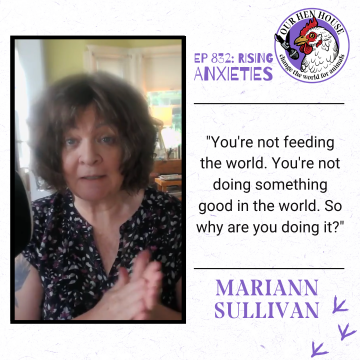 In this week’s Rising Anxieties, Mariann Sullivan dives into the theater of the absurd that is animal agriculture politics. From the Trump administration’s laughable attempt to blame California’s cage-free egg laws for nationwide price hikes (spoiler alert: it’s actually bird flu), to pork industry lobbyists desperately trying to justify their existence by fighting animal welfare laws nobody asked them to fight. Plus, a dairy farmer’s sob story about how incredibly difficult it is to exploit cows for a living (have you tried… not doing that?), and finally, some actually good news about a groundbreaking Animal Sentience Center at the London School of Economics.
This episode explores:
- How the Trump administration’s lawsuit against California’s Prop 12 is really a smokescreen for the pork industry’s agenda
- Why industry groups are fighting animal welfare laws that even many producers have already adapted to
- The hilarious self-pity of a dairy farmer complaining about the difficulty of the unnecessary job they chose
- How Helen and Scott Nearing demonstrated decades ago that plant-based farming offers more freedom than animal agriculture
- The promising development of the Jeremy Coller Center for Animal Sentience at the London School of Economics, bringing multidisciplinary science to animal advocacy
INTERVIEW TRANSCRIPT
Mariann Sullivan: Anxieties are rising. Can you hear from my voice how completely my own anxieties are rising?
Uh, I gotta stop watching the news. I really do. Uh, but how can you stop watching the news these days? I think it's, you know, even though the Epstein Report stuff is, you know, it's the first news in a long time that's given a sense that, uh, you know, something could happen. That, that maybe there are ways I, I don't know, maybe there are holes in this whole new approach to authoritarianism that we've developed, but I don't know about you if you've been following it like just, just being embedded in this whole story of pedophilia I, I think is affecting me.
I, I, I don't know. Anyway, that's nothing to do with what I'm here for. Um, 'cause I'm here to talk about animal agriculture! That'll cheer you up when you're tired of listening to pedophilia. And uh, alright. Our first story today is actually something I reported on, uh, last week, I think. But Kenny Torella has written an article about it.
Of course, it's much more in depth than anything I had to say. So I thought I'd tell you what he had to say. What won't Trump blame on California? And this is of course, on vox.com, which is where Kenny writes. A Trump administration lawsuit blames California for high egg prices nationwide, but it's not actually about eggs at all.
And this is making the point that I, I did make last week that, uh, it's insane to blame high egg prices on the law in California that requires that eggs sold in California, uh, shell eggs, be cage free. That is not what's causing the high prices of eggs, obviously, the high prices of eggs. It's caused by bird flu, which has killed billion, well... millions?
I don't know. Don't you sometimes like get overwhelmed by the, the numbers? Oh, uh, so, um, I think it's millions, hundreds of millions. So the lawsuit would nullify the part of the law that was passed in California in 2018, prop 12, that covers eggs. Uh, and it's, it was a little confusing because prop 12 didn't prohibit the sale.
It actually happens sooner than that. The legislature passed a law prohibiting the sale of, um, non non-compliant eggs in California. The Trump administration is blaming this law for the high prices of egg, not just in California, but, but all over the country. And as this article points out, it is a little bit more expensive to raise cage-free eggs.
It's a few pennies per egg, um, as you know, of course, like, why wouldn't it be more expensive to treat animals a little better? But, you know, the, the huge increase in egg prices obviously is 'case of bird flu, killing all the chickens. Um, and this apparently, uh, according to this article, unsurprisingly, since this makes no sense whatsoever, it this has nothing to do with the price of eggs. It's, uh, what he calls a smokescreen for other political goals. And this has to do with pork industry. And the pork industry has always been much more adamant about fighting, you know, all the lawsuits were brought by the pork industry about Prop 12 and how California isn't allowed to set its own standards for the pork sold in California.
And, you know, that's been shot down in the Supreme Court and whatever, but now there's, of course. They've tried it many times before, but there's a new bill in Congress that's trying to say that states can't do this, and Congress would be allowed to do that. It's known as the Food Security and Farm Protection Act according to this, uh, article.
But I think I saw from other articles that they're calling it the Save the Bacon, um, law, which I have to admit is a really good title. This lawsuit that they brought is pretending to be about egg prices, but actually the egg industry does not want this.
They're not asking for this. They're fine with California's law. And what this article is pointing out, which I think is really interesting and you know, has that insight that Kenny can bring to, um, these articles is, it's not really the pork farmers either. There are a lot of pork, I hate to call 'em farmers.
You know, the people who have the factory farms, some of the, the small producers, which they're always saying they're trying to protect the small producers. The small producers are mostly gestation crate free, which is mostly what this law is about. It's can you use gestation crates, which the pork industry has been moving away from.
And even the big suppliers are able to supply, uh, pork to California without gestation crates. I mean, there have been some stumbles, but the pork industry, the actual people who, who raise the animals, I hate to use the term. So, um, I hate to use any, any, any terms that, that aren't horrific when I'm talking about this industry, but they have been moving away from it. You know, it's slower than we want and everything, but, you know, they kind of get it.
And they understand that this is what they're gonna have to do and it's happening. So it's not really them, it's the National Pork Producers Council, which according to this, is struggling to justify their existence. It's these big industry players uh. and lobbying groups. Um, according to this article, I'll just give you this quote at a US House Agriculture Committee hearing on Prop 12 this week, meat industry representatives were invited to testify while animal welfare scientists, animal advocates, and small farmers were not. Oh, that's, that makes sense. Then, then, you know, you don't get like confusing opinions. It all amounts to political theater to set the stage for upcoming farm bill negotiations where lawmakers are expected to try to fold in legislation to nullify state cage free laws.
Like nobody even knows what this, well, some people pretend to know what it's for. Um, and actually there are a lot of articles, which I will not bore you with them all, in the industry publications about this bill. In Meat and Poultry, uh, Congresswoman Ashley Hinson introduces Save Our Bacon Act.
Oh, I called it Save the Bacon. It's Save Our Bacon. She is of course from Iowa. Where else? Um, well I guess there are a few other places she could be from and, um, you know, lots of co-sponsors. They've tried it before. They're trying it again. And I'm not saying they, it won't work this time, you know, 'cause things have shifted.
From pork business.com, no one is quote winning in a prop 12 world, six witnesses testify before House Ag Committee. It's really easy to show that no one is winning when you don't have anybody on the other other side. And, um, so this is by Jennifer Sheik and this is how she starts off. It begs the question, if producers are paying more and consumers are paying more, who is winning?, said Glenn GT Thompson Committee Chairman.
Well, you know, it's supposed to be about animals. Like they, they can't even see, like, like, they don't even understand the concept of this being about the animals, the actual animals who are the pork. Like, it just doesn't compute for them that that's a factor.
If producers are paying more and consumers are paying more, who is winning? I wouldn't say the animals are exactly winning. Winning a tiny little, uh, gesture. No, it's more than a gesture.
You know, it's, I'm always stuck in this conundrum of saying like, like these, these improvements, of giving these improvements a lot of credit when actually their lives are still fucking hell.
But, uh, you know, it's better than it was and it's actually a lot better than it was. Hinson, uh, this is from, I guess, is also from Pork Business. Um, Hinson Introduces Bill to Save Family Farms, Protect Pork Producers From Patchwork Regulations. Patchwork mean by patchwork regulations, they're talking about the fact that different states might have different regulations about what you can sell in their state. Like, isn't this like a, a thing? Like isn't this, knowing how America and government works? Um, that states are allowed to have different laws. Maybe we should just like not have any state laws since we're also dismantling the federal.
All right, I, I won't get started. Um, and save Family farms, you know, like everybody's got a family. That doesn't mean that your farm is a family farm. The small farms, as I said before, apparently, usually are already gestation crate free. Um, another article from Pork Business Boy, they can't shut up about it.
Prop 12, Clucked Up Egg Prices. New ad slams law ahead of congressional hearing. Apparently the Center for Environment and Welfare, what do they actually wanna help, uh, happen to the environment and welfare? That's the question. Says 60% of state voters want a legislative fix to prop 12 to bring down prices.
So that's the same claim about the egg prices. It's totally a sham. It's total nonsense like you know,
Next. Let's move on. From Hordes Dairyman, Animal Rights Groups Seeking Legal and Political Influence. This is kind of a stupid article, but whenever they're writing about the, the movement, I feel like I should tell you if I see it. Emily Ellis from the Agricultural Alliance wants everybody to be aware of what animal rights activists are saying.
Uh, a quote. They, they go to all the conferences, of course, which, you know, I guess they pay, so that's good. We need to focus on ending all animal farming. This is the true agenda of animal rights organizations, spoken directly by an animal rights extremist at a conference earlier this year. She doesn't say which one.
As 2025 unfolds, animal rights organizations are actively working to achieve this shared goal while attempting to downplay their true objectives. Nobody is attempting to downplay their true objectives. We want animal agriculture over. Well, maybe some people are, but I don't think so. I think that for people... there are welfarists.
There are groups that are in favor of welfare reforms, and either they admit that that's what they want. They wanna improve animal agriculture, or they say, let's do a welfare reform. We're all vegan. We think everybody should be vegan. But uh, you know, as long as we can't get that, let's get rid of gestation crates or whatever.
Well, you don't know that. And they went to three conferences so far. I'm sure there'll be more. Animal Legal Defense Funds' 2025 Animal Law Symposium, Animal and Vegan Advocacy, the AVA Summit, um, and Direct Action Everywhere's, um, Animal Liberation Conference.
According to this article, and this seems right, animal rights groups have increasingly focused on grassroots campaigns to support ballot measures, uh, direct candidate engagement, and leveraging local elections. You know, as the federal, uh, landscape has become more and more difficult, uh, I think that's really true.
Several sessions that they attended, um, focused on legal strategies including calling out gaps in animal cruelty laws. Yeah. How about that? And, um, public interest litigation, you know, already doing that. Yeah, I'm, I hope we'll be doing more. Speakers recommended incorporating sanctuaries into legal challenges to boost their odds of asserting legal standing, which is an excellent idea, you know, in the right case, coalition building.
Then she concludes by saying, for more information about the animal rights movement, or to find farm security best practices to make yourself a harder target, I love this military language. They just talked about people who are trying to get legislation passed; do they really have to make themselves harder targets?
Do they have to get like bulletproof vests or whatever? I don't know. I don't know. Alright. Um, from Hordes Dairyman as well, Lies I Have Told as a Farmer. Now you think this is gonna be an exposee? It's not, but it does bring up something that I, I like to, uh, talk about. And this is how sorry these people feel for each of themselves, how brutally hard their lives are.
Like, just don't do it anymore. If your life is that miserable, you're not feeding the world, you're feeding the world crap. You're not doing something good in the world. So why are you doing it? This is by Courtney Henderson, who's a Virginia dairy farmer, and things that she's told that are lies- I'll be done early tonight. I'm on the way. Next week, things will slow down.
And the reason these are lies is because their lives are so hard. For example, a normal everyday milking turns into cows being out, cows coming down with illness, equipment failures, cows to breed, and so on and so forth. Cows to breed. Like is that a sudden, I dunno.
Yeah, so don't do it anymore. Like if it's that hard. As farmers, we all know that life is crazy, hard, and overall tough. Our cows determine whether or not the above lies become reality or just another fantasy of a different life. Then get the o, get the different life. Go on. You don't have to do this.
Either way, the girls rule the world that we live in. Yeah. The girls are her cows. Yeah. Yeah. If the girl, if the girls were in charge, honey, things would be a lot different. And it kind of reminded me, reading this, of the old book, The Good Life, Helen and Scott Nearing 60 Years of Self-Sufficient Living.
And if you haven't read this, it's really quite an extraordinary book. It's about, um, Helen and Scott Nearing, who were big lefties in the thirties. They, they got, I dunno, they were really in trouble, but, you know, there was a, there was a real huge, um, anti-left, uh, attitude in the country and they decided to get outta town.
I think they, they were in New York and moved to rural Vermont and we're talking, you know, rural Vermont before, like modern, modern... mod cons as they say, uh, in the uk. Uh, modern conveniences. And, um, and they start, they, they'd never done it before. They started growing all their own food. And, um, you know, it was hard, but it was vegan. They didn't raise any animals. They didn't eat any animals or animal byproducts. And they make the, you know, there's a lot of just really, really interesting stuff about how they did it and very technical stuff sometimes, but it, the book is still totally worth reading. But they make the point that the farmers all around them who were, uh, you know, raising cows, it was in Vermont, and other animals, they were, they were tied to their farms 24 7. Like they were able, the Nearings were able to go off and go to conferences and whatever and meet with people and have guests because they didn't, they weren't tied to this like insane. They didn't have lives depending on them and deaths depending on them.
I highly recommend that book. It's a classic. Alright, I just wanna finish this. I, I'm not even sure they should be in Rising Anxieties only it was on a, an ag website, Watt Ag Net, which is a poultry site. This is really good news. I'm leaving you with good news. I didn't know about this before, maybe everybody else knows about it already.
Multidiscipline Animal Sentience Center to be set up in London. The first of its kind hub will be a place of ethical moonshots, its directors say, and this is by Mark Clements. They talk about this coming out of a central London University. They're talking about the London School of Economics and Political Sciences.
I mean, that's pretty damn fancy. And, um, it says guidance for policymakers on how to change public attitudes and behaviors towards animals and offer help for non-governmental organizations in the emerging sector of animal advocacy to design more successful interventions could soon start coming out of a Central London University, which like I said, is the London School of Economics.
This was founded by Jeremy Collar, he is a philanthropist and a very wealthy man who has, you know, done other, uh, really, really important work in, um, trying to get investments out of factory farming. And it will be called the Jeremy Collar Center for Animal Sentience.
It's inaugural Director, will be Jonathan Birch, who's already at the London School of Economics in the Department of Philosophy, logic, and Scientific Methods. And he says that the goal of the center is to use the emerging science of animal minds to design better policies, laws, and ways of caring for animals. And. It's going to be a really multidisciplinary center. Philosophy, vet medicine, evolutionary biology, comparative psychology, neuroscience, behavioral science, computer science.
And there'll be, uh, a lot of looking into AI and what AI is doing to, um, the way animals are being uh, cared for, and a shared commitment to benefiting animals. Now, their anxieties should be rising about this, but this is just a totally straight article. Uh, uh. So what? I thought it was pretty amazingly good news, so I'm gonna leave you with that.
And that's it for this week's Rising Anxieties.
Please, don't forget to subscribe, on YouTube or wherever you listen to podcasts. And if you are so inclined, and you would like to donate to our efforts here, you could do so at ourhenhouse.org/ support.
_____________________________________________

Thank you for listening to the Our Hen House podcast! If you enjoy our podcasts, believe in our mission to effectively mainstream the movement to end the exploitation of animals, find community and solace in our shows and resources, and would like to show your support for vegan indie media, please make a donation today. Our Hen House is a 501(c)(3) nonprofit organization, so it’s tax-deductible. Thank you for helping us create quality content!
Subscribe to our show on Apple Podcasts, YouTube, or your favorite podcatcher, and don’t forget to leave a 5-star review!
Check out Our Hen House’s other podcasts: The Animal Law Podcast, The Teaching Jasmin How to Cook Vegan Podcast, and the Antiracism in Animal Advocacy Audio Series.
Follow us on social media! You can find Our Hen House on LinkedIn, Facebook, Instagram, TikTok, Threads, or Bluesky.
The Our Hen House theme song is written and performed by Michael Harren.