 Apple Podcasts
 RSS
 Amazon Music
 Spotify
 YouTube
 PocketCasts
 CastBox
 Player.fm
 TuneIn
 Audible
 App not listed? Try this RSS link
This episode explores the powerful connections between factory farming, political repression, and the rise of authoritarianism with award-winning investigative journalist Will Potter. In a thought-provoking conversation about his new book Little Red Barns: Hiding the Truth from Farm to Fable, Potter reveals how his decade-long investigation uncovered the dangerous intersection between industrial agriculture and fascist movements. With authenticity and passion, Mariann and Will discuss how bearing witness to animal suffering can illuminate broader patterns of violence and political manipulation in our society.
This episode explores:
- How the meat industry uses the “little red barn” mythology to mask the reality of factory farming, while fascist movements similarly invoke a return to an idealized past
- Why animal advocates have been “canaries in the coal mine” for social movements challenging state and corporate power
- The evolution of investigative journalism and how animal rights organizations have filled crucial gaps in exposing industry practices
- The psychological toll of bearing witness to suffering and strategies for maintaining resilience while refusing to look away
- How reframing our relationship with animals could help address interconnected crises of climate change, authoritarianism, and violence
ABOUT OUR GUEST
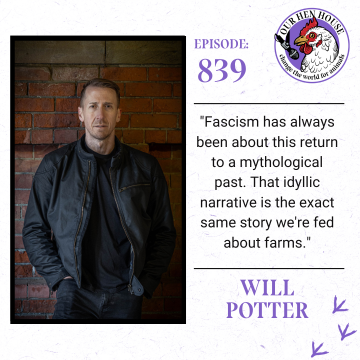
Will Potter is an award-winning investigative journalist and author, and a leading international voice challenging attacks on civil liberties in the name of fighting “terrorism.” Will was the first investigative journalist to be named a TED Senior Fellow, and has addressed governmental bodies including the U.S. Congress, Australian Parliament, and Council of Europe. He is the author of Green Is the New Red, which exposed the FBI’s targeting of environmentalists as “terrorists.” His new book, Little Red Barns: Hiding the truth from farm to fable, is a 10-year investigation of factory farms and fascism.
INTERVIEW TRANSCRIPT
Mariann Sullivan: Welcome to Our Hen House. I'm so thrilled today to welcome, actually welcome back, Will Potter, author, investigative journalist, a tour a force.
And I'm saying welcome back because Will, I think you were on the podcast like in the first year we were doing it, which means that I haven't seen you in a really long time, but
Will Potter: I think it's been quite a while, though I think we've both been busy. It's been quite a while. It's great to see you and thanks for having me back on the show.
Mariann Sullivan: Great to see you as well, and I'm super excited about this new book. Let me just do the intro for people who aren't familiar with your work. Will Potter is an award-winning investigative journalist and author, a leading international voice challenging attacks on civil liberties in the name of fighting, quote unquote, terrorism, and he was the first investigative journalist to be named a Ted Senior Fellow, which I did not know. And I, that is wildly impressive. He's also addressed governmental bodies, including the US Congress. I don't know how they let you in, um, Australian Parliament, Council of Europe, and of course he is the author of Green Is The New Red. I think that's probably mostly what we were talking about the last time
Will Potter: I think so.
Mariann Sullivan: were on, like 15 years ago or so.
And that was really exposing the FBI's targeting of environmentalists as quote terrorists and, uh, you know, not something that's actually stopped, but has shifted in various ways. And this new book, Little Red Barns, Hiding the Truth from Farm to Fable, is a 10 year investigation of factory farms and fascism. And I, this is just a master work, Will, because it, it, you know, I, I, I, I read about this stuff a lot. I talk about it a lot. And I am always like excited, if somewhat depressed, about a new angle on the way we should be seeing this. And you really took a step back from what is happening in the world and, and seeing kind of a big picture and the connections between different forces, which we're worried about all of them. Climate, fascism, what we do to animals. At least the people watching this podcast are, are worried about that last one. Not too many other people seem to be. But also we're all worried about people's unwillingness to look closely at all of these issues. And they, they're all actually connected and you connect them in really great ways.
And, at some point you say, quote, seeing animals helped me see fascism and violence against humans in a new way. And I thought that was a really iconic quote from this book. Can you kind of explain, uh, you know, tell us what the book is about? Since I'm the only one? Uh, well, maybe, maybe, probably some other people have read it already, but most have not. And, and what that means. How did it help you see these things in a new way?
Will Potter: No, I appreciate that very much. Mariann, thank you for saying that. Um, and for your attention to this. And this book, it challenged me to see these issues in a new way. I've been doing this a really long time, and part of the nature of this project was just grappling with the mess of it and how all of these things are both on their face interconnected and also felt like there were deeper connections that were just outta reach.
So as a little bit of background, Little Red Barns started with my reporting on ag gag laws, which I'm sure your listeners know about, that make it illegal to take photographs and video of factory farms, from undercover investigators, whistleblowers, and journalists.
And then as the project evolved over the years, I was both seeing the industry's efforts change and get more sophisticated and nefarious, and then at the same time, the broader culture was clearly changing. And in my work, I've both been passionate about animal protection, but also really focused on political repression as a warning of where this is going.
And then all of a sudden in the course of writing the book, it became clear, well, we're here. With the rise of Trump and then January 6th, then now, ICE agents snatching people off the street. And I guess the short answer of some of those connections between these issues is that the efforts being taken to hide factory farms, I think have been both a playbook for modern authoritarianism and cracking down on social movements.
And at the same time, they are hiding the nature of the threat itself. As one example, the FBI for many, many years was warned by the Inspector General of the Justice Department, by DHS, Congress, independent agencies, West Point Military Academy, that this relentless focus on animal rights and environmental activists as their number one domestic terrorism threat was leaving right wing groups and white supremacist violence unchecked.
So there's also this literal connection between the two. The FBI is cracking down on protestors against factory farms while allowing actual neo-Nazi groups to organize and rise. Um, but beyond that, I started seeing also the connections and that the, the line you mentioned of, or that quote from the book was really about realizing that if we see animals, we see how the language of animals are used.
So when people like Donald Trump and the Trump sons and members of Congress start calling Black people animals, when they start saying immigrants are animals, when they are using these tropes about like Haitians eating dogs and cats, this is part of a long history of how being an animal or being labeled an animal as a human is incredibly dangerous.
Being called an animal, whether you are one or whether you're a human being labeled that way is to signal you for violence.
Mariann Sullivan: Yeah. And so much of this book, I think is about framing. That's a perfect example of framing and yeah, I, you know, I follow the meat industry a lot. I read what they write on their websites, and they always seem very inept, but they're just not. They've been very, very good at pulling this off, which is disturbing. Can you tell us a little bit, I mean, talking about, speaking of framing, I think this is the, the iconic example in the book, the title of the book. Can you talk a little bit about the title of the book in this context of the relationship between animal agriculture and fascism?
Will Potter: Yeah, I mean, we all know what a farm looks like. Right? It's the play set. It's the storybook, it's the song, it's the little red barn dotting the countryside. I mean, we were raised on this story before we even know our ABCs or other stories like the Pledge of Allegiance, stories about gender, what it means to be a man or a woman, stories about capital.
This is really the first story that we learn. And the power of that, of being taught that so young and have it reinforced constantly is that all corporations have to do is invoke it to put us back in this kind of trance, mythological state. And it's like, oh yeah, that's a farm. So we see it on the labels, the billboards, the product signs, the coupon books.
I've seen names of grocery stores, uh, as Little Red Barns. I mean, it, it's, everything taps into that. And it really short circuits our critical thinking. Humans have a natural confirmation bias that's been extensively studied and we are taught this is true. And so therefore whenever we see something that dispels that, it's really difficult to break through because at the same time we're being hit with these images of the little red barn and we're like, oh and no, that's actually what this is. We don't need to worry about it.
But the other part of this that didn't come till much, much, I mean many years into working on the book, was realizing that's the exact same story that fascists use. Fascism historically has always been about like this return to a mythological past, right? Whether we're talking about Franco or Mussolini or Hitler or Erdogan, um, contemporaries today, Putin does this, Trump does this. Make America great again.
It's always invoking like, oh, things were so much better when they were pure and we had clear ideas of who, uh, a citizen was or who a man was, right? It's all these tropes. And that backdrop, that idyllic narrative is the exact same as the story were fed about the farms. And I saw this, you know, in the presidential campaigning, you had candidates and members of Congress actually doing press conferences at little red barns or talking to farmers, and it's subtle, but it's a way of tapping into that, um, storybook image that I think we desperately kind of want to be true.
Mariann Sullivan: Yeah.
And one thing that you mentioned right there, I mean, it's so beautifully said, well, it really is, but it comes through in the book too, that you wrote this over the course of years and that your book changed kind of.
Will Potter: Oh
Mariann Sullivan: Your idea of what you're going to write was going to change and like you actually report on this dawning realization, especially since, you know, you lived through the Trump years, the first Trump years.
You call 'em the Trump years, I think in the book, which is unfortunate, though I think you,
Will Potter: Right.
Mariann Sullivan: you finished it right as he was elected the second time, but you know, part of the time you were writing it, you thought they were over. But as you know, as, as they developed, like, your focus of the book was, I wouldn't say changing so much as it's just broadening and growing.
Is, is that how you experienced it?
Will Potter: I think that's a very generous way of describing it. It felt a little bit more, uh, a little bit more like madness than that in the sense of, you know, as a journalist, to feel like you don't get the story is just brutal. I mean, this has, this has been my issue. This is what I've focused really my entire life on, is these intersections of repression and animal advocacy and, you know, rising authoritarianism.
And I felt like I just wasn't seeing the thing. And I talk about in the book, you know, both the reason I bring in my, a lot of personal narrative is trying to, to emphasize that. You know, I both grew up in Texas with this story. I lived on a farm in Michigan surrounded by the little red barns. I was going back and forth as a professor at University of Michigan.
Like, I could not see the story in front of me. And that really hit home and changed the book profoundly. Of just realizing like, okay, I am in it up to my eyeballs. I, I am literally teaching, and researching storytelling as my job. Like, like the, the power of it, how it taps into our kind of subconscious, the way it structures human relationships.
And I just couldn't see this. Um, so yeah, I, I mean that's exactly what happened. The book at one point, well there's a couple points I, it, it grew into a three book series and then at one point it was an ebook and at many points I was just like, I need to be done with this stupid thing. Like, I don't know where to go with it anymore.
And I'm glad I stuck with it because those shifts that I talk about in the book were really how my thinking was changing. Uh, and so this book is kind of a product of me trying to process what it means to bear witness in this era, uh, of rising authoritarianism.
Mariann Sullivan: Yeah. I'm really glad you stuck with it too, because as I said at the beginning, like I, I feel the same way that that, uh, why didn't I see it this way before I read your book? But your, your book did
Will Potter: Oh, thank you.
Mariann Sullivan: really broaden the way I see it and I think I. I'm hardly as steeped in the dark side of it as you are, not even close.
But still, I spend a lot of my time, my time thinking about this and there's always new thoughts to think about it. Can, can we take a step back for a second? Because the book is also about investigative journalism and as you said, bearing witness. And I, I would just like to set the stage, 'cause this is another thing that started me thinking as I was, um, reading it.
Not so much just about animals, but can you just give us an overview, because this is something I've been thinking about before I read the book, an overview of what is happening in investigative journalism in today's media environment? You do talk about this.
Will Potter: Mm-hmm.
Mariann Sullivan: We have, through YouTube, we have more people commenting on, on what's happening than we've ever had in history.
But nobody's finding out what's happening.
Will Potter: Yeah.
Mariann Sullivan: Like there are a couple of big newspapers left, you know, who I'm sure have a couple of investigative journalists. But can you just talk about, because you did give me actually a little hope here because you talked about the fact that it's not necessarily pure journalists anymore, who are finding out what's happening. Well, broadly in general, who's finding out what's happening, who's doing these deep dives into, into the secret stories and, and also vis-a-vis animals?
Will Potter: Yeah, I mean, as I was coming up, um, this was always the goal was to be an investigative journalist. I started working in news when I was 17 at the Dallas Morning News, and it was always the pathway and not to, you know, clearly date myself, but this was also at a time when I think I was kind of one of the last generation that that seemed like within reach, um, the idea of being like a full-time magazine writer or an investigative journalist or a correspondent.
And then with the rise of the worldwide interweb, uh, all the kind of came crashing down. The news media never really figured out a new financial model. All of a sudden there's this like fragmentation in the media environment. The profit model is disrupted, stability is disrupted. And the people that were cut first and really consistently were the foreign bureaus, the investigative journalists, the expensive time consuming work that also is, um, frankly, potentially dangerous for the media organizations. It opens you up to lawsuits, you have to have lawyers reviewing. There's all kinds of risks. Now we've entered an era, like you said, where we have more content, more news, more, um, supply of information than ever before, but also fewer people that actually are doing the investigative work.
And also it feels like fewer people, if not fewer people listening, fewer people that have a, a critical thinking of the media that they're consuming, right? Everything feels so much more passive in these last years of just like mindlessly and constantly consuming all this content and you know, people having less critical thinking skills about like where that's coming from, the credibility to the people produce it.
We're also seeing this like really mind blowing rise of just outright animosity towards journalists fueled by Trump and the far right that I still am trying to wrap my head around. You know, it's like people talking about, oh, there's these, all these things being hidden from us and we gotta get to the truth.
And they're just like doing it from
Mariann Sullivan: Yeah.
Will Potter: the passenger seat of the car. Like there's not investigative work that's happening and the real investigative journalists are facing prison time. So that's all kind of the backdrop of when animal activists, like with nonprofits, started doing undercover investigations heavily and professionally.
It filled this kind of void and it also really challenged that media environment and it kind of confirmed. I grew up in a school of journalism that was really taught, it's not about going to journalism school, and it's not about your cv. Anyone can be a journalist if you follow the ethics of the craft and you are committed to this purpose.
So, right? So like Edward R Murrow, when he was really revolutionizing, uh, broadcast journalism during World War II in Berlin and in London, Murrow's Boys, you know, the people that he brought on board to help him we're not trained journalists. These are people who he just thought were sharp and smart and brave.
And I think we have to remember that. Like some of these ag gag laws were trying to say, well, we'll make exemptions if you're a credentialed journalist. And that's nonsense. Uh, that's putting everybody at risk. 'Cause we're seeing the credential journalists, uh, quote unquote, that are being invited into the White House right now.
They're hacks. There are teenagers with, uh, iPhones that are puppeting fascist talking points and being given a platform for that while the Associated press, uh, and Washington Post are being kicked out the door. Uh, and that's kind of the, the, the reality of the media landscape we're suddenly in, in 2025.
Mariann Sullivan: Yeah. Once you, once you start talking about credentialing people, you're running into a pretty scary, uh, gatekeeping kind of situation.
But I think that at least in animal agriculture, the undercover investigations really did, I mean, even though they're not, the people doing them are not journalists in the sense that they work for a journalistic enterprise. And even in the sense that they're going in with a particular mission, not just to uncover the truth, but I guess that's probably true to some extent of journalists. You don't just randomly investigate anything. You investigate something that you think there's, there's something to be hidden. And it has been unbelievably successful.
I mean, the undercover investigations really changed animal activism, but we've had a lot of them. I don't think they were without impact. I think they've had an important impact, but you know, we, it ain't over, factory farming is not done in spite of like the unbelievably horrific facts that they have uncovered.
So is it worth still doing them? Um, and if so, do you have additional ideas of how they should be used?
Will Potter: Oof. Yeah. That's kind of the heart of the, that's the heart of the question, right? Uh, I wrestle with that quite a bit. I agree with you that they changed the nature of the discussion, they changed the movement, they changed culture, and I think continue to do so. But I think at this point it also, like you said, is clear that it's no longer, oh, people don't know what's happening or that it hasn't been exposed.
We've exposed it incessantly and it does raise to me much deeper questions about what it means to see and why some people are both refusing to see what toll it takes on us to see and to bear witness and how we break through.
Like, like for me, I, the book opens with when I saw that first footage, you know, this was in the mid to late nineties.
That was it. Like there was no other, that was it, you know, and, and then you realize that other people aren't like that. That's something every animal activist has to confront is that some people can see this over and over again and just deliberately tune it out or say they don't care or they're not gonna look.
So your question, you know, I think it's really complicated, but I think we need to realize there's other barriers to people seeing beyond government censorship or industry restriction. And I think that's where the idea of the little red barn really comes in is useful to me to think about. That we have to think about the narratives that are in place, that are restricting our site beyond, uh, outright restriction.
We have to think about kind of our cultural narratives that we're raised with. There're these kind of layers of story that are underneath those images that we need to get to, um, in order to open up people to the possibility of that sight. In terms of how we do that, uh, I'm struggling with it because it also feels like this is an era where journalism, not just journalism, but fact itself is, uh, kind of becoming irrelevant. That truth is becoming irrelevant. Like this is not the currency of public discussion anymore. It's more vitriol and propaganda and manipulation. And that leaves me really questioning, as a journalist, what's the best way to go about exposing these things?
Um, so this book really pushed me of, you know, I kept with it, uh, uh, I wanted to make some kind of contribution with this, with this project, but all the while I was really struggling with like, is a book gonna do it? Like, are people reading now? Is another, another description of a factory farm gonna reach people?
Like, uh, I'm struggling with those same questions.
Mariann Sullivan: Yeah. And I mean, I think you're exactly right. The way you framed it with the connections to fascism and you make a very compelling case for it, is a very powerful way of framing it. And I think a lot of this does have to do with framing. I think that's what the industry, I mean, the industry has people's biases on their side, so we don't wanna give them too much credit for having done a good job of framing it.
But, but they have framed it successfully that this isn't about you somehow, even for people who are horrified by it. Somehow it is... what they're eating, you know, and what they're voting for and what they're supporting, it's somehow not about them.
Will Potter: Right.
Carry on. It's not you. No. Yeah, exactly. Exactly right.
Mariann Sullivan: Another thing that I really wanna, um, go back to, 'cause you talked about, I mean, so much of the book is about the concept of bearing witness, and you've alluded to it, you mentioned it, but I'd like to go a little deeper.
Can you explain what that means? And since we're talking about how, Okay, the undercover investigations have been powerful, not powerful enough. Most of the people who are listening are not journalists or undercover investigators and can't, you know, take that route to bearing witness. So, what are your suggestions for people, most of whom are listening to this podcast care a lot about this.
What is the best way that you feel people can bear witness in their own lives?
Will Potter: Yeah. No, I appreciate you raising that. I guess as a little bit of background, the concept of bearing witness. I think most people have heard the term but haven't really heard kind of where it comes from or what it means. And you really hear it most both in journalism and in religious teachings. And there's an interesting kind of relationship between those two.
I mean, at its most basic level bearing witness means to refuse to turn away when dark things are happening, injustice is being done in our name or being hidden from us, to directly confront it by looking at it. Um, and I think often in popular culture, the explanation stops there that, oh, this is just about, you know, scrolling on your phone and seeing the horrible photos coming out of Gaza or of factory farms or of anything happening in the world.
But it's the concept of bearing witness, I learned, has always meant more than just seeing. You know, it's to see and then to testify about what you've seen, to speak about it, to do something. And this goes all the way back to, um, both Christian teachings and teachings in Islam.
Particularly in Christian thought, this idea of the disciples of Christ as the original kind of witnesses in the scripture, meaning they spoke about what they saw or what they believed. The Son of God. And when they spoke about it, they were killed by the Roman state. So to see and then to testify, carried consequences. And one of the things that was most like kind of broke my brain a little bit in this research is talking to religious scholars who told me that actually, if you look in the scripture, the, the words for witness and martyr became kind of intertwined over the years and inseparable and they shifted. Um, and I think that's really telling that to witness has always carried some consequence. And I think that's why journalists talk about witnessing as speaking truth to power because witnessing at its core is an act of defiance.
I've come to view it as an act of spiritual defiance of whatever that means to people. Um, but on an individual level to repeatedly refuse to turn away despite this onslaught of just dystopian cruelty that we're seeing in the world is, is to claim a part of yourself and to refuse to give up a part of yourself.
And I think that's what I would say first and foremost to listeners thinking about this concept. Is to me, it's become less about, yes, it's bearing witness as like, what can you investigate? What can you expose? Can you know whether that's you're on a street corner or in a billboard or a TV interview?
There's all kinds of different ways to witness, but like, how do we apply that in our lives to sustain ourselves at a time when things are just really dark? And I think we're reaching a point, like I talk about in the book, I feel personally like there's a, a physical component to witnessing. Like, you, you see so much and your body starts like shutting down from it and wanting to pull away.
And so I'm really interested in how, how we keep doing this, you know, how we refuse to turn away right now, take care of ourselves, but also continuing the fight by witnessing.
Mariann Sullivan: Yeah, and something you just said struck me about taking care of ourselves. I mean, it can be very hard to do this depending on the audience you happen to be confronting and where you are in life and what kind of power you have, but there's two sides to taking care of yourselves. One is to, you know, not do the confrontation, not get the ridiculous pushback, not have people angry at you.
Not too many people are being martyred. You never know. But so far, uh, what most people confront is just disapproval.
But it takes something away from yourself too, to be quiet about something that's this important, which other people don't see. And which somehow, for whatever reason, we have been either lucky enough or unlucky enough to see, and we know that it's truth and we know that other people cannot see it.
So denying that is not doing yourself any favors either. I mean, but I guess we all seek that balance.
Will Potter: I would even maybe go a little bit further than that of not, not only doing us a disservice, but I think there's a real toxicity to it in terms of like an actual toxicity in your body. Like to constantly push down and like just try to put the blinders on and tell yourself like, oh, I'm just gonna do my job, or I'm just gonna do this and that's not my fight.
Be polite, you know, don't upset the family or, you know, the relationship or whatever it is. It doesn't work. I, I think it's, it just eats away at us. And I think that's not to say we just run around, you know, screaming from the rooftops everything that's... you know, there's a, a delicate balance here, but I think we have to really embody that defiance of, no, there's some things we can't be silent on and that might have consequences.
It might make people upset, but we have to follow our, our kind of internal compass on it.
Mariann Sullivan: Can we talk a little bit about the other side of, uh, the information kind of coming out and people sort of knowing what's going on? And that's the industry side. And in this context you talk about the industry's kind of shift in its efforts. It used to try to completely hide everything and now it's not possible.
And I think this is the most, one of the most fascinating pieces, the attempts to gaslight, the remarkably successful attempts to gaslight. Um, at, at one point, you made a compelling comparison of misinformation about January 6th, which has been one of the most extraordinary gaslighting episodes of, of our lives, I think, but also to the misinformation of factory farming.
You know, that, that they're kind of some very similar things. Can you talk a little bit about how the industry, instead of hiding is attempting to change what people think they're seeing?
Will Potter: It goes back to what you're saying. It reminds me of the, John Stewart used to do this bit on The Daily Show of evil or stupid, right? Where he'd have his correspondents debating like, oh, these people are really evil. And then the other person would be like, no, no, no, they're just really stupid. And so I think about that, but as I'm looking at this, I'm like, no, there's, it's, this is more on the evil brilliance side. Because what what's happened is after all these investigations, the industry at first responded by literally trying to shoot the messenger and criminalize and outlaw and just make it impossible to share the footage and broadcast, right? Censorship. And the public, you know, everyday consumers and the press really didn't like that. People don't like being told what not to see or what they can't think about.
And it backfired. And then ag gag started evolving, and we can kind of get nerdy about that in the forms it took. But we, what this really ended up with is the industry realizing that it's more powerful, not just to ban and censor the information, but to tell people that they can't trust what they're seeing.
So even though like, you know, nightly news has footage of body slamming piglets onto concrete floors, which is a standard industry practice, or another example of workers beating and sexually assaulting animals, which has come out over and over again, the industry is responding saying, no, no, no, you don't know what you're looking at.
They've said things like made a comparison to, uh, open heart surgery. Well, if you saw open heart, this is what they said in the New York Times. If you saw open heart surgery for the first time, but you're not a doctor, that's pretty bloody. You don't know what you're looking at. And this has been their messaging.
And unbelievably it has kind of worked and now it's reached this kind of other stage of the dystopian rhetoric because they've welcomed, uh, some CCTVs into the slaughterhouses and factory farms. Of course, they wanna be the one to adjudicate who gets to see it, whether it gets turned over, to where it's placed, uh, whether it goes to authorities, who's responsible, right?
But they're like, oh, we want oversight. We want come, like, we'll let the cameras in. While at the same time, this just happened in Australia, I saw news the other day. The industry is arguing that footage of cruelty at their farms is actually a copyright violation because it was recorded without their approval.
So it's this like kind of mind melding combination of authoritarian censorship, gaslighting, and then, I don't even know where it's going right now with these type of copyrights on cruelty arguments. That they're just trying to manipulate and keep people so reassured that the industry isn't the bad guy, that it's these terrorists and these radicals, and you don't need to worry about what you're hearing in the news.
Mariann Sullivan: Terrorists and radicals, but also the bad apples, like
Will Potter: yeah.
Mariann Sullivan: the couple of workers who just, Oh, we, we made a terrible mistake hiring them and we fired them.
Will Potter: Those bad apples are always the, the lowest paid, the immigrant worker, the person without legal representation. What do you know? They're the bad apple. Uh, it's not the CEO that pushed through this new industrial system over the years, or that made these standard industry practices.
It's the kind of worker that really doesn't have a say on anything. And that's of course, I, I hope people understand that's not excusing anything. But there has been this kind of tendency over the years in the animal rights movement to latch onto like these prosecutions against the low level workers.
Mariann Sullivan: I think that's eased a bit, but I, I agree
Will Potter: It has eased a bit. I think there's a shift now.
Mariann Sullivan: An answer to what's going on. And yeah, I mean, not that it's okay what those people were doing, but that's not where the real problem was. I was so pleased to see that you mentioned in this context, um, Timothy Pachirat's book, um, Every 12 Seconds, or at least his work.
And I, I think he was the first person to point out to me that, I mean, again, again, we're talking about framing. If the industry manages to frame, you know, we're, you were talking about how the little red barns is a, is a framing technique. There's also this, this framing technique that they have of, of taking out and out horrific cruelty, like slamming baby piglets on, on the ground and, and framing it as you know, this is normal industry practice. It's fine.
Will Potter: Yeah, no. Um, Timothy Pachirat's work was really influential in my thinking and challenged me, and I, I talk about that in the book. You know, I've
Mariann Sullivan: Yeah.
Will Potter: said hundreds, if not thousands of times all over the world, that the reason activists have been a threat and been labeled as terrorists is not 'cause they're breaking windows, but it's, they're creating them.
They're shining a light, they're exposing, like, I really have had this faith in witnessing. And some of those conversations, and particularly about his book, there's seeing the nuance to that and how it's co-opted. And that pushed me to go back into the archives and revisit Upton Sinclair. So at the turn of last century, you know, a lot of folks had to read The Jungle in high school or college.
The narrative is that Sinclair in this novel exposed the industry and led to all of these reforms and food sanitation efforts, and it kind of fixed things. In Sinclair's words, what he saw was that all of this was co-opted by the industry into what economists now call regulatory capture. The tendency of industry to control the oversight mechanisms that are meant to restrict them.
And so what Timothy was arguing, I came to find out, has actually been a very longstanding problem going back to some of the first investigators of industrial meat. The industry is co-opting this to push their agenda.
Mariann Sullivan: You know, there's something else in this same context that I wanted to bring up, but it, I don't know quite what to say about it, but it just occurred to me.
I'm not sure t his is something you addressed, but maybe you did, but I'm just gonna say it anyway 'cause you know, it's my podcast. Um, it's about veganism and reframing veganism, and I feel like they've been incredibly successful of reframing veganism, like as to be eccentric kind of hard. That activists are very, very, um, extreme in, in, you know, it's all or nothing. And the fact is, is that it's, as we all know, it's not actually that hard. Never in history have people had the, the unbelievable plethora of different kinds of food that we have.
It's really not hard at all. Also, it's not being forced on anyone. I mean, if, if somebody made me empress, it would be forced on people. But unfortunately for the world, that's not happening. You don't have to be a hundred percent if you don't want to. Like, none of these things are true. I mean, sure they can find people who say these kind of things, but I feel like this has been framed, whether it's by the industry or by the world, that, uh, not eating animals is seen as like, kind of like weird and, and you know, fine if people wanna do it, but it's not something you would wanna do. And I noticed recently one thing that they are really scared of, it's something, a kind of campaign that animal activists don't love that much, it's the, the mayor in Denver is doing this campaign, eat less meat, and the industry is
Will Potter: Oh, they can't stand it.
Mariann Sullivan: Furious. 'cause that's something that people might be able to hear, right?
Will Potter: Uh, well, that's what's really interesting about this is that they both freak out and say... the industry freaks out and says, oh, these are extremists. Um, they make all the kind of like, veganism isn't sustainable. It's not healthy. They attack it in every way, but at the same time, when activists try to come forward with just moderate reasonable proposals of things like Meatless Mondays or, you know, reducing your consumption or incorporating more plant-based meals in government.
Um, like you mentioned, they've completely freak out about that. There is no middle ground.
Mariann Sullivan: No.
Will Potter: There, there is no tolerance for any change. And I think that's what people need to understand about the industry. Um, it is complete denialism and gaslighting. They will not engage with the opposition. Um, now we're seeing some examples of, you know, there are some smaller farms that are trying to do the right thing and there's always gonna be those outliers, but I'm talking about like factory farming and big ag as this monolithic entity.
Um, they're attacking every tactic that activists can come up with. And what's been challenging to me is seeing, you know, I've seen in the movement over the years, activists, um, or, or vegans don't even like using the V word anymore because that's seen as signaling extremism or, you know, we've seen the rise of plant-based.
Now plant-based is kind of being questioned, like does that term work? And I think we're just trying to chase as if there's like the right term to cut through this. And I think it's kind of missing the mark, uh, that the stories and the industry manipulation are bigger impediments than, um, some of these individual terms that we're using.
Mariann Sullivan: Yeah. I don't know how you could get more anodyne than eat less meat, but still they're absolutely furious at the idea that anybody would tell anybody to do that.
Will Potter: And for folks listening, like there's a lot, I go into the research in the book of the environmental impact. Wherever you are in your kind of journey on this, just trying to eat less meat has an impact.
Mariann Sullivan: Oh sure. Eating less meat is definitely better than eating more meat .
Will Potter: Oh, a hundred percent. So just to reemphasize to people, like, the industry is acting like this is all the same, but making steps, uh, in that direction is making a difference.
Mariann Sullivan: So reading the book, one thing that I really loved about the book, I was struck by how odd it feels to be taken really seriously as an animal advocate. That's a rare experience for most of us. And I, I, I pulled out this quote, animal advocates have been the canaries in the mine for social movements, challenging state and corporate power.
And, you know, I couldn't agree more, even though we are trivialized so often. But you also addressed the question, which is I think just as troubling of the relationship between animal activism and the left and the failure of the left not only to embrace it, but to take it seriously as well. So can you unpack this a bit? I mean, I assume this has been a, a somewhat painful part of your journey.
Will Potter: Very much. Um, I've always felt like a weird bird. You know, like in the civil liberties, uh, journalism communities, like I'll be the one vegan. Like I don't feel like I've ever fit in. And also, frankly, in, you know, animal protection movement over these last decades, there's been a lot of times where I'm like, this is not my space.
I don't fit in. It's part of that question of, to me, like the way I was exposed to these issues early on, especially through punk and activism, they're all connected. And the ways we think about power are what are underlying all of those connections. And to me, I see animal, the ways we treat animals as kind of the most extreme representations of how humans regard power, right?
Like, we can do anything, we can manipulate them however we want. We can commodify and, and industrialize them so they're not even individuals anymore. And so I see these natural connections when we're talking about colonialism and war, and gay and trans folks and poverty, like those are also all about power.
And so it has been really struggling or, or challenging over the years of trying to wrestle with like why we can't talk about those animal issues in these other spaces. Um, and also to, to some degree why we can't talk about those other social justice issues in some animal spaces. Like there seems to be this firewall that I think is quite artificial.
And I think right now, especially as we're seeing full on fascism rise in the US, I, I think we would all do well to try to focus on our shared values and our common ground. And no matter what differences we have with other social movements that are on the progressive side of things, we have much more in common than we do with people that are advocating for Alligator Alcatraz, concentration camps, and ICE raids and things like this.
And so to me, this is like, could be potentially a turning point of we have to rally with like-minded people and build some new alliances that have been really neglected.
Mariann Sullivan: Yeah.
I, I mean, I really hope that's true. But on the other hand, the really interesting thing about animal advocacy I think is that, you can find people almost of any political persuasion who care about animals. I mean, it is like, maybe that's one of the problems that everybody cares about it, so nobody cares about it. I don't know. But o obviously there are the psychopaths, there are the assholes or whatever. Like, not everybody cares about animals, but really a lot of people do. I mean, I actually ask virtually everyone the same question, and so I'll ask it of you too, because I, you know, so far nobody's been able to answer it 'cause I don't think there's really an answer.
How do you explain the people, not, not the fascists or the psychopaths or whatever, but vast majority of people who would actually never in real life harm an animal. Why do they continue to participate in this violence? I mean, actually participate. It's not like a political issue that you're three steps removed. You're actually eating their dead bodies. Uh, so I usually get answers, you know, when I interview people about, which I think are totally important, um, the cultural relevance of, of food, you know, how important it's to people and certainly cognitive dissonance, you know, the way human human minds work. Are they enough to explain this, this truly extraordinary sin that people like, participate in, that just boggles our minds? And, you know, I, I hate it when I say it like that 'cause it, it makes it sound like I think we're better than everybody and I think we are on this particular issue.
It doesn't mean we are on other issues or anything else, but, but why? What is it about human nature? You've been thinking about this and I know from reading the book that you've gotten into some really dark places. I just wonder what your thoughts are on this unanswerable question.
Will Potter: Well, I think I'll add myself to the list of people that probably don't have a sufficient answer, but I'll, I'll throw my hat in the ring anyway.
Mariann Sullivan: Good, that's what I'm looking for.
Will Potter: You know, to me it boils down to, I think we've arrived in a culture that, whether it is explicit or not, we all know that there is a danger to empathy. That opening our hearts and opening our eyes, I think we all kind of implicitly understand that that's a very dangerous road. We see that in people's rejection of the factory farm footage or refusing to engage with the ICE raids on the street or what's happening abroad.
To me it seems like it combination of political power and a physiological response. That if we continue to open ourselves to all of the abuse and injustice of the world, um, I think there's a part of a lot of people that know it's a bit too much or feel like there's not agency there. One of the big kind of epiphanies I had that I don't talk about in the book, but I did, I was struggling with really severe depression and PTSD for very long time, uh, in the arc of writing this.
And one of the kind of turning points to me was realizing that depression is awareness of all of this evil and abuse and violence without the agency to do something about it. It's seeing these things and then feeling like this powerlessness to actually change it. So I don't feel like this is really an articulate answer to your, to your question, but I, I feel like it's part of the answer.
Um.
Mariann Sullivan: I, I totally agree, and that's a really moving answer. I mean, it, it's almost as if we could say, which I think would be a good thing to be able to say that animal advocates may be less empathetic 'cause we manage to do it. Whereas other people, people know. I know people who I think are like this, they know that if they allow themselves to think of this, they're not going to be able to bear it.
Will Potter: Yep.
Mariann Sullivan: don't allow them, but they have that lucky piece where they can then turn it off.
Will Potter: And, and, and people say that, do, does anyone ever say that to you? I've heard people say that to me. Like, don't tell me. Yeah, exactly. Because they already know. And so it's, it goes back to that conversation about sight. So is, is our task to just keep putting those images in front of them or do we have to try to get to what's underneath that that is making people keep that at distance? Like what is the fear? Is it, they won't be able to handle it, that they'll lose friends, that they'll lose family, that they'll be isolated, they'll be depressed. Like what is, what is it? And I don't quite know, I guess for everybody it's a little bit different.
Mariann Sullivan: No, I like your answer. 'cause it's frequently, and I think this is true, it's the importance of social conformity and that you'll lose friends. And, you know, that's a very important value is, you know, we're a tribal species and belonging is important, but I think you have put your, your finger on something added to that, that it's more than we can bear.
Will Potter: Well, and to kinda shift this just a little bit, it is too much for us to bear. Like I think that needs to be said. This is unreasonable. It's actually too much. Like as human beings, we were never designed as animals to take in all the violence of the world on our tiny little devices, one after another.
Like this is not. For anyone who's listening, who's struggling, like, that's valid. This is not sane. This culture is not sane. This is not normal. So I think we have to both recognize that and I finally arrived at a point at the end of the book of realizing like, and reminding myself, no, we can look at all this.
It feels impossible. And it does, it does take a toll that we have to manage, but we are all capable of looking. Like there is that in us that we can keep open, to seeing all these things and to living with our heart open in that way.
Mariann Sullivan: Yeah. I, people are remarkably resilient, even, even with this kind of information. Uh, we can keep going. I think it, I mean, I don't know whether this makes sense or not, but it kind of reminds me of our thoughts about veganism, why we as animal advocates kind of overvalue the value of our own veganism. It makes us feel like we're doing something which is so important to be able to handle trauma. Like, it, it, it, it feels real. It's something I do every day and it makes me feel better about it. And I, and people who are not able to go there undervalue with veganism. They don't think there's anything they can do to stop this. And I think, you know, those, both of those things are, are sort of true.
Will Potter: I think it goes back to that desire for agency, right? To have some control and,
Mariann Sullivan: Yeah.
Will Potter: Um, I think there, there's truth in it. I mean, it's clear by choosing to not eat animals, you're not directly contributing to this system, but I think there's a, like you said, we can kind of overemphasize it, and kind of cling to it because it, it makes it more clear decision.
Yeah.
Mariann Sullivan: If that's what we need to do, that's fine. But, but it is good to look at it and, think, well, what else can I do?
Will Potter: And where do we direct our efforts too? Like, you know, thinking about, I talk a lot about the oil industry in the book, and one of the most brilliant things they did, BP created this campaign that was putting it on the consumer. Like, how many showers are you taking? What are you doing for climate change?
And all of a sudden like, we're worried about stuff like that. And I'm not saying that's the same with veganism, but there's the same tendency of like really chastising and beating ourselves up for this like quest for purity when we need to hold the people at the top accountable. Like these are systemic problems.
Mariann Sullivan: I find that always such an important but difficult line to tread, of, uh, valuing veganism. I think it should legitimately be valued, and I think it can be activism when you're out in the world, you know, being vegan. It's not just personal practice, but also not thinking that's the answer. I think everybody has trouble with that.
Will Potter: I think we do too. And over the years I've tried to arrive at a point where like to not, obviously I'm still vegan, I'm not moving away from that, but to try like talking to people who are just making that transition to try to take some of that pressure off, like to, to not feel like you...
Right. Like, or to feel like, I guess what I'm trying to say is we need people that are in this, in these struggles for their lifetime, for decades, and we can't approach it as this, like, oh my God, I had something with a sodium sterile lactate or whatever, whatever, you know, obscure ingredient that I need to beat myself up over this now and like, no, like we're doing the best we can. Um, but
Mariann Sullivan: If, if you wanna beat yourself up about it, okay. But don't beat everybody
Will Potter: Move on. Yeah. Or don't beat up other people about it, maybe.
Mariann Sullivan: I mean, everybody's standards of purity are their own.
Will Potter: Sure.
Mariann Sullivan: And that's fine. But, you know.
Before I leave you, I mean, we've, the book is obviously a heavy book. I mean, not physically,
Will Potter: It's a summer read, Mariann, a beach read.
Mariann Sullivan: Heavy themes. But I don't want, I mean, I want people to read it and I don't want them to come away from this interview thinking it's just like a heavy political analysis or that it's all bad news.
Will Potter: Hmm.
Mariann Sullivan: You tell a lot of personal stories because you're a really good writer and you weave them in. And can you just, uh, share one, uh, maybe to give people a taste of, of how, uh, you have chosen to tell the big story and, fit in some of your personal experiences?
Will Potter: And just to emphasize with folks like that, that was the North Star as I was working on this project is like to not make it just a litany of cruelty, you know, it has to be.
Mariann Sullivan: Yeah.
Will Potter: I, when I realized the stories we're up against, it made me realize in this book that the way you counter that is with better stories.
So this is very much a personal narrative and journey along with an investigative one. Um, and some of the places that took me are like to, uh, Yakima Valley, Washington. I was doing drone investigations. I ended up losing a drone, had technical all kinds of stuff go wrong that brought me to this woman, Helen Reddout who'd lived in the community for years and years.
And by removing that kind of ability to document with the drone photography, I just went around her community with her and she was showing me through her eyes how things had changed. And she gave me a tour of her home of, you know, as she's sweeping up dead flies because she has to keep the windows closed from all the factory farm fumes and waste lagoons, spraying cheap perfume to try to mask the scent, you know, apologizing for the state of her home of just living next to these CAFOs.
We would go out on what she described as a poop tour, um, because the community is completely overrun with the feces and manure of the dairy farms. And I had never, like I documented slaughterhouses, I'd been on the kill floor, I'd been in factory farms, I'd been in factory farm communities, but not in that way with, with a long time resident who I could just, I could feel her pain and loss of like she wanted and moved there with her husband for the romantic image of the country life, and then she saw it destroyed before her eyes.
And so scenes like that are what I hope I'm able to convey in this book. That this isn't a polemic or an academic text. Like I'm, I'm trying to bring out the stories of people that have lived through this, uh, including my own.
Mariann Sullivan: That is exactly right. And, and that was a very moving story and she sounded, I mean, she, like her personality just really came through.
Will Potter: Oh, we hit it off. Yeah.
Mariann Sullivan: Sounded like a hoot.
Will Potter: Yeah. She was a riot. She was a riot. She was giving me, you know, at, uh, we were driving around and I would hop out to take photos and, you know, there were farm workers that were starting to come out and people were starting to get a little agro, and I was doing it anyway. And she was just kinda like, I like you.
And she was like, getting into it. We were driving around and taking photos. She was like, I looked you up. Like I I, you, you might be a little bad news, but I'm out to make trouble too. She, she was a lot of fun.
Mariann Sullivan: So, um, one thing we mentioned that I'd just like to touch on before I let you go is, uh, we mentioned that the book came out, or you finished the book right after the election, so you didn't have a lot to say about the second administration. I just wondered whether, uh, you had anything to offer at this point.
Uh, I assume it's not good
Will Potter: Yeah.
Mariann Sullivan: Not whether you have any good news to offer...
or on the other hand, have things now gotten so bad that it's a possibility we'll have change? there. Talk about framing!,
Will Potter: Exactly, and that's what I'm doing personally. I'm trying to be in that latter camp. I've wrestled with... my entire career since basically I was a teenager, before 9/11, has been warning about, okay, we're going down a dangerous path. We're going down a dangerous path. This is getting more authoritarian.
The political repression is intensifying and now I don't know, I don't know what my job is. In some ways 'cause like I'm, I'm done making those warnings. Like it's here and I'm not, it's not me saying this, it's every scholar of fascism globally. It's, the evidence is too much to even talk about in this conversation.
And so I guess I'm at a point, you know, not only rethinking journalism and like how we respond to all of this, but I'm kind of in that camp that you described of like, well now that the gloves are off, like none of this is hidden, they're being explicit that this is a white supremacist authoritarian campaign that is going after immigrants, and citizens, and judges, and the governor of California, sending in the National Guard. Like, I can't debate this anymore with people, it's here. And so I hope the turning point is recognizing how dire these stakes are. And that's kind of the penultimate chapter of the book is, you know, I say I'm done making warnings, but I guess my final one is that these trends of climate change and authoritarianism are intersecting. They're fueling each other.
And we have to confront them directly head on right now and be bold and brave and recognize what's at stake. Or otherwise, these are truly existential crises, not just for a democracy, but for the survival of our species. So, I don't know if this is a positive way of ending it, but it's saying like once you realize those stakes, there's something that opens up in you that's a little bit of just like, alright, let's go.
I mean, that's the point I'm reaching now. Like, okay, this is that bad.
Mariann Sullivan: This it.
Will Potter: It makes other things in your life seem less bad. It makes other decisions seem less difficult because it's like, this is what we have to fight. Um, so to everyone listening to this, like in whatever way we can, we have to summon that strength right now 'cause I, I really do think it is that bad. The threat is that bad right now.
Mariann Sullivan: Yeah, I, I actually, um, completely agree. I think that's a perfect place to end it, though I do wanna add that I think this book arms people with the argument that this current crisis includes what's happening to animals. I mean, both in the context of climate, of course, in the context of climate.
And that may be enough to put an end to factory farming. I don't know, but it would be so much a greater gift to the human race if we could, and I think this book goes a long way to doing it, encouraging people to see them and incorporate them. If we're gonna build a new world, and we have to build a new world at this point or we're done, let's try to include them.
And I, I think that's what this book does. It, it makes them part of this story.
Will Potter: I, I appreciate that very much. I mean, that's where my heart is with this, and I think that's the path forward. You know, the response to this cruelty right now is leading with empathy and compassion. And that's something that animal activists have a lot to say about, and can be in this fight alongside other people that are realizing what's at stake as well, and, and having their hearts opened by all this as well.
I think we have a role to play.
Mariann Sullivan: Yeah. I, I absolutely agree. I think this book is incredibly important in making that point. So thank you for writing it, Will, thank you so much for writing it, and thank you for joining us today.
Will Potter: Oh, thank you so much. That that means a lot to me. I appreciate you having me on.
Mariann Sullivan: Thanks everybody for joining us. We'll be back next week with our regular schedule and uh, I'm looking forward to it. Please remember to subscribe on your favorite pod catcher or on YouTube, we're on YouTube now. And, um, you know, leave a comment or review on Apple Podcast 'cause that really helps us out and thanks so much for joining us today.
_____________________________________________

Thank you for listening to the Our Hen House podcast! If you enjoy our podcasts, believe in our mission to effectively mainstream the movement to end the exploitation of animals, find community and solace in our shows and resources, and would like to show your support for vegan indie media, please make a donation today. Our Hen House is a 501(c)(3) nonprofit organization, so it’s tax-deductible. Thank you for helping us create quality content!
Subscribe to our show on Apple Podcasts, YouTube, or your favorite podcatcher, and don’t forget to leave a 5-star review!
Check out Our Hen House’s other podcasts: The Animal Law Podcast, The Teaching Jasmin How to Cook Vegan Podcast, and the Antiracism in Animal Advocacy Audio Series.
Follow us on social media! You can find Our Hen House on LinkedIn, Facebook, Instagram, TikTok, Threads, or Bluesky.
The Our Hen House theme song is written and performed by Michael Harren.