 Apple Podcasts
 RSS
 Amazon Music
 Spotify
 YouTube
 PocketCasts
 CastBox
 Player.fm
 TuneIn
 Audible
 App not listed? Try this RSS link
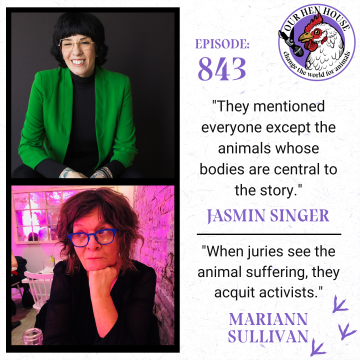
In this eye-opening episode of The Hen Report, hosts Jasmin Singer and Mariann Sullivan welcome back Jan Dutkiewicz, professor of political science at Pratt Institute and co-author of the forthcoming book Feed the People: Why Industrial Food is Good and How to Make it Even Better. The conversation centers on a problematic New York Times article about animal rights activism in Sonoma County, which Jan critiques as “journalistic malpractice” for its misrepresentation of Direct Action Everywhere (DXE) and its failure to mention key investigations into factory farming operations hiding behind a “humane” facade. Jan explains how the article reinforces harmful myths about small-scale farming while dismissing legitimate animal welfare concerns, and discusses how these issues connect to his upcoming book’s examination of food systems, environmental impacts, and the impossibility of scaling “humane” animal agriculture to meet current consumption demands.
Episode Highlights:
- Media Criticism: Jan provides a detailed critique of a recent New York Times article that misrepresents animal rights activism in Sonoma County and fails to mention crucial investigations by DXE that exposed factory farming operations.
- The Reichert Duck Farm Case: Discussion of how the article completely omits mention of the Reichert Duck Farm investigation, which exposed inhumane factory farming conditions hidden behind a “humane” marketing facade.
- Sonoma County’s Self-Image: Analysis of how the article uncritically accepts Sonoma County’s self-portrayal as a haven for humane farming despite voters rejecting a ballot initiative to ban factory farming.
- Legal Injustice: Examination of how courts in Sonoma County refused to allow animal rights activists to present the necessity defense or show evidence of animal suffering, unlike in Utah where similar evidence led to acquittals.
- Food System Myths: Jan discusses his forthcoming book “Feed the People,” explaining how small-scale “regenerative” farming is neither environmentally superior on a per-animal basis nor scalable to meet current consumption demands.
- Environmental Impact: Explanation of the “cow not the how” principle – that the environmental impact of animal agriculture depends more on what animals are raised rather than how they’re raised.
- Book Preview: Jan shares insights from his upcoming book (available February 17th) about industrial food systems, environmental impacts, and the need for more plant-based food production at scale.
- Media Responsibility: Discussion of how journalists should approach stories about animal rights activism with proper context, explaining both normative positions and factual investigations rather than reinforcing stereotypes.
RESOURCES
INTERVIEW TRANSCRIPT
Jasmin Singer: Welcome to The Hen Report from Our Hen House. I'm Jasmin Singer.
Mariann Sullivan: I'm Mariann Sullivan.
Jasmin Singer: And we're so excited about today, we're going to introduce our guest in just a moment. Just for those of you who are just tuning in on YouTube.
Thanks for being with us now that we're on YouTube, as a reminder, the Our Hen House podcasts are like a whole world of podcasts now. Rising Anxieties comes out on Tuesdays. The Hen Report comes out on Thursdays, that's this. The long form interview comes out on Fridays and bonus content for our flock members comes out on Mondays. So, as I just said, we're a podcast and we're on YouTube. So subscribe and hit like wherever you listen. I wanna introduce our guest today because you already know him. If you are a regular Ahan has listener. Uh, Jan Dutkiewicz is joining us once again to talk about Sonoma County, the, the and the New York Times, uh, and a few other things as well, hopefully.
He is a professor of political science at Pratt Institute in Brooklyn, and co-author of the forthcoming Feed the People: Why Industrial Food is Good and How to Make it Even Better. A book that Mariann won't stop talking about it. I'm excited about it too, but Mariann is like...
Mariann Sullivan: Yeah, I'm super excited about it.
Jasmin Singer: She won't stop talking about it.
Mariann Sullivan: This is exactly the book that needs to be written right now, so I really hope you've done a good job.
Jasmin Singer: And it is available for pre-order. And we are going to put a pre-order link on the show notes for this. And I just, I, I know I make this point a lot, but as, as an author, I will say that even if you're not an Amazon person, which I'm not, I don't, I try to not use Amazon.
Mariann Sullivan: All right. All
Jasmin Singer: Getting things on Amazon for authors is a, is helpful, or at the very least, leaving reviews for them on Amazon is also fabulous.
So anyway, all of that said, welcome back to Our Hen House, Jan.
Jan Dutkiewicz: Thank you. It's great to be here. And I appreciate the plug for the book too.
Jasmin Singer: Congrats on that. When does it, when does it officially come out?
Jan Dutkiewicz: It comes out on February 17th.
Jasmin Singer: Wow, you're getting there. You're getting into like the third trimester or something. I don't know
Jan Dutkiewicz: Yeah, exactly.
Jasmin Singer: But, uh, how are you? Are you excited about it?
Jan Dutkiewicz: I'm very excited. Uh, no, I mean, look, I think. I don't wanna hijack this to be about the book, but I just think that, or Gabriel Rosenberg, my co-author and I, uh, we just really thought that the conversation about food needed grounding in real food system analysis and really thinking about problems and solutions at scale.
Jasmin Singer: Mm-hmm.
Jan Dutkiewicz: Really parsing what works and what doesn't about the contemporary food system, rather than working with some utopian ideas of, you know, scrapping the whole thing and starting again. And so that's what we've, uh, that's what we've tried to do. And we actually spent some time in Sonoma reporting, and I'm sure we'll get to that.
Mariann Sullivan: Yeah, I mean, I actually talking about the book, which I don't mind at all, even if it was a totally different topic. It's sort of the same topic as, uh, is involved in the many, many things that are wrong with this stupid New York Times article. Um, so maybe we can start there, but also bring in the book whenever you want to, because I wanna hear about it as much as possible.
And it is the counterpoint. It's like, well, maybe we should have a food system that is grounded in reality instead of in some nonsensical fantasy. Uh, so can you just, um,
Jasmin Singer: Wait, wait, wait. I wanna just say, you, will you come back? I want you to say this on the air so that we have record of it. Will you come back when the book comes out so that we can discuss the book at length?
Jan Dutkiewicz: Yeah, I'd be honored. I'd love to.
Jasmin Singer: Okay, good. Now that you've said that, Mariann, you can continue.
Mariann Sullivan: I, I would like to stick you with you the, the, like, the summary. Like, can you, for those people who haven't read this article, I think almost everybody listening is pretty familiar with DXE, um, and the work they've done in California. Uh, you know, not, not everything. This article does talk about that, but in like the, just, well, I'll let you do it.
Can you just kind of summarize what this article was about? And of course it was probably instigated by the fact that Zoe Rosenberg's trial is coming up, and of course she has been on the podcast as well.
Jan Dutkiewicz: I mean, I think it's fair to say that the trial is the reason the article was written. And the way the article is framed is something like this- there is a group of rabble-rousing viral content hungry activists in Sonoma County, which is already the seat of small scale humane, high welfare farming.
This sort of readout of farming the way it should be done in the United States. And these pesky activists are bothering these farmers who are trying to do right by animals and the planet and foodies. And somehow wrapped up in this is a mention of Zoe's trial. And so the article basically frames DXE as this nuisance that's trying to critique what's best about the American food system in order ostensibly to, you know, shock some liberals, maybe get some of them on board with animal rights. And of course, the story gives, spends a lot of time giving voice to both local farmers, but also, uh, large scale farming interests who get their piece in basically saying, you know, absolutely DXE are a nuisance. They misrepresent the industry, they don't understand the industry and so on and so forth.
So that's what the piece says. And I, unless you have further questions, I can just launch right in because I mean, I just think it's journalistic malpractice, right? And I, I think that this is journalistic malpractice for the primary reason that DXE are not based in Sonoma. DXE have been active in Sonoma for, I mean, for two reasons.
One, potentially because this, it is the sort of liberal readout and it's close to, uh, San Francisco and or Oakland, where a lot of DXE is based. But I think that DXE has focused on Sonoma for two reasons. First, to suggest that, to use their investigations, to suggest that, you know, quote/unquote ostensibly humane farming isn't actually all that humane. But second and more importantly, and this is the case specifically with the, I'm not quite sure if it's Reichert or Ray chart.
Mariann Sullivan: I don't know how you pronounce it either, so we're all in the same boat.
Jan Dutkiewicz: Alright. So let's say Reichert Duck Farms. With that investigation, which is an investigation that specifically showed that a major duck producer was raising, uh, ducks in absolutely inhumane factory farm like conditions while defacto hiding behind this humane front.
So there's both a normative part to what DXE is doing, which is they're trying to tell people that perhaps they shouldn't differentiate so much between industrially RA raised and ostensibly humanely raised animals, which is a normative position. But they're also doing important investigative work that's showing that the claims to, uh, humane production or high welfare production, quote unquote, can actually act as a front for industrial operations, which is specifically what the Reichert Duck investigation did.
And so the glaring and biggest omission in the New York Times piece is that that investigation is not mentioned at all, it quite simply does not appear right. And so the piece in a sense, by missing this huge investigation, which specifically points to an industrial operation using, uh, quote unquote high welfare or local farms and hiding behind this sort of bucolic veneer that pervades farming in Sonoma, that's missing, right? And so if you take out this entire investigation, then all that's left is basically claims from both sides. So DXE saying, well, you know, humane, uh, humane farming isn't all it's cracked up to be. And then there's a lot of space left for industry voices, both local industry voices and large scale corporate meat producing voices that are talking around the issue.
So I would say that that's the first and biggest omission, right? I'd, it's quite simply incomprehensible to me how a journalist could come into this case, write about the story in the context of Zoe Rosenberg being on trial, and quite simply not write about the case, which is at the center of this whole thing, first of all.
Right?
Mariann Sullivan: Can I, can I insert, can you hold onto your train of thought and can I just insert a quote from the article? Uh, this is, they're, they're quoting Linda Hopkins, who is a Sonoma County supervisor who has a backyard farm where she and her husband raise goats and ducklings, and she says, we have free range cattle who live better than I do with multimillion dollar views of the Pacific Ocean. And then the article goes on to say these, the conditions do not matter much to DXE. The grassroots organization believes animals should have the same rights as humans and should not be used for food in any way. I think that whole little quote there just demonstrates like that they're trying to take DXE as saying something very, very specific about whether it's okay to use animals for food at all, and just shape all of the facts around there as if, as if the, the facts that they're confronting here are, are close to as benign as you could possibly be. Cows who have a view of the Pacific Ocean, when actually they just went into these places.
I mean, particularly Reichert, uh, where this, which is what this case is about, and found absolute hell holes. Sorry.
Jan Dutkiewicz: Yeah, no ab Absolutely. And so the second thing I was gonna say is that I think the journalist goes into this with this very, uh, you know, Michael Pollan-esque idea that what's happening in Sonoma is already good and should be taken at face value because it, it is this sort of American pastoral ideal right.
Of people, you know, with free range animals with views of the ocean whom they love very much. And these people are seen as sort of this paragon of, of farming, right? And this is very much been the line in foodie writing, going all the way back to, you know, going all the way back to Wendell Berry. It pervades Michael Pollan's writing, it pervades Bittman's writing it, pervades foodie thought about these issues.
And so that is uncritically accepted by the author, right? The, so for instance, in the piece you quoted, that juxtaposition implies that DXE is going after individual small scale farmers trying to, you know, harass them out of raising their animals, which is specifically not the case. DXE is going after large operations who are like Reichert, who are, uh, basically using this bucolic Pollan-esque vision and its appeal to hide, uh, low, well, low welfare industrial operations. Only the reader wouldn't know that because it's not in the story.
Mariann Sullivan: And because the, that's exactly what the reader wants to believe.
Jan Dutkiewicz: Because that's exactly what the reader wants to hear. Exactly. Right. Cuz, I mean, this hearkens back to the New York Times, uh, you know, the, that essay contest they had about, uh, right, a justification for ethical meat-eating.
Mariann Sullivan: Oh God, That was a
Jasmin Singer: That was a long time ago.
Mariann Sullivan: it.
Jan Dutkiewicz: But it, but
Jasmin Singer: Yeah.
Jan Dutkiewicz: it immediately made me think,
Jasmin Singer: we
Jan Dutkiewicz: made me think of that right. Immediately.
Jasmin Singer: Yeah. And Our Hen House at the time, we did a counter contest where we, we had people write and, and talk about why it's unethical. Um, and by the way, speaking of, speaking of things that make us insane, the, the author, uh Soumya Karlamangla, was very active in the comment section, which I never read the comments like, I don't know what possessed me to read it, but I was so mad about this article that I started reading it, and I noticed that she was very, very thoughtfully engaging with, at the time I looked, with nearly every single comment she was responding with thoughts and you know, further, you know, comments and whatnot.
And so I, I wrote a comment and it was in response to her saying, uh, that certainly since reporting on this quote unquote, she has given a lot more thought to how her food arrives to her plate. And she mentioned truck drivers and farm workers and grocery store staff. She also mentioned whether it was local or not. I sent a comment and I was really polite, like extremely polite, way too polite, uh, in it.
And, and I said, you know, thanks for covering the story. And you mentioned so many of the individuals who are part of getting your lunch to the plate, et cetera. I'm genuinely curious why you didn't mention the absent referent as Carol Adams would call it, the animals themselves. Right. And and I'm asking because it seems like the animals' bodies are central to your meal. And after deep diving in a story like this, do you see this as a relevant factor? And she didn't reply, which is a glaring omission because in she replied to every single other comment at that time. And in that section, uh, and I'm not trying to hijack this conversation, but I'm telling this story to kind of underscore the fact that like her bias is showing big time.
I mean, I recognize, you know, like this reminds me so much of. Jan, I used to be the senior editor at Veg News and like many, many years ago, uh, the, when I was just a writer at Veg News, the, there, there was a story about whether, whether or not to have kids. And it was written by someone who had kids, who had birthed kids. And you know, like obviously you're going to deal with someone writing that story who either has kids or doesn't have kids. But there are responsible ways of going about writing a story like that, including by talking to people who decided for whatever reason not to. But obviously like the end of that article was about why it's important to have them.
And this is supposed to be actual journalism, not like a lifestyle magazine. I am horrified by this article. Thanks for coming to my Ted Talk.
Mariann Sullivan: Do you think this is a part of the whole? I mean, this goes so far back into the whole, you know, abolition versus welfare kind of debate within the movement. and, and I, which I think has in many ways been resolved for a lot of activists. Well, not resolved, but, but they've come to terms with the fact that these, these positions don't have to be in opposition to each other. Um, which, you know, they were portrayed as that a lot of, in a lot of ways. But this, this article, I think, tries to use people's veganism, their belief that animals should not be used for any reason, shouldn't be killed, you know, even if it is humane, against them, to portray them as extremists and ignore the very facts of what's going on in this particular case. So veganism becomes like, you know, once again, veganism becomes proof that you can't think straight about animals.
Jan Dutkiewicz: Yeah. I mean, absolutely. I think that's absolutely the case. I think that's the framing, but there's also... like, okay. Instead of just criticizing the piece, I think as someone who used to work as a journalist, I mean, I still write for Vox and The New Republic, but as someone who used to be a professional journalist, the way you would approach this story is as follows, right?
You, your editor sends you and says, look, there are these animal rights people in Sonoma, which is why it's a story, right, because Sonoma is ostensibly good for animals. Go figure out what it's about. And so you just, you'd ask the basic sort of who, what, where question, right? So who is Zoe Rosenberg? Okay, she's part of DXE.
What does DXE do? Well, you'd talk to some DXE people. You'd read some material about them to find out what their positions are. Then you'd find out, okay, they're abolitionists. What does that mean? You'd explain to your readers what this position is. You'd in fact explain the difference between welfarism and abolitionism, and then you'd say, well, DXE falls perhaps mostly on the abolitionist side, and so they're therefore their critique, they critique animal agriculture in general.
What means they used to do this? Well, they use investigations and open rescue. They also do this in Sonoma, which is this readout of you know, sort of bucolic back to the land, regenerative blah, blah, blah, farming, right? You'd explain what that is, and then you would focus on the biggest case, which is Reichert.
Which sort of collapses the distinction between the two. And then you could get a reaction from the industry. Then you could get a reaction from local people who say, oh, you know, like I find these vegans annoying. But at least now you've done the due diligence of telling the story, right? Which is telling the normative position of DXE, but also explaining their tactics, but also focusing on the primary case.
And then you can do the local color, right? Like you can go to the local people who have their goats who look at the ocean, who are never targeted by DXE and get a word in from them. That's how you, that's how one should approach the story, but none of this appears, right? And so, yes, you're absolutely right.
Vegans are treated as these extremists who are unwilling to accept that the people of Sonoma already do everything and more that, you know, they give their animal, these, the, their animals, these million dollar views, excuse me. And so the reader is left with a negative view of vegans, a negative view of DXE, and little to no understanding of why there is a court case and why the young woman who is pictured in the story is wearing an ankle monitor and is going to trial, right?
And so it's a complete, it's a complete failure. And so you actually, Jasmin, you said that this person's written a deep dive, but I don't think they've written a deep dive at all. Right? In fact, they've sort of parachuted in, they've skipped along the surface like a stone and skipped back out to wherever they're based, which I think in this case is San Francisco, not having done any service to the reader because they haven't actually informed the reader about what's, what's happening, nevermind their normative position.
This person could be a committed meateater, and that's fine. It's not their duty to have a normative position as a journalist, but it's their duty to do good work as a journalist to inform their audience. And which is, which is why I think this series of omissions in this article is absolutely inexcusable.
Like, I have no idea how this got past an editor.
Mariann Sullivan: Yeah.
Jasmin Singer: you writing an op-ed? Did you submit an op-ed for this by any chance?
Jan Dutkiewicz: I, I did, I did not. No, I have to. I'm in the middle of the semester. I'm teaching and I'm working on my book. I don't know.
Jasmin Singer: know. I'm like, can you do something about it? Can you fix this?
Mariann Sullivan: this?
Jan Dutkiewicz: Well, I mean, I, I, I don't, I mean, I don't think I can fix it. I mean, I think I, I've just
Mariann Sullivan: That that was a joke. That
Jan Dutkiewicz: You know, but I would love, I mean, yeah, if, hey, if someone's watching, like I would love to write an anatomy of what this story should look like. Not even as an op-ed, like just go rewrite this, go rewrite the story.
Some other, some other outlets should send a journalist to write the same story, but along the lines that I explained. So at the very least, the readership comes along with an understanding of what the actual case is about and what DXE's position is. Even if you disagree with DXE.
Jasmin Singer: I totally, I I'm there for that. Yeah. I'm, and also, yeah, I, I realize you're, you're a bit like, just a little bit busy these days. I just, uh, I, I just think that your background and, and. You know, CV would, would qualify you to get, uh, the, be the first op-ed there on the, on the New York Times page, and really good promotion for your book, your forthcoming book.
But I digress.
Mariann Sullivan: Put it on your to-do list.
Jasmin Singer: Thank you.
Mariann Sullivan: All
Jasmin Singer: I'll take that.
Mariann Sullivan: Can, can I take another quote from this article just for people who haven't read it and who do not understand how completely infuriating it really is? these are the actions of a new generation of radical activists, literate in the viral culture of social media, and driven by the same goals as predecessors who sprayed fur coats with red paint in the 1980s.
Wow. We're never gonna escape that are we? Organized by the group Direct Action Everywhere, they're seeking to end animal agriculture worldwide by breaking into farms and filming what they say are ill and abused hens cows and other livestock. I mean, there are videos so we could like, you know, like, there could be just more than they say that these are abused or they could at least be like, what look like abused hens and cows.
I mean, if you look at these videos, they're absolutely horrifying, but it's always just, he said, she said, and uh, and, and the, the, he said is, is a bunch of radical activists who want you to stop eating meat completely. Like they never move on from this, this framing.
Jan Dutkiewicz: Yeah, no, abso absolutely. The count, the counter framing here, right, which is completely F, which is completely factual, it's not a normative position, is as follows- groups, so not DXE directly, but groups in the DXE orbit put ballot initiatives on the ballot in both Berkeley and Sonoma seeking to ban factory farming.
These ballot initiatives passed in Berkeley. Berkeley doesn't have factory farms, of course, but it shows that there is political will in a place like Berkeley to ban factory farming. If Sonoma actually believed in these principles of very humane, high welfare farming, why did the residents of Sonoma vote against a ballot initiative banning factory farming?
Shouldn't Sonoma have been the first place if they truly lived by these principles to vote in favor of banning factory farms so they could actually point to the fact that they've banned factory farms and only do you know humane, regenerative or what have you agriculture? No.
When Wayne Hsiung was o n trial in Sonoma in front of a Democratic judge in deep blue Sonoma County, the judge didn't allow the footage that you just talked about to be shown in a trial and also rejected for no stated reason, an amicus brief written by, uh, Kristen Stilt, one of the foremost animal lawyers in the entire country from being allowed into the case.
Why is that? Like why not put Sonoma and Sonoma's self-image that this author assumes here as this sort of liberal, high welfare redoubt? Why not put that reputation on trial as it were, alongside accusations of DXE right? Because the author is taking Sonoma and these various commitments at face value.
She's basically implying, you know, Sonoma's a place you would never see a factory farm. Well, no false DXE's investigations showed us there were factory farms. She says, people in Sonoma hate the idea of factory farming. No false. Given a clear democratic choice to ban factory farms, they opted to keep them. Right?
Like that's the story of Sonoma. The story of Sonoma is of a story that people in a place like that tell themselves about themselves and sell to the outside world, but they're, they're, you know, they're talking the talk really loudly, but they're not walking the walk. Sonoma isn't the place that just has small scale farms, quite the opposite.
Mariann Sullivan: To, to read that article and read the quotes? Uh, if this, if this fictional reporter were able to get any of people's explanations for why they voted against, I mean, I would love to know why not the people who own the, the companies, but why other people in Sonoma thought this was wrong to, to, to, turn Sonoma into a place where it actually does what it already purports to do. I mean, I would be fascinated to hear people's explanations for why they voted that down.
Jan Dutkiewicz: Yeah, me too.
Mariann Sullivan: That would be an interesting article to read.
Jasmin Singer: What do you think is the
Mariann Sullivan: Can I just put in a plug for myself at the moment, like, uh, an ad for
Jasmin Singer: Always.
Mariann Sullivan: a, I wrote a law review article partially on the, that, that Sonoma case and also on the Utah case, which had to do with, uh, you know, and when you mentioned Kristen's, um, really great, uh, uh, amicus brief, uh, it all, it all had to do, and this is what the article was about with, with whether the jury should be allowed to hear the necessity defense, which is basically, you know, a kind of lesser of two evils defense, which is an obvious common sense defense that is, you know, used in the law either as a practical matter or is a legal matter all the time, which, if you do something that would be illegal if you didn't have a good reason, it's, it's not illegal if you have a really good reason that outweighs the harm that would be done by committing the crime. Like if you run into a burning, building, passed a no trespassing sign to save, um, a child or a dog or whatever, it's not a crime. I mean it's a, it's is really basic defense in the law, and they refused to let the jury know that that was a defense, that you could take that into account.
It's insane.
Jan Dutkiewicz: I mean it is, and especially because it happened in Sonoma, which is why I think this whole idea of the story Sonoma tells itself about itself and tells the world about itself is so important in the story, right? Because in Utah, I mean, this is a ruby red part of Utah. In Utah, which is a red state, and it went to a jury, right, and the jury found for DXE seeing the evidence at hand. A jury in Sonoma was not allowed to see that evidence.
Mariann Sullivan: Yeah, or similar, the similar evidence.
Jan Dutkiewicz: Or.
Mariann Sullivan: They, they were, there were different crimes, but similar kinds of evidence that, that these animals were suffering. And what these people were trying to do was to save them from this horrific suffering. Yeah. That was the evidence. They wanted to present it and say like, we were just trying to save these animals.
We weren't trying to do any harm. And, and yeah. When the jury saw it in Utah, they acquitted. When the jury didn't... when they did the trial in Sonoma, they said, no, no, we can't, we can't, um, we can't allow a jury to see that. That would be crazy.
Jasmin Singer: So what do you think as we start to kind of wrap this up, what do you think?
Mariann Sullivan: can I just, we
Jasmin Singer: Yes.
Mariann Sullivan: Can ask your question first, but I, before we leave, I do wanna make sure, because I said in the beginning that this, um, I thought this case was about the same issues as in your book and I would like, I would just like to hear Jan's position on that since I haven't actually read his book. So.
Jasmin Singer: Yeah, that's fine. But, uh, let me just ask you something before we get to that. What do you think the best possible outcome from this article that already exists is or could be? What do you think that the worst possible outcome of this article existing could be?
Jan Dutkiewicz: Well, I mean, look, I don't think any one article is going to have huge reverberations one way or another. So I don't think we can say this is, you know, this is a world changing event. But I think, look, I think the worst case, which I think is, I hate to impute intention to anyone, so I won't impute intention, but I think one can see how an article like this simply reinforces people's notions about what constitutes quote unquote humane farming and who animal rights activists are, which is that animal rights activists are extremists that will stop at nothing in, even in the face of high welfare, non-industrial animals. And that this somehow shows that, you know, vegans can't be listened to and shouldn't be reckoned with, which I think is a, is a very standard position, right? This is a status quo position, and what this article does is reinforce it.
And so the best case scenario is, you know, for things like this podcast, potentially for things to be written by people who are not myself or maybe even myself, right? But yeah, but the idea is to actually tell the story because I think the story in itself, even if one at the end of the day doesn't come out on the side of DXE or veganism or whatever, the story itself is far more complex and speaks to, I think, in many ways the problem with assumptions about things like, you know, uh, quote unquote humane animal treatment. Right.
And I also think that groups like DXE should be given a fair hearing and their position should be given a fair hearing in the media, right? Like I, which is what I said, which is what I said before, one would hope that a reader comes away from a story like that not thinking that DXE are some, you know, kids running around trying to go viral online, but to understand it, you know, what their normative positions are, what their tactics are, what their quite long, now quite long history of activism is, and so on and so forth. The reader leaves that story knowing none of that.
So I think to the extent that this can be a platform for people actually learning about DXE and their tactics and their positions, but more broadly about the debates about welfareism, abolitionism, the failures of welfarism in many cases would be a good outcome.
Jasmin Singer: Is there anything that you would advise our listeners to do? Because our listeners are very savvy around animal advocacy and many work in animal advocacy or, or are otherwise involved? Uh, any, any tips for where to put their, their kvetching or, you know, asking for a me.
Jan Dutkiewicz: I mean, you know, if anyone is, if anyone is savvy with doing things like recording Tiktoks, do dissect this article and you know, fact check it and correct it and plug the gaps. I, being older now, I'm not of the tik, I'm not of the TikTok generation and video as a format, but but something like that, right?
Writing about it, I don't know to what extent complaining about these things on social media works, but may, but maybe it does. Right. So I think, I think all of these things could be done in the immediate sense, right? But in the broader sense, if people are talking about animal rights activism, I think one of the biggest things that people who are concerned with animal issues should do is talk about the positions of the different players involved. Right?
I think there's a tendency to critique or not talk fairly about other people in the animal space if you disagree with them. And I think that that does an injustice to the whole movement, right? Like even if you disagree with DXE, you should be, you should be able to go on social media in the case of a story like this and say like, look, this misrepresents DXE.
It misrepresents what this group is doing and it, and in doing so, it doesn't just malign DXE, it maligns anyone concerned with, uh, the harms caused by animal agriculture.
Jasmin Singer: Yeah. Couldn't agree more. Mariann, did you, uh, wanna ask your, your question?
Mariann Sullivan: just wanna, you know, can we bring it back to the book? I assume you like bringing things back to the book, having just like sacrificed the best few years of your life to produce it.
Jan Dutkiewicz: I even have copy.
Mariann Sullivan: Oh. It's beautiful.
Jasmin Singer: Wow. That's a good, it's exciting. Exciting. Yeah.
Jan Dutkiewicz: Yeah. So in our chapter, uh, Gabriel and I, in our chapter on Sonoma, it's actually, it involves animals directly, but not so much animal ethics as the environmental impacts of agriculture. And we basically went to Point Reyes and Sonoma because of the number of claims circulating about small scale, quote unquote regenerative uh, agriculture, having... being, in a sense, a viable alternative to industrial agriculture and being a way that people can have, uh, people who are concerned about industrial meats, uh, environmental, climate, public health impact can, you know, nonetheless eat animal products. And we went to Sonoma basically looking into, to what, and to Point Reyes, to look to what extent that was actually a fact, right?
So we were reading uh, stacks of scientific publications about the impacts of different forms of agriculture. We were looking at what's been happening in, um, Point Reyes and the various land disputes with the dairies and the ranches. And we found two very basic things, which is number one, when it comes to environmental impact, it's really what you produce and not how you produce it. So it's the cow, not the how, if you will. And in fact, an individual free ranging cow on a per unit basis probably has a significantly larger, uh, environmental impact, uh, and in fact, a larger greenhouse gas emissions impact over its lifetime than a cow that is fattened on a feedlot.
So the environmental impact in a place like Sonoma and Point Reyes is only smaller to industrial systems because there are just far less animals, not because it's actually a more benign system on a, in the aggregate, right? So that's the first thing. And the second thing is that none of these systems themselves are actually scalable at all to meet anything resembling, uh, current American animal product consumption.
And there's never a theory of change given for how you not only shift people to that, to buying animals produced through those modes of production. But how you drastically scale down animal product consumption, right? So if, if you did away with factory farms tomorrow, I'm sure your listeners know this, right?
The United States would have 99% less chickens, 97% less pigs if you count industrial feed lots, like 60 something percent less beef. What's the theory of change for a basically a mostly vegan society that then, you know, on the fringes, eats these high welfare for animals, but that doesn't exist. Right.
And so part of our argument is that places like this act as a sort of, you know, like a moral release valve that people can say, well, that alternative exists out there somewhere, and so I don't actually have to question fundamental things about my consumption habits or about the production systems that we use in this country to produce animals on, on a massive scale.
So, that's just one chapter in the book, but we have a ch and then of course in later in that chapter, we go and look at some alt protein startups. We go to Chinatown, we look at various tofu based dishes and you know, proto alternative protein. But in that chapter, we basically try to get at the question of what forms of food production have the lowest environmental impact? And our reporting
basically bears out the growing scientific consensus that really, if we're talking about having a food system that stays within, uh, planetary limits, it has to be far more plant-based, and it has to be far more plant-based at a large scale to have a large impact. So in a sense, systems like Sonoma's are the worst of both worlds, right?
So on a per unit basis, they're more impactful and they're inherently not scalable. So they're not actually a viable food system solution at scale at all.
Mariann Sullivan: Of course. Yeah, of course. This is such an important message. It is unbelievable that people don't think this through that of, of course we, we can't do that. Do they have any idea how many people there are? Like it's. It's just such irrational thinking. We recently interviewed, um, Will Potter about his new book, Little Red Barns. I dunno whether you're familiar with it. Really interesting. Not, you know, there are a few parallels with, with, with your book, but one that just struck me with what you were talking about, he's, he's, he's talking about the intersections between fascism and animal agriculture. Kind of theoretical and actual intersections.
And he is talking about how this myth of the little red barn, which is what he calls, uh, you know, the book, is just so fundamental because any kind of fascist system always has to look back to a mythical past that actually never existed and certainly still doesn't and could never be resurrected. But it's this myth that they can use to keep people, uh, tied into, I don't know, the current reality. Just thinking about the wrong thing all the time. I, it, it. I mean, a very different, uh, book from yours, but also similar in that, in, in that respect that we, like everybody is trying to think of a way to wake people up to this reality that this doesn't make any sense whatsoever.
We can't go back to that. And it's not even going back to it, it, it never actually existed. Um,
Jan Dutkiewicz: I mean, exactly. It never actually existed at scale, right? I mean, this is, this is a whole different conversation, but American. The earliest American farmers were already tied into global circuits of commodity circulations, were already producing food for urban markets and the large urban centers of the East Coast, right?
Like we never lived in a moment of small scale self-sufficient farmers who were somehow cared about animal welfare and you know, environmental stewardship. Like that whole Aldo Leopold land ethics sort of, Michael Pollan, et cetera, myth, like it's a myth, as you just said. It's a myth. It never, it never existed.
And it's just an idea people wanna, I think, hold onto. To think of, um, farming and agriculture as this noble and benign thing.
Jasmin Singer: Yeah.
Jan Dutkiewicz: Right? Rather than a business which it, which it is.
Mariann Sullivan: that came to are, are you familiar with James McWilliams?
Jan Dutkiewicz: Yes, yes, yes.
Mariann Sullivan: I, I just remember years ago we had him on a few times. Um, he was a friend and, um, I just remember the quote that I first read of his, I think, I think it was in an article, I'm not even sure it was in a book like, um. It said something like, if you wanna feel good and, and get some exercise, ride your bike to the farmer's market. If you actually wanna do something about, um, suffering animal or do something about the a the environment. He wasn't even talking about suffering animals, uh, become a vegetarian. He had not yet become vegan.
So I'm not changing the quote for him, but, uh, know, people just wanna think it's cute. It isn't cute.
Jasmin Singer: Mm-hmm.
Jan Dutkiewicz: Yeah, exactly.
Jasmin Singer: Well. Do you, do you have any final words? Yeah, I know. I'm super excited about, actually reiterate the name of it for our listeners.
Jan Dutkiewicz: The book is called Feed the People, and the subtitle is Why Industrial Food is Good and How to Make it Even Better.
Mariann Sullivan: Um,
Jan Dutkiewicz: Which I think is intentionally provocative because there are obviously parts of the industrial food system, like industrial animal agriculture, we don't support. But we're talking about a broad set of industrial values, which is high labor productivity, strict regulation and standardized production at scale, which is what we mean by industrial.
Mariann Sullivan: And everybody remember the pre-ordering is really helpful to a book.
Jan Dutkiewicz: Yes, please pre-order, uh. You can go to the Hachette site and pre-order from there, or yes, for the algorithm, if you want to swallow your, swallow your ethics, you can, and perhaps should, pre-order for my sake from Amazon.
Jasmin Singer: Well, uh, I think that maybe people could even do both if they want. I'm, look, I'm having people do their, um, their Valentine's Day shopping. You said it comes out in February. Right? Okay. A Valentine's Day gift is a very strange marketing campaign for that book, I admit. But you know, I, I already love the book, so I am, I am excited about it, regardless of why people get it.
I think they need to. Alright. Don't go anywhere.
Mariann Sullivan: I have one more quote, let me just read it. Doug Beretta, a third generation dairy farmer, said that he and others feel unfairly attacked by a group trying to force veganism on the county. He spent $5,000 on a fence to prevent DXE from filming videos of calves in pens along a main road.
Exactly what is the connection between forcing people to be vegan and hiding your calves, uh, in hutches? How is that? Does he think that by, uh, by taking filming of them, it's gonna force veganism on people? Well, maybe actually he's right.
Jasmin Singer: On that note,
Jan Dutkiewicz: On that note.
Jasmin Singer: because we need to, we need to do our fancy outro that you get to sit here for. But then also we need to finish the upload, so, so don't hang. Just yet. Hang on. Um, okay. Well if you are here and you are watching or listening, thank you so much. And Jan, do Hold on a second.
Don't tell me I'm gonna get it right. Dutkiewicz. Right.
Jan Dutkiewicz: Perfect.
Jasmin Singer: Well, thank, first of all, thank you for being our wingman today and for joining us for The Hen Report. We, we, we, this was such a cool conversation. I'm very excited about having you back on when your book comes out. So, and also you just came on so last minute and I just really appreciate that.
So thank you.
Jan Dutkiewicz: Yeah, no thanks. Having me on.
Jasmin Singer: And thank you for viewing us right now, for listening to us right now. Don't forget, oh, Mariann did. Did you have a Animal Law podcast come out recently?
Mariann Sullivan: Yes. Last Friday, my interview with Christopher Barry from, um, Non-Human Rights Project, regarding their work on that case in Brooklyn of all places, which is where Jan is, um, about, uh, valuing a dog who was, uh, negligently killed in front of, um his guardian, in on a Brooklyn Street And the judge in the Supreme Court, which is the lowest court in New York, which is confusing to everybody, but it was the trial court, made a very, very momentous decision that really broke from, from, from a lot of, um, the, the past law, uh, in, in, in this area and, and basically ruled that the dog was a family member.
And, and because of that, her trauma could be recoverable. Really fascinating case. Um, and tomorrow, don't miss our interview with Carol Mithers, who, um, wrote a Rethinking Rescue, which is a book about, um, about some new thoughts and more progressive thoughts on what to do with, uh, animals who are in particularly those who are in the hands of people who are struggling, um, either financially or with, um, with issues of mental illness or all sorts of other things. And it's such an important thing to read right now because, uh things are bad out there in the shelters. They were, they were a lot better for a while and they're not now, things are getting worse. And, you know, particularly, uh, with, with the horrific violence against immigrants, um, perpetrated by our government, um, there are animals ending up in the shelters and, and anything that we can do to keep animals in homes is, is such important work.
I love that interview. So don't miss that tomorrow. And Monday, Carol will be, um, reading, uh, an excerpt from the book for our flock members, so don't miss that.
Jasmin Singer: And if you're watching this, remember that Our Hen House is a nonprofit 501c3. So if you're able to become a Flock member and you're not one yet, ourhenhouse.org/support. Thanks so much and we'll talk to you soon.
_____________________________________________

Thank you for listening to the Our Hen House podcast! If you enjoy our podcasts, believe in our mission to effectively mainstream the movement to end the exploitation of animals, find community and solace in our shows and resources, and would like to show your support for vegan indie media, please make a donation today. Contributions of any amount will go towards our fundraising goal and are hugely appreciated. Our Hen House is a 501(c)(3) nonprofit organization, so it’s tax-deductible. Thank you for helping us create quality content!
Subscribe to our show on Apple Podcasts, YouTube, or your favorite podcatcher, and don’t forget to leave a 5-star review!
Check out Our Hen House’s other podcasts: The Animal Law Podcast, The Teaching Jasmin How to Cook Vegan Podcast, and the Antiracism in Animal Advocacy Audio Series.
Follow us on social media! You can find Our Hen House on Facebook, Instagram, TikTok, or Bluesky.
The Our Hen House theme song is written and performed by Michael Harren.