
 Apple Podcasts
 RSS
 Amazon Music
 Spotify
 YouTube
 PocketCasts
 CastBox
 Player.fm
 TuneIn
 Audible
 App not listed? Try this RSS link
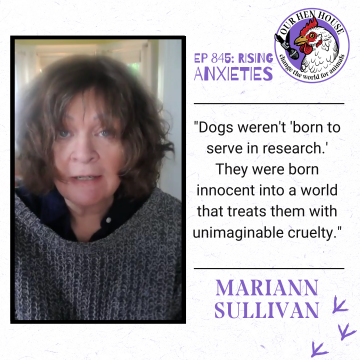 In this week’s emotional rollercoaster of righteous indignation, Mariann dives headfirst into the meat industry’s latest shenanigans. From legal battles over lab-grown meat to the absurdity of milk being crowned official state beverage in 20 states (water, anyone?), to the heartbreaking reality of dairy farm fatalities, this episode serves up a buffet of reasons why the meat industry should be nervous.
Episode Highlights:
- Federal Lawsuit Challenges Texas Cultivated Meat Ban – Texas faces legal action over legislation that could imprison people for up to a year for manufacturing or selling cell-cultured protein
- Dormant Commerce Clause at Center of Legal Battle – Unlike California’s Prop 12 animal welfare regulations, Texas’ ban appears designed primarily to protect its beef industry
- Rise For Animals Exposes “Lab Dog Lie” – Controversy over researcher’s claim that dogs are “born and bred to serve in research” following exposé at St. Joseph’s Hospital in Canada
- Milk Named Official State Beverage in 20 States – Including New York, Pennsylvania, and Minnesota, while Indiana wisely chose water
- Tragic Deaths at Colorado Dairy Farm – Six workers, including three family members and a 17-year-old, died from hydrogen sulfide exposure from a manure pit
- Dairy Industry Safety Concerns Highlighted – Similar fatalities documented across multiple states reveal regulatory gaps, including OSHA standards that don’t cover agricultural confined spaces
INTERVIEW TRANSCRIPT
Mariann Sullivan: Anxieties are rising. This is the podcast in which I talk about how the industry's... the meat industry, obviously. Do I talk about anything else?
Anxieties are rising and increasingly how my anxieties arising, which, you know, I have to talk about, I have to have somebody to talk about it to. Oy! Our first story, I, well, it's kind of a good story.
Uh, it, it, it Texas Hit With Federal Lawsuit Over Cultivated Meat Ban. This is from Feedstuffs, which is an industry site, and they do not like that there is this federal lawsuit. It is very similar to another lawsuit that I interviewed the attorney for, Paul Sherman, uh, on, um, let's see... it was episode 115 of the Animal Law Podcast.
Um. It was last December, and that was about the Florida ban. And, you know, they're trying to get ahead of the game here and, and stop, uh, cultivated meat from existing. And so far, uh, you know, they haven't been successful. Neither of these lawsuits is, is completed. And their basic argument is that, is that, you know, there are a few arguments, you know, as everything with a lawsuit.
It's more complicated than, than than you imagined. But, uh. But is that it, you know, it, it violates the, uh, the, the dormant what's called the dormant commerce clause, which protects interstate commerce. You know, it basically, it, it, it just has certain provisions that provide that, that states can't discriminate against each other in a variety of different ways. Um, just to protect their own, uh, their own industries and, and farms and whatever.
And, uh. So, so now Texas has been hit with this federal lawsuit because they have recently, you're probably aware of it, also banned, um, cultivated meat. You could actually go to prison for, for I, let's see. Uh. I don't know- manufacturing, processing, possessing, distribution, offering for sale on or sale of cell cultured protein.
You can go to prison in Texas. Um, so that's nice. Um, up to one year. And you can also be fined $4,000 or both, and that's probably for every, every time you do any one of those things. So, um, that was signed into law by, by Texas's governor Greg Abbott on June 20th, and now this lawsuit has been filed and, and, um, you know, as, as the, uh, the proponents of this lawsuit say, which includes Upside Foods and Wildtype Foods, which is, uh, also, which is the one that's like recently produced, the fish, um, uh, salmon, I think, uh.
Uh, and, and you know, the, the Wild Type's founder says, this band slams the door on choice. When we're all, all we're asking is the freedom for Texans to decide for themselves and, and, uh, I think it's a good lawsuit. I mean, I think this, these lawsuits have legs, uh, because basically what Texas and Florida are both trying to do is protect their own industries, and that's what you're not allowed to do under the dormant commerce clause.
I saw this article somewhere else in the, um, you know, when I'm reading industry sites that compared it to Prop 12. And Prop 12 of course bans the sale in California of, of certain pork products that come from pigs that have been raised in, in basically in gestation crates. But, you know, basically, uh, not in conformance with the way pigs have to be raised in Cal, California.
And, uh, that's been upheld by the Supreme Court as not in violation of the Commerce Clause. And they said, well, it's the same thing. We're just banning these other things. But it's totally different because it's your purpose. It's, it has to do, I mean, as I, I always have to give these disclaimers. It's more complicated than this, but basically the issue is your purpose.
The state's purpose in doing it, California is trying to protect animal welfare. The Supreme Court held, that's, that's legit, which is pretty nice for the Supreme Court to have held that. And uh, and they're doing the same thing to California growers, pig pig farmers as they are to, uh, out of state. So, so they're just trying to, uh, to enforce their, basically what is an animal welfare regulation and ban the sale of products that have been derived from cruelly treated animals.
Of course, they haven't succeeded in doing that, but that's the basic principle. Whereas what Texas is trying to do is protect its beef industry. I mean, they basically admit they're trying to protect their beef industry.
That's exactly the kind of thing that, uh, that the interstate commerce clause is designed to, to, uh, work against. One state discriminating against products from other states, basically to protect its own industries. We want there to be interstate commerce, uh, not, you know, we want the, we want commerce to flow, uh, fairly between the states.
That doesn't mean that one state can't, can't have particular regulations protecting its residents or, or protecting animals that, that, that might, uh, you know have a different effect on out... well, it has the exact same effect on out-of-state growers that it has on California. Anyway, um, so this is this, I, I think this is perfectly demonstrated by this quote from, um, the president of, you know, some cattle...
Texas and Southwestern Cattle Raisers Association, ranchers across Texas worked tirelessly to raise healthy cattle and produce high quality beef. Our association is grateful for those legislators who voted in support of this legislation and understood the core of this bill to protect our consumers, the beef industry, and animal agriculture.
They wanna protect their beef industry. That's what, and, you know, a, a, a particular type of agriculture, uh, the fact that they're saying they wanna protect our consumers, well, I guess that's kind of like the, the, the argument that they've got that sounds, that doesn't sound outright wrong. The other two are just outright wrong.
But, you know, as we'll see from these lawsuits, that's not what they're doing at all. We know that's not what they're doing. You know, like the, the people from, from the plaintiffs are constantly saying like, we're just giving people a choice. They don't have to eat it. It's Texas. Don't they believe in freedom there?
Um, alright. Rise For Animals. This isn't a long, um, point that I wanna make, but I did wanna make it Because, um, Rise For Animals is talking about, uh, uh, the lab dog lie. And I, it just really does grate on me when people in vivisection call these dogs, lab dogs, and they're talking specifically about, um, this vice president of research and scientific director at St. Joseph's Hospital in Canada, which has dis discontinued some of its dog experiments after this graphic expose and a public out outcry. And so, uh, she left the hospital after the expose. She's probably, I don't know whether she was fired or she saw the writing on the wall, but she told her staff that the dogs whose torture and killing she oversaw were born.
Um, the animal, and I have the direct quote here, the animals used in this research, we all note they are heroes, born and bred to serve in research. Those dogs wouldn't be alive if it weren't for this work. They were born to do this work. Bullshit. This is the most offensive line, like as if. As if you are God and, and like this mythical God that can decide like why anybody was born.
I mean, is this the exact same argument that was made to, um, defend slavery? I believe it was. They were not born to... they were born, they were born innocent into a world that was going to treat them like in the most unimaginably cruel ways possible. I just hate this trope and I think that, you know, there's been a lot of work to, uh to, to destroy it to. You know, this is something that people get, especially when it talk... they're talking about dogs. People will believe this about farm animals. Well, those pigs were born for that because they won't think any further than that. But people know dogs weren't. They really do. Um, she was also recorded telling her staff that research protocols, quote, are not meant for the public because the public doesn't understand the science.
Well, bullshit again. Like the public is perfectly capable of understanding the science. They just do not understand, uh, why we should have to do this to these animals, uh, which we don't, uh, because the public is, is smarter and has more morals than you do. I hate that, that the use of those kind of expressions.
And I do think more and more pushback to it and more and more understanding. Especially, you know, as I mentioned when it comes to dogs. Alright, this is, um, just this weird article from Ag Daily and you know how annoying it is when you go to some program and somebody in the, and there's somebody speaking from some organization and people stand up, and maybe I'm the only one who finds this annoying, people stand up in the audience is, you know what you should do. It's like, there are many things that can be done, and we, we need everybody to have good ideas, but they're not just for other people to do. Everybody needs to do them. So what I'm gonna do now is say, you know, you know what someone should do 'cause I'm as bad as anybody else.
I, maybe I could do it. I don't know. I don't know exactly what the campaign would, would be. This is a stupid little article from Ag Daily. Milk Reigns as the most widely adopted official state beverage. Did you even know there were state beverages? Of course there are. You know, there's state everything. Um, and he does mention this is by Brian Boyce, um, that 20 states, including Arkansas, Kentucky, Minnesota, Oregon, and Pennsylvania.
But I looked it up. And also including New York, um, which is where I live. Milk is the state beverage. This is offensive. This is my government promoting milk. As if they don't all the time. He grew up Indiana. I have to say. He grew up in a small farm in Western central Indiana and there were lots of dairies and he's obviously all for it, and he was surprised to see that the official state beverage of the Hoosier state is water.
I mean, go Indiana. That is so brilliant. That is by far the best thing anybody can drink. I think every state should adopt and also like, like is there any in, well, I guess, I guess you could say people selling bottled water, but it's not bottled water that's their state beverage. It's just water. I love Indiana.
Well. I don't actually, there are many things that Indiana does that I'm not fond of, but I love that. There are a couple of states that have alcoholic beverages, but they are co uh, official beverages. I guess they don't wanna suggest that everybody in Virginia should, should drink George Washington's rye whiskey or everybody in Wisconsin should drink brandy, but good for them.
Um, other, other favorites. All of which are fine with me. Apple cider, tomato juice, that's an interesting one, lemonade, uh, lemonade is a lovely one. Um, also, you know, like. Not, you don't see some industry, uh, pushing, pushing those particular ones. However, we all know that industry has pushed, uh, milk as the favorite beverage.
And, um, even he admits that it's a mixture of economic interests, nutritional advocacy, and a helpful heaping of grassroots initiatives. Like it just seems like this would be, I mean, it would be very hard to get any legislator to adopt this legislation unless you have some unbelievably friendly, uh, legislator.
But still, it's just such an opportunity to explain why milk really, really, really shouldn't be, uh, a state's beverage. And he, he points out he, after doing this whole thing about how kids got adopted, got it adopted in Oregon. Yeah, I bet it had nothing to do with the dairy industry because kids love milk so much.
I hated milk. I really did. Maybe that's where it all began. Um. Milk is disgusting. It leaves that flavor in your mouth. Uh, and, but, uh. Then he, he does mention that it requires corporate backing. Well, it obviously doesn't require corporate banking uh, backing because then water would not be the beverage of Indiana.
Just good. It requires good sense. And he also mentions that there has been some pushback against milk, but based on fat content. Well, we need to push back of milk being your state beverage based on, uh, cruelty evil... mons... being monstrous, being the worst thing in the world. Are those good enough arguments?
Uh, you know, I don't think it really, like, I didn't even know there were state beverages. I'm not surprised 'cause they're state everything, but I'm not. But it's not like it's really influencing anybody. Though they obviously consider it important 'cause they work on getting it done. But it's such a, I think it's a great vehicle for, uh, getting press, getting attention.
Um. Speaking of milk. All right, this is my last story, and it's a terrible, terrible story. I'm sorry. Uh, I'm sorry to, to have to tell you this story, but it's just awful. If you wanna turn it off now, uh, I guess you can, um, but it would hurt my feelings. Colorado. This is from Dairy Herd Management, Colorado Community in Mourning After Devastating Tragedy at Prospect Valley Dairy.
And it says, we are now learning more about those who lost their lives on the evening of Wednesday, August 20th, as a tight-knit Colorado community is reeling from a devastating incident that occurred at Prospect Valley Dairy. And, uh, and the initial findings by the Weld County Coroner's Office hinted at exposure to hazardous gas.
And, uh, so that's pretty much all they talk about, um, with, with the cause. Uh, a source, no, there is one other thing. A source close to Dairy Herd Management described the chaos as the dairy manager attempted to assist others before collapsing, highlighting the confusion and fear that gripped the location that day.
Uh, and. These were the, um, men who died. Ricardo Gomez Galvan, Noe Montanez Casanas, Jorge Sanchez Pena, Alejandro Espinoza Cruz, Oscar Espinoza Leos, Carlos Espinoza Prado. All of those Espinozas were related. Can you even imagine? One of them was 17, 17 years old, and they all died as if you know. That's all the information that's in this art, art article.
Fortunately, we have Kenny Torella at Vox to tell us what really happened. Um, Cow Manure Just Killed Six Workers on a Dairy Farm: it happens more than you'd think. Dairy farms are among the most dangerous workplaces. Why aren't they regulated like it? And now we're getting into, you know, it was just, it's portrayed as an accident.
The word accident implies that it was nobody's fault. Well, as any lawyer knows, uh, any tort lawyer knows most of the time when there's an accident, somebody was negligent or worse, uh, did something deliberately. I don't think we're talking about deliberate here. Uh, it's, it's usually somebody's fault, sometimes more than another.
Sometimes somebody was extremely reckless, somebody. Sometimes somebody just made a stupid mistake. This is pretty, you know, maybe you could portray this as intentional because they could fix this and they don't. Um, as he points out, dairy farms are often portrayed as quaint and bucolic, but on the ground, the dairy industry is among, is among the most hazardous to work in. The heavy machinery, the large animals, and the millions of tons of toxic manure.
It creates, uh, a perfect environment for injuries and even death and, um. He, he acknowledges that local officials haven't said much about the deaths other than confirming the victims died from gas, gas exposure in a confined space. But that gas was from cow manure.
And according to some, uh, some dairy industry sources who spoke to, um, uh, an A BC affiliate in Denver, it, it started with a contractor working on an underground manure pit, who accidentally turned on a valve or pump that released hydrogen sulfide. In the first place that accidentally, he didn't do it on purpose, but why did he do it? Like was it, was it easy for him to do it? Like these are really important questions. Was it like clearly marked? Was it very hard? Like did you have to unlock something?
Like are we, like was it an easy mistake to make? These are really important questions. Um, alright, so you release hydrogen sulfide, you pretty much die. Uh, they col, he collapsed almost instantly. And then these five other workers at the farm like were killed trying to save him. It's just horrifying. Just horrifying.
Three members of one family. One of them was 17. Uh. Um, and you know, of course, because Kenny does a really thorough job, he, he reports on the fact how this is not unusual. And, and, and there would be other ways to store this manure if they wanted to. It's not like the only solution is to not have dairy farms, though that obviously would be the best solution.
It's, it's more expensive, you know. Um, and earlier this year he points out a man in, at a New York dairy, died after trying to retrieve a tool that fell into a manure tanker. His colleague attempted to rescue him, also died.
In 2021, three Ohio Brothers died in a manure pit. Uh, and. And, uh, in two, 2007 methane, another toxic gas, separate from hydrogen sulfide, emanating from a pipe in a manure pit at a Virginia dairy, killed four family members and one worker.
This is obviously something that happens all the time. It is obviously something that is preventable by spending money. They're not adequately regulated. And Kenny goes into that in, um, in great detail, uh, and points out that they're often described as accidents, but they're not really just purely accidents out of the blue.
Like somebody was irresponsible and part of the irresponsible is in the law, the gaps in labor law and enforcement that make agricultural work so dangerous is the other topic that he covers here. And, and, and how, um, uh, as an example, OSHA's standards for confined spaces, uh, do not cover agriculture.
Unbelievable. Unbelievable. Highly recommend, of course, Kenny's article. And, um, I'm sorry to end with on such a dark, dark note, but, uh, it is a note that, you know, just creates more and more inspiration to do something about this horrifying, horrifying industry. Oh, that really rose, rose. That really, how did I say that?
Made my, made my anxieties rise. Anyway, thank you so much for joining me today on Rising Anxieties. Please, please, please remember to subscribe or like, uh, wherever you listen, and that really helps us out, especially on YouTube. Well, not especially on YouTube, wherever you are, but we're trying to build an audience on YouTube.
And of course, if you are able and you want to, you can always donate at ourhenhouse.org/support.
_____________________________________________

Thank you for listening to the Our Hen House podcast! If you enjoy our podcasts, believe in our mission to effectively mainstream the movement to end the exploitation of animals, find community and solace in our shows and resources, and would like to show your support for vegan indie media, please make a donation today. Our Hen House is a 501(c)(3) nonprofit organization, so it’s tax-deductible. Thank you for helping us create quality content!
Subscribe to our show on Apple Podcasts, YouTube, or your favorite podcatcher, and don’t forget to leave a 5-star review!
Check out Our Hen House’s other podcasts: The Animal Law Podcast, The Teaching Jasmin How to Cook Vegan Podcast, and the Antiracism in Animal Advocacy Audio Series.
Follow us on social media! You can find Our Hen House on LinkedIn, Facebook, Instagram, TikTok, Threads, or Bluesky.
The Our Hen House theme song is written and performed by Michael Harren.