 Apple Podcasts
 RSS
 Amazon Music
 Spotify
 YouTube
 PocketCasts
 CastBox
 Player.fm
 TuneIn
 Audible
 App not listed? Try this RSS link
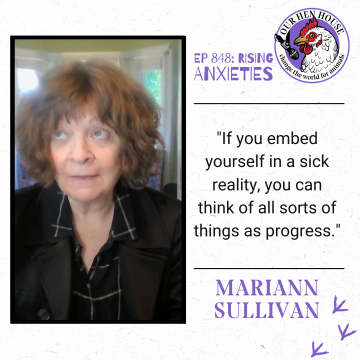 In this episode of Rising Anxieties, we go on a whirlwind tour through the meat industry’s latest absurdities. From a meat industry writer’s hilariously misguided claim about “the first real science fiction movie” to the EPA’s disturbing rollback of slaughterhouse waste regulations (because nothing says “unleashing prosperity” like animal blood in the water supply), Mariann doesn’t hold back. The episode culminates with a genuinely exciting legal victory as Legal Impact for Chickens successfully establishes their right to prosecute animal cruelty at a self-proclaimed “regenerative” dairy farm—proving that sometimes, justice finds a way through the cracks of a broken system.
This episode explores:
- The meat industry’s bizarre embrace of AI as a potential savior, even as it might eventually conclude their practices are inefficient
- How the Temple Grandin mythology continues to provide convenient cover for the meat industry’s horrible practices
- The EPA’s troubling removal of pollution regulations for slaughterhouses under the guise of “defeating the cost of living crisis”
- A groundbreaking legal victory allowing animal advocates to directly prosecute cruelty cases against Alexandre Farms dairy
- The shocking increase in “beef production per cow” from 217 pounds in 1951 to approximately 700 pounds today
INTERVIEW TRANSCRIPT
Mariann Sullivan: Anxieties are rising! Crazy stories this week.
I, I, I have to say, and perhaps the craziest, uh, oh, I think I'm supposed to explain what Rising Anxieties is, but you probably watch it, but, or listened to it before, but it's where it used to be my reports on, on things of why the industry's anxieties were rising and we were winning.
Okay. I got a little bit more realistic and then now I include things about why my anxieties are rising and one of the things that has made my, my. Anxieties rise, or my ire rise this week is this comment, which has nothing to, this has nothing to do with animals. I'm just gonna start off this comment on this story.
It's from this, this article on Meating Place by Matt Graves. Artificial intelligence a means to an end or the end. Alright, before he gets to any discussion of the media industry, he, he says that the first real si, most of you are too young to remember the first real science fiction movie, Stanley Kubrick's, 1968, release of 2001, A Space Odyssey.
I'm definitely not too young to remember that, but that wasn't the first real science fiction movie. Are you crazy? Oh my God. What about, uh, uh, The Day the Earth Stood Still? Oh, like, what about Godzilla King Kong? Um, all right, I'm looking on, on. On Google. On The Beach. On The Beach is technic On The Beach.
If you haven't seen On The Beach, you have to see On The Beach. It's about, it's about us. I, there's millions of them. They were huge in the fifties. The Fly, like, anyway. Alright, I digress. I digress before I even start. And what he's talking about. I mean it just his way of starting this article on AI and it just has this weird take that I thought I would talk about.
Let's apply ai, he says, to protein production. That's what they like to call killing, slaughter, the slaughter industry is protein production. In a document prepared by the European Parliamentary Research Service, Claudia Vinci author, April, 2025, it was predicted that overall, the increasing use of AI in livestock farming is a significant step towards creating a more efficient, productive, and sustainable food production system.
Aren't we happy they're not talking about getting animals out of it? This is the, and then you list some ways in which AI is going to affect protein production. Health monitoring, precision livestock farming, genetic selection, nutrition optimization, disease prediction. Can you just like all of these animals, continuing, continuing forever for as long as our species exists.
Like what are we doing here, people? Just caught in this unbelievable web of sick human invention. Alright, uh, I'll stop. Um, alright. He says that the ex, these examples show showcase how AI can Im impact and forecast needed changes within the current protein production practices. Yeah. Uh, it does need change.
These are not the changes that are needed. Um, but, and this is what he's really, the point he's really trying to make, I think, I'm not totally sure, but AI may determine that cell cultivated proteins are the best alternative for the earth and it's human inhabitants' sustainability. Yeah. All right. Let's bring on the ai.
I'm all for it. He asked, is such a reality the end of which I speak? He's talking about is it, is ai the end? Well, if it's the end of the meat industry, let's, uh, let's do it. All right. He talks about this article in Drovers by John Lka comparing beef production per cow 74 years ago to today. This is really unbelievable.
In 1951. Where a, a year in, which I'm sure there were many great science fiction movies, but in 1951 the figure was 217 pounds. You got 217 pounds of beef out of one cow. This year it will be about 700 pounds. That's almost unbelievable. It, it is almost unbelievable. And in one way, I guess we could call, in our sick, sick reality, we could call this progress because fewer animals are being killed.
Like if you embed yourself in a sick reality, you can think of all sorts of things as progress. However, he points out, AI may conclude in some distant future. Let's hope it's not that distant, that even while such production gains are phenomenal, they are simply replications of a current, inefficient, and costly system when compared to cell cultivated beef production.
Yeah, bring it on and if AI continues its present track, it may just mandate and implement a production change without input. Are you ready for that? I'm ready for it. You know, and it's interesting 'cause he, he has previously written like without, you know, there's kind of assuming that AI cell, cell, cell based meats or whatever we're calling them, cultivated meats are gonna be the future.
Interesting. Interesting and creepy. It's all creepy. Alright. Also from, uh, speaking of creepy. This is from Janet Riley, also from Meating Place.
The Science of Stories new film and Open Door is Model of Education and Persuasion. I had not heard of this movie. You may have. I. I admit that I'm, I haven't watched it and I will do a lot for you people. I really will, but I'm not gonna watch this movie for you. Um, this is, um, this is a movie about Temple Grandin, who I think is the creepiest person.
Um, and she starts off by this column by saying, she just, this story, little story she's telling of, of a conversation she had with somebody who's really not familiar with the meat industry at all. Chaz Ebert, who was, um, wife of, uh, the late film critic Roger Ebert, as we spoke, the subject of animal welfare came up.
She then described Dr. Temple Grandin's impact. She told a very descriptive, very accurate story about how Dr. Grandin led the redesign of plants and livestock handling systems and of the welfare auditing process. I asked her how she knew so much. Her answer, I saw the movie. This is a movie that is feeding people all the information that they want.
They wanna think that the industry is humane. And of course, Temple Grandin's work probably has made it a little less horrifyingly inhumane and served as a cover. Just as it does for her. She probably doesn't wanna stop eating meat. Um, so apparently it's on Amazon Prime and Apple tv last started last month.
I did look it up on Amazon Prime. I wasn't gonna watch it. I'm sorry. I'm not gonna watch it. Stop nagging me. I'm not gonna watch it. Uh, and you had to pay for it. So, uh, I don't think it was on Prime. I don't know. Uh, I, yeah, I'm not recommending that any of you watch it. It's probably just the most annoying thing you've ever seen.
So there was that movie that, um, I think it was with Claire Danes, like a while back about her childhood. This is about her career. So you can imagine. And the persistence it took to advance her ideas. The film is so compelling that it captured best biopic at Cannes. Um, and you know, it talks about how the industry is male dominated.
It still is. And she was able to, uh, to succeed anyway. And her story now inspires countless people. And this is the example that she gives. Um, the industry could share public data about decreases in produce. Oh yeah. This is a real, I mean, it's good if they use fewer, if they electrocute the animals, well, not electrocute, like give the animals an electric charge fewer rather than more times it, I'm not saying that's not good.
Or the industry can share a story Dr. Grandin once told about flying to Ireland and taking a helicopter ride to a rural plant. That plant, of course, is a slaughterhouse that couldn't seem to drive their cattle through a chute without excessive prodding. Oh my God. Oh my God. It's a crisis within the meat industry. By assuming the point of view of the cattle, like, fuck you Temple Grandin saying that you can think like a cow. Like, how dare you?
Temple concluded that the lighting and shadows were frightening the cattle and causing them to back up. With some cardboard and duct tape, oh, isn't she clever? She fixed the lighting and the animals moved forward without the stress of a prod. After this low tech fix, she jumped back in the helicopter and caught a plane back to Colorado, proving that good welfare... where I'm sure everything is just dandy...
we're proving that good welfare requires us to think and see like our livestock sometimes. Yeah. Why don't you do that a little bit more, honey? Like, why don't you actually do that a little bit more? Did that story create a picture in your mind? A scene that you won't soon have forgotten? I'm guessing it might have. Did for me.
Oh, this is the kind of bullshit. Not sure that's the right word. Maybe it's exactly the right word. Uh, that they try to feed the public, and the public is just so easy to convince. All right. I have two, two articles to talk about. I'm not gonna go into detail in them. They're both environmental issues.
They're both from Sentient Media. Of course it does like amazing work. If you wanna read them, you should go look on Sentient Sentient Media. The first is by Sophie Kevany. FDA drops proposed rules. You know, when we're talking about what's happening in today's political environment, all of which is bad. F oh E-P-A! E-P-A drops proposed rules to limit slaughterhouse waste pollution.
Trump's EPA cites quote, unleashing prosperity as it withdraws rules meant to curb pollution from slaughterhouse blood in the water supply. Charming, right? Uh, so they, they, these were proposed rules. They hadn't even gone into effect yet. They, they were of course, advanced during the Biden administration and now they're saying, no, no, no, no, we don't wanna do that.
Um, because, uh, withdrawing these proposed rules would be advancing the goals of President Trump's executive actions on defeating the cost of living crisis. Oh yeah. Doing a great job with that. And unleashing prosperity through deregulation. It was meant to reduce pollutants from animal blood, bone, muscle, manure, and other sources, all of which are carried in wastewater from meat and poultry slaughterhouses.
Charming, right? Uh, they apparently, there's no actual figure for this, so they had to figure it out. And they estimate that slaughterhouses produced about 71 billion gallons of wastewater in 2024. So even if you're vegan, probably drinking some of this. All right. I don't actually know that that's true, but it probably is.
Alright, so the, the other environmental disaster story from Sentient Media, um, that I decided to cite though I recommend you read all their work. Um, this is by Gaea Cabico, um, Water Pollution Fight in Iowa Hits a Snag as EPA Removes Rivers from Impaired List. This is something that actually had gotten done.
And, and, and now they're withdrawing it. Um, so Iowa Clean Water Advocates had worked for on this for a long time, and there had been a decision adding seven Iowa River segments, not the full rivers, to the state's impaired waters list. And, you know, I think we've all heard about the fact that Iowa has a serious, serious water pollution problem because of agriculture.
And this removes the requirement for cleanup plans under the Clean Water Act. You know, they were trying to enforce the Clean Water Act and now I guess they're just not going to. And reduces federal scrutiny of these Iowa waters. And this is largely because of nitrate concentrations, which are driven in part by agriculture and livestock operations produce 109 billion pounds of manure each year.
Going in the water. Um, this is a very long art. Well, it's not a very long article. It's a long article. It has a lot of details. So if that's an an issue that you're interested in, I highly recommend. Alright, finally, finally, my story that I really am excited to talk about, right? If you listen to the Animal Law Podcast, uh, you might recall an interview I did, um, in April of this year.
Geez, it seems like longer ago than that. Um. Time. Time is confusing these days, and this was with Alene Anello of Legal Impact for Chickens. Can an SBCA prevent cruelty to cows? And this has to do with, uh, the work that, um, Legal Impact has done. And, um, one other, another organization as well. I think that, um, uh, the Animal Legal Defense Fund also tried doing this. Under California law, it's possible to incorporate, um, if you, if you meet the requirements, an SPCA, which is has, you know, sort of these kind of quasi-legal authority to enforce cruelty laws like. Many states have something like this, but you know, it varies from state to state.
So, uh, so it wouldn't be exactly the same process, but Legal Impact for Chickens went through the process, got themselves certified, or however you actually, I'm not sure, it's called a certified. Um, and then, uh, they decided, and that means that they can enforce a cruelty law. Which is normally enforced only by a DA, it's hugely important.
Um, it doesn't mean that they can go in and arrest everybody or everything. They, they can bring a case, um, and, you know, let the courts decide the, did animal cruelty happen here? And that's exactly what they did. And this is this place Alexander Farms, which apparently is a big outfit and calls itself America's first certified regenerative dairy.
So they're really embracing that, you know, that, uh, we're humane kind of, uh, we're the humane alternative kind of nonsense that, that so many people love these days. Um, the whole Michael Pollen kind of, uh, route to changing the food system. So they filed this complaint, um, against, uh, just things like pouring salt into the cow's eyes, dragging disabled animals across concrete, starving cattle.
I mean, just hideous, hideous stuff. And they filed their complaint in Humboldt County Superior Court. And Alexander filed what's called in, in California a demur called in every place I know of, of, uh, um, motion to dismiss for failure to state a cause of action. But, you know, it's, they're just, Alexander was saying, no, they can't do this.
Uh, this is a private organization. They can't, they, they can't bring a criminal action against us. And so they responded and, and state that, uh, that, that yes they can because they've been certified as a, um, SPCA and this is animal cruelty and, and they're gonna move forward with it. And the judge in Humboldt County agreed.
Uh, and allowed them to continue the case. And then they brought this kind of type of appeal. It doesn't sound like it's a direct appeal, but some kind of a writ for a mandate. Don't really know, need to know the procedural stuff, um, to the, to the appellate court. Um, uh, Alexander did and, the appellate court said, no, this is legit.
They can bring this case, send it back to Humboldt County and let's try this fucker. So exciting. I can't wait for the next steps in this. This is such a big, huge deal, um, for animal lawyers because. You know, the problem generally isn't that there aren't laws, and it isn't that there aren't people who are willing to, to enforce those laws.
It's that the courts won't let the people who are willing to enforce the laws enforce them. They only let the, you know, it, it. I mean, in, in criminal cases, they only let the DA, in other cases, there are other problems about, uh, who can bring cases. It's getting the cases into court, uh, that is the really, really big obstacle for animal law.
So this is a huge, big deal. Can't wait to hear what happens next. Um, so I hope that Alexander Farm's anxieties are rising now that, uh, everybody's gonna see what they do and, uh, I'll leave you on that happy note.
Uh, don't forget to, to subscribe. You can subscribe to the podcast, wherever you listen to podcasts, or you can just subscribe on YouTube. We've separated the podcast into three parts. Today's episode is Rising Anxieties, and then we will be doing our Hen Report. and our interview. And, if you haven't catch our interview from last week, with Adam Durand, who is one of my heroes and, and an investigator and did one of the earliest investigations into a factory farm years and years ago and really started things off right here in Rochester, New York. Please try to catch that. I think you will really, really enjoy that interview and I will see you soon.
_____________________________________________

Thank you for listening to the Our Hen House podcast! If you enjoy our podcasts, believe in our mission to effectively mainstream the movement to end the exploitation of animals, find community and solace in our shows and resources, and would like to show your support for vegan indie media, please make a donation today. Our Hen House is a 501(c)(3) nonprofit organization, so it’s tax-deductible. Thank you for helping us create quality content!
Subscribe to our show on Apple Podcasts, YouTube, or your favorite podcatcher, and don’t forget to leave a 5-star review!
Check out Our Hen House’s other podcasts: The Animal Law Podcast, The Teaching Jasmin How to Cook Vegan Podcast, and the Antiracism in Animal Advocacy Audio Series.
Follow us on social media! You can find Our Hen House on LinkedIn, Facebook, Instagram, TikTok, Threads, or Bluesky.
The Our Hen House theme song is written and performed by Michael Harren.