
 Apple Podcasts
 RSS
 Amazon Music
 Spotify
 YouTube
 PocketCasts
 CastBox
 Player.fm
 TuneIn
 Audible
 App not listed? Try this RSS link
Our Hen House presents an eye-opening conversation about the growing movement to limit factory farming through state legislation, focusing on New York’s efforts while exploring the broader national implications. This episode explores how advocates are working to address the environmental devastation and animal suffering caused by industrial animal agriculture through policy change.
This episode explores:
- The details of New York’s proposed legislation to ban new large-scale factory farms and its potential impact on the dairy industry
- How agricultural policy has shifted to favor massive industrial operations at the expense of smaller, independent farms
- The connection between factory farms, climate change, and the troubling rise of “biogas” as a false climate solution
- How coalitions of environmental, animal welfare, and community groups are finding success in states like Oregon
- The political challenges of regulating factory farms and strategies for building public awareness about these issues
ABOUT OUR GUESTS
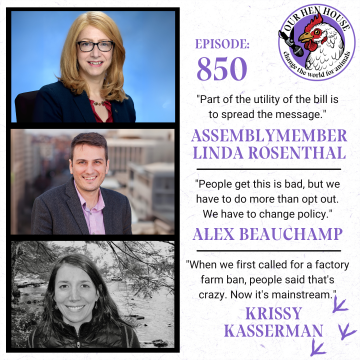
Assemblymember Linda B. Rosenthal represents the 67th Assembly District, which includes the Upper West Side and parts of Hell’s Kitchen in Manhattan. She is a lifelong resident of the Upper West Side and serves as Chair of the Assembly Housing Committee. Since taking office in 2006, Assemblymember Rosenthal has passed more than 200 laws that have helped to improve the lives of all New York State residents. Rosenthal is a leading advocate for animal welfare, having passed the first-in-the-nation ban on cat declawing, ending the sale of dogs, cats and rabbits in pet stores and prohibiting the sale of cosmetics tested on animals. She has also passed laws protecting survivors of domestic violence, preserving affordable housing, strengthening women’s rights, environmental protection, data privacy and more.
Alex Beauchamp is the Northern Region Director with the national advocacy organization Food & Water Watch. He is based in Grosse Pointe, Michigan.
Krissy Kasserman is the Factory Farm Organizing Director with the national advocacy organization Food & Water Watch. She is based in Pender County, North Carolina.
INTERVIEW TRANSCRIPT
Jasmin Singer: Welcome to the Our Hen House interview. This is Jasmin Singer.
Mariann Sullivan: This is Mariann Sullivan.
Jasmin Singer: And we're so excited about this week's interview, which is about legislation to limit factory farms, specifically in New York, but hopefully not limited to New York.
Uh, but first, a quick reminder about the Our Hen House podcasts. Rising Anxieties comes out on Tuesdays. The Hen Report comes out on Thursdays, and the long form interview comes out on Fridays. So bonus, by the way, bonus content for flock members comes out on Monday. We are a podcast and we're on YouTube, so please hit subscribe and hit like wherever you listen.
Now, Mariann, do you wanna welcome our guests?
Mariann Sullivan: Sure. Alex Beauchamp is, uh, is the Northern Region Director with the national advocacy organization Food and Water Watch. Don't think we've ever had anybody on from Food and Water Watch, so it's pretty exciting. He's based in Grosse Point, Michigan. Krissy Kasserman is the Factory Farm Organizing Director of Food and Water Watch.
She's based in Pender County, North Carolina. Welcome to you both. And I just wanna add. We also hope to be joined later in the program by Assemblymember Linda Rosenthal, who represents Manhattan's 67th Assembly District in the New York State Assembly. Not an area really known for its proclivity to factory farming, um, except for its products of course, but, but she is one of the sponsors of this specific bill that we're going to be discussing, among other issues. She's kind of famous here in New York because she's the leading proponent for animal welfare in in the state legislature, I think it's safe to say. And she's passed first in the nation ban on cat declawing, ending the sale of dogs, cats and rabbits in pet stores, which you've probably heard of that ban, prohibiting the sale of cosmetics tested on animals.
So she's been a real animal hero, and I'm kind of excited that it's an animal person who's really at the forefront of this particular legislation. We don't often interview folks about pending state legislation because you know, a lot of pending state legislation doesn't turn out to be legislation in the end.
And we have listeners from, from all, really all over the country. I mean actually from some other countries as well. So picking one specific state is, you know, it's not something we nor normally do, but this is kind of a diff... I feel like this is different, not just because both Jasmin and I live in upstate New York, so we are personally concerned, but this could be an important part of a nascent effort in other states as well to put some limitations on factory farming, something which legislators have, as you know, completely failed to do, allowing it to mushroom into just one of the most horrific things that has ever happened, uh, I, I feel safe saying that has ever happened. So, um, Alex, maybe we could just begin by explaining exactly what the bill would do since we are focusing our conversation around that, and so people know what we're talking about, but then we'll go into all of the reasons, not only as to why it's needed, why you feel that this is the right approach?
Alex Beauchamp: So for us, this is a really simple bill, right? Um, we know factory farms pose huge problems to our water supply. We know they pose huge problems to animal welfare, huge problems the climate as well. and importantly it is getting worse, right?
So you're seeing more and more factory farms, um, displace small kind of traditional family farms in New York and, and around the country. So, at a minimum, we think we should stop making the problem worse. The easiest way to do that is to just ban new large scale factory farms, right? So you're talking about, in the dairy sector, which is what most factory farms in New York are it's, the line is, it's 700 animals. So over 700 it's a large scale factory farm. It's not putting anyone out of business. So for us, it's a very common sense first step. Uh, but you're right. This is the kind of thing that is important not only for New York, but we're, we're trying to do around the country, and, and my colleague Krissy could talk to that better, but, um, but we do see it very of a big nationwide movement, not, not just New York.
Mariann Sullivan: So Assemblymember, uh, Rosenthal, welcome. I'm glad you were able to get here so quickly because I really would like to hear you. I, I mean, I already introduced you. So people already know, who didn't know already that you, you are, are, you know, really iconic in the New York legislature as being an advocate for animals.
But this is really taking a, a big step in, in a, a much broader direction. What, what made you think that this was the right moment to start doing something about factory farming?
NY Assemblymember Linda Rosenthal: Well, traditionally, um, the Farm Bureau, which is an industry group whose members are the farms, uh, and the large farms in New York state have forbid, through their actions or threatened actions, for us to do anything about farm animals. Uh, people have introduced legislation, but I have some as well about, about cows, about veal, about, uh, hens, all of that. Nope. They have a measure of control on the elected officials who represent those areas. So this is partially a way to get to, uh, protecting animals, but it's also something that is very present in all of our discussions in Albany, in the Democratic Conference. So this is a way to unite talking about animals and talking about protecting our environment and protecting humans from air pollution, water pollution, and things like that.
So I thought I was, uh, despite me being from New York City, which uh, people who oppose this bill have criticized me for, um, this is a very important topic of discussion, awareness, education, and ultimately passage.
Mariann Sullivan: So, uh, Alex, let's go back a a little bit to, to the specifics 'cause I think I forgot to ask you a follow up question, which I really meant to do and that was. And you mentioned that dairy, so dairy is the big, is the biggest source of factory farms in New York. Are there other kinds of factory farms here? And specifically this bill, what would it specifically it do? And is it a mirror image of the federal bill that was, that was, uh, backed by Cory Booker? Um, that, that has not gone anywhere, but, but is sort of trying to do the same thing. Is it just mirroring what the def the federal definition of a large cafo. That was like, I asked you like 12 questions in one question.
Alex Beauchamp: That's okay.
Mariann Sullivan: I, I trust you to sort it out.
Alex Beauchamp: Well, maybe we'll take the last first, um, I mean, yeah. So the, the federal government does define factory. I mean, they don't say factory farms, right? They say large scale CAFOs.
Mariann Sullivan: Yeah.
Alex Beauchamp: Um, so both the federal government and then New York from a regulatory standpoint uses that definition as well. So there's already a natural cutoff point there where those farms have different permits.
You know, different requirements already. So it makes a certain amount of sense to, to draw the line there. and you know, it's similar to the Cory Booker bill. I, I think it's perhaps better to think of it as similar to efforts that we've run in other states as well. So Krissy's been really involved in this.
We, we passed a bill in Oregon that was, there was somewhat similar.
Mariann Sullivan: I definitely wanna hear about that. Yeah.
Alex Beauchamp: So, and you know, I mean, particularly where we're at right now, federally, I just think that's the better way to think about it. Where like in rea... and, and you know, who we have in Congress right now is a nightmare. But it's not just that, right?
This is the way most good things tend to happen is that you get it done in a few states first, and then you kind of level it up to the federal government, and certainly no one's under any illusion we can move anything in Congress, you know, with, with the lunatics who are running things now. So, so I think it's perhaps better to think of it as similar to efforts in, in other states, and particularly that bill in Oregon.
Um, and then I'm, I'm sort of forgetting what the first question.
Mariann Sullivan: Oh, like which animals are we talking? Like
Alex Beauchamp: Oh yeah, yeah. No, we're we?
Mariann Sullivan: be, the limits you're putting on these farms are still huge. I mean, they, they would still be huge farms. It's just we're trying to like draw the line somewhere.
Alex Beauchamp: So
Mariann Sullivan: but So
what, what is, I mean, I, I know there are dairy farms in New York state because I see them all the time. Um, what other kind of factory farms do we have in New York state? Are there pig farms? Are there chicken? There's gotta
Alex Beauchamp: yeah,
Mariann Sullivan: There's chicken farms everywhere.
Alex Beauchamp: The only thing at scale really is there's a few hog CAFOs in Western New York, but, but compared to dairy, it's like a, a tiny number, right? I mean, the va the, the opposition to this really is the giant dairy guys. Those are the folks who, um, who are opposed to it. And, and I think the, by far, the biggest impact of this will be on, on dairy.
You know, New York doesn't really have a bunch of the other factory farms. And, and the reason for that, by the way, is that increasingly we're seeing the ag sector nationwide consolidate, right? So like if you look at a map, New York is dairy, somewhere like Iowa or North Carolina is hogs, somewhere like Maryland is chickens.
And so we really have kind of consolidated state by state. Uh, so it's not surprising in that way. Most states are that way now where we're kind of like consolidating a given ag sector, uh, at least in animals in, in a given state. Uh, but yeah, in New York we're, for the purposes of this, you can really think of it as dairy.
Jasmin Singer: Well, and, and sticking with dairy for just a second. Krissy, bringing you in. Thanks for being patient. It's always a little tricky when there are so many people here, but we really appreciate all of your brains. Uh, Krissy, farms and in particular dairy farms as we're talking about, Like to portray themselves as family farms and as I always like to say, everyone's got a family.
So in reality that's not really saying anything. But what is the landscape currently around the country regarding ownership of factory farms and what is the direction it, it's, it's headed toward?
Krissy Kasserman: That is a great question. In, in a lot of ways, I think it does vary by state and by region and also by sector. So I'm based in Eastern North Carolina. The vast majority of factory farms here are hog farms and poultry farms, and those are part of a system that we would call a vertically integrated system, where essentially there is one entity, think Smithfield or Purdue or Prestige or you know, some of those names that are, that are fairly common household names at this point that, that own everything on these farms and dictate the conditions to which animals are grown on these farms. So, you know, to give you an example, the hog farm that's two miles up the road from me, um, it's a Smithfield facility. And so Smithfield is going to bring the farmer the, the pigs, when they're small, they're gonna bring all of the inputs, so the food, the medicines.
They're gonna determine the veterinary schedule for how to raise these hogs, how to care for them. Smithfield owns the hogs. The farmer is just essentially their caretaker, right? Raising them. Um, when the, when the hogs reach maturity and are ready to go to the slaughterhouse, that is a Smithfield owned slaughterhouse. They are driven there in a Smithfield truck by a Smithfield driver. So you see these big integrators, essentially controlling every step in the process. We see that more commonly in hogs and poultry than we do in dairy. Um, but you know, one of the big issues with hogs and poultry being raised in this way is that you previously had, you know, a small, independent farmer who was owning these, owning the animals that they raise, they're not doing that anymore. They are raising these hogs for these big, massive integrators. And the only thing that the farmer at the end of the day owns are the, the two things that are the most costly to deal with.
And one of those is the barns, and one of them is the waste from all of these animals. And so it really does disenfranchise, um, your, your independent farmers who, you know previously were able to make a living, running a small, diversified farm that is next to impossible in the, in, you know, this day and age. Um. In dairy in places like New York and Michigan. Um, and Alex should chime in here too, if, if you, if you have a little more experience with this, but my understanding with dairy in places like New York is that you do a little more frequently have, um, and a farmer who is independent, who is managing one of these big dairy farms, and so not contracted with, know, a Smithfield, right?
The farmer actually does own the cows that are on these farms. So in some ways, they are a little more family owned than you know, what you would see in hogs and poultry and much of the rest of the country. But the problem continues to be the scale, right? Regardless of who owns these animals, when you are raising this many animals in confinement, there's no way to avoid all of the harms associated with these practices. And so know, you had mentioned earlier Cory Booker's Bill, so that bill was called the Farm System Reform Act, and it contained a number of things, one of which was a ban on new and expanding factory farms after 2040. And then also a series of market reforms that would make it possible for small independent farmers to compete in this environment. Because the other thing that's happened over the course of the last several decades is that our farm policy has shifted to favor these massive industrial operations, and it's very hard to survive as an independent farmer. So some of the reforms that are in that bill would really make it possible for people to run a smaller scale independent farm in a way that, you know, probably happened 50, 60, 70 years ago. But that isn't happening as often now because of the market forces where people are, are essentially forced to scale up, add more and more and more animals to just eke out a living as a farmer.
Mariann Sullivan: You know, it also, it also, all of this brings up like you have such a deep and realistic image of the industry, but like nobody else in the planet does. And, uh, so Assemblymember Rosenthal, you mentioned that your district is in Manhattan, where there are not a lot of factory farms, but there's plenty of the products of factory farms as there is everywhere in the country.
Uh, do you see concern growing about this issue or awareness growing about this issue or. Do people just worry about the price of eggs, uh, over and over and over again and not think about, still not think about the animals? Are you seeing any shifts there?
NY Assemblymember Linda Rosenthal: Well, first of all, I think we're all reeling every day there's another bad breaking news, and my district in particular, which is the Upper West Side and parts of Hell's Kitchen, is a very educated and active group, 140,000 strong. And, um, they care about animals. In general, you know, companion animals, um, many people are moving toward vegetarian or vegan, on the whole they are. But my district, um, yes, they do support, they do support these efforts, but I think part of, you know, this is not a bill you can pass tomorrow. You know, it takes a lot of, uh, buildup and education. Part of, uh, the utility of the bill is to spread the message because, you know, if you're in the city, you have a busy life, you have two kids, three kids, whatever, one kid, you're working, you're struggling to get by because of the high cost of housing, childcare, et cetera, here. You have room for X number of issues. And so we're gonna use this bill to educate people, um, about this problem as well. I think people have like an idea. They've heard, they've heard about cows what they do to the environment. So I think they understand, but I think there is a great need to, um, spread the word.
Jasmin Singer: Mariann and I lived in, uh, in Manhattan for a very long time. I actually. lobbied, lobbied, uh, a bill you were working on, but you have been doing this for a really long time, Assemblymember Rosenthal, and I mean, unfortunately there aren't that many of you, or at least from where I stand, you are a bit of a unicorn. What is the political reality in New York at the state level, Assemblymember?
Like how powerful are the factory farms and their protectors with the legislature and the governor?
NY Assemblymember Linda Rosenthal: Yeah, they're, they're very, very powerful. I alluded to some bills, uh, earlier. I have a bill that would ban the docking of cow's tails. So cows have tails for a reason, and that is to switch away the flies that gather around them. To make things easier for dairy farmers and those who sell their milk, they dock the tail so they can get to the udders better or it's better in the mechanical, you know, milking. I could not get that through. I had all of a sudden an onslaught of Farm Bureau, farmers. And it's always you are going to ruin our business. And the governor is very keen to protect business. Uh, for example, I passed a law some years ago banning the sale of dogs, cats, and bunnies from pet stores, and we had a one year enactment date.
The governor actually wanted more years. She also, and, and all of them who are not familiar with this terrain need to be educated. Why are pet stores not a good business model? Because animals come from puppy mills and, and other such bad, bad, harmful, abusive environments. So people often think, well, we have to maintain business in New York state and that these kinds of measures will harm business and cause them to go bankrupt. But the fact is 700 is a lot, and it's an enormous number of course the, you know, we had a press conference in, in, um, in Albany along with the Senate sponsor, uh, Senator Jabari, uh, Brisport. Immediately we, we were attacked as if we, you know, killed them already. And so they don't like city people messing in their business. However, city people eat. We eat the stuff that the farmers, uh, grow and produce and we care about our air and our water and our environment and the animals. So I, I don't accept that criticism, but you know, they don't want to cede an inch because they think after that you will continue advancing the rights of animals. And, um, and we're up in their business. So, you know, there is support. The governor did sign the pet store bill, but you know, as often is, we need to educate people some more and, and you know, you'd think it would be easy 'cause people love animals, right? And you know, animals need to have a higher priority, but it's also basically a bipartisan issue, I would say, except for CAFOs, it's hard to gain support at all
Jasmin Singer: But it is also true Assemblymember Rosenthal, that this is one of the very few issues left that runs the gamut of the political spectrum. And Mariann and I have been hosting Our Hen House for 16 years and sometimes it's really hard to see how little has shifted around farmed animal issues.
But I am heartened and, and given hope by the fact that we have had Republicans on, you know, like there are, there are common ground issues here, and you don't more and more, you don't find that.
NY Assemblymember Linda Rosenthal: No, that's absolutely true. But part of the reason is because their constituents demand it. Uh, a lot of animal activists are single issue voters and they will not vote for someone who doesn't support animal... not the CAFO yet, we're working on that, but companion animal bills.
Mariann Sullivan: Getting back to dairy farming. Krissy, I'd like to like look a little bit on the broader scale and, and, and to be fair to us, Assemblymember Rosenthal, I think we all know this isn't gonna pass tomorrow. What's exciting about it is that it's a first step that we actually could get some more broadbase support for and bring that, bring that issue to the attention of some people who don't pay attention to it.
And I also wanna say that even though this is a moment, obviously, as we all know that we lurch from crisis to crisis, to crisis to crisis, it is also clearly a time when there could be a lot of change. I mean, we're all scared it's gonna be for the worse, but who knows, maybe some of it could be for the better. So Krissy, my understanding is that getting back to dairy, which is, you know, if you're upstate in New York, that's all you see. Dairy farming in particular is growing in a lot of areas though it's really interesting what, what you noted about how it's all becoming very regional. Um, but some of the thi of the things I've heard is that the west is getting where, where a lot of dairy farming is.
It's very focused in California, even in Arizona. But the water is, I mean, dairy farming uses unbelievable amounts of water and they just don't have it anymore. So are we expecting to see a mo even a greater move East? Because my sense of New York State and the governor is that they are all, Senator Gillibrand too, they are all for it. They are very pro-dairy. They're trying to bring more and more in.
Krissy Kasserman: Yeah, that's a great question. We have really seen a shift in, um, where the dairy industry is, is concentrated in this country over the past several decades. So, you know, traditionally you think of places like Michigan and New York and the Northeast and all of those places have traditionally had a lot of dairy. new facilities, which we would call mega dairies, you know, just massive factory farms with thousands or tens of thousands of animals. We're seeing those become more and more prevalent in the southeast in particular, or southwest rather in particular. Um, so New Mexico, Arizona, there's a lot in California.
The industry's growing in, you know, several other western states, Oregon, Washington, and so these, these mega dairies, these massive facilities. Um, I do a lot of work in Oregon. The biggest mega dairy in the country is in Oregon. It confines 70,000 cows. Um, you know, we're seeing a lot of that in the Western US where there's more space.
It takes a lot of land to, um, to, you know, raise 70,000 cows. It takes a lot of land to grow feed for 70,000 cows, and so we are seeing much of that production start to shift to the west. The other thing that's happening, there's a, there's a program in California called the Low Carbon Fuel Standard, which is incentivizing factory farms to produce factory farm gas. So you may have heard this called biogas. This is, you know, in previous years like a byproduct. And now, um, because of this California program, it's incentivizing the production of biogas by allowing farmers who are capturing methane from their manure stores to sell credits into California's cap and trade marketplace.
And so we're seeing a huge build out of the dairy industry in California simply to facilitate that sale of credits. So, you know, previously before the low carbon fuel standard, before we were capturing methane and turning it into factory farm gas this, you, you know, the manure from these factory farms was a byproduct, right?
It was a waste product. It was a, it was problematic for farmers to deal with because, you know, you have to dispose of it somewhere, right? And now all of a sudden, um, you, you're seeing this become almost the number one product coming out of these farms. And unfortunately, it's to the point where it's essentially made the cows just like a cog in the production wheel.
Right. And the, you know, many years ago, maybe eight years ago, the general manager of Three Mile Farms, um, Three Mile Canyon Farms in Oregon, which is that 70,000 cow mega dairy that I, that I mentioned, actually went on record saying that the biogas that they were generating at that facility is more valuable than the milk at this point. And so what you're seeing is, um, the production of factory farm gas and California's low carbon fuel standard really incentivize the growth in herd sizes throughout the country. I mean, there are LCFS pathways in New York where farmers in New York are selling credits for the biogas that they're generating into California's marketplace, but that's happening a lot in the Western US as well.
Mariann Sullivan: Yeah, I, we've had guests on speaking about that unbelievable crisis. Do you see this as does new, are you saying that New York is already a part of that because they can ship their, their methane to, um, California and um, do you see that as a growth, uh, part of the growth effort? And I just wanna make clear what you probably just did, but every time I talk about this, I just wanna make clear like we're producing basically a fossil fuel gas. It's not from fossils, but it's, it has this big... we're producing it by, by way of these cows. As if we don't have enough to worry about with fossil fuels. We're actually creating methane. And Yeah, it's better if you create methane to burn it than to let it just fly off in the air, which was what they've always done with these manure lagoons.
But. But it's just a crisis of monumental proportions, I think, the whole biogas thing. And do you think that that's part of the, uh, of the New York industry and part of the thing that, um, would, since these, the bigger the dairy is, the more manure they produce, and so the more money they're gonna make off of that manure a, a push to, to not have limits on the number of cows?
Krissy Kasserman: Well, what I can, what I can say is that, you know, we've done some analysis that shows that states that have a robust number of, they're called pathways. So basically, you know, farmers in one state selling credits into California's marketplace. We are seeing growth in herd sizes in those places. So, California, Wisconsin, um, primarily. There are a few pathways in New York.
I don't know how many, but there are some, um, which is wild when you think of how far New York is from California. Um, and the fact that, you know, a California policy could be driving the expansion of herd sizes in New York, but that is absolutely happening and will continue to happen. Um, and, you know, you're right.
We could do a, we could do another 90 minute show on biogas and, and you know how this. This biogas, which is chemically identical to fossil fuel gas or frack gas, is essentially gonna prop up fossil fuel infrastructure. So in addition to entrenching factory farms, it is also entrenching the fossil fuel industry.
It's absolutely the the worst of the worst.
Mariann Sullivan: Assemblymember Rosenthal, I'm just curious, does this, does this come up in the discourse about this, about dairy farming and the bill in the legislature, or are they, they not up to speed on having to counter this messaging?
NY Assemblymember Linda Rosenthal: That's too in the weeds, but fascinating. And a factoid I will be using to educate, uh, my colleagues. Uh, 'cause I'm sure most people are unaware, unaware of this.
Alex Beauchamp: You know where it comes up actually in New York in a, in a kind of weird way, is we're involved like right now fighting a bunch of new gas pipelines. There's several proposals.
I won't bore the listeners with them 'cause there's a bunch. But what's really funny about it is everyone who's trying to build gas infrastructure right now, like every gas utility, they just sort of pretend that one day it will all be biogas. So they're like, we'll build this pipeline and yeah, we know we have stop burning fracked gas in the next 20 years, but don't worry, we're going to put all biogas in there. And it's, it's wild, I mean, one, that'd be an awful idea, but it's also just definitely not going to happen. They know it's not going to happen. It's just sort of an excuse and they say, don't worry about it. Later, we'll, we'll magically have all this biogas and to do it at the scale you would need for like,
Jasmin Singer: Yeah.
Alex Beauchamp: you know, even New York City's, uh, gas utilities is, is almost unfathomable.
I mean, it's just not possible to do, but they just sort of pretend. They just wave their hands and say biogas. It's totally nuts.
Mariann Sullivan: I, am I missing the memo or something? Isn't it just as bad if it's biogas? Like, like,
Alex Beauchamp: Yeah, it's, yes.
Mariann Sullivan: Does that? It doesn't. It's so
Alex Beauchamp: I mean, the best way to think about it,
Mariann Sullivan: Whole discourse is so crazy making, it's like, well, that's bad that we'd actually be creating more gas to, to use and burn and create.
Alex Beauchamp: yes,
Mariann Sullivan: All right. All right.
Alex Beauchamp: It's insane to think anyone falls for like, what if we've set the manure on fire and we just pretended it was clean energy. I mean, that's what this is. You know, it's totally nuts.
Mariann Sullivan: Great way of putting it.
Jasmin Singer: Yeah, Well, uh, Alex, just sticking with you for just a second. Uh, and then, and then Assemblymember Rosenthal, I have a follow up question for you. Alex, as Krissy just said, the messaging on this bill seems to primarily revolve around the environmental devastation of animal agriculture. Well, Krissy didn't exactly say that, but you were talking about the environmental toll.
And while our, our listeners are deeply concerned about those issues, as are we obviously. I expect that the driving force for many of our listeners is the horrific animal cruelty involved. Is the cruelty ever going to be an issue that can gain traction with the public at large? And I also would love the Assemblymembers' perspective on this, but Alex, jump in.
Alex Beauchamp: Yeah, I hope so. I mean, look, we're... Food and Waters is an environmental group, so we, we obviously kind of highlight that 'cause it's, it's who we are. Uh, but I will say, and I think you're right, right, there's a broad constituency for this and a huge factor is, is the animal welfare piece. And, and we've been working really hard to build a based coalition, including Mercy for Animals and, and I think we hope in, in the next session we'll have a broader base of animal welfare groups. But yeah, I think they have to be at the table. And if we're going to win this, you're going to need a, a really big grassroots movement. You know, I mean, we were talking earlier about this kind of ridiculous city rural divide that the industry always tries to play up.
Partly they do that because people like to rail against New York City if you don't live there. Um, but partly they do it, I think to disenfranchise people. Um, you know, the, it's clear the path towards winning this is a bunch of people not just showing their preferences in the market or shopping a different way, but actually getting involved in the political process and for us to win, that means a lot of people where a lot of people live. And that is mostly urban and suburban settings, right? That's where most of New Yorkers live and where most Americans live. I, I think for us, the organizing challenge is like, people get this is bad. People are big, you know, you can see in the market data, people are opting out where they can.
We have to do more than that. We have to change policy. And to do that, you have to get a lot of those people involved in the political process. That's kind of the challenge. And, and to your point, I, I do think animal welfare is a huge motivating factor for a wide swath of New Yorkers. And, and we're sort of at the beginning of building that.
But for sure if we're going to win, we need all those folks at the table.
Jasmin Singer: Assemblymember Rosenthal, what do you think?
NY Assemblymember Linda Rosenthal: No, absolutely true. This will take a big coalition, and that includes environmentalists and animal lovers. You know, in niche, you know, someone just cares about water. Okay, you're in. Someone cares about air, you're in. It has to be a large group. All of all of us together.
Jasmin Singer: Well, sticking with that subject, Assemblymember Rosenthal, I know you have many bills and successful legislative initiatives to your credit, we don't have time to cover them all, but I am particularly interested in a bill you're sponsoring, which would help farms convert to plant-based agriculture. Can you tell us about that?
NY Assemblymember Linda Rosenthal: Yes. Um, this bill, it's a 1 6 3 9, would establish a plant-based agriculture grant program. So it would provide financial support and technical assistance to small and mid-size farms to encourage plant-based farming. So, transitioning from raising animals to hemp, oats, and other things. And, and you know, a lot of farmers in New York state, and I guess across the country, the small ones are struggling. This is a good use of your acreage because there will be a greater demand and you can get started by getting a grant to help you get, get off the ground as it were. And so, um, I'm pushing that as well.
Mariann Sullivan: I love that idea, and particularly living upstate. Uh, I, I would love to see it it passed and for more farm, you know. It, it's so depressing when you, when you learn that, um, all the beautiful waving fields of corn and soybeans are, are, are raised for animal feed and they, they don't look beautiful anymore.
I would love to see some more, uh, farms raising actual food. Krissy, I before, before we let you go, I promised I would come back to Oregon 'cause I'd really like to hear what that approach was legislatively, and just your thoughts on why this is so impossible to approach legislatively. Obviously there's the power of the industry, but there are a lot of powerful industries.
It just seems insane that we've gotten ourselves into this like disastrous situation. Um, so I just like, you know, you're, I, I assume that's something you ruminate on from time to time, but specifically what did work in Oregon?
Krissy Kasserman: Yeah, great question. So, you know, I think to the last part of your, your question, um, you know, we have what we refer to as agricultural exceptionalism in this country where we, we essentially think, you know, and I mean, not, we, we certainly don't think those have Food & Water Watch, but, um, the country as a whole believes that agriculture continues to be the kind of agriculture that we saw like that our grandparents were engaged in, right? Like everybody has a red barn and there's a barnyard and there's, you know, some happy cows and a couple happy pigs in the barnyard and you know, they're raising all the crops to feed those animals on site. And so, you know, I think that is the image the industry projects because it brings on this sense of nostalgia for a lot of folks, and I think it makes them impossible to touch. Right? And so, I mean, we see that in New York. We see it in every state where I've ever worked on this issue. Um, the industry very smartly promotes those remaining small scale farmers as like the face of agriculture.
Mariann Sullivan: Can I, can I interrupt you for just for a second, but hold your thought 'cause I don't wanna, I don't wanna throw you off track, but have you, are you familiar with Will Potter's new book, uh, little Red Barns? Um, because if not, I think you would really enjoy it. Uh, 'cause when you said Little Red Barns, I was like, right.
He just wrote the book. And he not only talks about the mythmaking of the industry, but also the connections to, to like fascism basically, which is always based on this myth that we're gonna return to some idyllic past and cr and creating the idea that that past exists when it actually doesn't. Uh, it was a fascinating book.
Uh, it's just out recently. I, I, and what you were saying, just so rang a bell with me. But now continue.
Krissy Kasserman: Yeah. I'll look that up. Thank you. Um, yeah, so I think, you know, the industry wants us to believe that that's, that's the way animals are being raised. Um, and so they hide behind the few farmers that are doing it that way. And, you know, it, it, they wield a lot of political power. Um, and so, you know, in Oregon, well, to, to back up one step further, what Food and Water Watch has found, we were the first national organization to call for an outright ban on factory farms.
That happened in 2018, and the reason we did that was because, as we've been discussing, the, the issues that are associated with this problem are just big to fix any other way, right? You know, you've got air and water pollution issues, you have harms to animal welfare, you have harms to workers. You have, um, I mean, the impacts on rural communities, uh, particularly across, you know, certain parts of the country, North Carolina in particular, are astounding. Um, and so, you know, when you, when you aggregate all of those harms. The way to really address those issues is to get rid of the factory farms entirely. And y you know, for a long time, I think a lot of organizations were very focused on what continues to be very valuable work, but like reigning in air and water pollution from factory farms, for example. And what I can tell you as a rural person and from all my years of working with rural people is that rural people don't want better regulated factory farms as their neighbors. They don't wanna live next to a factory farm, the end. Right? And so when we decided to call for a factory farm ban, back in 2018, that was our reasoning that the mor, a moratorium on new large factory farms would address all of these issues. And so we have brought that vision into all of our state campaigns since. And so we're, we are now working on the ground, obviously in New York, also New Mexico, Iowa, and Oregon. Um, in Oregon we have a really broad and diverse coalition called the Stand Up to Factory Farms Coalition. It's brought together, um, really some unlikely bedfellows, but it works really well.
It's a great coalition. Um, so we have groups focused on food safety, animal welfare, um, you know, small family farms, consumer groups, and so we have, you know, really broad base in Oregon. And we ran a moratorium bill in 2019 and 2020. We're not kidding ourselves about these being long-term campaigns. Um, we didn't pass those bills.
We ran the bill again in 2023. While we didn't get the moratorium that we wanted, one thing that we always say at Food & Water Watch is that by asking for what you really want, which in this case was a moratorium, you leave a lot of space in the middle for incremental improvements that can still make real improvements in people's lives.
And so that's what we did. We passed a bill in the 2023 session, you know, we had, we were working with our bill sponsors and they came to us and they said, look, we don't think we can get this moratorium through. Um, but, but what will, what, what can we pass? And so we sat down and put our heads together and made a list of reforms that we knew would significantly impact issues that Oregonians were facing as a result of this industry, and passed a really powerful regulatory bill. The two most important things in that bill, which immediately went on to stop one massive mega dairy and two massive poultry farms were setbacks. So now communities, um, local counties can adopt ordinances that would essentially require a certain setback from factory farms. Um, those, when they were first adopted in the county where those poultry farms were proposed, I think were a mile.
They were very, very broad. And so, you know, basically wiped those poultry farm proposals off the map right away because they were within, you know, a mile of a home or a school or a business. Um, the other thing that that bill did was close a loophole called the stock watering loophole, which essentially allows, and this is, you know, in the very arid west, which of course looks different from what we have here in the east, but allows a farmer to pull out unlimited amounts of groundwater as long as it is being used for watering stock. And you know, I mean, this is sometimes at the expense of other people nearby who can't then access water because of depleted aquifers and whatnot. And so we temporarily closed that stock watering loophole for three years, which caused a massive proposed mega dairy, I think it was 35,000 cows, um, to pull their application in Oregon.
So passed this bill, wasn't the bill we wanted. Still had a lot of really good stuff in it and stopped three massive factory farms in the process.
Jasmin Singer: Hmm. Wow. Well that's inspiring. That's super inspiring. And as we start to close, uh, what is the current status of, uh, the bill at hand and, and what, if anything, could help it move?
Alex Beauchamp: There's gonna be a much bigger campaign going into next year and, and look even starting next year, it's probably a multi-year, but, but we're kind of going into that eyes wide open. So I say all that to say there'll be a bunch more campaign activity going forward. It's a big, big priority for us in the 26th session, and I think we'll be for, um, for a whole bunch of allies. And then to, to stay informed or, or learn about what to do.
I, you can certainly go to our website. It's foodandwaterwatch.org. So like all one word, foodandwaterwatch.org is probably the best way. There's like social stuff too, but the website's probably the easiest.
Jasmin Singer: Cool. Thank you. And Krissy, uh, do you have anything that you wanted to add? Are you feeling you feeling hopeful when someone on a podcast says, are you feeling hopeful? Do you feel like you have to say yes?
Krissy Kasserman: I do not feel like I have to say yes, but I am feeling hopeful, and I think part of the reason that I'm feeling hopeful is that I, I think people are now believing this is possible. You know, when we first called for a factory farm ban in 2018, people were like, that's crazy. And I think we've, we've, you know, this policy position has now become so mainstream that people are talking to their elected officials about it.
There are bills in multiple states, and so that gives me hope.
Jasmin Singer: Well, I'm glad. I'm very, very glad to hear that the three of you are just, uh, so inspiring. This has been such an honor. Thank you so much to Krissy, Alex, and Assemblymember Rosenthal. We will put the links in the show notes.
For those of you who are watching and listening, thank you for joining us today. Remember to subscribe and like on your favorite pod catcher or YouTube or both. All of it. And remember us at this end of year season that we're suddenly somehow going into as Our Hen House is a nonprofit. Thank you all so much for helping us to change the world for animals.
_____________________________________________

Thank you for listening to the Our Hen House podcast! If you enjoy our podcasts, believe in our mission to effectively mainstream the movement to end the exploitation of animals, find community and solace in our shows and resources, and would like to show your support for vegan indie media, please make a donation today. Our Hen House is a 501(c)(3) nonprofit organization, so it’s tax-deductible. Thank you for helping us create quality content!
Subscribe to our show on Apple Podcasts, YouTube, or your favorite podcatcher, and don’t forget to leave a 5-star review!
Check out Our Hen House’s other podcasts: The Animal Law Podcast, The Teaching Jasmin How to Cook Vegan Podcast, and the Antiracism in Animal Advocacy Audio Series.
Follow us on social media! You can find Our Hen House on LinkedIn, Facebook, Instagram, TikTok, Threads, or Bluesky.
The Our Hen House theme song is written and performed by Michael Harren.