
 Apple Podcasts
 RSS
 Amazon Music
 Spotify
 YouTube
 PocketCasts
 CastBox
 Player.fm
 TuneIn
 Audible
 App not listed? Try this RSS link
Filmmakers Annie Laurie Medonis and Tracy Nichole Cring discuss their documentary A Culinary Uprising, which chronicles Bloodroot, one of the last remaining feminist restaurants in America. Founded in the 1970s, this Connecticut establishment has spent nearly five decades creating a unique space where veganism, feminism, and community intersect through intentional food practices and inclusive principles. Sadly, the restaurant will be closing this December.
This episode explores:
- How Bloodroot evolved from vegetarian to vegan as part of the founders’ feminist philosophy
- The remarkable 48-year partnership between founders Selma and Noel that sustained the restaurant
- How immigrant women staff members influenced the restaurant’s diverse culinary offerings
- The intentional language and community-building practices that define the Bloodroot experience
- The filmmakers’ personal transformations while documenting this intergenerational feminist wisdom
ABOUT OUR GUESTS
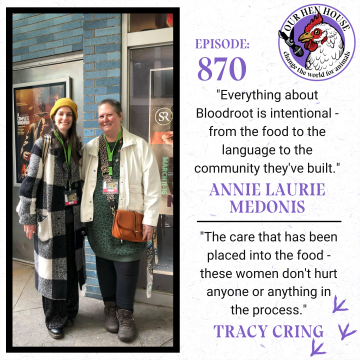
Annie Laurie Medonis is an award-winning filmmaker. Since beginning her documentary, A Culinary Uprising: The Story of Bloodroot, about the iconic feminist restaurant Bloodroot, Annie Laurie’s understanding of feminism and connection has profoundly deepened. Inspired by Bloodroot’s legacy of empowerment, she founded Women Artists in Action, a monthly collective dedicated to fostering vibrant events for female artists to collaborate, inspire, and support one another.
Tracy Nichole Cring is an editor of more than forty films. She secured the grand prize at the 1995 LA Film Festival for a captivating short film ingeniously crafted using old TV studio equipment. Embarking on her career as a cinematographer and editor, Tracy joined forces with the Extraordinary Film Project. This ambitious initiative aimed to produce 12 feature films within a year; ultimately, it took 20 months, but she made films in Michigan, Arizona, and California during that time. Tracy’s work has gained widespread recognition, earning the national attention of NBC Nightly News, PBS, and hundreds of film festivals. Tracy now devotes herself to mentoring women in film and editing documentaries that amplify the voices of women and shed light on crucial social justice issues.
INTERVIEW TRANSCRIPT
Jasmin Singer: Welcome to the Our Hen House interview, I'm Jasmin Singer.
Mariann Sullivan: I'm Mariann Sullivan.
Jasmin Singer: And today, oh, I'm so excited.
We're gonna be talking about a truly extraordinary vegan restaurant, about some truly extraordinary women, and about a new extraordinary movie about all of that.
Uh, before we do that, I just wanna remind our listeners that Our Hen House is now a whole universe. Well, we've always been a universe, but now our podcasts come out multiple times a week instead of one really long one. So, Rising Anxieties is on Tuesdays. The Hen Report is on Thursdays, and the long form interview comes out on Fridays. Our bonus for our Flock members comes out on Mondays. We are a podcast and we're on YouTube, so please subscribe and hit like wherever you listen. It really helps us a lot. Okay. So, uh, Mariann, I am excited by today, but I'm also excited that a cat butt keeps going past your screen. Like it's, I'm living for it.
Mariann Sullivan: If anybody wonders why I, I have no words. I have to use the script to, to do anything, and my cat keeps walking in front of my script, mostly in a way that you can't even see him. So you don't even know why I'm sitting here saying nothing.
Jasmin Singer: No, it, it's, it's, uh, it's adorable.
Mariann Sullivan: It's Eugene. And I'll tell you, if he knew that there were humans looking at him, he would die.
Jasmin Singer: Don't, don't tell him that. Don't tell him. Uh, so, okay, Mariann and I, for our, for our listeners, you might, you probably know how obsessed we are with Bloodroot and I feel like we actually mentioned it, Vicki, is it true we mentioned it on the podcast like a week or two before we got this pitch right? Like totally randomly.
Um, alright, so let's introduce our guests because we're gonna chat a lot about this today. So, Annie Laurie Maedoni is an award-winning filmmaker with a passion for storytelling. As a director and producer, she creates narrative and documentary films on socially significant topics. And since beginning her documentary, A Culinary Uprising, The Story of Bloodroot, about the iconic feminist restaurant Bloodroot, her understanding of feminism and connection has profoundly deepened. Inspired by Bloodroot's legacy of empowerment, she founded Women Artists In Action, a monthly collective dedicated to fostering vibrant events for female artists to collaborate, inspire, and support one another. Mariann, why don't you introduce Tracy?
Mariann Sullivan: Tracy Nitole... Oh, Tracy Nichole Cring... I was so worried about pronouncing Cring that I got Nichole wrong somehow.
Jasmin Singer: And that's also how I spell my middle name Nichole, too.
TracyCring: No way!
Jasmin Singer: Way. way.
TracyCring: My brother makes fun of me and calls me Ni-chole.
Jasmin Singer: Oh, well, your brother's job is to make fun of you.
My brother makes fun of me and calls me things that are worse than that. Um, also, sorry Mariann and everyone in the world.
Mariann Sullivan: And, and the entire audience!
Jasmin Singer: I know. I, I know, I know, but I just, this is, this is important. Hold on. This is really important. When I grew up in the eighties and people had these little tiny license plates with their names on them for their bikes, there was never a Jasmin. There was certainly never a Jasmin with no e. And so my mom, my mom got me one. It didn't even say Nicole, it said Nikki.
Mariann Sullivan: It's so sad.
Jasmin Singer: All right, Mariann, please continue...
Mariann Sullivan: This, this explains so much. All right. I have to move my cat so I can like actually read Tracy's bio.
Jasmin Singer: That feels on brand.
Mariann Sullivan: Tracy Nichole Cring is an editor of more than 40 films whose work has earned the national attention of the NBC Nightly News, PBS, and hundreds of film festivals. Tracy now devotes herself to mentoring women in film and editing documentaries that amplify the voices of women and shed light on crucial social justice issues. Welcome to both of you, we are so excited to be talking about, about this movie.
Can I just, can I just start off because I, I, I know that Jasmin and I love Bloodroot. We've talked about Bloodroot before. We don't get there as often as we would like to, but, but I think maybe it needs some explanation as to, to start off like what is Bloodroot? And how and why did you come to make a full length feature documentary about a vegan restaurant in, in, in suburban Bridgeport, Connecticut? It doesn't, it doesn't make sense when people first hear about it.
AnnieLaurieMedonis: So in the seventies and eighties, there were over 230 feminist restaurants in the United States and in Canada, and this is one of two remaining. So it really, it came out in a movement where women were opening up spaces, um, inside the women's liberation march. And so Bloodroot really created this restaurant outside the patriarchy because whatever was going on in the government, they're like, well, we wanna make something that we're excited about and attract people who are like-minded.
So when they created it, I mean, they had all different walks of life that were coming in. And I'm just, I'm also really curious about like how it is, I mean, wherever I travel across the world, I end up finding people that are like, I've heard of Bloodroot, um, and that it's, you know, there, there's all these crossovers.
It's got the LGBT community, it's got the feminism, it's got the vegan component, people who were, I mean, in the seventies, to find a place that was vegetarian, that was rare. So I'm also curious how it is that you both, you, Mariann and Jasmin came across Bloodroot, like where did that show up?
Jasmin Singer: Well, we lived in New York City for a really long time. We're in Rochester now, uh, hence they're not getting there enough. Um, we've been vegan for, uh, you know, me over 20 years, Mariann over 30. Uh, we're, I mean, I identify as a lesbian. I mean, we're both in the, in the LGBTQ community. Um, and so Mariann like, was it 'cause your family's in Connecticut?
Or like, how It's just kind of like, it's iconic. It's always been there.
Mariann Sullivan: Yeah, and there weren't that many, I mean, it was a vegetarian restaurant then when I first found out about it. It wasn't vegan yet, but uh, there aren't that many, you know, vegetarian restaurants. It was like even though we didn't really have the internet yet, we had no one to find out anything, somehow communication did happen back then, and people did find out about things.
And, and so I had heard of it. I mean, I wanted to go a long time before I had heard of it because, uh, it was even then, uh, by the time... because I mean, I'm as old as the women who founded, um, well not quite as old as the women who founded, um, Bloodroot, but, you know, in that, in that group.
But I didn't go, um, vegan until I, or become aware of what's happening to animals until the nineties. So it was then that I really started finding out about it. But it, you know, even within the vegan world, I mean, restaurants that have been around for that, for that long are, are, iconic. And like I said, we did have, I, I don't remember how we communicated with each other back then. I really don't, but we, we somehow managed to.
Jasmin Singer: Well, Annie, what about you? I mean like, yeah, how did you originally, I actually would be curious about both of you, how you originally learned about Bloodroot?
AnnieLaurieMedonis: Yeah, so I was roommates with this guy named Zach, who grew up in Westport, Connecticut, and he was going there as a kid with this mom for years, and so we were on our way to Philadelphia, Zach and I, on a trip, and he's like, okay, we're gonna stop at this really cool place.
You're gonna like it. I'm like, okay. So we stop at Bloodroot. I walk in there and I immediately fell in love with it. I was looking at all the pictures on the walls and the paintings, and had so much comfort in the space and the energy and the warmth. And I ordered the Jamaican jerk and I remember specifically the table, like even where I sat at. And I looked at him and I said, how has it taking you, you so long to tell me about this place? I'm in love with it. You know?
And it just, it instantly like came up to me as this place is special. And then fast forward a couple years later, I was in Montreal with a friend of mine named Dr. Alex Ketchum, who's in the documentary, who found out about Bloodroot through Zach as well, and then she looked at me and she said, you should make a documentary on Bloodroot.
And I said, there's already one. She said, yeah, but your yours will be different.
So I looked at her, I was like, okay, good point. It will be different. Um, but even her, like, she spent 10 years of her dissertation studying feminist restaurants in the United States and Canada. So there's just all this interesting research that was happening in the background.
Uh, and it, and it fascinated me. And then I just started going to Bloodroot as soon as I started filming in 2020, during COVID because of really looking at the age of Selma and thinking, well, shoot, if I don't start this documentary now, when the heck is this gonna happen?
As soon as, Yeah, and as soon as I started filming, I mean, I was hanging out with them all the time, like for days on end, hundreds of hours, and fell in love with them.
Got to eat all the, you know, food, pretty much almost every single item on the menu. Of course, I have my favorites. Um, but really it was, I mean, it is my favorite place to go to in the world, so.
Jasmin Singer: Yeah. Tracy, what about you?
TracyCring: Well, I saw a Facebook post that was like super old. It was like a month old. And in the social media world, that's ancient, it's like hieroglyphics at that point. And it was Annie Laurie and her team reaching out to find an editor for their crowdfunding campaign.
And I was like, what the heck? You know, it's like empowering women, it's, you know, on brand for me. I'm gonna, I'm gonna send my stuff anyway.
And uh, I started checking out Bloodroot and I was like, Ooh, I should definitely check that place out. But I'm in Tuxedo Park, New York, so it's a little slog. And uh, Annie called me and was like, oh my God, you know, we had a very long conversation and at the end of it she said, well, I guess I'm gonna have to fire the editor I thought I was gonna use.
Jasmin Singer: That's so great.
TracyCring: Really, I did not know anything about Bloodroot until then.
But after I started editing some, when I did go, it had like much extra, it was like so special. Uh, even more special because when you're editing something, you kind of start to feel like the people that you're looking at on screen are like celebrities to you. So
Jasmin Singer: I totally had that when I was watching, when I was watching the film, by the way. I was like, I met them. You know? Uh, that's, that's funny. And you both used
Mariann Sullivan: I totally had that when I would go to the restaurant, like, like, I was very like going to the restaurant was a really wonderful experience, but I was always nervous too that I was gonna screw up.
Jasmin Singer: Yeah, there was like the, the calculators and the like, we don't, we don't serve you.
Mariann Sullivan: We don't serve you.
Jasmin Singer: Yeah. Like, but, and it, that it was just such an iconic moment, but you're both saying the word special, and I think that that really is true. There was just, there's something very special about the restaurant.
Uh, you know, I, Annie, I just was thinking when you asked how we heard about it. I know this is true for some of our flock members who are here as well, but, uh, when I kind of came into the animal rights movement from working in the AIDS awareness, uh, movement, I came in by way of, as if there's like a door, but it, it was, it was feminism and, and my first article that I wrote was about the overlaps between animal rights and LGBTQ rights.
And, and I'm not sure that that's when Bloodroot came into my life, but I, it, it, it all feels like smushed into that same moment in my, you know, mid twenties, like, uh, 20 some odd years ago. And, and it, it just is a very special place for so many of us. And I, you know, Mariann and I don't focus on like specific location restaurants on the podcast a lot because we have, as you could tell from the people here for Flock Friday, we have people who listen from all over the world.
But this is sort of like a, a movement unto itself, Bloodroot. And it's sort of like, you know, it, it's amazing if someone can actually go and experience it, but through your film, people are really gonna get to experience it. So I wanna talk a little bit about the story of the, the founders and the, the women and the, the good life they built.
Uh, tell us a little bit about why that relationship is in itself so special. Because, you know, in these very difficult times right now, when we feel sordidness has really taken over the world, it's the beauty of relationship, and relationships like theirs, that to me is like the, the thread of life, like the good things that we really wanna hold onto.
AnnieLaurieMedonis: Yeah, their, their relationship is just so unique. I mean, to be able to run a restaurant, you know, start off as a collective and the rest of them eventually left, their dynamic where they kind of like fill in the gaps, their ying and yang, and you can see that connection in the documentary, which is part of that specialness.
It's like Selma has that driving factor. She's the passionate one. Intense. And she's like, this is where I'm going. And Noel really, there's so much collaboration inside of that where she's there supporting her and, uh, the, the inspirational part.
I mean, it's, it's so special because also like a restaurant lasting for 48 years, I mean, there's ups and downs so many times the business could have just folded. Yet their love for one another, their love for the community is the glue that has kept it going, their curiosity and thirst for life, for food. And that's where I find it's just so inspiring to get up and do that every day of their life, for the love of it. To continue to do that is fascinating.
TracyCring: The thing that I think is really interesting about this film is you also very much get the legacy and like I started applying things from the film into my life and maybe I didn't even notice I was doing it, but like I would call Annie Laurie's relationship with me, even inside the film and as friends, it's like a Selma and Noel relationship.
And I, as I've gotten older, I've, I've come to really appreciate those female relationships in my life and all of the women on our team. You know, just having those deep connections and, and I think I was really getting that from Selma and Noel because if you ask me a couple years ago, I would say it was very hard for me to be friends with women.
And that's not the case.
Jasmin Singer: Yeah, totally a hundred percent. And I love that there is this moment where it becomes clear that they weren't a couple, uh, but they had dated at some point, or they had slept together at least, but, but yet they were like clearly soulmates.
And, um, I'll just say, I don't really usually talk about this, but, uh, you know, Mariann and I, we were married to each other and, um, and our podcast has far outlived our, our, our marriage.
But Mariann's like my, you know, one of my people, like, she's my, one of my soulmates and, and is my family. Like, and um, and there was something about it that also made me feel like that, you know, in terms of like how much I love Mariann. And like, they had, they were, they were both older, but one was clearly much older than the other, at least 10 years, I think. I looked it up.
And, you know, so there was like a, a, a dynamic of like almost a I think a mentorship type thing, but also a caretaking thing and like, I don't know, it was just really moving to me. And so I love hearing that you two kind of also echoed that. And I think that that wholesomeness and that heart really comes through in the film. Um, okay. So, uh, lesbian shenanigans aside, um...
Mariann Sullivan: One of the things that I, that you just said, Jasmin, that I wanted to pick up on was that we don't really do interviews about vegan restaurants. I mean, we love vegan restaurants more than anything in the world, but we're not food people. We're not foodies. We're not, and one of the things I loved about this movie is that it was about food, but it wasn't about the food.
I mean, it's called a culinary, uh, a culinary what a cul culinary, um...
AnnieLaurieMedonis: uprising.
Mariann Sullivan: Uprising.
I was gonna say revolution, but I knew that was wrong. Um, but it wasn't full of recipes or like how we fix this or what we're serving today, and I really loved that because that's how I feel about, um, about vegan food.
The food is is centrally important, but not in a foodie kind of way. There is this kind of short reference near the beginning of the movie to Selma's reasons for being vegetarian and then vegan and talking about it as a political act. But by and large, the movie takes this really interesting approach of making it clear here and there that veganism is central, absolutely central to their relationship to this restaurant, to their lives and everything.
But without really talking on it, without really dwelling on why I it, it's just kind of a given. And I'm wondering, was that a conscious choice to not go into and this is why we're vegan?
AnnieLaurieMedonis: Yes and no. I mean, a lot of it was part of the, um, how much we can fit. Yeah.
So in the film, I mean, there's so many hours that we can do and, and honestly what we, what we'd like to do as a documentary miniseries where we'd go more into depth into certain sections, but really we knew that the vegan part was important, as it is part of their feminism.
And also as a, for me, you know, I often say it's like it's the filmmaker's view and how they're looking at it that shows up in the film. So it's what are they interested in, what are they curious about? It's the lens at which they, they look through the camera. And for me, I mean, I had a lot of curiosities, I asked a lot of questions, and a big part of it was the community.
For me, I was so inspired and just blown away by the sheer number of people that would show up consistently excited. The turnout and the fact that the restaurant's been around for 48 years. And I was like, something about this place keeps people coming back. And also the curiosity of what makes this place so successful as a, as an inspirational place for others to look at.
And so those are the, I'd say the key part of it, and the other parts are important as well, is just, that's kind of the, the umbrella of where I was coming from.
TracyCring: I would love to add that Selma and her curiosity in cooking, in the film she mentions that, um, there's so much that's still explorable inside of being vegan. You know, recipes and ways to formulate things, and her curiosity for that. And I mean, in the last probably 10 years of her life, she was making cheese in the basement.
She was showing it to Annie Laurie in the basement. I mean like just so curious. And she was like, you know, eating meat and all of these things are played out and it's all been done. And, you know, inside of veganism, there's still a world yet to be discovered.
Mariann Sullivan: One thing that really is coming back to me as you're talking about it, is it doesn't really look like a restaurant and the food actually doesn't look like restaurant food. It looks like if you went to some friend's house who was a really good cook and they made you a meal, that's what the food would look like.
And I don't even, I'm not sure I can define what that difference is. I mean, it looked good, but it wasn't like, I don't know, fixed up. And, and
Jasmin Singer: Insta-ready.
Mariann Sullivan: she wasn't a, she's not a chef, she's a cook. Um, so is all that part of the story, that attitude towards the food?
AnnieLaurieMedonis: Yes. The intentionality, I would say everything about Bloodroot is intentional. What you see at their houses, I mean, I got the privilege of going to both their houses and how they showed up at the restaurant is how they showed up at their houses. The, the food, the words like you just said, cook instead of chef.
That's a part of it. They say feminist, they say women, they don't say ladies, and going to their houses, I would see all this artwork and um, items from different travels that they went on in South America and it was just so beautiful. And I had this really unique experience where I would see all of these things and on the outside it would maybe occur as chaotic and messy. And yet I never had that experience. I had the experience of, this is fascinating, I'm so curious.
And it, and it was because the intentionality of what was behind each of those items and what it meant to them showed up in the display. And I actually took that for my own, where I started to put things that I got from other countries in my bedroom and I was like, oh, I get to leave my room beautiful just the way that Noel gets to leave her room beautiful. And those core values and what's important to them, that shows up at the restaurant. People have the opportunity to experience that when they're there, when you're having conversations. And it's just like, wow. The impact of the language that they use is, is fascinating.
Jasmin Singer: I wanna stick with the subject of values and feminism for another few minutes here. Can you articulate, Annie Laurie, how and why they described the food, like as feminist food? I, I might not even be just asking that question exactly right. But to me they, they saw it as one and the same. Can you elaborate on that?
AnnieLaurieMedonis: Yeah, feminist food, meaning like not eating sentient creatures was a big part of it in terms of their vegan. And then having the diversity and their culture being represented is feminist food bringing people together and the community aspect. So I mean that... there's so much that could go being put into that.
And Dr. Alex Ketchum, like I said, who's done all this research, she's gotten into like deeper levels on it. So highly recommend looking at Ingredients For Revolution.
Um, but really it's like the, their feminist part of bringing people together and the connection and the community representing different cultures is their feminism. That is such a big part. And so food... and food in general brings people together. So it's like having the feminist restaurant, food being represented, people traveling from afar that that all connects.
Mariann Sullivan: Actually one of the most moving points of the movie was, um, their staff, like the, and the importance of the fact that so many members of their staff were immigrant women, uh, from all different parts of the world. Uh, speaking all different languages, and we're talking about a small staff. They probably had five different languages with a staff of five people or something like that, all bringing these personal histories to the food. They weren't vegan, or they weren't vegan coming in, I didn't sense that they became vegan. There was nothing about that anyway. But, but you know, they were asked to veganize the food.
They were fine. Um, they didn't have any trouble doing it. And, and, and, and it, it was just this family of all these people from all around the world.
Did you know when you were making this, how big this was going to hit at the moment that this movie was going to be released? This important message about, um, about immigrants and foreigners and, and welcoming the stranger.
AnnieLaurieMedonis: No, not at all. I just knew that it was unique and special and that this story needs to be told.
That was that.
Jasmin Singer: That was very moving.
TracyCring: They actually, um, really were connected with the Mercy Center, um, in their area. And so, you know, when they were looking for women to work, because there's only ever been women working there, you know, um, it, it, was important for them to welcome people from all walks of life and all cultures. And, you know, you can look at their menu and see what an impact that's had from, you know, a young woman saying, oh, well we always cooked our beans in clay pots or Jamaican jerk being on the menu or mole.
You know, it just, everything that they bring in and all of the women that they bring in serve to enhance the whole experience.
Jasmin Singer: Yeah. In this way, what I'm about to say is sort of preaching to the choir with our particular audience, because this is something that I think, uh, our audience is, is, uh, definitely already thinking about. But, you know, back in the day when I went vegan, when Mariann went vegan, when a lot of people went vegan who didn't recently go vegan, we were vegetarian first. I, I actually think the restaurant was vegetarian first. Right? Before it was vegan. Yeah.
Uh, and you know, for me, kind of going back to that moment that I was talking about when I was doing AIDS awareness, uh, theater and, and then got involved in animal rights, I was a vegetarian then. And as with so many people who I know listen to Our Hen House, it was the exploitation of the female reproductive parts and, and, and systems that ultimately made me go vegan 'cause I saw a disconnect in terms of what I was advocating for, you know, in my, in literally my job, which was my AIDS awareness theater company that I was a part of and what I was believing in and, and partaking in, in my mealtime.
Uh, in fact, when I was a vegetarian, all I ate was eggs and cheese. I was like one of those, you know, uh, I think nowadays people are going vegan more so than stopping, sort of stopping at vegetarian along the way. But why did the restaurant go from vegetarian to vegan? Because that wasn't like that long ago.
Right? I sort of remember those headlines.
AnnieLaurieMedonis: You know, it's actually interesting. I just talked with Noel even more about that today on the phone, but really they, it, it was just evolving inside of their life. Like kind of what you, you know, for you, you discovered it along the way, things that were popping up. And for them, they really just realized, okay, this is, you know, we don't wanna eat animals.
Like, it's just evolving. And, and also people that would come to the restaurant who were vegetarian, and some of them were vegan and they were saying like, Hey, you know, I think you should be vegan.
And they started looking into it and, um, I mean, it, it became sort of this natural progression as they even removed some things on the ingredients off the, the dishes.
I mean, it's like, remove sour cream from the soup, like, like things here and there that actually made it like an easy transition for them.
Jasmin Singer: I loved that little part in the film where, uh, there, there was kind of a, a rule that you couldn't, before it was fully vegan, that you couldn't mix like a, a vegan thing with a, a non, a non-vegan thing. So like the vegan cake, you couldn't put cow milk based whipped cream on it because the, the word I think you used was, or not you, but the, um, interview subject said it would ruin the integrity of the dish.
And I loved that. That was just, that was so, that was so cool.
Mariann Sullivan: The word feminism, of course, has become fairly tarnished in, in, in the past, I don't know, 10, 20 year, how long has it been?
I mean, they're, they're such classic second wave feminists, a a, a group of people I, you know, I, I feel rooted in, and, and, and attitudes towards feminism have really shifted, and just, just towards the word, I mean, as if it means something other than women should have rights. Like it means this huge cultural thing. I feel like the exact same thing is being done to the word vegan and to the idea of veganism. That these things that are meant to move us forward and to take us to a new positive place, become tarnished, uh, because of the powers that be.
Uh, and like in bringing this message is, is there a way to bring this message into the future? Is that one of the things that you were trying to do? To, to not let this really second wave feminism kind of spirit, like lie in the past and not inspire people in the future?
Because I thought they were, I think they're very inspiring people.
AnnieLaurieMedonis: Uh, I didn't really look at it as waves of feminism. I really came in at it as curiosity. And I think with feminism, what I grew up in, what I heard was really one perspective. That there are these women that were burning bras and it was extreme and it was intense.
And so for me to hang out at Bloodroot and ask some of these questions of what it means to be feminist to you and discovering that everyone's answer is different.
And it's like, if I were to ask someone, you know, what does it mean to be vegan to you? Or what does it mean to be a Christian to you? Like that they own their own definition. And that was so fascinating to me 'cause I hadn't met someone who's like, oh, under my feminism, these core values are all connected.
And so for me, I, I came from the curiosity. I asked the questions, I was so intrigued and kept digging, and that, that's really where the film came from and wanting people to be inspired in their own life. The intention is to, to, to be inspired in their own life, to create something that they're excited about.
And I mean, there's, the possibilities are endless in what we can create in our world.
TracyCring: I really loved having women who were, you know, 79 and 89 to tell us, because I feel like, you know, second wave feminists and the women who are left from that era, there's to me, a disconnect between even my age in my fifties and younger and younger women and that second wave feminist movement.
And it was just really important for me to hear stories from them, um, about, you know, Selma and getting pregnant in high school and, you know, just get that out there, that a woman, almost 90 is going through the same thing that you're going through right now, young woman.
And that I, I think through those kinds of stories, that's how we reconnect with one another. We're all experiencing the same thing as women. We're all going through the same kinds of things, and it's really inspiring to hear someone of that age tell us and give us that information to pass it on.
Mariann Sullivan: Yeah, I agree, the through line between different generations is so enormous and everybody, the nowadays it's like, well, are you a millennial? Are you a Gen X? Are you... like, as if we're different in some fundamental way, but the through line came through very clearly that, that the things they were struggling with, maybe with a somewhat different style or, you know, somewhat different emphasis, but still basically all the same things.
And I love that the question of whether you eat, um, sentient beings is, is, is one of those through lines that, that had so much meaning to me. I just wanted to mention Annie Laurie too, you, you just mentioned Christian, you know, d people have different word of Christian too.
Like Christian is another thing that has just been hijacked. Like, you know, I mean, I'm not religious, but when I was brought up religious, Christianity included a lot of nice things. I mean, it wasn't all this brutal, horrible, let's be mean to everybody. How did they manage to hijack all of our best things?
And I think that, you know, the movie really helped to, for people who do have some kind of bad feeling about the idea of feminism. And I think there are a lot of younger women who are like, oh, I'm not a feminist.
Like, to realize it just means like being allowed to live your life, uh, in, in a decent and good way, uh, it doesn't seem like that radical an idea.
Jasmin Singer: Hmm. That's really well put. Also, I'm trying to not take it personally, Mariann, that you were talking about, random people who bring up generations, because I know it's like me in pretty...
Mariann Sullivan: oh, no, I, you don't do it anymore than anybody else.
It's, it's all like, everybody defines themself completely by what, and like really narrow little slices of each generation.
Like, we're not all that different.
Jasmin Singer: I know,
Mariann Sullivan: Our experiences aren't all that different. I mean, except, you know, like the internet and stuff and not being able to remember how I knew anything before the internet, which I really can't remember how I knew anything.
When I first became vegan and got interested in animal rights, I, I ordered a, a magazine, The Animal's Agenda. 'cause that was how you found out stuff.
Jasmin Singer: Well, also, I remember ordering the feminist magazines too. I mean, you know. Uh, anyway, uh, shout out to my Gen Xers. Okay, I'll move on. Uh, jk. Um, so another point that the film made, I think for, for both of us, Mariann, and, and, and more by showing rather than preaching, is the centrality of food to life. Not really the food itself.
Like as you were talking about before, Mariann, uh, and I know you kind of touched on this earlier, but I just wanna go back to the fact that... I don't know. One of the things I got from the, the film was that veganism and the, the knowledge that we're not killing anyone to feed ourselves can actually deepen, deepen joy. And I feel like there was a lot of joy in this film that had also a lot of complex layers and it was addressing really difficult issues, but there was a lot of joy. Can either of you speak to that?
AnnieLaurieMedonis: Tracy, you wanna go ahead?
TracyCring: What comes to mind immediately for me when you're talking about joy and veganism, is they make their own bread. They pick their own blueberries, they make their own pie crust, like everything has integrity of being handmade there. They make their own butter, and that was a real challenge for Selma to figure out butter that really was like an actual butter. And she is like a little food chemist and she figured it out, but that butter goes on their bread. I, I know, especially when I'm there eating, just the care, the care that has been placed into the food and these, these women don't hurt anyone or anything in the process, and I think it's just beautiful because you can sit down and truly enjoy your food knowing that this has been prepared with real thought and love.
AnnieLaurieMedonis: Something I wanna add to that real quick is that the, and the challenge, I mean, people who are vegan get this, it's like having food that tastes good, right? You can make it at home, but going to restaurants and finding good vegan cheese can be a challenge in itself. And so to have the intentionality and like what, uh, the integrity in what Tracy speaks on is they put that hard work into making the food. They want it to taste good for people.
And Selma has done all that hard work in the background of testing. You know, it's like a chemistry lab. I was making jokes in her kitchen. She's just like, oh my gosh, here we go, concoctions and mixing things. And then, you know, she tries something, maybe it doesn't taste up to par, and then she switches something else and she perfects it.
And so like, we get to have the experience of eating it after she's already perfected it. And all these people have tested it to the point where it's like... I mean, I love the food so much.
Jasmin Singer: I wanna just sort of address this really briefly, that they were doing this before, you know, there were cookbooks on how to do it. I mean, that, I wanna put that out there for any of our, like, our listeners who are like, it's so easy to make vegan cheese, or it's so easy to make vegan butter.
Like, it wasn't always, you know, and, and those of you who've been vegan long enough, remember the dark days of vegan cheese when it all tasted like cardboard. So, uh, yeah, we needed people who were like basically scientists in the kitchen. I am not one of them. So I'm, my hat's off to everyone who, who was. Mariann?
Mariann Sullivan: Just want, I, I just wanna make a note, like they stayed in a certain mindset, but I used to make bread in the seventies too, which seems to me hard to believe.
I really moved on in my culinary ambitions. But it is kind of what people did in the seventies. We made bread.
Jasmin Singer: That's funny.
Mariann Sullivan: Should have stayed there. I find my, my bread would be so good by now.
Jasmin Singer: Well, the night's still young.
Mariann Sullivan: So what was the process of making the movie like? What were they like to work with? I mean, I, I, I'm not gonna lie, every time I've gone to Bloodroot, which I love, I'm a little scared. I think I mentioned that before, that I'm gonna do the wrong thing. They're, I found, found them kind of intimidating.
There were a lot of rules, um, because they had to have rules because they wanted to do things differently than the way they were done out in the rest of the world. And then you have to have rules to guide people on how to do that. Um, so were, were they like that to work with or were they just pure joy?
AnnieLaurieMedonis: I mean, I came into it in 2020, right? So I, as we grow older, we're all different human beings, right? So I can't speak on like how it was at Bloodroot prior to me going to Bloodroot for the first time.
Um, but I mean, they were great to work with. Like I said, I kind of look at them as the matriarch asking them questions. So curious. I would spend all my Saturdays there, like all day, 10, 12 hours in a row, um, several times in a week.
I would, I would ask them questions. And I think the, the parts that were challenging was they would, especially at the beginning, they would say these comments that were so amazing and beautiful, and I didn't have it recorded or would ask them to record it again.
And so I found little workarounds to just have them micd the entire time I was there, um, because those moments are just, they're so poignant and I'm like, oh my gosh. And being able to learn from them and discover from them was the part that kept me coming back. And I mean, even the cooking part, like I would watch them, how they made the food, which, so I was constantly getting information from them on a daily basis.
Jasmin Singer: Mm.
How did making the movie affect each of you personally?
AnnieLaurieMedonis: Oh gosh. Tracy, do you wanna start?
TracyCring: Well, I don't say guys anymore.
And it really stands out whenever I hear it now. Um, this is something from the film that, um, Noel has made bumper stickers for, and Selma and Noel were very, um, we're big proponents of, stop using the word guys. We're women, and we're not ladies and we're not, you know, young ladies. We're, we're women.
And so it's connected me back with my roots from Tennessee because I've started to call people y'all.
And I feel like in the climate as we move forward and we're dealing with gender, you know, questions, I think that eliminating the word guys is gonna be one of those G word. It's gonna be the G word, the one we don't say anymore.
And I'm a huge proponent for that and the intentionality of it.
Jasmin Singer: That's cool. I mean, I know anytime you do a creative project, you know, even when you are not the, the, focus of it, but you're doing a film about someone, for example, it, it affects you in long-term ways. And so my guess is it's still unfolding. And, uh, I remember when my first book came out, there was the process of writing it and then there was the process of it being out there and kind of talking to the people at, you know, book events and stuff like that.
Uh, what has been the reception so far and, and how have, how has that felt? And, and also, I mean, I don't mean to double ask a question. I know I'm not supposed to do that, but I know everyone's wondering how they can watch it. So talk a little bit about how they can watch it and what the reception has been so far.
AnnieLaurieMedonis: We, okay. I'll answer the question about the reception so far at, at first. I mean, we've had so many responses, people that were excited to watch it. We get emails frequently.
We have gotten into 16 film festivals. We've received five awards, and I just got back from the International Vegan Film Festival in Toronto.
So I mean, it's been an incredible experience. We had Alison Bechdel watch the film and she had given us a quote. I mean, we're like constantly finding people that have found the film through someone else.
And we have virtual screenings monthly. We have two on November 22nd and then November 23rd. So if you go to our website, culinaryuprisingfilm.com, you'll see a list of our upcoming screenings. Currently, like I said, we have the virtual screenings and then we have one in Connecticut on December 2nd. And we're really, this whole entire year was this celebration tour.
So we're at the end of our film festival circuit and we'll continue doing screenings next year. And we, you know, we like part of our tour is like empowering people to host their own screening. If they're excited to bring the film to their community, great, let's talk about it and share this message with other people and what we can create and empower others to create what they want to in their life.
So that's, yeah, that's a big part of it.
TracyCring: This may be too political, I don't know. But, um, this film, we really want people to see it and we really want it to get out there, but also in an ethical way that's fair to the process. Because if you just sell it to Amazon Prime, it's on a website. Actually, Selma and Noel don't like Amazon, so... um, you know, you don't know who's watching it.
You don't know what they thought. There's no conversation that comes from it, and you make 10, 10 cents every 10 hours that someone watches. You know, it's, it's not a sustainable model.
And you know, if you do one thing the way you do all things, I think it's important that we share this film in a way that we can sustain the film even longer.
Jasmin Singer: Totally. I mean, it's, it's, it's like when we interview authors and we're telling people le leave a review on Amazon, even if you're not buying it on Amazon, it really is helpful. Uh, and, and my my final question for both of you before we do our bonus content, is what do you hope comes of this for the people who watch it?
Like what do you hope like a particular takeaway might be?
TracyCring: I hope that people take away similar to what I've taken away from the experience.
You know you're gonna hear something and it's gonna make you question a thing that you're doing or a thing that you're saying, or maybe how you've treated someone. And that would be amazing if someone watched it and said, I'm gonna try a little harder.
Jasmin Singer: Hmm. Love that. Annie Laurie?
AnnieLaurieMedonis: I, I was gonna say something similar. That's so funny. It's the, um, wanting people to question something in their life, whether that's, uh, their sexuality, which is what showed up for me. And being okay to be like, Hey, I, I don't have to get married and have kids, like coming out from that space of sexuality. Even age, questioning about their age.
Like, wait, I could be 70 and still live another 20 years and and do cool things in my life? Like it doesn't have to end here?
Questioning their, the food, what they, what the items that they buy, the consumerism, everything, just questioning their life.
Jasmin Singer: Mariann. As a viewer of the film, what do you hope a takeaway is for people?
Mariann Sullivan: I want everybody to go vegan. That's pretty much my takeaway for everything in the world, and I want the animals to be freed and stop suffering the horrific, unbelievable, monumental abuse that they're suffering every single day of the year.
Jasmin Singer: Well, I think...
Mariann Sullivan: Kind of my standard takeaway for everything in my life.
Jasmin Singer: If, uh, if, if Annie Laurie, and Tracy, if you could just get on that, that would be awesome. Thank you.
Mariann Sullivan: Well, I'm sure that there will be people who watch this movie who,
I mean, I, I, I really think this movie will, will make people say, and I, like I said in the beginning, I feel like the fact that it, it wasn't really pushed. It was just there.
It was just there that they were vegan, you have to be vegan, this is what you do.
Uh, you, we don't have to explain it. I think a lot of people, you know, smart people seeing that movie will say, oh, maybe that, maybe they have a reason for that and maybe I should look into it. I, I think it's a very effective way of to communicate.
Jasmin Singer: I, I, if if little me, like, you know, 25 years ago, me, uh, saw this film... 25 years ago me was still vegetarian, not yet, not quite yet vegan. This would've a hundred percent like. Boom.
And, and I know that that's probably not
Mariann Sullivan: Especially since we got to sort of experience, um, Selma's transition from vegetarian to vegan, even though it wasn't happening during the movie. She talked about it, uh, you know, of, of, of dropping that. And as soon as she realized she had to drop it, she just dropped it. And she had a restaurant. I mean, it's a lot harder.
Jasmin Singer: Yeah, right.
Mariann Sullivan: your diet when you have a restaurant.
Jasmin Singer: But she was so practical about it.
She was so like, oh,
Mariann Sullivan: and figured
Jasmin Singer: is what you do.
Mariann Sullivan: Figured out how to cook everything and, and we're good.
Jasmin Singer: You just move forward. That was so cool. That was, that was, I love that you, that you've said that Mariann.
AnnieLaurieMedonis: We have an update to share with all of you, as Noel gave me permission that I can share this. Is that Bloodroot is officially closing on December 21st. So if you wanna go to Bloodroot and eat the food, go now. And there's going to be a potluck that day where people are bringing food from the cookbook.
And it, you know, to hear that when I first heard it, it was, yeah, devastating for me. And I also at the same time understand. you know, it is my favorite place to go to in the world. It's got to the point where Noel is exhausted, she's burnt out.
And you know, she shared with me today, it, it's basically like the cycle of life. Like Selma passed, cycle of life. And she said that, you know, without her and Selma like it's just no longer going to be Bloodroot, however you look at it.
Mariann Sullivan: Well, that is, very sad news, but
um, it makes me doubly grateful for you having made the movie. I'm sorry, Jasmin. Go ahead.
Jasmin Singer: I understand why she would make that choice. Um, I think it would be really sad to, to continue on. Thank you for sharing that.
Uh, Annie Laurie, can you reiterate one more time the website for people so that we can make sure it's in everyone's brains?
AnnieLaurieMedonis: Yes. culinaryuprisingfilm.com.
Jasmin Singer: Amazing. And we will add the relevant links to the show notes that go with this episode. And I just wanna thank both of you so much. I know you're gonna hang out with us for a few more minutes for q and a with our flock. Uh, but just thank you both for showing up so authentically and for doing such a beautiful job of telling this story.
It was really well edited too. I just wanna say, like, I have, you know, you see films sometimes and you're like, all right, why is this like three and a half hours? This, you know, you just, you really honed in on such important parts of it. And I'm sure you had like endless footage, I'm sure. I'm sure it's not an easy thing to do, but you told the story in a way that really honors these women, but also bigger than that honors their mission and all of the individuals who they care so much about whether the individuals are working in their kitchen or it's the individuals who are not on their plates.
So thank you for coming today and joining us on Our Hen House and for all that you do to change the world.
Before we conclude, I just wanna say that we're in our end of year fundraising. This is when we raise the vast majority of the funds for the whole year. Uh, and so if you believe in the power of media and you believe in the power of using the media to change the world for animals, we hope that you'll join the Our Hen House universe, as I called it before. Go to ourhenhouse.org/support.
And remember, we have a triple match going on between now and the end of the year. So if you donate $1, we get three. And thank you so much for those of you who are already doing that. And for those of you, I know we just got a donor the other day at $5 a month and I was like crying 'cause I was, I was, I'm, I was just so moved by it.
I, I know that it's times are hard right now and. I know that not everyone can show up in that way. Uh, and that is completely fine. If you can't show up in that way, share Our Hen House with someone who you think would appreciate it. Uh, and if you can, even at $5 a month, we just, we so appreciate every one of you who are listening and watching this right now.
_____________________________________________

Thank you for listening to the Our Hen House podcast! If you enjoy our podcasts, believe in our mission to effectively mainstream the movement to end the exploitation of animals, find community and solace in our shows and resources, and would like to show your support for vegan indie media, please make a donation today.
Between now and December 31, every donation up to $20,000 will be tripled! Contributions of any amount will go towards our fundraising goal and are hugely appreciated. Our Hen House is a 501(c)(3) nonprofit organization, so it’s tax-deductible. Thank you for helping us create quality content!
Subscribe to our show on Apple Podcasts, YouTube, or your favorite podcatcher, and don’t forget to leave a 5-star review!
Check out Our Hen House’s other podcasts: The Animal Law Podcast, The Teaching Jasmin How to Cook Vegan Podcast, and the Antiracism in Animal Advocacy Audio Series.
Follow us on social media! You can find Our Hen House on LinkedIn, Facebook, Instagram, TikTok, Threads, or Bluesky.
The Our Hen House theme song is written and performed by Michael Harren.