 Apple Podcasts
 RSS
 Amazon Music
 Spotify
 YouTube
 PocketCasts
 CastBox
 Player.fm
 TuneIn
 Audible
 App not listed? Try this RSS link
In this episode of The Hen Report, Jasmin and Mariann reflect on the peculiar psychology behind our collective blind spots to animal suffering, inspired by a thought-provoking Carl Sagan quote about the painful process of acknowledging when we’ve been “bamboozled.” From unexpected wildlife encounters to groundbreaking animal testing reforms, the duo navigates the latest developments in animal rights with their signature blend of wit and wisdom, celebrating progress while confronting the uncomfortable truths about our relationship with animals.
This episode explores:
- How Carl Sagan’s insights about “the bamboozle” perfectly explain why otherwise compassionate people continue consuming animal products despite knowing the suffering involved
- Exciting progress in the UK’s ambitious £75 million plan to completely phase out animal testing, signaling a major shift in scientific practices
- The effectiveness of wildlife overpasses in Utah, which have reduced animal-vehicle collisions by up to 77% and demonstrate how animals intelligently adapt to human infrastructure
- Jeff Goldblum’s recent decision to stop eating meat after working on “Wicked,” highlighting the film’s often-overlooked animal rights themes
RESOURCES
-
-
- Most Americans Think Schools Should Offer Plant-Based Meals And Milk
- Wildlife Overpass in Utah Drastically Lowers Collisions with Nonhuman Animals
- UK Sets Deadline to Phase Out Animal Testing
- Major Animal Welfare Charities Disassociate from Controversial US “Humane” Meat Label Scheme
- ‘It’s changed me’: Jeff Goldblum says he has stopped eating meat after working on Wicked
- The Runaway Monkeys Upending the Animal-Rights Movement
- Proposal to ban Central Park horse carriages voted down by key NYC council committee
- Support Jonina’s Cancer Treatment Journey
-
INTERVIEW TRANSCRIPT
Jasmin Singer: Welcome to The Hen Report. This is Jasmin Singer,
Mariann Sullivan: And this is Mariann Sullivan.
Jasmin Singer: and we are here from Our Hen House, which is your Hen house too. Uh, remember that theme song we used to have? Our Hen House is
Mariann Sullivan: Yeah. I had totally forgotten that.
Jasmin Singer: by Michael Herron.
Mariann Sullivan: God,
Jasmin Singer: Yeah.
Mariann Sullivan: We've been doing this a long time.
Jasmin Singer: I know, I
Mariann Sullivan: We had something before that too, didn't we? Because that was like the new thing when we got it. I remember when you used to. Um,
Jasmin Singer: I can't do it. But yeah,
Mariann Sullivan: It was some like just tune that we bought off of. Uh, yeah. I was just thinking the other day 'cause we were talking about Animal Place in California.
Jasmin Singer: Mm-hmm.
Mariann Sullivan: I tried to come up with that video we made there, which I couldn't open, but we're going to try to get that fixed. Remember that? It was, that was like a million years ago.
Jasmin Singer: Mm-hmm.
Mariann Sullivan: And it was Christmas time. We made a Christmas video with, with, with video of all the animals at Animal Place and Farm Sanctuary. They were both, they were not too far from each other. In California, obviously.
Jasmin Singer: If our,
Mariann Sullivan: I don't know. I was just strolling down memory lane. We have been doing this for so long.
Jasmin Singer: If Our Hen House was a human being, that human being would be driving now.
Right off a cliff, uh, Thelma and Louise style. Alright, so before we get to everything that we're going to be talking about today, and we have some news and we have some surprises. Just a quick reminder about the Our Hen House podcasts, Rising Anxieties comes out on Tuesdays. The Hen Report, which is this, comes out on Thursdays, and the long form interview on Fridays. Bonus for Flock members comes out on Monday.
We are a podcast. We're also on YouTube. You could also call that a podcast if you want. I won't fight you on that. Hit subscribe and like wherever you listen, it really does help us. So, you know, speaking of the old days, we used to begin every episode with a quote and.
Mariann Sullivan: Oh, that's right. I had forgotten that.
Jasmin Singer: But you found a really, you found a quote this week that you wanted to share?
Mariann Sullivan: Yeah, this was from Carl Sagan, uh, who said many, uh, memorable and notable things, and somebody had quoted him in the context of talking about our president. And, um, it, this was the quote. It, it, I thought, well, when I heard it, how applicable it is to animal agriculture, but we can talk about that on the other side.
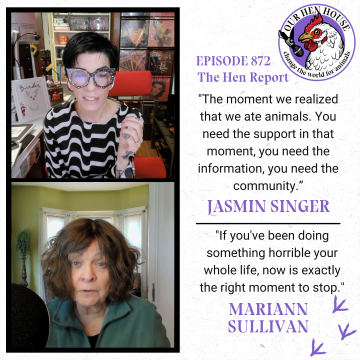
Here's the quote. "One of the saddest lessons of history is this. If we've been bamboozled long enough, we tend to reject any evidence of the bamboozle. We're no longer interested in finding out the truth. The bamboozle has captured us. It's simply too painful to acknowledge even to ourselves that we've been taken. Once you give a charlatan and power over you, you almost never get it back."
I, I mean, uh, we're not talking about a specific charlatan because there's a whole world of charlatans who are trying to sell people on animal agriculture, and many of them actually believe it themselves, I suppose. But I thought in other ways it was, you know, we're always searching for the answer to that question.
Why do otherwise good people like continue to eat animals in the face of all of the evidence of the horrific suffering? And I thought this was a pretty good one, that, you know, this is a bad thing about human nature.
Jasmin Singer: So I was, uh, leaving rehearsal the other day and there was a, a, a buck, like a, a, a huge buck. Well, maybe, maybe he was just like a normal sized buck, and I'm never this close to bucks, but
Mariann Sullivan: Are, are there other, is there another term for, for a male deer?
Jasmin Singer: I, I'm not sure, uh, a, a sweetheart get it. Uh, anyway,
Mariann Sullivan: uh.
Jasmin Singer: Thi this was a giant animal and he, he, he was just a
Mariann Sullivan: Stag. That was the thing I was thinking of. Stag. I guess that's more British. I'm sorry, I interrupted you.
Jasmin Singer: It's okay. I, I, I think he was just as surprised to see me as I was to see him.
Mariann Sullivan: This is really in a suburban area too.
Jasmin Singer: Yeah.
Mariann Sullivan: Scared for them.
Jasmin Singer: was,
Mariann Sullivan: He wasn't very old either. I don't think his, his antlers were not huge. I saw a picture.
Jasmin Singer: Just, yeah, just so that everyone knows, I did see him later run into the woods. So all ends well
Mariann Sullivan: Right.
Jasmin Singer: in this story, but there was, he was in the parking lot of the theater. I was alone. We, I got out of rehearsal very late. The doors closed behind me. I was completely alone. And, uh, except for him that, and he was alone except for me. And, uh, we both were like, whoa, what do we do now? Anyway, it was a little intimidating. Uh, I think he was between me and my car and I, for like a half a second was like, I guess I'll just go to my car. I'm glad I didn't because that could have made him feel cornered. But uh, and that might not have been a good ending for either of us.
Mariann Sullivan: No, I don't think they're like super dangerous unless you do something that makes them, I mean, they'd rather run away than attack, but, but if you make them feel like they can't run away, that could be dangerous.
Jasmin Singer: Anyway, so
Mariann Sullivan: And also from what I've read, if it's, I don't know whether it's mating season, I don't suppose it would be, but maybe it is.
I don't know. They have babies in the spring, so that might make sense. If it's mating season, all bets are off because of testosterone, you know, which basically is ruining the world.
Jasmin Singer: I said I did look sexy that night.
Mariann Sullivan: That was,
Jasmin Singer: Anyway.
Mariann Sullivan: I don't know whether it'll laugh at that or not.
Jasmin Singer: No. Yeah, no. Uh, but the reason I brought that up within the context of this quote by Carl Sagan is because. I, uh, sent, I took a little video. I sent it to a couple of the folks from the rehearsal, and one of them, who's like a lovely human being, sent me this sort of spiritual sort, sort of witchy thing about when you come across a buck in your life.
And it just was like time for contemplation and like, uh, peace and blah, blah, blah. And I found it quite inspiring and like, you know, it was nice and I, I have my own witchy vibes too sometimes, and I thanked her, and she said that she's super into like, oops, that she's, that she's super into the symbolism of running into different type of animals. All I could think was you eat them. Like
Mariann Sullivan: Wow. Yeah.
Jasmin Singer: I
Mariann Sullivan: You look at your plate and think, oh, a chicken? Oh, chickens mean happiness.
Jasmin Singer: I'm glad you said that because I was recently designing something on Canva. And I wanted to put some chickens in the design and I typed in chickens and it's a mix of like dead animals, like
Mariann Sullivan: Yeah, yeah,
Jasmin Singer: and chickens and it's so, it it, it, it's so awful. I mean, it's really rattles somebody, you know,.
Mariann Sullivan: Yeah.
Jasmin Singer: Anybody who gives, gives a damn is gonna be rattled by that. Uh, but
Mariann Sullivan: yeah. If you give a damn, your life is just a complete series of being rattled.
Jasmin Singer: It's true. So again, with the quote, once you give a charlatan power over you, you almost never get it back, just makes me think of that. Yeah, it's inappropriate. It's an appropriate quote.
Mariann Sullivan: Because it's too pain. I, I mean, I've, I mean, we've often thought of this as, as one of the reasons to the ultimate question of why do good people eat animals, otherwise good people eat animals. And I, I do think that it's too painful to acknowledge is, is a big deal. I think... recently got this during a conversation.
The, the response you o often get, well, I only buy local. Like, people try to immediately try to come up with a, with, with something that will somehow convince them that they have not done this because it's too painful to acknowledge that you've been doing this your whole life. I, I, I think that was a block for me.
But you know, if you've been doing something horrible your whole life now is the, now is exactly the right moment to stop.
Jasmin Singer: Yeah, and I'm the, it's so interesting because, and I'm, I'm thinking out loud here, so this might be terrible, but you know, obviously as you know, uh, the play that I'm in, which opens in like two weeks.
Mariann Sullivan: Oh, you're in a, you're in a play? Really?
Jasmin Singer: I'm in a play. And I play Judy Garland in it. And, you know, she started to take med, she started to
Mariann Sullivan: Yeah, I kind of remember you saying something about that.
Jasmin Singer: Alright, shut up. She started to be drugged by when she was like a young teenager. And you know, as as this line in the play goes, like, "I was up at 4:00 AM, 15 years old, 14 hours a day. Take this, swallow that. Even my own mother insisted I take every pill they give me. You know, how could I stop? Like, how? I could barely stand up without those things, let alone sing."
And of course, that's what ultimately took her life when she was my age. Uh, and the reason I bring that up is because I've been giving a lot of thought to addiction. And of course when it comes to food, we are addicted to animal products. They, they are literally made in such a way that we become addicted to them.
Mariann Sullivan: Oh, I, it's kind. I mean, some of them and kind of, but
Jasmin Singer: Fast
Mariann Sullivan: I don't think they're like nearly as addictive as like sugar and white flour and heroin.
Jasmin Singer: Okay. Yeah. Agreed. However, you know, there, there's a science to it. Making the food the right blend of smushy and salty and
Mariann Sullivan: Yeah. Sweet.
Jasmin Singer: Goes down your gullet at exactly the right speed to like trigger you wanting more, more, more. Anyway, when I was thinking about Judy, I was thinking, you know, it's, it's true. Like how could she stop without the right intervention? Which she never got. It, it would be like being 46, my age, and waking up one day without your legs, like just, and no wheelchair and no physical therapy and no anything. And it just makes me think of, uh, the moment we realized that we ate animals, right?
And how you need the support in that moment, you need the information. You need the community to get you through that period of time. Am I, am I going off my rocker a little bit?
Mariann Sullivan: No, I think, I mean, I, I'm not sure you need all of those things 'cause I think there are people who have done it without all of those things and, but absolutely it really helps if you're not trying to do it all by yourself and, and in the face of people who think you're crazy. Uh, yeah, all, all of that helps.
I mean, isn't that what Our Hen House is all about? Like, like trying to, um, create a place to support people and to encourage other people to support people who... you know, maybe they wake up a tiny bit and they, you can go one way or the other. You can sink back or you can, uh, say, I'm gonna take the next step in my life in the way I want it to go.
All right. I just wanna add one story because it it, this story, the, the, your story about the, the, the buck, uh, reminded me of this thing that's going around, which I had mentioned to you, but you hadn't heard of it. Um, and online, I don't know what, there's a survey or just a question or whatever, but a whole lot of women were asked online if you were in the woods alone, um, and you came upon either would you rather come upon a bear or a strange man who you don't know? And for like the unbelievably vast majority of women respond a bear. I just think it's interesting. I mean, I do think I, I was saying later, I think it matters kind of like how the man is dressed and is the bear a black bear or, or a grizzly bear.
'Cause I really wouldn't wanna come across a grizzly bear. But I just think it's very telling, like, like we don't, we're, we're not nearly as scared of animals as we are of each other. And I think that's with very good reason.
Jasmin Singer: I, I don't think the way the man is dressed would change my mind.
Mariann Sullivan: I think it would, I think it would influence me. I'm not saying that's a good thing about me. And I'm not, I'm certainly not saying that if somebody is well dressed, like... and I don't mean like well dressed like fancy, but you know, looking like a hiker or something, like dressed in that kind of clothing and I don't know.
But, uh, other than that, other than that, uh, I. I do not think that's any guarantee of safety. I would, I do not like to come upon strange men in lonely circumstances. I don't think any women do. I don't think men, the men who, who don't do that sort of thing, which I think is the vast majority of them, but we seem to be running into a lot of the others at the moment, but they, they don't realize, I mean, I think when you hear them talk about it, like podcasters or whatever, they're so shocked and women are like, yeah...
Jasmin Singer: I have a friend who has a teenage daughter, and the, my friend is a male and he has a teenage daughter, and they were going to be hiring, like a, a, a dude to work on their house. And it, the, the situation was such that he was going to be there when she was there alone. And my friend's, uh, wife was like, no, no way.
Mariann Sullivan: No way. Yeah.
Jasmin Singer: And my friend who's a male was like, what are you talking about? This is a reputable person.
Mariann Sullivan: Yeah.
Jasmin Singer: He called me and asked me my opinion, and I was like, no way.
Mariann Sullivan: Yeah.
Jasmin Singer: not. And he did
Mariann Sullivan: Yeah. Not unless you, I mean, you can find out enough information or it's not like you think every man is, is, uh, is gonna behave horribly, not by any means. It's just that it's really hard to know. And men, of course, they don't know because they don't run into this, they have never been
Jasmin Singer: just the
Mariann Sullivan: approached and inappropriately.
They've never like, like what woman has not been at least approached inappropriately, like very inappropriately at least once. So
Jasmin Singer: and,
Mariann Sullivan: rare.
Jasmin Singer: just the what, what about just the worry from the, the, the teenage girl? Like, just, just
Mariann Sullivan: Yeah. Even if he's fine, she has to think about it.
Jasmin Singer: yeah, exactly.
Mariann Sullivan: if she's not thinking about it, she should be thinking about it. Alright, let's move on. Let's move on.
Jasmin Singer: on.
Mariann Sullivan: There's enough of this
Jasmin Singer: we have a
Mariann Sullivan: because we have a lot of articles. None of them is a huge, big story. But I did wanna talk, well, one of them, the first one I wanted to talk about is a huge, big story.
It's this article in the New Yorker. Unfortunately it is behind a paywall. I don't know how to get beyond the paywall. I mean, I got behind it, beyond it, but that's because I paid. Um, and, uh, but it's an important article. It's not anything that you really have to read. The Runaway Monkeys Upending the Animal Rights Movement and the subtitle is A Troop of Macaques escaped one of the largest primate breeding facilities in America.
Now, a strange coalition of uncompromising activists and MAGA loyalists is demanding that all ab animals be set free. And it's by Ava Kaufman and. It's a really good article. It's very long. It's the New Yorker, and it goes into a lot of detail, which we probably already know a fair amount about, about how just dreadful these breeding facilities are.
This is one that's in Yemassee, South Carolina. And, uh, and you know, and apparently monkeys escaped quite regularly and this was a huge escape and, and it's just a horrible, horrible story. And she goes into a great deal of detail. You don't really need to know that.
I just wanted to mention it because it's great that there's such, this long form article in the New Yorker about monkeys and also because she does make the point, and it's mostly based on, on, uh, White Coat Waste Project, which is, you know, a, a basically a right wing oriented, um, animal protection organization.
And, uh, that the, the role that they played. I think that's where she's getting this MAGA bent. But I think this is just one more piece of this puzzle where the, for animals, there is this, this faction on the right, that I think sometimes we ignore, that you know, kind of really cares about animals, and we saw it with the squirrel story.
Um, I forget the squirrel's name. Um, and, uh, other stories that, you know, have, uh, have indicated that people can get very, very emotional. And, and because people on the right I think are, um, opposed to authority in, in a lot of different ways, they, sometimes they see it. You know, what, what, what authority is doing to these animals.
So, really interesting article and I just wanted to, you know, if you do have a subscription to the New Yorker, don't miss it. And, um,
Jasmin Singer: Wanna say though, that I don't have a subscription to the New Yorker and I just was able to open it. So maybe there's a certain amount
Mariann Sullivan: Are you sure? Are you sure you're able to read the whole article?
Jasmin Singer: Uh, it looks like it,
Mariann Sullivan: Oh, okay, good. Then there must, I must have used up my monthly, um, allowance.
Jasmin Singer: Yeah.
Mariann Sullivan: Um,
Jasmin Singer: Well, that's cool. I mean, like we've always said, the animal rights is, is one of the few issues that runs the gamut of the
Mariann Sullivan: yeah.
Jasmin Singer: spectrum, and that's something to lean into, I think.
Mariann Sullivan: It's totally something to lean into, most of all, because it can help the animals obviously to have people coming from different directions. But it's also one of the few issues where we do find people of different political viewpoints who can, can agree, um, at least to some extent, and that is increasingly valuable these days.
There's just one quote I'm gonna take out here. It occurred to me that both narratives, the one about activists and the one about accidents, these were narratives she had been told by each side of the, the story, obscured the role played by the monkeys themselves, who seem to be very much trying to leave. Uh, I really, and she, she actually cites to the 2011 book by Jason Hribal, Fear of the Animal Planet, The Hidden History of Animal Resistance.
And I think this is a, this is a fact that is kind of known within the movement and not very far. That, that animals, they don't just happen to escape, you know, especially monkeys who, you know, are, are both, uh, thoughtful and quite devious. And, uh, and there she said, she pretty much says that they spend all their time trying to figure out how to get out.
And one of the really tragic things is that a lot of them stayed in the area. And of course, the people in the facility, you know, kind of made it sound like, uh, they either didn't hate the facility or they're stupid or whatever, but I think the woman from PETA was quoted as, as making an observation along the lines of, well, their, their families and friends are still in there.
They, they wanna get everybody out. I think that's a beautiful way to look at it.
Jasmin Singer: Yeah. Yeah. Uh, I, I've been seeing a lot of buzz about this lately. You know, I, it, it just sometimes feels like it's one of those issues that's gonna continue to circle around and circle around and circle around. I guess we'll see. We'll, we'll see how this moves it forward. Um
Mariann Sullivan: Yeah. And one of the people who's, who's quoted as saying good things about White Coat Waste, though not this particular incident, was Laura Loomer. So, uh, yeah, strange bedfellows indeed. Also, Nancy Mace. Like,
Jasmin Singer: hmm. Yeah.
Mariann Sullivan: Like how is this all gonna sort out? I don't know.
Jasmin Singer: Right. Well, we have some good news. It looks like lots of good news to chat about. So
Mariann Sullivan: There's one more piece of bad news that I have to cover before we get to the good news. I'm sorry. And I, I probably wouldn't even mention this, uh, but we did mention recently that there was a lot of progress on carriage horses in New York City, and according to the ABC News, the proposal to ban the Central Park horse carriages was voted down by a key New York City Council Committee.
So apparently this industry still has the inexplicable stranglehold on the politics of New York City. Hopefully when the new mayor comes in, things will change, but I don't know. It's the unending issue. And you know, we thought we saw progress. We shouldn't have talked about it.
Just making fools of ourselves.
All right. Good news. Good news now
Jasmin Singer: Please, please get there.
Mariann Sullivan: I, this is a PCRM survey, so you know. I don't know whether they're reliable, but why not? Most Americans think schools should offer plant-based meals and milk, I admit. I bet that's really true. This is an article from Plant-Based News, and it says that 60% percent of respondents agreed that schools should offer plant-based milk, meat, and milk.
I mean, why wouldn't people say that? Why wouldn't people think that kids should be able to get the food that they want? And this, the vast majority of these people did not even know anything about lactose intolerance. They were just like, assuming this is what the kids wanted and they should get it. Like, yeah, what a, what a thought, what an idea.
Jasmin Singer: Yeah. By the way, just tiny little aside here, I was at the gym this morning and before noon, they offer free coffee and they do have a non-dairy option for the, for the milk, but it's almond milk. And if you go to the little cafe, you could ask for oat milk. But why is almond milk still being offered?
Mariann Sullivan: Oh, almond milk is, I think is the most popular plant-based milk.
Jasmin Singer: Is it?
Mariann Sullivan: Yeah. I mean, I'm, I haven't seen that statistic in a while, but it's not that long ago. It, it's,
Jasmin Singer: in coffee. Like revolting really in coffee.
Mariann Sullivan: is. Maybe it's like, okay, like if you drink milk, do people still drink milk?
Jasmin Singer: No, I mean,
Mariann Sullivan: What about on on cereal?
Jasmin Singer: I
Mariann Sullivan: Maybe it's fine on cereal.
Jasmin Singer: Almond milk is fine in cereal and in smoothies, but again, do not
Mariann Sullivan: You can't even taste it.
Jasmin Singer: Do not have it out with, with coffee. Just don't do it.
Mariann Sullivan: I agree. It's like, so water. Well, we,
Jasmin Singer: I'm
Mariann Sullivan: There are probably a few people out there who, who are totally annoyed with this and the rest of the, and the rest of them are bored.
Jasmin Singer: I need James, uh, um, what's his name, to glue his, glue his hand to something for
Mariann Sullivan: Cromwell
Jasmin Singer: Cromwell. I need James Cromwell to glue himself to something.
Mariann Sullivan: James has, James has done a lot.
Jasmin Singer: Yes he has. Alright. So has, uh, this overpass in Utah. I love stories like this and this is as reported by Vegan FTA Jordi Casamitjana which I might
Mariann Sullivan: Who does some amazing work. Follow him on social media.
Jasmin Singer: Really
Mariann Sullivan: Um,
Jasmin Singer: Mm-hmm.
Mariann Sullivan: Tracking down news stories, positive news stories. Well, not just positive news stories, a lot of news stories about animals. Wildlife overpass in Utah drastically lowers collisions with non-human animals. And what I think is so cool is that, you know, they, they built this wildlife overpass, which is great, but somebody had to gather the, you know.
It's not just a matter of doing things, then they have to gather evidence of why it. It, it helps so that other people will do it too. And so this was, this study was done by a master's student, um, at Utah State University. His name is Blake Ledbetter. The name of his study, it, it's a little, uh, bit of a mouthful, is Seasonal and Temporal Influences on Successful Crossing Rates by Ungulates of a North Utah Wildlife Overpass.
And, uh. And yeah, all these different animals, like they come to the highway, there's an overpass nearby, and they use it. They're not stupid, they're just like at risk. Uh, something like, um, wildlife vehicle collisions in the area have dropped by as much as 77%. We need this everywhere. I am so sick of seeing little dead bodies on the streets.
We need it on in, in the middle of the city so the squirrels can, you know, just go from tree to tree without being in the, uh, in the street. 97% of mu of mule deer and a and a hundred percent of moose that were near the bridge used it.
Jasmin Singer: We need
Mariann Sullivan: They're not stupid.
Jasmin Singer: of the theater that where I met my buck friend.
Mariann Sullivan: Right, right.
Jasmin Singer: Yeah, no, there's actually one, I remember doing an episode about something related to this for Environmental Connections and there's one like in Buffalo, that,
Mariann Sullivan: They should be everywhere.
Jasmin Singer: Yeah, they should be everywhere. Absolutely.
Mariann Sullivan: The world should be very different. Have you guessed that I feel that way?
Jasmin Singer: No, I have no idea what you're talking about, but, uh, we are doing some good news now, so let's talk about the news from the UK.
Mariann Sullivan: Yeah, this is the really big news. I think this is huge. Uh, for some reason the article I got is from something called the Farm Buzz. UK sets deadline to phase out animal testing. UK accelerates animal testing phase out with new 75 million pounds strategy. They wanna get rid of it completely and they're working on it.
75 pound million pounds. And that's in the uk. You know, their budget isn't as big as ours. And, um, they, this is this groundbreaking plan and they're trying... I mean, there's already a process going on of phasing out animal testing for products and, um, and they're trying to, to speed that up. And, but it's not just product testing, it's, um, medical testing as well, uh, vaccine testing.
Um. You know, and the plan the UK has formulated aims to discovery alternatives to these. So they're really moving ahead and they're very committed to it. And I love that. And, you know, things are also proceeding well in, in the US as well. It's one of the few things that this, um, administration has done that isn't horrifying.
Um, so I loved that story.
Jasmin Singer: Yeah, this
Mariann Sullivan: think that's, that's a really big deal. We're talking about a lot of animals.
Jasmin Singer: right. This is also, you know, one of those issues that has actually made a, a, not
Mariann Sullivan: Yeah.
Jasmin Singer: like a frigging, you know, hole in the... since we've started Our Hen House, since I, since we've been involved, it's, it's amazing. There's a huge shift, like a massive, massive shift,
Mariann Sullivan: I mean, it's certainly far from being completed, but it, it's on its way. It's, I I never would've thought we would've gotten here even just a few years ago. Uh, you know, it is, um, the, the, the need to do this is, is, is acknowledged as, as partly, you know, financial and better science. But I really think this is something that is driven by the fact that they know that people hate them and, um, it's, they, they keep, they work so hard to keep what they do to animals secret, and they know it's just a huge problem, not only because it's financially ridiculous.
Scientifically, frequently, scientifically, uh, poor research, but because people won't have it. For some reason, this is the issue that really, that really makes people crazy. Maybe because it doesn't affect their individual life. I don't know.
Jasmin Singer: Hmm. So back to Jordi at Vegan FTA. Uh, tell us about this, this article that he, that he found.
Mariann Sullivan: Well, this is the Global Animal Partnership which has always been affiliated with Whole Foods. And I mean, I remember when this was, this was invented and, and animal protection organizations were working with them and there's been constant controversy that, you know, it's basically totally welfarist and there are different levels.
And, and, and finally, uh, the, the three prominent animal welfare organizations that were working with them, the ASPCA, A Humane World for Animals, and Compassion In World Farming said, No enough. They severed ties with them. They left the board of directors and, um, they, you know, it, the conclusion is that it's pure humane washing.
It's not actually doing what it says it's going to be doing. PETA has been against it for a very long time and has worked very hard to, to try to end this like, this like, uh, fake, uh, patina that they put over, over a lot of these facilities. That, that when they've done the undercover investigations, they've been treating the animals horribly.
So, you know, I am not against the idea of, of doing this, of having these labels. But I think this article, like everything else about humane quote unquote humane, uh, treatment of animals in the industry, it just shows that you can't do it. You can't still, you can't treat animals well and, and, and sell their flesh.
Like if you wanna do that, it's gonna cost a fortune because it costs a lot of money to take care of animals, and it just doesn't work. It's not financially feasible. So even if, even if you're not morally opposed to the idea of eating animals at all, which, you know, of course I am. I'm just saying I'm not, I'm not against the whole, uh, um the whole concept.
I just don't think it's, it, it, it's work, it's not workable. I mean, against the concept and the idea that that makes it okay. I don't think it makes it okay, but if people wanna work towards that, I don't think it's like, you know, the worst thing in the world, except it is the worst thing in the world.
Am I making any sense at all? Because it's all untrue. It's not, none of it's true. At least when they do cage free campaigns. I mean, I think they can be very deceptive because they make it sound like it's okay, but all they're saying is that it's cage free. They're not saying it's humane necessarily. Well, I guess some of them are.
Um, so at least it's not an outright lie. You can't be humane and raise animals for food. It's not possible.
Jasmin Singer: Okay. Well then the next, I guess, and maybe final piece of news for this week is something that I'm very pleased by, though.
It does confuse me admittedly,
Mariann Sullivan: Yeah, you've mentioned that before. Well, go ahead.
Jasmin Singer: Okay. Well it's about, uh, this article, which is great, and it's from The Guardian and, and the name of it is, It's Changed Me. That was a quote, Jeff Goldblum says he stopped eating meat after working on Wicked. And the thing that confuses me is I already had him clocked as a,
Mariann Sullivan: Yeah, I, I googled that and I didn't, I didn't see any reference to that. Are you sure?
Jasmin Singer: Well, I did have it clocked. Maybe I just am a psychic. Uh, but regardless of that or not, this is very cool. 'Cause he said that it was discussions about animal cruelty with director John Chu had led him to as the article says, join Ariana Grande and Cynthia Erivo in renouncing meat. I'm personally not a hundred percent sure that that certainly that Cynthia's still vegan.
Uh, but regardless...
Mariann Sullivan: You're not sure that Cynthia's vegan?
Jasmin Singer: No,
Mariann Sullivan: that's.
Jasmin Singer: was, there was some, there were some pictures of her, like holding fast food that came out last year. She wasn't eating it, and it was for a promo, but, um, and it, it was not entirely clear. And I sound like, so the vegan police right now, but there have been a few mentions I
Mariann Sullivan: Hmm.
Jasmin Singer: not being vegan anymore.
I don't have it in front of me. I'm totally spreading rumors right
Mariann Sullivan: Yeah. Seriously, this is not our job. Jasmin to spread rumor unfounded rumors. We're,
Jasmin Singer: All right. Talk about
Mariann Sullivan: we're supposed to be the source. All right. Google it while I just talk about this article a little bit. I had, I, I mean, that does ring a vague bell that, um, gold, Jeff Goldblum might have been vegan, but I did not find anything online to support that.
What I really liked about this article, when I first saw the story, it, it said that, that he had stopped eating... I don't, I don't think, um, he stopped eating fish. Uh, so it's not, it's not like he's gone whole hog, so to speak. Uh. But I originally heard that it was because of talking to Cynthia and Ariana, and I'm pleased now at seeing this article, which was in The Guardian, that, uh, because it was the scenes, the film series of themes about animal cruelty.
I, I really like that, you know, because I just think that it's such an unbelievably important theme in this extremely popular and, and iconic film series, uh, of the two films. Um, it. And it's just ignored by everyone that, that it has anything to do with animals and it's so obvious. So I like that it that, that this story really emphasizes that. Maybe people will, you know, it's just like that quote that we used at the beginning of this episode that, uh, people just don't, you know, see, uh, what's what, what they can no longer bear to see. And people did not do not, they'll see Wicked and don't realize it's about animals. When it's all about animals. It's crazy.
But he apparently did notice that, and that is what, what focused him, I'm sure didn't hurt that Ariana and Cynthia were there to support him and egg him on, so to speak.
Jasmin Singer: Yeah, and I, you know, the internet, which is always. reliable said that, uh, doesn't say anything. Uh, so I could have maybe made it up in my head. Sorry. Sorry, Cynthia. I'm sure you're listening. Uh, but regardless, that is, this is very cool. And as we've discussed 9 billion times, well, well, well, well before the movies the first movie came out, obviously Wicked is just an animal rights, you know, manifesto.
And, and there's, to me no other way of seeing it. I don't understand why everyone's not talking about it, but I'm really glad Jeff Goldblum is. And I can't wait to see the second one, personally. I'm super excited. Alright, so is that, is that basically it?
Mariann Sullivan: That's it for the news. I did wanna mention this isn't a news story, but it is something that I really wanted to mention. You know, we've interviewed the folks, Sarah Saluzzo and Jonina Turzi at, um, at Lancaster Farm Animal Sanctuary, and I just love them and they're doing a really amazing work there. And we just found out that Jonina has been, um, diagnosed with cancer.
Like here she is, like, I don't know how old she is, but she's not very old. And like, how, why does this happen? Uh, it's so upsetting, but, um, they, it's a rare sarcoma and, and her treatment is, uh, pretty specific and she has to travel for it. So she needs a lot of specialized care and, you know, insurance is covering some, but it's definitely not covering others.
So I just wanted to mention that they are doing a GoFundMe and, um, for people who can, uh, who can contribute, I'm sure that would be deeply, deeply appreciated. I'm just so upset about this.
Jasmin Singer: Yeah, it's really sad. She's a wonderful human and I love Lancaster Animal Sanctuary, and I absolutely loved their episode too. It, I just, they do really amazing work. And you know, this is the kind of thing that like everyone thinks, oh, that happens to someone else until one day it happens to you. Uh,
Mariann Sullivan: I, I just feel like recently I've been hearing about it happening to way too many people who are young. Like cancer specifically.
Jasmin Singer: Yeah,
Mariann Sullivan: It's very, very scary stuff. I.
Jasmin Singer: We'll link to that for people who are. to support good folks. And speaking of supporting good folks, we are in our end of year fundraising right now. We're doing the vast majority of our annual fundraising at the end of the year per use. And so I just wanna thank you all.
Those of you who already contribute to Our Hen House, those of you who are thinking about it, we hope that you join us by going to ourhenhouse.org/support. If you become a flock member, there are some fun perks that you get, including bonus content and an invitation to join us for our Flock Fridays. And watch some interviews being recorded live and have an opportunity to do q and a with the guests. Uh, we know that times are tough right now, especially in the US, so of course we understand if you're unable to contribute financially, but if you are able donations of any amount count toward our goal and are tax deductible and are being triple matched. So every dollar that you donate becomes three, ourhenhouse.org/support.
Thank you so much for being such a important part of the Our Hen House community. What do we have coming up Mariann?
Mariann Sullivan: Uh, our, our interview, uh, on tomorrow is with Benny Smith and Seth Green. And these, like, I love it when we interview people who are a million years younger than we are. Well, a million years younger than, than me. More or just 500,000 years younger than you. Um, and they're up and coming activists, very, very bright, very, very educated.
And using that, um, using that to figure out research on the effectiveness of various theories of change, both, both, uh, for recognizing animals and for going vegan. I mean, I think so often all the research just focuses on how do you get people to eat differently, but we, there's also quite a discussion of like, how do you get people to care about animals when, when they probably already do so?
Great interview.
Jasmin Singer: It is a great interview. I'm really excited about this one airing. So thank you so much for those of you who are still tuned in. We really appreciate you and we will talk to you next time.
_____________________________________________

Thank you for listening to the Our Hen House podcast! If you enjoy our podcasts, believe in our mission to effectively mainstream the movement to end the exploitation of animals, find community and solace in our shows and resources, and would like to show your support for vegan indie media, please make a donation today.
Between now and December 31, every donation up to $20,000 will be tripled! Contributions of any amount will go towards our fundraising goal and are hugely appreciated. Our Hen House is a 501(c)(3) nonprofit organization, so it’s tax-deductible. Thank you for helping us create quality content!
Subscribe to our show on Apple Podcasts, YouTube, or your favorite podcatcher, and don’t forget to leave a 5-star review!
Check out Our Hen House’s other podcasts: The Animal Law Podcast, The Teaching Jasmin How to Cook Vegan Podcast, and the Antiracism in Animal Advocacy Audio Series.
Follow us on social media! You can find Our Hen House on Facebook, Instagram, TikTok, or Bluesky.
The Our Hen House theme song is written and performed by Michael Harren.