
 Apple Podcasts
 RSS
 Amazon Music
 Spotify
 YouTube
 PocketCasts
 CastBox
 Player.fm
 TuneIn
 Audible
 App not listed? Try this RSS link
In this week’s episode of The Hen Report, Jasmin and Mariann explore how animal rights themes are increasingly appearing in mainstream media – from the explicit animal liberation narrative in Wicked to the vegan consciousness in Apple TV’s Pluribus. They celebrate recent policy victories while examining why veganism often faces social resistance, emphasizing that effective advocacy keeps animals, not vegan identity, at the center of the conversation.
This episode explores:
- How the film “Wicked” presents a powerful animal liberation narrative that some viewers surprisingly miss
- Recent policy wins, including the CDC’s unexpected end to monkey research and Poland’s fur farming ban
- The psychological dynamics behind why vegans face social resistance and how to effectively navigate those conversations
- Why centering animals rather than vegan identity leads to more productive advocacy
- The importance of celebrating incremental victories in animal rights, like societal shifts away from fur
RESOURCES
-
-
- Have your say in the EU’s public consultation on animal welfare.
- The Internet Loves These “Gay Sheep.” The Real Story Is Much Darker.
- The Dutch Senate has voted to phase out public funding for primate experiments
- Exclusive: CDC to end all monkey research
- Poland’s president signs fur farming ban into law
- Dr Gemma Newman Explains ‘Why People Seem To Hate Vegans’ And What To Do About It
- Bed & Breakup
- Governing Bodies: A Memoir, a Confluence, a Watershed
- The Goat Conspiracy with Nicole Schonemann
-
INTERVIEW TRANSCRIPT
Jasmin Singer: Welcome to The Hen Report. This is Jasmin Singer.
Mariann Sullivan: This is Mariann Sullivan.
Jasmin Singer: And we're so excited that you're here today.
This is the Our Hen House sort of umbrella you. Every time we do a show now, I'm just gonna use another bad metaphor, whether it's the universe or umbrellas or whatever. But in any case, we're glad you're here because Rising Anxieties comes out on Tuesdays, The Hen Report on Thursdays, the long form interview on Fridays and bonus for Flock members comes out on Mondays. We're on YouTube.
We're also on every pod catcher that you listen to. So please hit like and subscribe wherever you can. So we finally saw Wicked and uh, yeah, on,
Mariann Sullivan: left.
Jasmin Singer: on Thanksgiving, and I loved seeing it on Thanksgiving. Not only was the theater on the empty side, but uh. I, you know, Thanksgiving is always hard when you're vegan and you know that so many people are just centering an entire event around a dead animal.
Mariann Sullivan: Somehow I feel like I've, I've gotten past that. I mean, obviously if I, I mean, for most people, they have to go somewhere where there's a dead bird then I wouldn't be past it, but I, I, I just, you know, I enjoy Thanksgiving. I, I don't think about the fact that this is a particular celebration of, of killing animals.
I mean, they all go out there and kill animals every day and, and whether it's a celebration or not. So I, I think you need to own Thanksgiving, but one way to own it is to go see a great movie,
Jasmin Singer: About animal liberation. I, you know, it's so funny, so I know we've been talking about Wicked far, far before the movie was even a glimmer in Ariana Grande's eyes, uh, because we saw it on Broadway so many, I saw it so many times on Broadway, and obviously...
Mariann Sullivan: it once. I'm
not
nearly as much of a wicked afficianado as you.
Jasmin Singer: I'm not even sure I'm like the biggest fan in the world.
I just, for some reason, tickets always landed on my lap, uh, to see the play. But it's, it's like a manifesto about animal rights as we've discussed. And the funny thing.
Mariann Sullivan: Movie was even, and I even more than the play, and I think the second movie was even more than first.
Jasmin Singer: Yeah, a hundred percent. But so the funny thing is, I get a text from someone the other day, uh, and and she's like, do you think... this person's vegan, and she hasn't seen it. And she goes, so is is wicked like animal rightsy? And I was like, oh yeah. Like, totally. And she was like, oh. 'cause a friend of mine saw it and said, and said it wasn't. The friend of hers is.
Mariann Sullivan: what I'm hearing that
Jasmin Singer: but hang on. The friend of hers is also vegan, and so I was like, oh, okay. Well here's the plot. It's about a woman who liberates animals and is then misunderstood and objectified for it. Meanwhile, society sort of starts to, uh, commodify and exploit these animals, and we're trying to get them liberated.
Like, I'm like, this is not my interpretation. This is the plot. What do you think? It's the actual plot. What? Like, I, I am, I don't under,
Mariann Sullivan: How could anybody not get it?
Jasmin Singer: it's very,
Mariann Sullivan: can talk? And so they say, well, those aren't real animals. They're standing in for somebody else. I don't
Jasmin Singer: Hmm. Yeah. Maybe.
Mariann Sullivan: about animals.
Jasmin Singer: So. Were you happy with, did you love it? Yeah.
Mariann Sullivan: I mean, it was, it was pretty dark. I mean, both actually, uh, figuratively and literally. It was just dark, but, um, uh, darker than the, than than the first one. It didn't have as many light moments,
Jasmin Singer: Agreed.
Mariann Sullivan: it, I thought it was, I thought they served the story really, really well. I, I loved it.
Jasmin Singer: Me too. I loved it.
Mariann Sullivan: And
Jasmin Singer: I to
Mariann Sullivan: was like, I mean, it was about animals mostly.
It was also about women and women friendships and the power they have in, in, in the world. It was about, I thought it was totally about, um, authoritarianism,
Jasmin Singer: Uhhuh.
Mariann Sullivan: um, the, the like and, and the fact that the wizard, he, he sings that song Jeff Goldblum. Then he just kind of fell into being an authoritarian 'cause everybody just started doing what he wanted 'em to do.
Like, uh, that rings a bell.
Jasmin Singer: Yeah. Yeah, totally. Uh, there, it's been an interesting week for taking in media that is, that sort of has vegan themes whether explicitly or not. I watched the new, the, the new show PLURIBUS on Apple
tv.
Mariann Sullivan: I haven't seen it yet, so you're gonna have to like, tell me
Jasmin Singer: Yeah.
Mariann Sullivan: it, what, what the story is.
Jasmin Singer: Well, it, it's basically about like there's this sort of, I will say like alien invasion basically, where, where everyone is sort of forced everyone on, on earth is, is forced into a collective conscience through what is more or less like,
Mariann Sullivan: or consciousness.
Jasmin Singer: Uh, consciousness. Thank you. And basically it, it's through like a A DNA strain that aliens put into humans.
And for some reason, 11 people on the planet that they know of are immune to this. So there's 11 people who are just like going about their lives and everyone around them is basically sharing a consciousness. And the vegan theme, in my opinion, comes in in the sense that the consciousness, like from the, the people, well call it, is vegan and, and it's a, it's based around nonviolence. And so there's this scene at a dinner table where they kind of fly in, uh, multiple people from the group of 11 who, uh, are immune to this disease, I'll call it. And they're talking about eating. And the, the, the folks with the shared consciousness say that they won't kill animals because it's against their worldview and their belief.
And one of the people who did not succumb to this disease was basically like, so what if I want, you know, a steak for, for dinner kind of thing. And they're like, well, there's a lot of, you know, stored meat still that we have to go through. So, you know, we would make it from that. And he is like, well, once we're through all of that, then what? He, and they're like, well, you know, it's, it, we, we don't kill.
And, and he said, well, what if I go and kill? And it was, it was so bizarre. This, this.
Mariann Sullivan: Who are the good guys and who are the bad guys?
Jasmin Singer: Yes, that's the question. I mean, in my opinion, the good guys are the, the ones with the shared consciousness because they're the ones with the vegan ethic, but there's obviously other layers to the story and act. Act one.
Mariann Sullivan: crazy. That's
Jasmin Singer: Yeah.
Mariann Sullivan: know whether I wanna watch it.
Jasmin Singer: Yeah. I, I mean, I, I loved it.
Mariann Sullivan: it. It sounds useful,
Jasmin Singer: It's amazing. It's really well done. Um, but this is funny because something else happened recently where I read a book just 'cause I wanted to read something stupid and or, you know, just not stupid, but light. Yeah. And so I read this, uh, kind of romcom type of light novel called Bed and Breakfast by Susie Dumond, and it's lesbian-y so that's why I read it.
But so like within the first moment in the book, it's, I, it becomes clear that it's about a vegan chef, like a lesbian, vegan chef.
Mariann Sullivan: and, and you just happened to upon it
Jasmin Singer: It just happened upon it. And, and so then, so the whole book, I'm like waiting for the, the veganism to be like a butt of a joke, but it never is. It, it's always about like, thinking in new ways and trying new foods and like having these, and they describe the foods in it, uh, and they all sound amazing.
And I sort of wonder if, if this author is vegan. Um, Susie Dumond because I, if, if she's not, I'm very perplexed. But it, I mean, it's a very sweet, cute read, by the way. It was a really good book. Not at all stupid. Like when I said I wanted to read something stupid, I just meant I I didn't wanna read headlines.
Mariann Sullivan: I, I might read that.
Jasmin Singer: You should do totally read it. It's, it's cute. It's super cute. Uh, so what about you? Have you taken in any
Mariann Sullivan: I do is watch the news on YouTube.
Jasmin Singer: Right, as we know.
Mariann Sullivan: I don't know why. I'm making myself insane,
Jasmin Singer: We know.
Mariann Sullivan: The thing I wanted to talk about specific, I mean not, it's very little of it's about animals. Um, it, it's just about, you know, the nightmare. And so I, I watch Heather Cox Richardson all the time. I don't know whether any of you, probably some of you are watching, maybe not all of you.
I don't know. I love her. She is keeping me sane through the insanity. She, I get so much information, but she always conveys it in a hopeful way and in a historical context. So I'm watching her, she does this show with this other history, she's a history professor, which this other history professor's name I can't remember. And who the, the other professor has a pet bird and you can hear the pet bird in the background. And, uh, Heather Cox Richardson says, well, maybe he's upset 'cause we're talking about eating turkeys and those are birds. And then they both laugh hysterically.
Jasmin Singer: Oh, not the laugh. No.
Mariann Sullivan: Laugh that I interpret as uncomfortable because it's not funny.
I mean, nothing funny got said like, so, you know, laughter covers a lot of emotions and I think it's a discomfort, but, you know, maybe I'm just telling myself that, but it was just depressing. Like my, I mean, she's keeping me sane, this woman and her, I mean also her husband apparently is a lobster fisherman. Uh, so there's that too.
Jasmin Singer: Wow. Yeah, I kinda had something like that. You know, my play opens this week, uh, where I'm playing Judy Garland and I follow all these Judy Garland things on Facebook. And there was one that was like the Judy Garland experience or something, and I'm really into what they post, 'cause they post these like gems from Judy Garland's life.
And on Thanksgiving they posted something that said. Uh, you know, something like for once, we're not gonna be just staring at Judy Garland. We're gonna be staring at that terrified Turkey or something. And then they wrote a little smiley face and it was kind of the same thing as what you just described.
And also I was like, don't muddy my safe space. No. It's just, yeah, I mean obviously there's so many ways we could look at those smiles and those laughs as as progress, as
Mariann Sullivan: well, I
Jasmin Singer: discomfort, rising anxieties.
Mariann Sullivan: figure there's some kind of discomfort 'cause they didn't say anything funny. Like,
Jasmin Singer: Yeah, but, and then they laughed,
Mariann Sullivan: Why would they be laughing other than to cover for, for themselves not, not to disguise it, but to cover their own sense of discomfort.
Jasmin Singer: Uhhuh.
Mariann Sullivan: This must be funny because if it's not funny, it's really awful. You know what? It's really awful.
Jasmin Singer: Yeah. Alright, well let's move on to talking about some of the stories that we were gonna chat about this week.
Mariann Sullivan: Don't forget that we have a couple of shout outs. Do you wanna do them now or do you wanna do them later?
Jasmin Singer: Uh, let's do them later.
Mariann Sullivan: All right. But don't forget.
Jasmin Singer: I won't, I have it open.
Mariann Sullivan: Alright, the first story I wanted to talk about is actually an act, just a piece of activism that people could get involved in. The EU apparently is doing a public consultation on animal welfare uh. This is a, an action alert from Anima International. And, and they're, they're really opening it up to, uh, you know, people's thoughts about how they should be changed. And, you know, we often talk about the fact that EU laws are better than ours here in the us but they're still absolutely abysmal. So, we'll put the link in the show notes and, um, or you can just go to animainternational.org. and, and, uh, they're not... They want public participation. They want public comments, and they're not just asking it from, from Europe. Uh, it's from anywhere. So if you feel like taking a quick, uh, armchair piece of activism, I would suggest that one.
Jasmin Singer: Yeah, I, that's really interesting. And also we're, we have an interview coming up with Neil Dullaghan, uh, I think on the Animal Law podcast, who's gonna be talking about farmed animal welfare in the EU. So I don't, that might be an interesting thing to bring up as well. Cool.
Mariann Sullivan: All right. This other article is really creepy. It really upset me. This is probably something that people have heard of. I don't know, because I don't pay attention to anything. I guess. This is from, um, TNR, which is the, um, the, The New Republic. The New Republic, um, the internet loves these gay sheep, the real story is much darker.
Apparently, there's this thing being going on. That's been, I guess, on Instagram with this fashion show and all of the wool, there's all these different outfits in wool, and they were taken from gay sheep. These are sheep, uh, male sheep who have been rescued because they, they, they are drawn more to their male friends than to, um, than to female goats.
Jasmin Singer: my God.
Mariann Sullivan: So the gay, like, there's this whole gay thing about how great this is. And, and then they were rescued and they did this really cute, um, uh, thing on Grindr put on, I wool survive a runway fashion show. And, uh, the swimwear wearing stars and stripes, Speedos made out of the wool, a mechanic of,
Jasmin Singer: Oh
Mariann Sullivan: all of this
Jasmin Singer: God.
Mariann Sullivan: just like fucking cute and trying to show that even sheep can be gay just like us and like.
Uh, totally and
Jasmin Singer: my God.
Mariann Sullivan: ignoring everything that happens to sheep and lambs. That gay rams who don't breed with ewes generally, uh, you know, they're just killed. Uh, so these happen to have been rescued. Doesn't mean they're all rescued because the rest, uh, they're... just very, very disturbing. I am very glad for this article, which points this all out, but, you know, people have just gotta stop this cutesy thing.
Like, it just makes me crazy. It's just using these animals.
Jasmin Singer: Unreal. I'm I,
Mariann Sullivan: Yeah,
Jasmin Singer: I am.
Mariann Sullivan: a bad one. All right, let's
Jasmin Singer: That's a bad one. I mean, it just, there's, so it makes me think of all of those articles that I wrote when I was... like 20 years ago on animal rights and gay rights, and the overlaps between the liberation movements, but also the exploitation, and this is disgusting. I'm horrified. Let's move on.
Mariann Sullivan: All right. Let's get some good news.
Jasmin Singer: Yes, please.
Mariann Sullivan: From, from Lady Free Thinker. This is a great story from, um, the Netherlands. The Dutch Senate has voted to phase out public funding for primate experiments at Europe's largest primate lab. Uh, it's 12 and a half million dollars a year that will go towards human focused research, so that's really nice.
But wait til you hear of this story that goes with it, I don't even know what to make of this. It's crazy. This is from Science, uh, science.org. Um, Exclusive CDC to End All Monkey Research. This is from November 21st, so I, I don't know whether it's, you know, whether this is still going on, but get that title again. CDC to end all monkey Research. Studies related to HIV and other infectious diseases will be phased out, sources say, fate of the agency's animals remains unclear. Okay. This is like the dream come true. They're getting rid of mon, I mean, do you know how many monkeys like they finance research on? It's... and, alright, so I'm just gonna read the first paragraph.
Scientists at the US Centers for Disease Control and Prevention have been told to phase out all of their monkey research. The directive communicated to CDC staff by former department of governmental efficiency, that's doge, employee and recent college graduate who is now a top official at the agency, will end studies on approximately 200 macaques.
Oh, I thought it was more than that. The fate of the animals largely used in work on HIV prevention is unclear. Some may be transferred to primate sanctuaries, others may be euthanized. So appar... this is the kind of story like talk about your strange bedfellows. This is these, you know, doge lunatics who came in, uh, they're like kids, they destroyed the federal government. Apparently one of them was this guy, Sam Beta, and he, he was recently named CDC's, Deputy Chief of Staff. He's right outta college. He didn't major in science, he did graduate from Columbia. So, you know, he is probably reasonably bright and uh, and I don't know what his goals are.
I don't know what his aims are, but hooray!? I think.
Jasmin Singer: I am getting.
Mariann Sullivan: This could backfire horribly like, like, if they, they... they're actually looking into sanctuary for these animals. All the scientists are completely freaked out. Even the people at White Coast Waste, well they're not freaked out, but they're like surprised that all this happened so fast. Uh, they cheer the decision. This is exceeding our expectations, said Justin Goodman. Uh, no shit. So they don't know what they're gonna do with the monkeys, but as I said, they're looking into this Peaceable Primate Sanctuary, which is one of the largest monkey refuges in North America. And, um, they, they're like, to... according to the guy at the sanctuary, he wanted to know how many monkeys we could take immediately, and whether it would be possible to retire all of them within a year.
Of course, you know, they, they would need money in order to do that. Um, it costs money to take care of animals. So this is the craziest story in, in the history of, of, of animal rights. Like we won? I mean, of course it could backfire in the sense that they'll save all these animals and then, you know, they'll just start again, uh, with a whole new traunch of animals or the, the administration will change, which... now am I supposed to be hoping for the administration not to change? The world is nuts.
Jasmin Singer: I am getting serious whiplash today on Our Hen House. Like that story is.
Mariann Sullivan: Yeah, that story is crazy.
Jasmin Singer: Yeah.
Mariann Sullivan: Alright. One more piece of good news. Poland's President signs fur farming ban into law. Poland has apparently, um, a lot of fur farms. It's this world's second largest fur farming nation, and now it's the 18th EU country to end, uh, fur farming. Um, you know, there it will be phased out, but there are actually gonna be incentives given um. Because it will go into effect immediately for new farm, no new farms or within 14 days. Um, virtually immediately, but there are already 200 fur farms. So they have until 2034 to close, but they're going to be given incentives, uh, to close earlier than that. So that's a lovely piece of news. God, it doesn't it like that...
the fact that they're still doing that is
just
so crazy.
Jasmin Singer: No, I, I,
Mariann Sullivan: are our news articles. Then there's this one article that I really wanted to talk about.
Jasmin Singer: Well, can I just say real quick? I, I think I've mentioned this before, but it, it's good to hold on to how much of a collective shift there has been societally about fur. Because, I mean, in, in like our time as activists, as animal activists. And it's, it's good to hold onto that because it kind of happens quietly, like over time.
There's not always a big moment. There's not always a big, like,
Mariann Sullivan: it's very easy for us to think that we're exact in exactly the same place we were at 20 years ago and we were, we are really not.
Jasmin Singer: You know, the, it makes me think of this, this song from a musical called Flora the Red Met.
Mariann Sullivan: break into song?
Jasmin Singer: No, I'm not. I'm too tired. But there's this song from Flora, the Red Menace, which I was in in college. It's a great musical, and there's this line in it that goes, when it all comes true just the way you planned. It's funny, but the bells don't ring, it's a quiet thing.
And sometimes that's how activism wins happen. Sometimes it's a quiet thing.
Mariann Sullivan: Haven't won yet, but we have made real progress.
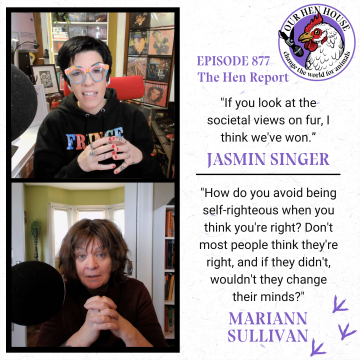
Jasmin Singer: I just mean this, the, I think su, if you look at the societal views on fur, I think we've won. I do. I mean, you're right. It still exists.
Mariann Sullivan: The sense that we haven't gotten all the animals out.
Jasmin Singer: That's true. That's true.
Mariann Sullivan: There has been the, the shift is in motion. And I think, I mean, I think maybe the point you're making, and I think you might be right, is that now it's inevitable. It's just a matter of playing out the,
Jasmin Singer: Yeah.
Mariann Sullivan: the, the sad denouement.
Jasmin Singer: Mm-hmm.
Mariann Sullivan: Until it's over and then, and then it's over.
Jasmin Singer: Let's talk about this article that, uh, that you wanted to chat about. It was very interesting. This is as, as, uh, reported by Plant-based News, uh, though it's about Dr. Gemma Newman's, uh, talk on why people seem to hate vegans and what to do about it. Why did this strike you so much?
Mariann Sullivan: I don't know. I thought that the way she articulated it was pretty good.
Jasmin Singer: I did too. Yeah.
Mariann Sullivan: Alright, so she is apparently a senior partner at a family medical practice, so she actually practices medicine and she also is the author of the Plant Powered Doctor and she. This, she did this video to Facebook, um, in which she talked about all of this, and she talked about the symbolic threat that vegans present to meat eating identities. And how vegans and omnivores alike can overcome negative perceptions. Uh, and I, I mean, I think it does. Um. It does present a threat. I think it's a good way to think of it. It does present a threat... um, vegans. I'll, I'll just read what she says that's easier than me trying to paraphrase it. Vegans don't just pose a threat to our identities as moral people. And she's saying that's not all, but that definitely is part of it. They also pose what researchers call a symbolic threat to group identities, cherished traditions, cultural values, and social norms. Now, some of that is obviously stuff we already know that, you know, people are always bringing up traditions. And you know, like you always say if, if you can't bear to give up your mother's brisket on, uh, on Hanukkah, like then eat your mother's brisket on Hanukkah and give up all the other stuff. You don't have to use it as an excuse. But I also think that this threat to our people's identities as moral people is really significant. Um, and, and I feel like, here they associate, these are the words that people associate with vegans.
Some of them are really good, caring, committed, empathic, dedicated. And then it shifts into annoying, self-righteous, judgmental, arrogant. And that self-righteous thing, it's like we've always said, like how do you avoid being self-righteous when you actually think you're right? And don't most people think they're right, and if they didn't, wouldn't they change their minds?
Like, like how? Uh, it, it is a moral stance. It's a moral stance. It can't help it. It, I think it's immoral to do what they do to animals and, uh, and I don't think that's just a message of changing your messaging.
Jasmin Singer: You are making me think of another theater reference. Sorry. But you know, I'm a little, uh, I'm a little focused on theater this week, but.
When we were talking backstage about crying on stage and we were talking about like how people do it and if it's easy or not. And I said, you know, it's something that I struggle with.
I can get there, but I need, it takes me a, it takes me a while. Whereas one of the actors in the play, like he could just cry like that. And I said, I'm really envious of that. You know, 'cause it's really hard for me to get there. And, and he said, I'm really surprised to hear that given how empathic you are.
I was like, that's so interesting. Like, he goes, he is, he goes, you're so sensitive and empathic. And it's, it's like how you show up in your life and this and that. And I, I, I'm a little perplexed by the fact that that's how I'm seen
Mariann Sullivan: You think it's cause he knows you're vegan?
Jasmin Singer: Yeah. Yeah. A hundred percent. A hundred percent. And I'm a little perplexed by the fact that like, that's how I'm seen, and yet they're still okay eating animals.
Like I, I don't quite know how to put it, but if you see someone as empathic and sensitive and, and kind, which is how I was described, which is very sweet, then wouldn't you wanna also be empathic and sensitive and kind? Like, wouldn't you wanna also do what you can to not contribute to the suffering of animals?
Mariann Sullivan: Empathic is, is kind of a interesting word
because
it's not kind. I mean, it's not the same thing as kind.
Jasmin Singer: Right.
Mariann Sullivan: Empathic is kind of like an emotional thing. So like you have this emotional thing, so that makes you act like this. Like you wouldn't wanna see a scary movie, or... it's not focusing on the harm that you're against, it's focusing on your reaction.
And so if they don't have that reaction, you know, they're just different people.
Jasmin Singer: Do you think that the reason it's harder for me to cry on stage than this particular actor is because I've become deadend to the human race and to... I have to compartmentalize. I have to com.
Mariann Sullivan: strong.
Jasmin Singer: I, I have to compartmentalize everything so well.
Mariann Sullivan: time crying than other people.
Jasmin Singer: Oh yeah, for sure. I, I really genuinely do envy him. Like, I wish I could just
Mariann Sullivan: Another
Jasmin Singer: it.
Mariann Sullivan: Another interesting line in this article is while omnivores anticipate being judged by vegans, Newman noted that vegans also anticipate being seen as judgmental. And she added this preemptive defensiveness makes meaningful communication challenging and called for empathy and understanding on both sides.
Well, I think that we've got a, but I think that that happens a lot. I think that we're worried about being seen as judgmental, and I think actually we may overreact a little too empathically by taking care of the person we're talking to, rather than being honest about what's happening to the animals. We, we act more like it's a personal choice.
Jasmin Singer: Yeah.
Mariann Sullivan: We don't wanna be seen as the person who's judging.
Jasmin Singer: Yeah.
Mariann Sullivan: The only way to deal with it from my point of view is just this constantly center the animals. They want it to be about you.
Jasmin Singer: I was just about to say regarding this article, it's a very human-centric article. I mean, it's very much, or the whole story of this is very much about like vegans as the oppressed, as opposed to animals as the oppressed. And I could care less if vegans are oppressed.
Mariann Sullivan: Exactly. I think that people get too focused on the vegan movement and representing vegans and, and representing veganism. It's just keep it about the animals and that way you can forget about yourself.
Jasmin Singer: Exactly.
Mariann Sullivan: Hopefully you can get them to forget about you and to think about the animals. Though that's somewhat a harder lift.
Jasmin Singer: Mm-hmm. Well, as always, we'll link to this in our show notes, and I will go to those announcements now that we were chatting about earlier. Uh, we have two shout outs. When people are making donations to Our Hen House at certain levels, then we do offer the opportunity to have us shout out, uh, an organization of their choice, and we have.
We've actually learned about some really fantastic organizations and, and efforts this way, which I greatly enjoy. But anyway, so one of them is we, and this was a shout out last year as well, the New Hampshire Animal Rights League, nhanimalrights.org. And there's so many cool things coming up for,
Mariann Sullivan: Yeah.
Jasmin Singer: this group.
Mariann Sullivan: Very activisty. I love that.
Jasmin Singer: I do too. And I love that it's, you know, animal rights focused and, and they're.
Mariann Sullivan: Totally animal. It's all about the animals. Yeah.
Jasmin Singer: Right, but the, they have a protest coming up this Saturday, uh, uh, at a puppy store, at the Puppy Palace in Manchester, New Hampshire. And, uh, there's been peaceful protests ever since this place opened, which is fantastic. They have other things coming up. Protests bull riding, uh, the following week.
And, and there's also some really good looking vegan recipes on their, on their website that I will not cook, but I will hope that someone cooks for me. Uh, and, you know, new Hampshire's a funny place because it's, it's a little more conservative than a lot of the neighboring states at least in like New England.
Mariann Sullivan: Being very liberal, but New Hampshire is not. Maine is not.
Jasmin Singer: Yeah, and, and so it's just extra cool to see this going on. So rad. Love it. New Hampshire Animal Rights League, keep doing your thing. The Goat Conspiracy we have featured on our show before, and I know that you bring up many times a week that we need to take a trip out here to Bloomington, Indiana, which is where it is. But it's thegoatconspiracy.com and it, it started as a goat farm and creamery, but not that long ago actually transitioned to a sanctuary for goats and chickens, and it's a very cool story.
We'll make sure to link to that in our show notes as as well. But this is, uh, an organization that we think is absolutely incredible and they have some cool stuff going on right now, including an online auction.
So if you're a shopaholic or if you have shopaholic tendencies like I do, then check it out because they allow you the opportunity to name certain animals, uh, for, you know, a bid, which I think is so fun. I mean, I know we've gotten to name animals at sanctuaries before. As someone who doesn't have human children, I greatly enjoy naming my teddy bears and my dogs... and maybe a goat, who knows? Uh, so thegoatconspiracy.com really great.
Mariann Sullivan: We have to get out there sometime. Also have one, uh, a, a new book announcement that we do sometimes. Um, this is a book by Sangamithra Iyer, or as we know her, Sangu Iyer, who has of course been on the podcast, a wonderful activist and she has a new book out, which is a beautiful, really beautiful book. Um, I mean, I just love the way the cover looks, which I don't have it around me. Oh, I'm sorry. Um, and it's called Governing Bodies, a Memoir, a Confluence, a Watershed. Sangu is an extraordinary writer. She wrote a piece for us once that is just one of my favorite things. And, um, I'm just gonna read a little from the description, a beautifully rendered debut memoir of family, legacy, conservation, the natural world, and those who inhabit it. As a civil engineer, Sangamithra Iyer knows about resilience from studying soils and water. As an animal rights activist, she advocates for a revolution in how we value and relate to other species. And as the child of immigrants from India, she searches for submerged histories.
And I'll, I'll, this is really, it's interesting 'cause this book is, is written in the, the first person and this... I guess it would be the second person, 'cause it's written as kind of, um, letters or at least conversations with, with her grandfather, who was an activist with Gandhi, and her father who was the, you know, the one who immigrated to, uh, the United States with like, I dunno, less than a dollar in his pocket.
That story. And who sounds like just an extraordinary person. And, uh, the third is to, uh, the rest of us, um. She's an, she's an amazing writer. So,
Jasmin Singer: Yeah, totally.
Mariann Sullivan: forward. I'm looking forward to digging into this.
Jasmin Singer: Yeah. She's a phenomenal thinker too, and I've been following Sangu's work for decades, so I love that this book is out there.
And I love that you're out there. If you're listening to this, if you're watching this, thank you so much. Our Hen House has been operating for almost 16 years now. In January it will be 16 years.
We have released, I don't know how many episodes, more than 860. We're at maybe 8 7, 8 77 I think. Wow. And, and, and, uh, more than 125 episodes of the Animal Law Podcast, and, and we have our end of year fundraising going on right now. So if you believe in the power of pro animal media, and if you're listening to this, and if you are able, please join us by going to OurHenHouse.org/support.
We currently have a triple match going on, which means for every dollar you donate, we get $3. So it's a big time of year for us to fundraise and any dollar that you're able to donate really helps a lot. Tell us about the interview for tomorrow, Mariann.
Mariann Sullivan: Yeah, it's our latest interview with people from the Animal Policy Alliance. We've had a whole series of them, and these are really, really inspiring stories of, um, this public policy work that these activists are doing in what is, I think, all of our favorite kind of advocacy and that is advocating for vegan food, especially for kids, but not just for kids.
And, um, the, the two places that we will be featuring are, are Minnesota and New Mexico, but you know, this kind of work needs to be done all over the country. So I hope you find it as inspiring as I did.
Jasmin Singer: And thank you so much for listening to Our Hen House today. We will talk to you next time.
_____________________________________________

Thank you for listening to the Our Hen House podcast! If you enjoy our podcasts, believe in our mission to effectively mainstream the movement to end the exploitation of animals, find community and solace in our shows and resources, and would like to show your support for vegan indie media, please make a donation today.
Between now and December 31, every donation up to $20,000 will be tripled! Contributions of any amount will go towards our fundraising goal and are hugely appreciated. Our Hen House is a 501(c)(3) nonprofit organization, so it’s tax-deductible. Thank you for helping us create quality content!
Subscribe to our show on Apple Podcasts, YouTube, or your favorite podcatcher, and don’t forget to leave a 5-star review!
Check out Our Hen House’s other podcasts: The Animal Law Podcast, The Teaching Jasmin How to Cook Vegan Podcast, and the Antiracism in Animal Advocacy Audio Series.
Follow us on social media! You can find Our Hen House on Facebook, Instagram, TikTok, or Bluesky.
The Our Hen House theme song is written and performed by Michael Harren.