
 Apple Podcasts
 RSS
 Amazon Music
 Spotify
 YouTube
 PocketCasts
 CastBox
 Player.fm
 TuneIn
 Audible
 App not listed? Try this RSS link
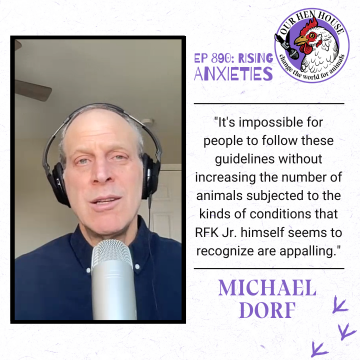 In this entertaining episode of Rising Anxieties, Mariann Sullivan and legal expert Michael Dorf dive headfirst into the bizarre world of RFK Jr.’s controversial new food pyramid and dietary guidelines. With equal parts horror and humor, they dissect how these scientifically questionable recommendations prioritize beef consumption while dismissing plant-based diets through deeply flawed analysis. The episode explores the concerning environmental implications of increased meat consumption, the contradictory nature of the guidelines themselves, and the meat industry’s desperate attempts to maintain relevance despite growing public awareness of factory farming cruelty.
This episode explores:
- How the new upside-down food pyramid contradicts established nutrition science while promoting excessive animal product consumption
- The environmental consequences of increasing protein intake through animal sources, requiring land area larger than multiple states combined
- Why 71% of Americans oppose common factory farming practices despite continuing to consume factory-farmed products
- The influence of industry representatives in reshaping federal dietary guidelines against expert recommendations
- How these guidelines impact federal programs including school lunches, military meals, and SNAP benefits
INTERVIEW TRANSCRIPT
Mariann Sullivan: Welcome to Rising Anxieties, everybody. My anxiety is rising a lot. I'm not sure about you guys. So, uh, we have a guest today, and I don't think I've ever had a guest before for Rising Anxieties, but Michael Dorf is here, once again.
He was here last week, but, um, on The Hen Report and, uh, there's a couple of reasons, uh, that he came back this week.
Uh, one is that we, we spent a lot of time saying nice things about RFK Jr. Last week, and the, uh, well, some nice things, some not so nice things, but, but nice things about the, you know, the commitment to end a lot of animal testing and research and really a lot. Uh, we'll see how that works out. But as soon as we stopped, uh, recording, or very shortly after, the whole announcement came out about the, the food guidelines, the, uh, the food pyramid, which has created quite a to-do among vegans and everybody else pretty much.
So, so I thought it was only fair to have, um, Michael back on to discuss this new element of RFK Junior's reputation vis-a-vis animals. The other reason is, is that, um, I'm a wreck. Like I'm very anxious about the world in general, not just about animals, but you know, you know what I'm talking about.
Those of you who are not in the states also probably know what I'm talking about. Uh, it's, it's very perilous times and, and I'm a very anxious person. I think I've mentioned before that my nickname as a child from my mother was my little worry wart. Apparently, I've been worrying since I was one. And, um, Michael's kind of a calming influence.
He's, he always seems to take things in stride, whether he does or not. So, so I'm very happy to have him here today. We're gonna talk about, uh, about those, the, the new food pyramid, the new guidelines, the new craziness, um, and all of that. And, uh, welcome, Michael.
Michael Dorf: Well, thanks so much. I feel like I now have the, uh, Our Hen House equivalent of an EGOT, you know, the Emmy, Grammy, Oscar, Tony. 'Cause I've now been on as a guest on the regular guest segment, on the Animal Law podcast, on The Hen Report, uh, and now Rising Anxieties.
Mariann Sullivan: You're right.
Michael Dorf: Yeah.
Mariann Sullivan: I never thought of that. Like we, we should actually have an acronym for that, though. I'm not sure anybody else. I, I mean, actually preparing for this made me very nervous 'cause I usually totally just wing it on Rising Anxieties, talk about this and talk about that. Now, I had to like think about what I was going to say, so.
Michael Dorf: You always sound very well prepared on the
Mariann Sullivan: Oh, thank you. That's very nice.
Michael Dorf: of stories and so forth.
Mariann Sullivan: That's very nice. Well, it may become obvious that I'm not, um, well prepared today. And um, I just saw Lulu in the background. Lulu is my, um, my almost 17, she'll be 17 next month, uh, year old dog. And I was told by, um, Vicki that if, if she appeared again on the podcast, to just tell everybody, especially the listeners who aren't watching, that that clicking you hear in the background is Lulu's toenails on my floor and there's nothing I can do to stop it.
But don't worry about it. It's all fine. Um, so.
Michael Dorf: I assumed, um. My, my three dogs are behind the closed door behind me because every now and then, if there's a, a person delivering a package or something, they go insane.
Mariann Sullivan: Yeah, I've met your dogs. Yeah, insane is about right. Um, Lulu will not do anything like that, um, but she does click. So, uh, which I think is less identifiable than, than, than hysterical barking.
Alright, I, I also have a caveat before we start. I don't think it's really necessary to say this, but I will. We are both lawyers, uh, and we're not health experts and so, uh, we are gonna be talking about health today.
Usually on Rising Anxieties, I mostly talk about animal welfare issues and the industry's like weird attitude towards, uh, welfare, um, and trying to pretend that they have it, the animals have some kind of decent welfare, but today we're going to talk about how they're pretending about animal food is good for you.
I occasionally talk about it, but I, I thought I just mentioned that we're not health experts, but like most vegans, we know more about diet and health than, than most anybody else, including most of the health experts. So that really wasn't much of a caveat. So these new guidelines, which you've probably heard about, they may seem like a treat for the industry, but I think they do reveal some underlying worries and, and the industry has put a really lot of effort and no doubt, a really lot of money into influencing them in ways that are, that are honestly batshit crazy.
Uh, I mean, I know we're used to things from the government being crazy. And these also have some good stuff in them, so you might be able to overlook, uh, the craziness, but not if you start looking, looking closely. So, Michael, can we just get your overview of the guidelines? And then we can get into some of the details from the article that, um, I've picked out. Uh, mostly articles that are criticizing them because I haven't actually seen any articles from the industry itself promoting them.
Michael Dorf: So, um, I guess at the, my top level view is that this is about animals, uh, in the sense that, uh, as has been widely reported, at least in the food pyramid, which they've, um, you know, brought back, although they now have inverted it. Uh. It looks like, and this is consistent with the guidelines themselves, they are promoting the consumption of large quantities of animal products, um, including, you know, red meat, uh, full fat dairy. Uh, they don't say much about eggs, although there are eggs pictured in their, their pyramid. Uh, you know, RFK Junior has in the past said that he is, um, opposed to factory farming, uh, but of course the vast majority, uh, something like 99%, uh, in some categories, 95% in other categories of animal products that Americans consume come from animals that are within, uh, CAFOs uh, factory farming. Uh, and so it's impossible for people to follow these guidelines without increasing the number of animals who are going to be subjected to the kinds of conditions that RFK JR himself, uh, seems to recognize are, uh, appalling.
Uh, so that's the sort of top line thought about animals. With respect to the specifics, uh, you know, there is, uh, a number of the articles we'll talk about make this point. Uh, there are the policy prescriptions, and then there is the sort of atmospherics. And some of the policy prescriptions are not bad. You know, they suggest reducing the intake of, uh, refined sugar of, uh, processed foods. Although, as you've talked about, the term ultra processed foods is, uh, quite misleading, given that it depends on the nature of the food, the nature of the processing, et cetera. Um, uh, you know, it continues to recommend, uh, consuming a lot of. Uh, fresh roots and vegetables. Uh, and so those, you know, it's sort of a mixed bag, but it's also contradictory because even as they're, uh, saying that they're ending the war on, uh, fat, uh, and they're, uh, increasing the recommendation for the amount of protein people should have, they're not changing the limits on the saturated fat one should consume. So if you tried to increase your protein to the levels they want using the animal foods they say you should be eating, you would invariably go way over the saturated fat limits. Um, so it's sort of contradictory.
Mariann Sullivan: I think you can take the sort of out of that comment.
Michael Dorf: Sure. So it's, it's, so, yes.
So there, there are contradictions within it. Uh, and of course, as you were, uh, suggesting earlier, right, it's not science-based. They got rid of, uh, they didn't follow the recommendations of their own expert panel, uh, and they instead went to a group of people that is very, very well connected to the, uh, animal agriculture, uh, industry, uh, as the sort of source of these guidelines.
Mariann Sullivan: Yeah, and I particularly wanted to, um, mention when you talked about it. They, they, they talk about ending the war on fat. They talk about ending the war on protein. They've talked about ending the war on saturated fats. Apparently, whenever anybody disagrees with them, based on science, it's a war. I mean, the use of that word is insane.
Like people disagree with them. That doesn't make it war. Um, alright. Yeah, that was an excellent summary. Let's get into, as usual, one of the most incisive commentaries, in my opinion, on them was from Marina Bokova at Box, one of our favorite commentators. And, um, she had both, uh, a, a great article saying, The new food pyramid is lying to you. It's also a contradictory mess. Um, and also, um, an interesting post on Blue Sky, which i, I wanna get into. But, uh, do you have anything in particular to say what, what Marina had to say about the guidelines?
Michael Dorf: Yeah, well on the Bluesky post, I'll start with that, uh, she pointed out that, uh, one of the people who was involved, um, essentially admitted that in their analysis of vegan and vegetarian diets, which they regard as highly deficient in all sorts of ways, um, they didn't actually look at a real vegan or vegetarian diet.
What they did was they took the standard American diet and they subtracted the animal foods. And then they asked like, what would you be left eating? Which I guess is french fries and you know, um, you know, the egg McMuffin
Mariann Sullivan: Though it, it might have even been a healthy meat inclusive, or a relatively healthy meat inclusive diet, in which case you would be left with lettuce. I.
Michael Dorf: Right. Yeah. Um, or, you know, blueberries or something, something good. But they didn't, they didn't look at that. They didn't, they didn't, you know, ask what happens if you substitute, uh, vegetable proteins for the animal-based proteins. Uh, and so they're, you know, they're essentially, or this person at least, is essentially acknowledging that the claims in these new guidelines that, you know, a, a vegan or vegetarian diet is deficient, uh, are not based on actual real analysis. But of course, the guidelines are still out there. It's not as though this is an amendment to the guidelines. Um, maybe we ought talk a little bit about why the guidelines matter,
Mariann Sullivan: Yeah. No, but I do Before we get to that, and I definitely wanna get to that because. Because some people, you know, think, well, nobody follows them anyway. But that's not entirely true. But, um, I, I, I did wanna, um, mention in the context of what you were just talking about with this, uh, with this, uh, deception about, about the, the animal foods, uh, that that was within... people have probably seen the upside down pyramid, which for some reason they decided to turn upside down and they think that was extremely innovative. Um, and it, it's also accompanied by, by a report that goes into detail about what you're supposed... and that's what you're talking about. It's within that report that, um, they basically trash vegan and vegetarian diets and say they're lacking in nutrients.
They're also, the way they judge them, they're lacking in calories. Like there's basically starvation diets, unless, of course, as you pointed out, they include french fries, um, and other foods that are not part, they might have a lot of calories, but, uh, not particularly nutritious. So it's within the, it, it's within that commentary that they seriously trash vegan and vegetarian diets, which is crazy.
Um, but yeah. Now let's get into the point of, of why they're important. And I think this was really pointed out in, um, this article in Sentient Media by Seth Milstein. Almost all of the articles I have to talk about today are from people I agree with not, it's not my usual because the industry is honestly not talking about this, but, um, but, but yeah tell us, tell us why they matter.
Michael Dorf: Well, they matter because, um, they're not just guidelines in the sense of, well, here's something that people on their own, uh, might want to consider doing, uh, in the way that some of the medical advice that you get from various agencies within HHS is. Rather, the guidelines are obligatory for a number of institutions, including for reimbursement for, uh, school lunch programs.
They affect what's served in the military and prisons. Uh, and so, um, you know, to the extent that the biggest, uh, problems are in the pyramid, that's less of a worry because as, as I said, and as a lot of these articles point out, the guidelines themselves don't change all that much, but they do change a bit. Uh, so, you know, it might now be possible to, you know, have um, uh, school lunches in certain districts in which they're going to, you know, completely exclude, uh, vegetable sources of protein, uh, and think that they're doing so because they have to comply with these guidelines.
Mariann Sullivan: Yeah, they kind of give a nod to the fact that that vegetables can, in, can include protein, but the, the entire emphasis is, is really on the very old fashioned idea that in order to get protein, you have to eat, it's not even meat. It's really beef. I mean, it's really emphasis on beef, uh, which is so bad.
It's just so bad. Um.
Michael Dorf: Yeah, it's, it's connected to this, um, you know, trend, uh, driven by the MAHA movement influencers, et cetera, to get people to avoid seed oils and to use beef tallow, uh, for which, you know, there the evidence is pretty strong, that if you're going to use oil in your, your food in general, you should use as little as possible.
But if you're going to, the seed oils are better because they contain much less saturated fat. Um, but you know, that's, that's all part of this, this movement. And it's made its way now into federal policy.
Mariann Sullivan: No, that's important.
Michael Dorf: that's just what they're doing.
Mariann Sullivan: That's important to point out that it's not just, um, it's also the seed oils, um, which are vegetable based oils, which, you know, no... like, they have somehow become the huge enemy of health in these people's minds, which for, for reasons which I don't understand.
I'm not sure you mentioned, but another place in which the guidelines do, um, enter into is what foods could be bought, um, with SNAP benefits, which is hugely important.
Michael Dorf: Very important. Right. Um, although that, that's been, um, you know, the Trump administration, uh, for for whatever reason through the Department of Agriculture has been giving people trouble, uh, along those lines wholly apart from animal based foods, uh, you know, on a kind of parallel track.
Mariann Sullivan: Yes. No, there are many, many different attacks going, going against people on SNAP benefits who want to buy enough food to live on, plus they would like it to be healthy. Um, alright, so just to... the, the most satisfying thing about doing this particular, um, particular topic, and there's not a lot that's satisfying here, but we're not just talking about Vox and Sentient Media.
Though I wanna add that Vox and Sentient Media are my heroes because they are giving really brilliant in-depth coverage to these issues, which hardly anybody else does. But the New York Times has actually gone there, which is kind of cool. There was a, there was an op-ed, um, by Matt Prescott who, um, who was identified as the author of a book, that he truly did write, Food is the Solution, What To Eat To Save the World. But it did not mention that he is also the, um, the, that he heads up the, the Accountability Board, which is this, um, organization that owns shares in like a hundred publicly traded companies. And it's doing shareholder activism to hold companies, quote, to hold companies accountable on issues relating to the environment, social matters, and corporate governance.
They, I think it's interesting either he left that out of his bio or the New York Times left it out of his bio thinking it was so outrageous, like, I don't know that, uh, we shouldn't even admit that he's so prejudiced. As opposed to like everybody from the meat industry who have no prejudice whatsoever.
They're just going at it, you know, from the science. Um, but he did write, he did manage to get a, an op-ed in the New York Times, which is, you know, no easy task. Um,
Michael Dorf: I mean, it was mostly focused on, uh, the environmental
Mariann Sullivan: That's, that's more their, uh, their, their thing.
Michael Dorf: Right.
But it, you know, it's true again. Right? You know, another contradiction, uh, before becoming, um, a, you know, his, his current job before entering politics, RFK Junior made his reputation as an environmental activist suing big companies, and it was for mainstream environmental organizations. So to be out there promoting increased meat consumption, um, especially beef, right, beef and dairy cattle are probably, uh, on a sort of per calorie basis the worst contributor is to not just, um, uh, global warming, but also to, um, you know, water use, to, uh, pollution of other sorts. I mean, I guess the, the pork industry is, is up there as well, but, but the idea that you have someone who calls himself an environmentalist, and who for many years was an environmentalist, out there doing this without any recognition that this is totally contradictory, is it's kind of head spinning.
Mariann Sullivan: Yeah, it really is. And it, it just goes to the, this whole like trend in, um, which we've been living with for 20 years or so, like the, the whole Michael Pollan trend of thinking about food. That what we're supposed to be going back to is this kind of, uh, you know, expansive agriculture instead of intensive agriculture and, and that will save the environment.
And yeah, if we get rid of like two thirds of the pop human population of the world, maybe that would be good, but we're not doing that. So, uh, it's, I, I'm just glad to see that there are some people who are, uh, who are, you know, pulling back from the, the idea that it's either.
It's either industrial agriculture or, or this ridiculous bucolic return to like the old farm, which actually never existed. But I, I feel like that's, that's the, the genre of thought about food that he's coming from. Um, if he's coming from any genre thought about food, because honestly, he seems a little wackadoodle as, as,
Michael Dorf: No question.
Mariann Sullivan: Yeah.
Michael Dorf: But, but, but, but again, it's, it's not even, it's, it's worse than that because, um, at least the people who are saying, you know, you ought to get your animal products from these, uh, you know, non CAFOs. Right. You know, they've got their own problems. They're not acknowledging that to, to do that requires much greater land use and all sorts of other problems.
But, but that's their message. Whereas he's saying, Eat more animal products and, you know, not dealing at all with the fact that those are coming from the CAFOs.
Mariann Sullivan: Right. No, it, it is more incoherent, uh, even more incoherent. Uh, um, I just grabbed a quote from this, um, article from Matt Prescott, uh, which as you said, focused on the, uh, environmental impact, but I thought this was, this was pretty startling. If Americans increase their protein intake by just 25% in response to the administration's new recommendations, maintaining their current ratio of animal to plant protein, it would require about a hundred million acres of additional agricultural land each year, an area larger than Michigan, Ohio, and Pennsylvania combined and increase in annual emmissions by hundreds of millions of tons of carbon dioxide equivalent.
That's according to the World Resources Institute. I mean, I thought those numbers were staggering and, uh, like they don't even seem to have given any thought to it at all.
Michael Dorf: Yeah, I mean my, my one hope, I mean, at the top of the show, I think you painted me as more optimistic than I am. I mean, I mean, I'm
Mariann Sullivan: No more optimistic than me. That it's a pr It's a low bar. It's a low bar.
Michael Dorf: I mean, it's true I'm not anxious,
I, but I'm, you know, I, it's not because I think that, you know, everything's going well. Uh, but I do have one small hope here, which is, you know, the, I see the recommendation for increased protein consumption in the, the guidelines as just part of a fad, right?
There's now a fad in which there's protein in everything, um, added protein
Mariann Sullivan: Yeah, it's our, it's our latest thing.
Michael Dorf: That's right. And you know, like most fads, uh, because you know, there's no real scientific basis for it, uh, of course there are minimum protein, uh, requirements that people have, but Americans are not protein deficient.
Right. Uh, so like most fads, I think this one will fade. Um, and, you know, to, to putting a, putting aside the very substantial problems that the guidelines have, because they're tied to these various, uh, federal, uh, reimbursement standards, uh, I think the, the, you know, there's this independent problem even before the guidelines of now companies are racing to put protein in everything and some of that, a lot of it is coming from, from animal sources, unfortunately.
Mariann Sullivan: Yeah. Which of course it doesn't have to, I mean, people can get plenty of protein. I don't care if they get protein. If you wanna like overdo the protein, it's fine, it's fine. And the great benefit is that if you're... Like if you're getting protein from animal foods, it's gonna be accompanied by saturated fat, which is bad for you.
If you're getting protein from plant foods, it's going to be accompanied by fiber, which is probably the thing that we are most dificient of and which is really, really good for you. Every day they find out that fiber is more and more important, uh, to human health. So there, there's so many reasons why, why we should be eating beans, which somebody said was on that picture, but I didn't see them. They must have been really tiny little beans.
Michael Dorf: I also don't, don't remember seeing the beans. Um, but maybe they're in there somewhere. There are the blueberries next to the broccoli. There
Mariann Sullivan: Blueberries could, could look like they could use the same picture for both.
Michael Dorf: Oh. Oh, you know what?
There's a can of green beans. It's
Mariann Sullivan: Well, that's not the same thing. I mean, green beans are a vegetable.
Michael Dorf: That's correct.
Mariann Sullivan: I mean, beans are a vegetable too. I know that. But uh, you know what I mean?
Michael Dorf: No, I think there are, I see just above whole grains to the left of the bananas, there's what looks like a peanut, maybe one, one lima bean and one other kind of bean.
Mariann Sullivan: Oh, there you go. One lima bean. Yeah. And also if you're gonna put green bean.
Michael Dorf: the piece of shrimp.
Yeah,
Mariann Sullivan: If you're gonna put green beans on there, why would you put canned green beans? I mean, for heaven's sake, just put a green bean.
Michael Dorf: Yeah. The, the green beans are, are in a can, the peas are in a can. Um,
Mariann Sullivan: Canned peas are disgusting. Get some frozen peas.
Michael Dorf: Right, right. Frozen is often just as good as fresh.
Mariann Sullivan: Yeah, sometimes better. Sometimes better. All right, moving on. I do have a few more things to talk about because The New York Times did not only publish that article by Matt Prescott, but I just saw this article, uh, about beef tallow, which is without question the most disgusting thing I've ever seen in my life.
But, um, you know, I hear, I've heard of beef tallow 'cause they've been talking about it for a while, but I don't think I've ever seen a picture of a pan with be... it's the stuff that you would throw out and be so glad you weren't eating if you were in the habit of cooking meat. Um, and, uh, I thought this was interesting because this was not by an advocate.
It was a regular article by Kim Severson who's a food writer for the for, for The Times. And she, um, was talking about how, how beef tallow has, uh, you know, been promoted, uh, maybe in the guidelines themselves. And, um, and it's that, it's just, it was very clear from the article that, um, that she was kind of horrified.
Michael Dorf: Yeah. You know, it's, um. Uh, the, I speaking again about RFK Jr. Then I, I, I need to leave him alone for a bit. Uh, I saw that he posted something around Thanksgiving about how he, he and the MAHA movement cooks for Thanksgiving and he was frying an entire Turkey carcass in a big vat of beef tallow. And, right, you know, quite apart from the uh, animal issues, the notion that that is about making people healthy, is just crazy. Um,
Mariann Sullivan: You know what other thing is crazy and all right, I'm gonna go off on a tangent here. You're just gonna not listen to me. But it's my understanding that there are women who find him attractive. I am so unbelievably perplexed by that. He's so peculiar looking.
Michael Dorf: Yeah. I'm not gonna comment on that. Um, I...
Mariann Sullivan: I knew you wouldn't, and I shouldn't have said it either.
I don't like to comment on appearance, but in the con, in this particular context, I thought it was fair. He's so odd looking and he has that weird voice, which, you know, it's not his fault. He has something wrong with his vocal cords or something, but, but it's not attractive.
Michael Dorf: Well, it, I think it might be, again, I, I, I also agree that we shouldn't, you know, belittle people's appearances, but it is, I think, notable that, uh, he tries to project this kind of macho healthy image. Right. So he'll, you know, take his shirt off and do pull-ups and so forth and, um, you know, he is kinda ripped for a guy his age.
Mariann Sullivan: He is. No, he is in great shape. It's just, it looks so creepy when he just takes his shirt off. I mean, he should have like athletic clothes on or something that, that didn't... like, he has jeans and no shirt. That's not a good look.
Michael Dorf: No, I was reminded of something I, I heard from a, uh, vegan nutritionist at a lecture I went to many years ago who was talking about people who are fit but not healthy.
Mariann Sullivan: Oh yeah.
Michael Dorf: And I wouldn't be surprised if that's a fair characterization of him.
Mariann Sullivan: If he's eating turkeys fried in beef tallow, chances are he is not... you know, the heart is not. Also, he is in odd shade. Just... I've never seen anybody, I've kind of never seen anybody who quite look like him. He just looks a little like a different species. Alright, I better shut up because I'm, I'm gonna get myself in trouble.
Alright, let's see. The, so the beef tallow, uh, I thought that was notable 'cause that is an indication that even The New York Times, which tends to bend over backwards to be kind to these people, I think, um, are like, Wow, this is gross, but...
Michael Dorf: yeah, I will say one, one other bad thing about the beef tallow trend is, you know, sometimes you find yourself in a situation where you know you're, you have nothing available to eat. Uh, you have to eat in a restaurant that's not vegan. Um, in the old days you could, know, you'd have to ask, but you'd have to ask like what kind of oil they're cooking things in.
Um, and usually it would've been, you know, some kind of canola oil or some other kind of vegetable or God forbid seed oil. Uh, but now the odds are it's gonna be beef tallow and so that's gonna be just one fewer thing you can eat.
Mariann Sullivan: Yeah. Now there used to be stories, which I think were true. I don't think it was apocryphal that McDonald's fries were, were cooked in in some kind of beef fat long time ago. And then I think they changed. I don't know. But now I guess they're all gonna change back. Yeah. Well, we'll have to stop eating fries.
We'll live even longer. Um, all right, so the other, there were a couple other articles I pulled out and I was just... in the, in the interest of, of saying why maybe, maybe there, this is a sign of rising anxieties because there's no doubt, as I said before, that the industry put a lot of effort into making this happen.
I mean, as you pointed out, the people who were, who were plant... I mean, they had developed the, the regular committee had developed guidelines. And then they were pulled and then they added all these people who had serious connections to the meat industry. I mean, that had got to, that cost them a lot. I mean, I know the meat industry has a lot of ins, but, but they put effort into this.
And why? Like, it seems like people are very happy eating meat. It doesn't, I mean, the beef industry is, you know, doing just great. No matter how high the price goes, they seem to be fine. But that one of the purposes of this segment is always to point out they're more nervous than you think. And there were a couple of articles that I found both from Sentient Media, what would I do without you, Sentient Media? Um, that really I think were really interesting.
And, um, one of 'em was on, um, GLP ones of all things. And um, the other was on American's Attitudes towards common factory farming practices. And they were both super interesting. Um, the one on GLP ones, and, you know, I've talked about this and the industry has been talking about this in the fact that people are just eating less food and a lot of people are eating less food, and that's just a big deal for anybody in the food industry.
I mean, this is big enough so that they're taking it into account and they're concerned about this. But this article, which is by Natasha Gilbert, points out that not only do, um, people eat less food, but they, sometimes at least, lose their taste for meat if they're on GLP ones.
And they're more likely if, I mean they are, people on GLP ones are supposed to be consuming a lot of protein, I think, but they're more likely to move to plant-based proteins because meat is, uh, if this is true, I want the entire world to be put on GLP ones.
It would also have the benefit of benefiting Denmark, which is where they invented them or whatever. They're making, you know, the pharmaceutical industry in Denmark is making a fortune. And then Denmark can supplement its army and fight off the United States of America when it invades Greenland. So it all goes together.
Um, but I, I think this is remarkably good news, uh, if this is true, because this could re, this could seriously affect them.
Michael Dorf: Yeah. So, uh, you said at the top of the show that neither of us is a nutritionist. We're also not biologists, but I'm going to now speculate
Mariann Sullivan: Play through.
Michael Dorf: As to the mechanism. Right. So, uh, I mean, when I read that article, at first I thought, well, wait, are they just eating less food and therefore also eating less animal products? But the answer is no. Right? They said the one category of, uh, foods that people are eating more of on GLP ones are fruits and vegetables. So, so here's my hypothesis. Um, uh, as we know, GLP ones work by, uh, suppressing, um, certain urges, uh, and it's not just dietary urges, right? So people who've gone, gone on GLP ones who were compulsive gamblers find that they have less of a compulsion to engage in gambling. Uh, people who drink a lot, drink less. Uh, and so you, you might say, well, what, what's going on there? So my, my hypothesis is that part of what it's doing is suppressing, uh, an instinct, uh, that human beings evolved in circumstances of scarcity, right? So if you think about why is it that people, uh, like to eat, uh, fat, salt, and sugar, none of which are good for us in modern conditions, the conventional answer is that our ancestors evolved in circumstances when they didn't get enough of those things. And so if they really loved them, then when they were available. Uh, they would eat those food, those foods, um, they wouldn't have the harmful health effects 'cause they're not doing it very often.
Uh, but you need to have a real taste for it in order to, um, to, to motivate you to, to eat those things. And uh, it's almost like they're eating this compulsively, right? That is, you can imagine, you know, the sort of hunter gatherer clan, uh, that comes across the, animal that they've killed or whatever it is.
Uh, and they wanna sort of devour it. And
Mariann Sullivan: Yeah,
Michael Dorf: of in a, in a, in a frenzy.
Mariann Sullivan: They're hungry. And also the, the food goes bad. I mean, they didn't have a ways to preserve meat. I mean, meat goes bad almost immediately, so there's real incentive to, to, to.
Michael Dorf: But, but, but, but I'm, I'm suggesting that, and I, and I think this is what the science says, that it's not just that they're making a rational calculation. We better eat this before it goes bad. It's that evolution
Mariann Sullivan: absolutely.
Michael Dorf: right, over thousands of years codes for us to wanna do that.
Mariann Sullivan: Yeah. To be able to be and to be able to stuff ourselves. 'cause it's.
Michael Dorf: So when you suppress the biochemical mechanisms that motivate people to just sort of, you know, do things in a frenzy, that's not gonna suppress your desire to eat fruits and vegetables, which are the sorts of things that in hunter gatherer societies, which really should be called gatherer hunter societies, you're coming across routinely.
And so you're eating those things much more calmly. And so that's my sort of just so story as to why this, this would be
Mariann Sullivan: I, I love evolutionary explanations, even if they're not from evolutionary biologists. And I think you're absolutely right. I think it make, that makes total sense. Uh. Um, there's one more article that I just wanted to point it out, is about why the industry is so nervous and is working so hard to make this happen.
And this is also from Sentient Media and I just, I just really wanna just mention this article because it's great. It's by Gaea Cabico and I'm, I apologize if that's wrong. Um. And it, this is from a, a survey that was done by Faunalytics, uh, you know, which is also doing great work. More than 71% of Americans oppose common factory farming practices.
This was a new poll, 71%. And the things, uh, they particularly emphasized were confinement, um, such as battery cages, gestation crates, crowded barns for broiler chickens. And even though some of these methods, you know, are being sort of phased out, they're not being phased out in favor of anything really very much better.
It'll still be extreme confinement just not maybe as extreme. And they can't do business without these methods. And you know, we've waited all of this time for people to wake up and I don't know whether they ever will and, you know, see this is wrong, but all this attention to what people are eating and, uh, and uh, the industry going to such lengths to tell people, No, you have to eat meat. Even though we know it's a lie and it's ridiculous, uh, I think it really does come back to the animals in, in a lot of ways.
I think that they're all, they all are, I mean, that's the whole basis of this, of this segment that, that they really, they know what's going on and they worry about it and they try everything they can to get around it. And unfortunately the world works with them.
But, you know, at some point, they're gonna go too far and, uh, and people are gonna wake up and realize that no, they shouldn't be eating steak all the time and they don't have to.
Michael Dorf: Yeah, I would point out that, you know, the 71%, that's the sort of at the low end, the, the survey found even higher, uh, numbers for opposition to confinement methods. So these were numbers
Mariann Sullivan: Right.
Michael Dorf: in the eighties
Mariann Sullivan: They were in the eighties. Yeah. Those three, those three things I mentioned were in the eighties.
Michael Dorf: Yeah. Uh, so, you know, that's, that's an encouraging sign. Um, you know, here I'll be the, the sort of negative voice a little bit, I guess, which is, you know, you wonder what that means to say they're, they're opposed to it, right?
Because people know, but they continue to buy and consume foods that come from this system. Uh, now maybe it's because they know, but they don't know, right? So they're, you know, they're, they're in a kind of denial. Um, or they think, well, I get my, you know, my eggs, that there's a picture of a happy hen on the box, and so therefore it's a little different.
Uh, but, um, I'm not sure that those numbers are all that different from what you would've seen at some other point. That is to say, I don't know that this is a change, as opposed to, well, people are always against, uh, cruelty to animals, um, it's just that they don't recognize or act on that fact.
Mariann Sullivan: That is the question that we spend most of our time at Our Hen House trying to figure out, and we don't have the answer, but it's still reassuring to know how, um, how people do feel. I think that what you just said might be the answer to the whole thing. They know, but they don't know.
And not to get back... I know, I, I said that the whole reason I had you on was because I didn't, I wouldn't talk about the rest of what's going on in the world. But I mean, I just can't help but think of the murder in Minneapolis and the fact that we have video of it, that, that close to conclusively shows exactly what happened, and yet the, um, the administration and lots and lots of people on social media and in the real world, uh, in spite of that video are saying that it proves the opposite. That, uh, that this woman like was breaking the law in some way and deserved to be killed. And uh, and I think it's very similar. I really do. We have actual video of what's happening to these animals, and it's awful and everybody agrees it's awful, but somehow they don't think it, um, it's wrong. Uh. I'm just, I'm just gonna, uh, sort of, well, I'll let you have the last word, but I'm gonna close here by quoting once again.
I've quoted this quote too many times in the past few days. From 1984, George Orwell, The party told you to reject the evidence of your eyes and ears. It was their final, most essential command.
Michael Dorf: Yeah, I mean, I think that is characteristic of a totalitarian state of the sort that Orwell was describing, um, but I think it's also characteristic of so much of modern life, right? That is, you know, you get, um, essentially irrefutable video evidence. And, uh, in this instance they're just saying, well, it doesn't say what, it doesn't show what you think it shows.
Uh, that's not new. Uh, if you think about the Rodney King case, uh, 36 years ago, there everybody saw and was horrified by the police, you know, beating this guy. Um, the officers were acquitted because the defense attorneys for the police officers involved in the beating, broke it down frame by frame, said, well, this doesn't, you know, it looks bad, but you're not getting it from this angle or that angle.
And so, um, you know, as long as you have people who don't care about the truth, uh, because they have some motive not to care about the truth, uh, they'll be willing to recharacterize what we can see with their own eyes, hear with our own ears. Uh, and then if other people are sufficiently motivated to believe them, they'll believe them.
Mariann Sullivan: Yeah. I mean, I think that we've proven that beyond the shadow of a doubt. But at the same time, I think Rodney, the memories of Rodney King, I think in a great many people's mind is that, uh, the officers shouldn't have been acquitted. Um, and it's the same with George Floyd. I mean, what a lot of people who saw that were shocked, learned something new and, and changed how they thought about things.
It didn't change the world. But it, it does have an effect, I think.
Michael Dorf: I, I don't, I think that's right. And I think, you know, all you can do is keep spreading the truth, um, putting it in good narrative form. I was just thinking about, um, uh, your interview last week with Wayne Hsiung about, you know, getting a good narrative out there. Uh, and, uh, you know, that's what, uh, Donald Trump and JD Vance, uh, were trying to do with this Minneapolis case.
And, uh, so, you know, in this instance, and to take it back to animals, um, we should have an advantage with the narrative because our narrative is true.
Mariann Sullivan: It's true, and most people actually care about animals. Not everybody, but I would say the vast majority. Well, this has been really, really helpful. Um, I don't think we got off topic too much and if we did it all, it was my fault. Uh, and thank you for mentioning Wayne because, um, I was gonna tell people that was on last Friday's interview, uh, Wayne Hsiung on what he's put up to of late, including studying at a seminary.
Michael Dorf: It's a great interview, people should listen to it.
Mariann Sullivan: Yeah, yeah, really good interview. On Thursday we'll have The Hen Report and hopefully Jasmin will be back. On Fri this Friday, Sue Donaldson and Will Kimlicka will be talking to me about their new book, uh, out from Oxford University Press, Animals and the Right to Politics. They do amazing, amazing work.
And, uh, thank you so much for, for joining me today and for joining Michael. And thank you, Michael, for joining me. Don't forget to tune into our other podcasts. And don't forget to subscribe, either on YouTube or on your favorite pod catcher.
_____________________________________________

Thank you for listening to the Our Hen House podcast! If you enjoy our podcasts, believe in our mission to effectively mainstream the movement to end the exploitation of animals, find community and solace in our shows and resources, and would like to show your support for vegan indie media, please make a donation today.
Contributions of any amount will go towards our fundraising goal and are hugely appreciated. Our Hen House is a 501(c)(3) nonprofit organization, so it’s tax-deductible. Thank you for helping us create quality content!
Subscribe to our show on Apple Podcasts, YouTube, or your favorite podcatcher, and don’t forget to leave a 5-star review!
Check out Our Hen House’s other podcasts: The Animal Law Podcast, The Teaching Jasmin How to Cook Vegan Podcast, and the Antiracism in Animal Advocacy Audio Series.
Follow us on social media! You can find Our Hen House on LinkedIn, Facebook, Instagram, TikTok, Threads, or Bluesky.
The Our Hen House theme song is written and performed by Michael Harren.