
 Apple Podcasts
 RSS
 Amazon Music
 Spotify
 YouTube
 PocketCasts
 CastBox
 Player.fm
 TuneIn
 Audible
 App not listed? Try this RSS link
In this lively episode of The Hen Report, hosts Jasmin Singer and Mariann Sullivan navigate the evolving landscape of animal advocacy with their signature blend of wit and wisdom. From discussing the first recorded death from “meat tick” syndrome to analyzing a New York Times article on grass-fed beef’s environmental impact, they balance serious animal rights content with moments of levity. The conversation shifts to examine claims about veganism’s supposed decline, with the hosts offering a more nuanced perspective: while vegan restaurants may be closing in some areas, plant-based options are becoming mainstream across regular establishments, suggesting not a retreat but a transformation in how veganism integrates into society.
This episode explores:
- The surprising spread of Alpha-Gal Syndrome (the “meat tick”) and its first recorded fatality
- New York Times’ honest coverage of the environmental impact of grass-fed beef
- The inspiring journey of Buddhist monks walking for peace with their rescued dog
- A critical analysis of recent claims about veganism’s decline in popularity
- The ongoing success of animal advocacy through increasing plant-based options
RESOURCES
-
-
-
- First Death Documented From Tick-Induced Meat Allergy
- Is Grass-Fed Beef Really Better for the Climate?
- Walk for Peace USA on Facebook
- Aloka the Peace Dog has successful surgery. When will he join the monks?
- Not-Guilty Verdict For Beagle Puppy Rescuers In Landmark Legal Case
- How Veganism Got Cooked
- Prioritze Plant Protein messaging guide
- GFI’s Messaging to drive consumer adoption of plant-based meat
- Report: Google Searches for Veganism Outpace Those for Climate Change, While Flexitarianism is Now Mainstream Globally
- Christspiracy
-
-
INTERVIEW TRANSCRIPT
Jasmin Singer: Welcome to The Hen Report from Our Hen House. I'm Jasmin Singer
Mariann Sullivan: I am Mariann Sullivan.
Jasmin Singer: And I'm excited to be back. I've been away for a little while. Mariann, thank you for kind of holding down the fort.
Mariann Sullivan: It was really Michael who held down the fort.
Jasmin Singer: Thank you, Michael. Did he
Mariann Sullivan: Michael Dorf. He, he, he, he came in here and he would, he pretended to be you.
Jasmin Singer: Did he wear like a black Liza Minnelli wig while he was? 'Cause it feels very him to do that. Uh. Yeah, I'm super grateful and, and really missed it too, even though it was just a few weeks, uh, the end of my play came and went, and I had a bit of an existential crisis. And, uh, then I had some, like a medical procedure done, which was, um, something that I've been looking forward to.
So it's all good, uh, which I'll talk about a little bit more later, as it's related to one of our articles, sort of. But,
Mariann Sullivan: That's something for everybody to look forward to.
Really there's nothing people enjoy more than hearing about other people's medical issues.
Jasmin Singer: wanna talk I wanna talk about the protein, is what I wanna talk about, not like the drains. You know what I'm saying? But uh, just a quick reminder that Rising Anxieties comes out on Tuesdays, The Hen Report on Thursdays and the long form interview on Fridays. Bonus for Flock members comes out on Mondays. remember, we are on YouTube, we're also a podcast on all of the listening platforms that you know and love. So hit subscribe and like wherever you listen.
So I wanted to tell you that, I don't even think I told you that the official announcement just happened, but I am officially a thrift-fluencer for the Goodwill of the Finger Lakes.
Mariann Sullivan: It's so you. Oh my God.
Jasmin Singer: They just announced it. And what makes me so excited about it is that in my, like in my interviewing for it, in my application, I talked about veganism and how I really wanna kind of bring a vegan lens to it a little bit. So I plan on doing that and talking about like...
Mariann Sullivan: So I, for people who aren't, I mean, this will be on social media so people could follow it even if they're not,
Jasmin Singer: Yeah, for sure.
Mariann Sullivan: 'Cause this is the, this is the local. The local Goodwill?
Jasmin Singer: Like, not, not hyperlocal, but local-ish, you know, it still includes like Ithaca and Sy and Syracuse and,
Mariann Sullivan: Right, right.
Jasmin Singer: just the, the Finger Lakes area. And I love this organization. I love the work that they do.
Mariann Sullivan: You love the clothes that they sell.
Jasmin Singer: I do, I've, I've really enjoyed MCing the gala for the last couple of years.
And, uh, I just, I, I'm so excited to be, I'll be making videos of what I'm finding at Goodwill, how I'm using it.
Mariann Sullivan: It's kind of what you, what you always do. Making videos of your new outfits only you only send them to me. Now you can send them to other people too.
Jasmin Singer: Yeah. But I might need to edit it a little bit more 'cause uh, but maybe not. Maybe I'll just be like, Hey, Mariann... that'll be weird. Anyway, uh, so do you wanna start with the meat tick?
Mariann Sullivan: Well, I dunno. I organized the articles we have to talk about, things that we should just mention. Then some good news that we should mention, and then we have like a, a kind of serious discussion in depth about veganism and a recent article. So somehow the meat tick ended up at the top of the list. So I'll, I'll talk about it.
Uh, you've probably heard of the meat tick. We've all heard of the meat tick. It's this tick. Um, it cau and, and if it bites people, it causes, uh, alpha Gal syndrome, and that means that you become allergic to meat, red meat, unfortunately not all meat. Um, and, uh, this is a sad story. I mean, I don't mean to sound like I'm celebrating that, but the first death has been, uh, recorded from Alpha Gal Syndrome.
Just this poor guy, um, uh, who, uh, went on a camping trip. He was 47. It was in New Jersey. So these, these ticks have gotten pretty close. Yeah, I mean they've gradually been going up the, the US but apparently they're basically here and um, and then he first reacted to a steak and two weeks later he ate a hamburger and he died.
Like, so this is serious stuff and you know, we all know about it. I bet a lot of meateaters don't. Don't, haven't heard about it because, you know, they don't pay attention to this sort of thing. So tell 'em.
Jasmin Singer: Yeah,
Mariann Sullivan: Let 'em know.
Jasmin Singer: have a ve, I have a vegan friend who didn't know about it. Think she's like, she's a vegan for the animals, but she's not particularly plugged into the animal rights scene and she doesn't really follow the news. And she found out about it and was like flipping out, like it was science fiction or something.
And
Mariann Sullivan: It, it sounds like science fiction. It really does.
Jasmin Singer: It does, right? It does. But anyway, uh, yeah. 47, how old I'll be this year. From New Jersey, me too.
Mariann Sullivan: And yeah, I mean, you must have been in decent health. Who was going on a camping trip? I don't know.
Jasmin Singer: Poor dude, but poor animals that he ate also.
Mariann Sullivan: Yeah, but I'm not gonna go into like meat shaming this guy who just died. I mean like
Jasmin Singer: Was I? Maybe.
Mariann Sullivan: Kind of.
Jasmin Singer: A little bit?
Mariann Sullivan: Kind of. I don't, I normally don't mind meat shaming people, but you know, I mean, the guy died.
Jasmin Singer: Move on. Let's let that lie
Mariann Sullivan: Yeah, I think we've said enough about it.
And then I also wanted to mention, just ran and in random, uh, news, this is a good article, so this could go in good news 'cause I like to do good news separately, but it's not good... you know, the news itself isn't good. But this is a great article. It's from the New York Times, it's from their climate section.
Is grass fed beef really better for the climate? And you know, everybody believes that. Everybody thinks that if they just pay more for meat. It means it doesn't do all the harm, which is completely nonsensical and people will pay more for grass fed beef and think they're doing something good.
It is better for the animals. Uh, it's not better for the climate. I mean, all of that. Um, as you know, I mean this has been known within the, um, the movement for a long time, but it's nice for it to be in the New York Times.
Jasmin Singer: You know, I, I read, I found this in the middle of the night. I haven't really been sleeping well, just like busy brain, but I, I read this in the middle of the night, like squinting, like with no light on. And you know, if my glasses were on my nightstand and I'm like, am I reading this right? It actually talked about the land use issue. And how, and like no one ever talks about that. Like how, like even if you want to do this for whatever asinine reason, you can't scale it. So as we say, and you know, I think I'm quoting you here, unless we want a world where the rich eat animals and the poor eat nothing, we have got to come up with a way to transition to a plant-based society, or largely a plant-based society for people who, for whatever reason, aren't going to go fully vegan. But you know, I hope they do.
Mariann Sullivan: You know, there, there was, and there's been research done. One of the researchers is Gidon Eshel. I feel like he was on the podcast like a really long time ago, and they did research about whether, uh, because there's this argument from the regenerative people that, uh, the, that the grazing of the animal stores carbon in the soil and that makes up for everything and actually makes it all better.
And, and so they did, they did the research. We wanted to see exactly how the numbers add up, Dr. Eshel said, the bottom line answer is that they mostly don't. Uh, that doesn't make up for it. It doesn't make it better. It's just, uh, it's a disaster taken together. Meat and dairy production use 80% of agricultural land.
Unbelievable.
Jasmin Singer: Unbelievable.
Mariann Sullivan: So, but good to see. Good to see it in the, in the, in the, in the times.
Jasmin Singer: I have to tell you, just real quick. Since, since last we spoke, I was on, uh, Facebook and I saw someone on, like, my neighborhood ha has like a group.
Mariann Sullivan: Yeah. Yeah. One of those, one of those crazy Facebook groups. Yeah.
Jasmin Singer: be able to hear them, but they're gonna be barking for a while 'cause Moore is about to leave. Sorry.
Mariann Sullivan: Because your, once your dogs start barking, they like to keep it up for a month or two. Yeah. I.
Jasmin Singer: At least. Anyway, so I saw someone comment on Facebook on this like neighborhood group that like, does anyone know anyone with like backyard birds? Because he wants to get their eggs from them because he no longer wants to support the, like the culling of the, the male chicks.
And some people were like, such and such this and that, yada yada. But like of course they were all bullshit. I, I DMed him and I was like, Hey, I just want you to know, like, you know, Just Egg is, is the way to sidestep all of that, and I think it's pretty great. And I said, if you wanna know how this killing is, is part of a bigger industry let me know. So I was like tiptoeing a little bit and he replied and was like, Hey, what do you think about Just Egg though? Like I've had some like not so great, you know, substitutes. And also I'm very torn on the fact that there's canola oil in it 'cause I'm reading a lot online about how it's bad.
So I reply and I'm like, okay, I have this guy's good graces at this point. So I reply and I'm like, you know, I think canola oil is frequently used in, in baking products and cooking products because it reacts well to high heat. And also like, you know, it's, it's, it's an oil, like whatever. Anyway, so, uh, and, and then I, and then I said about the backyard birds.
Then I was like, by the way, the chicks that the people get, the majority of these from, come from the exact same places as, as factory farmed birds. And so it is a system that still involves the killing of the male chicks. And uh, and I didn't hear back.
Mariann Sullivan: That was a dispiriting story.
Jasmin Singer: No, but I don't
Mariann Sullivan: I mean, I was thinking great activism until you got to the end. And I'm still thinking great activism, but as usual, you don't. Yeah, you, you never know when you've made an impact.
Jasmin Singer: Mariann, you were giving me the hurry up vibe and so I was, I kind of cut it short. There were a few other back and forths.
Mariann Sullivan: Oh, that was only when you were talking about the, I don't know,
Jasmin Singer: Oil. Okay. The, but the, the last, you know, the last correspondence we had, I said that and you know, I'm sure I was an annoying vegan to him. This was me pretty
Mariann Sullivan: You, you shouldn't be sure of that. Like, I don't know. It was just an online communication. Like you, you conveyed everything you had to say. He heard it. Like
Jasmin Singer: Yeah.
Mariann Sullivan: is there to say? He is gonna write to you forever. Be your pen pal. Like, I think you should chalk that up as a success because
Jasmin Singer: it, so I, I, the,
Mariann Sullivan: you don't know he's probably vegan now.
I think that's what you should assume.
Jasmin Singer: But the reason I'm mentioning it is because in light of this, this story, like no one ever really thinks about the scalability. And he wanted, obviously the scalability is a enormous issue if you're thinking about backyard birds and if you're thinking about beef, um, uh, grass fed beef or whatever. Uh, and, and I'm just glad that the New York Times went there. So another thing I'm glad
Mariann Sullivan: the other reason to do this speed up sign is because we have a lot to cover. So
Jasmin Singer: Yeah, so, so the last Sunday I was in my recliner, which is where I'm basically living these days. and I was watching CBS Sunday morning. So anyway, one of the stories is a, i I, I was watching one of the stories and I saw that you pulled it to talk about today, and I'm so glad you did because it's, it's really charming. So
Mariann Sullivan: Yeah, I'm sure a lot of people have heard of this because other people, of course I hadn't, but other people like see more, uh, see a wider variety of news than I do. And it's about this walk for peace, these Buddhist monks who, uh. I think they started in Texas maybe, and they're going to, I don't know where, but you know, somewhere in the mid, Mid-Atlantic and they're walking the whole way and it's gonna take a long time.
And, um, I don't, I, I have, I tried to look, I did not see anything in there saying from them that they were vegan or vegetarian, but I saw a lot of people saying that they're vegan, that they're vegan and please, if you're gonna bring them food, bring them vegan food. And apparently this has become huge and they have a dog who's going with them, who they rescued.
Um, and, um, her name, his or her name is Aloka and, and he or she just had to have surgery. Uh, unrelated to the walking, apparently the walking is totally fine. See, the dog seems to be enjoying themselves tremendously and um, and the surgery went fine, so, so Aloka will be rejoining the monks. Everywhere they go, there are huge, huge crowds greeting them.
And I don't know whether they are really messaging a vegan message, but they're certainly messaging a message of peace and the fact that other people are, are saying that they're vegan, are bringing the animals into it. Uh, I just thought it was very inspiring.
Jasmin Singer: I wanna add something, um, that I saw on CBS Sunday morning when I was watching this story, is that they actually have like a, a, little kind of, I don't know if it, a wagon for the dog that they put the dog in. And the dog kind of slowly gets driven while, while people are walking. And so when they feel like the dog needs to take a break, they put the dog in this, and they showed the dog just whining and like, no, I wanna walk and like, get me out of the... it was really cute.
And apparently everywhere they stop, people wanna engage with the dog and hug the dog. And like the dog's like therefore, but this had been a stray, I think. I mean, as you,
Mariann Sullivan: Yeah. In another country, I forget what country. Yeah.
Jasmin Singer: it, and the dog sort of wound up like hanging out with them and not leaving their side. And they were like, okay, well this is their dog.
Mariann Sullivan: Yeah, I think one of the, I I should mention, I think one of the monks was very seriously injured, was hit by car earlier in the walk, which was a terrible thing. I mean, I, you know, I've learned most of this from looking at Facebook posts, so
Jasmin Singer: Yeah, I
Mariann Sullivan: have an incomplete and potentially inaccurate view of it, which I shouldn't be talking.
I, I should be doing better research, but, um,
Jasmin Singer: like
Mariann Sullivan: being the person who hit the monk,
Jasmin Singer: a monk? Oh my God. Uh, I did wanna share something that I should have shared at the beginning, which is, you know, Moore and I adopt senior dogs frequently. And you might remember that last summer we adopted June a very, very elderly chihuahua.
Um, who we actually found out was a chi, a Chihuahua. Uh. Rat terrier, like a chihuahua rat terrier. And you, you were like, Hmm. I think that actually she might be a rat. Like she sort of looked like a rat. Um, June did pass away, uh, like a little less than two weeks ago. It was like a fast, very fast ending, and we're very lucky that she didn't suffer very much at all. Um, we didn't know she was going to die, but we don't know how old she was. She could have been like 18. So, think, you know, we're, as we work through the... grief is very different when you, I think grief is very different when, when you are, when you've had a senior dog as opposed to have had a dog, it's a different type of grief. When I see stories like this, I just, it's, it's really heartwarming. Like I've been completely glued to the YouTube channel and, and Instagram platform We Rate Dogs. They do like roundups of, uh, you know, these rescue dogs. And I just keep thinking of little sweet June and obviously you have a se very senior dog also, and we just always think of it.
They're just so frigging intrepid and resilient
Mariann Sullivan: Yeah, they really are.
Jasmin Singer: And so I just, you know, I'm sending so much love to my, my little June dog who I miss every day. These dogs who are barking.
Mariann Sullivan: Yeah, those you can get rid of.
Jasmin Singer: Yeah, I just, there's some monks who might want, want you to go for a walk with them guys. Let's, let's move, let's move
Mariann Sullivan: Alright, I wanted to report on the latest trial in, in the UK about the beagle rescuers. And we reported, uh, a couple of weeks ago, or maybe it was longer ago than that, um, of, of, uh, a first, apparently there were a bunch of rescuers and they've been tried in, in groups of five, and the first five were found guilty and, but these, this is the second group and they were acquitted of ev of all charges.
Um, and they had rescued 18 Beagle puppies from MBR Acres, which is this huge site breeding animals for, uh, for experimentation and testing. Another branch of which is very near to where we live in Rochester, but this was in the UK and, uh, it was a seven day trial and, and they, they brought it the defense of honesty, which I think might be very similar to the defense of, um, uh, that, that people have been using in, in the US of justification. Uh, that, that their theft wasn't dishonest. It was honest. And I, I mean, I really don't know a lot about it. I'm just reading that from an article, but it sounds like that. And I just, I'm over the moon. That, that there, that there was an acquittal in this case.
Uh, 'cause you know, these people could be, be facing substantial charges. I mean substantial sentences. And as we saw, you know, when I interviewed Wayne Hsiung a few weeks ago, his wife was one of the first group of defendants who was tried. And that jury, Same facts, same incident. I don't know what, how they deal with that, uh, was found guilty.
And she's facing, you know, serious jail time, which I hope she doesn't get.
Jasmin Singer: Yeah. No, it's good to see good news around this, especially because I think there's been a lot of energy on Our Hen House recently about the negative stuff going on, so it's it's a...
Mariann Sullivan: Well, it's kind of the world we all live in, isn't it?
Jasmin Singer: Awful. Yeah. But it's having that kind of reprieve for just a moment of like the breath of fresh air
Mariann Sullivan: Yeah.
Jasmin Singer: Is, is great. Uh, alright, so let's move on to an article that, that we read in New York Magazine, which I have to say is very hard to link to. Uh, I get it through the news app on my iPhone that I pay like $10 a month for. Really good $10 a month to be spent if you have an iPhone because it shows you like so many different news items. I wound up like pasting the verbiage for you to read it. So I'm not sure we can link to this directly, but it is called How Veganism Got Cooked. Plant-Based eating was supposed to be the future, then meat came roaring back. It's by Rachel Sugar. I want my last name to be Sugar.
So this was, this was, this was an article I, you know, I think that there's a lot in it that's deeply disappointing and deeply disturbing. Um, but when you and I were prepping for this you certainly acknowledged that that's true, but you did have a little bit more of a
Mariann Sullivan: Well, I thought it was realistic. I mean, not totally realistic. I didn't agree with everything in here. And I thought the slant on some things, the, it apparently the author is vegan, um, seemed to be somewhat more on either the health or the, uh, the environmental, um, which, you know, people clinging to so they don't have to go full.
But apparently is vegan. So that was, that's something. And a lot of it is negative, but a lot of it is true. I mean, there is like comes some weird kinds of emphasis. Like she talks about how loads of vegan restaurants have closed. But you know, there's a lot to be... in New York City. This is specifically about New York City, though we can assume that some of it is translatable to the country as a whole.
Um, and. You know, there's a lot of reasons that restaurant, vegan restaurants might be closing. I also have heard of a lot of them opening, but that she does make the point that seems like there are fewer than there used to be. There's fewer opening that than, than closing. Um, but, you know, uh, running a restaurant is really hard.
Restaurants close all the time. It's not unusual. Um, and a, a number of points, uh, that were made, these were particularly made by, um, Isa Chandra Moskowitz, who was quoted pretty extensively in the piece that making vegan food is actually pretty labor intensive. You know, cooking meat is really, actually pretty easy.
You just, you, you throw it on a, um, throw it on a hot fire and it, that's how people like it. Uh, that pe a lot of times, vegans, or people going to a vegan restaurant, they're not all vegans of course, but they might be somewhat health oriented. They're likely to drink less. And alcohol is a huge, huge piece of restaurant profitability.
Um, uh, Ravi de Rossi, who is closing his restaurants, we've interviewed him before on the podcast. He's always had a million restaurants and he always opens and closes them all the time. But now he's moving on because I mean, one of the reasons he cited is New York City rents.
New York City rents are completely insane. And I don't know how anybody would start a, a business, um, paying those kinds of rents. And, um, and, you know, I thought, oh, you made this point that Nil Zacharias made some really good points. He was also quoted and you know, like, like this is a kind of, it became very trendy and, and trains come and go.
Like, and that's just how trends are. I don't think that's, this is all that's going on. I'm just saying starting off, I would say there's a lot of good reasons to think, uh, other than nobody's vegan anymore, nobody cares about veganism anymore. Um, that, you know, this could be happening that that vegan restaurants just aren't, um, happening.
One of the points that the author, her herself makes kind of at the end of the article is that now a lot of restaurants now have, um, re you know, omni restaurants have vegan options a lot more than used to. They used to not even like, understand like what it meant. That never happens anymore.
And so people don't need vegan restaurants as much. Anyway, uh, so, so, it's depressing, but I don't think it's necessarily unrealistic, but it doesn't list all of those reasons.
Jasmin Singer: Yeah. Just to kind of, well, we already spoiled it, but the, the, the article concludes, so this is an ultimate spoiler here. In one world, mainstream veganism looks like an explosion of meatless restaurants, in another meat simply recedes on the menu. You order the vegetables or alternative proteins, traditional or technological, not because you are unusually attuned to animal suffering or climate change or your own cholesterol, but because it's the thing you want. And so that is very aligned with what every, the, the vast majority of people on Our Hen House have been doing. Uh, you know, maybe we all want liberation. We all want animal liberation. I will stop at nothing before we get it, but I am aware that it is the thing you want that is kind of the crux of that paragraph.
And as long as we make it the thing people want, then we can still keep fighting forward in the same way we already have been, which can be quite, uh, profound. And if this article is judging the growth or lack thereof of veganism largely by the restaurants, then it is a very flawed premise.
Mariann Sullivan: I totally agree. I totally agree. That's not, I mean, it's, it's one factor, but it's certainly not, I mean, I guess what I feel is that this is a very different situation than we were in like 15 years ago, before this kind of boom in vegan restaurants started. People didn't know what it was. Then people called it veg-in, like, like, like they, they...
now everybody will have a vegan, well, not everybody, but almost everybody will have a vegan meal out once in a while. Some people have vegan meats, meals all the time. Loads of people are trying to increase the num, the amount of fruits and vegetables in their diet, in spite of the new food pyramid, which kind of equates steak with fruits and vegetables.
But the new food pyramid is from RFK Junior, who is trusted by a few people and actually not trusted by most people. So I'm not sure it's all such a bad thing and, and, uh, so I, I think that it's really important to remember for our activism that we are in a very different place and whatever activism is called for is probably different than it used to be when we were just trying to give people the idea of what veganism is.
Jasmin Singer: Right.
Mariann Sullivan: The other, sorry,
Jasmin Singer: no, I just, I wanted to say that it did talk about like, obviously there was that huge boom in veganism in,
Mariann Sullivan: Was trendy.
Jasmin Singer: I remember when my book, the Veg News Guide to Being a Fabulous Vegan was being shopped around. It was kind of like the perfect time for it to be, 'cause it was right in the middle of that trend.
And it was like that we, we were holding onto some of those numbers like the future depended on it because we thought it did. And one of those numbers was that like the search term for vegan had had gone up by 600% in one year. And that was, that was the year that we were shopping the book around. And you know, that's one of the things that they say is going down.
But like I, I'm just, I'm just talking here. I'm not, I'm certainly no scientist, but I, I do know that a lot of younger people do not use labels. It's kind of like the Gen Z way of life. Like I follow this one influencer on, uh, on YouTube, who she, by and large is vegan, I'm the one labeling her that. She is an environmentalist.
She uses lots of, uh, no waste products, but I do notice that she has like wool balls for her in her dryer. Like so is that vegan? No, but I guess my point is she, she's not the one labeling herself vegan, and it was inappropriate that I did. If you're using the, like our definition of veganism, because she's using an animal product, but she probably doesn't use any other animal products than that. And so, is she gonna be counted in in the, in these stats? No. If she's indicative of an entire generation, then again, we have a flawed premise. So maybe this was a little bit click bait-y, like maybe veganism being down, you know, in, in, in its rankings is inherently click bait-y.
Mariann Sullivan: Yeah, I'm, I, I agree. Pe it's a, it's something that people like to hear. I didn't think it was totally unfair. Um, but there were some things in it that I thought were, were, you know, the kind of thing that people wanna hear. And, uh, the other thing that they talked about was the, which I think is worth thinking about is how vegan meats took off like a bat outta hell and then really crashed. And both Impossible and Beyond are now, you know, doing, uh, really, really struggling. And, and I think there are reasons for that, that, that, uh, that it's worth looking at. Most vegans are motivated by health. Some are motivated by, um, the environment, and the animals kind of come in third.
Well, if you're a health vegan or you're an environmental vegan, why would you eat it beyond, like why you don't have to go totally vegan. Like there's no concept of the necess... For us, it's like, well, every animal matters. It's like for them, the, the argument is much for total veganism as opposed to just cutting down is much more obscure and, uh.
Jasmin Singer: Why would you need, why would you need to do it?
Mariann Sullivan: Who is buying these meats? I mean, if, if those people are yearning for a burger, they'll, they'll just have meat, you know, so AR vegans buy them. There aren't enough of us to support that business. And, and I, I, I don't think the, the case has been made for the, for the world at large that they have to cut out meat.
Uh, so when they want meat, they have meat. I do think the case has been made that they should cut down on it. I mean, not that everybody does that. And of course the article does point out that they're selling, they're still selling a really lot of meat. But, uh, but I don't think there's any question that people are more conscious than they used to be.
I just, no question at all.
Jasmin Singer: Yeah, I totally agree with that.
Mariann Sullivan: And you know what annoyed me particularly? She talked about celebrities and she mentioned a whole bunch of them. You know, Beyonce, who I'm not sure was ever vegan, and Lizzo, who was, and, and, and a whole bunch of other ones. And, um, among them was, um, you know, the, the, the, the singer who's the
Jasmin Singer: Miley Cyrus.
Mariann Sullivan: No, no, the good one.
Um.
I can't remember her name, which is terrible because she's the one who stayed vegan passionately. Um, uh
Jasmin Singer: about. Sorry.
Mariann Sullivan: oh, you know, with the brother. The what with the brother,
Jasmin Singer: Billie Eilish. Jesus Christ. Holy crap. Okay.
Mariann Sullivan: She has this big quote from Lizzo about how, uh, you know, she, she's thinking more clearly or that she's eating meat with some bullshit and they don't talk about, well, Billie Eilish actually did it for the animals, and she is still vegan, like.
Like, why quote the person, only the person who, who gave it up and only the person who was only worried about their own health. Uh, so that was, I, I was very annoyed with that. So what do.
Jasmin Singer: yeah,
Mariann Sullivan: are your,
Jasmin Singer: What?
Mariann Sullivan: I just, what are your activism takeaways? Um, from, from thinking in this way, which I think is realistic of that, yeah, people aren't going vegan, but people are eating more vegan food and, and, um, maybe will go vegan at some point.
Uh, people aren't thinking about the animals 'cause it's too hard for them to do that for some reason. I'm not talking about everybody, but it's in the world now. They, the meat industry, no matter what it does, cannot toss it out. They have to malign it. So what are the activism takeaways?
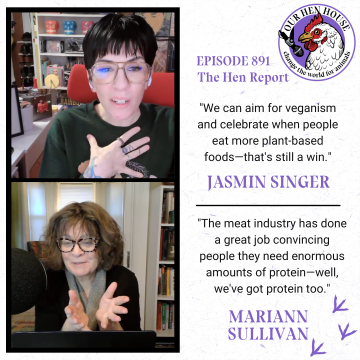
Jasmin Singer: I will tell you that based on what I said a few minutes ago, I think that a good activism way forward here is exactly what people are doing. I mean, like if we, if we aim for veganism and we try and bring people to veganism and people wind up eating more vegan, then you could consider that a win.
Mariann Sullivan: Totally.
Jasmin Singer: So I don't know if much needs to change in terms, I, I think that the, and I'm only realizing this through our conversation, I think that the thing needs to, that needs to change sort of what Nil Zacharias said in this, which is like, don't take these articles that seriously.
Mariann Sullivan: Yeah.
Jasmin Singer: People, I know this is shocking that people on the internet were up in arms, but saw people like really upset about it, and then I kind of was like, oh, me too, you know?
And. And then I was like, eh, you know who cares? Like let's just keep doing the thing we're doing. Like, that's all we can do.
Mariann Sullivan: And I think,
Jasmin Singer: I don't mean who cares, like dismissively,
Mariann Sullivan: I know, of course, of course.
Jasmin Singer: On a very selfish level, I will say, I'm glad I lived in New York City during the height of all this 'cause I got to eat at all of those
Mariann Sullivan: There's still loads of great vegan restaurants in New York City. I hear people talking about them all the time, and the last time I was there, I ate at great restaurants and it wasn't that long ago. So yeah, some of that is just nonsense. There's lots of great vegan restaurants and there's probably lots of great vegan options in in other restaurants that didn't used to be there who would look at you like you had two heads if you wanted something vegan.
And, and I think one of the most important thing to remember is this is not backwards. This is the next phase and thing, you know, things go up and down and this is the next phase, and that's what we've gotta deal with. I also, I, I mentioned to you, I want, like, I want us to have a plan to go out to dinner once a week and pick a restaurant at random, not checking to see what they have and just go and either be delightfully surprised that they have a good vegan thing on the menu, or if they don't just order around.
Be really nice, but just make it clear like we're very disappointed. I know that that's not real activism, that's just an excuse to go out to eat, but, but.
Jasmin Singer: know,
Mariann Sullivan: But it's kind of activism and maybe I can translate it into more of a, uh, more of an attitude. And I, you know, the other thing is like always center the animals.
The animals are what make people go vegan and stay vegan.
Jasmin Singer: Yeah, I totally agree Mm-hmm. And I do like to eat out, but I wanna kind of be a little more discerning about it, I think, even though I do understand where you're coming from
Mariann Sullivan: It'll be fun. We can have cocktails!
Jasmin Singer: Okay.
Mariann Sullivan: They're frequently, vegan.
Jasmin Singer: That's true.
Mariann Sullivan: Not always.
Jasmin Singer: Alright, let's move on. Why don't you walk us through these next stories?
Mariann Sullivan: These are just, uh, things I thought were interesting and that people might wanna... we will, we'll put a link in the, um, in the show notes. People might wanna check them out. One is this, uh, is I had seen this, uh, message from TK Pillen, who was one of the founders of Veggie Grill. He's working on this project and, uh, I'm not sure what he's gonna do with it or what other, I mean, I, I don't think it's just him doing it.
He has partners as well, and it's called Prioritize Plant Protein. And I just, I heard that and I thought that is a good message because the meat industry has done a really great job in convincing people that they need enormous amounts of protein, but I don't... but they, even on the meat industry sites, and you know, I'm one of the few people who, who reads the meat industry sites pretty regularly.
They don't call it meat anymore. They call it protein. They just push protein. Well, we've got protein too, and I think a lot of people might be open to the idea that, yeah, plant protein is healthy.
Jasmin Singer: Right, and this is where I wanted to mention what I, what I alluded to before about like the medical procedure I had done. And like I don't wanna get into what, what it was or why. So sorry if you're wondering, but I'm fine. Um, I will tell you that I did, I was advised to significantly step up my protein, which is not... dogs are whining, sorry, but, which is not something that I've ever really paid attention to.
'Cause I, in my 22 years of being vegan, have never been protein deprived or anything close to that. But I decided to start paying attention to it because they told me get a hundred grams a day.
Mariann Sullivan: Your dogs are so annoying.
Jasmin Singer: I know. It's because Moore left to like
Mariann Sullivan: Yeah. Well, that's a good, that's a good reason to become hysterical. Whenever Moore leaves the room, I become hysterical.
Jasmin Singer: Yeah. Uh, anyway, so I was told to get a hundred grams of protein. For someone my size, that's a lot. But I was like, I can do it. And I can, and I did. And the surgeon had like, you know, was, was very skeptical that it was possible. And, and it, it's easy, it's not only easy, but I'm sort of enjoying it. Like it's kind of fun. It's not just protein powder. There's plenty of days that I don't have protein powder. Um, so I just wanted, wanted people to know, like I, I am proof positive that as a non, you know, bodybuilder, it is still very, very possible and not difficult to get a hundred grams of protein or, or however much you want. That is a significant amount. And I really like this plant protein focus.
I think it's a cool pivot.
Mariann Sullivan: Yeah, I, I think people can hear that. I don't know. What do I know? Um, and on the same line, GFI, Good Food Institute, just put out, um, in, in November this report on messaging to drive consumer adoption of plant-based meat. Uh, and this is a fairly long report. I haven't examined it in, um, detail, but they've done a lot of research on, and a lot of this is focused, though I think rather than calling it plant-based meat, I mean, in your advocacy, not in this report, but, uh, calling it plant protein is the way to go.
But, um, have they, they've really done a deep dive into, um, into plant-based meat messaging angles. And, and I think, you know, this is great, great information for any activist. So, uh, we will link to that in the, in, in the, um.
Jasmin Singer: Show notes.
Mariann Sullivan: And there, there, their four big messages on a health basis are gut health, heart health, antibiotics, and protein. And I think protein should be at the top of that list. 'cause people are protein obsessed. Why not take advantage of it?
All right, just one more article that I thought people would find reassuring after we just brought everybody down with talking about that New York magazine article. Um, on Vegconomist, Google searches for veganism outpace those for climate change. Well, that, I don't know whether that's good or bad actually.
'Cause it might just mean that nobody's searching for climate change. Well, but this is the thing. Flexitarian is now mainstream globally, and, um, polling across 10 countries indicates that while veganism remains uncommon, flexitarian is now mainstream with 16 to 30% of the population across 10 countries identifying as flexitarian.
I think that that is totally in line with everything we've been saying and you know, it's just, I think, been hard for everybody in this movement to do that pivot because Flexitarian is just as like, what? Like, like it's okay to kill just a few animals instead of a lot of animal... like what? But you know, sometimes we gotta look at the way things are going and, and work with that.
And it doesn't mean that we ever have to betray our own principles and say it's okay to eat a few animals, but we can encourage people to cut down.
Jasmin Singer: Well, that's what I was saying before. Or we can encourage people to go vegan and they will
Mariann Sullivan: Yeah. And they'll, they'll do what they wanna do. Yeah. People, people don't always do what you tell them to do. I've found.
Jasmin Singer: Shocking. They always do what you tell them to do, Mariann.
Mariann Sullivan: Wouldn't, wouldn't the world be a nice place? It really would.
Jasmin Singer: Why don't you tell them to watch Christspiracy?
Mariann Sullivan: Oh yeah, yeah, yeah. Just an announcement. Um, if you haven't seen Christspiracy yet, I think it's, I mean, I. It's a tough, it, it could be a tough watching places, but the stuff on Christianity I thought was as interesting as anything I've ever seen in this movement. I mean, fascinating. And it's now available for free online, so we'll, we'll, we'll give you a link.
I'm not sure how long that's gonna last. Um, whether it's a temporary, it looks like it's a temporary offer, but, um, so if you haven't seen it, I recommend it.
Jasmin Singer: And, uh, another announcement. We're so thrilled to give a heartfelt shout out to End of the Line Cafe in Pensacola, Florida, courtesy of our amazing flock supporters, Sheila Ward and Ray Harry, this vegan gem has been serving up scratch made plant powered deliciousness since 2002. Take that New Yorker.
Mariann Sullivan: They haven't gone outta business. Yeah.
Jasmin Singer: Take that!
Mariann Sullivan: Also it just sounds like they're, they're, they're making like good, delicious food. Like that's a, that's a method for a successful restaurant.
Jasmin Singer: And by the way, I just said New Yorker article, but it's
Mariann Sullivan: New York magazine,
Jasmin Singer: the
Mariann Sullivan: I.
Jasmin Singer: magazine. So take
Mariann Sullivan: Yeah.
Jasmin Singer: York magazine. And also Vicki insists it's one of her all time favorite vegan hotspots and she, she's like, kind of a tough critic, so I would pay
Mariann Sullivan: Yeah,
Jasmin Singer: to her recommendations. She especially raves about their legendary pink potato salad and says, that's absolutely worth planning a Florida road trip for.
Mariann Sullivan: That's a pretty high bar for me.
Jasmin Singer: Yeah, so
Mariann Sullivan: I dunno, what, what do you suppose makes it pink?
Jasmin Singer: uh, I think potatoes can be kind of pink.
Mariann Sullivan: No,
Jasmin Singer: know.
Mariann Sullivan: I don't think it's that the potatoes are pink. I think it, the potato salad is pink.
Jasmin Singer: Yeah, I don't know what makes it pink. I just know what makes me wanna eat it, which is that it's in front of me and it's vegan.
Mariann Sullivan: I wanna know what makes it pink.
Jasmin Singer: or you're just passing through Pensacola, treat yourself to something from their mouthwatering 100% vegan menu. So check them out at eotlcafe.com.
Tell them that Our Hen House sent you, and again, it's End of the Line Cafe in Pensacola, Florida. So thank you so much to Sheila and Ray, also.
Now, while we're on the subject of cool opportunities, I do want people to know that there is an upcoming webinar that's totally free that you can go to if you'd like.
And it is called The Compassion Mandate with author Neil Dullaghan. And it's coming up on Monday, the 26th of January, and we will link to that. Uh, but it is about remaking the European Union's leadership on farmed animal welfare, and you are going to be interviewing him soon for the Animal Law Podcast.
But you know, it's always these types of, types of webinars are cool to attend, even if it's like on in the background while you're cooking or whatever. We will link to how you can register, but again, it's the Compassion Mandate and it's by, it's a new book by Neil Dullaghan, and
Mariann Sullivan: I I think it, I, I haven't looked into it yet, but I think it kind of tackles the problem how when I was first coming up in animal law, Europe was, you know, definitely at the forefront of welfare reforms. Um, and I think maybe it still is, but not a lot has happened since then.
Jasmin Singer: Yeah, agreed. So that is coming up on January 26th. That's really soon. Alright, before we close, I just wanna thank all of you for helping us to make our match this year. Uh, it's another strong year of Our Hen House.
Mariann, happy Our Hen House anniversary. It is our 16th anniversary. Our, Our Hen House is now a driver.
If our Hen was a human, it would be driving now is, is my point.
Mariann Sullivan: And we would be so worried every time it went out at night. It's only 16.
Jasmin Singer: But we have nothing to worry about because we have such a wonderful global community of listeners and flock members. And so we just wanna thank you so much for helping us end Our Hen House, uh, end ends 2025 for Our Hen House on on a, on a big high note. And we're entering 2026 now on a high note as well.
And that's thanks to you. So thank you so much.
Mariann Sullivan: Can I just say it really doesn't feel like 16 years ago that we were sitting in that pizza parlor in, in Philadelphia, which was the coldest weekend I've ever lived through and thought, well, maybe we should do a podcast.
Jasmin Singer: Yeah. Does it feel like less time or more?
Mariann Sullivan: Oh, less time.
Jasmin Singer: Hmm.
Mariann Sullivan: When I think of like how much you know how time is and you think of it one way, and it seems like yesterday you think of it another way and you think of like all that's happened between then and now and it seems like forever ago. Time is just weird.
Jasmin Singer: It is. It's super weird. Yeah, and we were visiting Philadelphia for that weekend. We were living in New York City at the time. I was 30. and don't know, it's just amazing. I'm just so grateful to our listeners and to you, Mariann, for putting up with me every week. Or multiple times a week now that we're on multiple times a week, rising Anxieties comes out on Tuesdays, the Hen report on Thursdays, and the long form interview on Fridays.
This week's interview. Why don't you talk briefly about this week's interview, Mariann?
Mariann Sullivan: Yeah, it's with, um, Will Kymlicka and Sue Donaldson, who you've probably heard of, um, because of their book Zoopolis. Um, they are, they're political philoso, well, Will is a political philosopher. I'm not sure exactly what Sue classifies her academic category as, but they write about politics.
They write about political science and uh, and. It's kind of taking it, you know, they take the whole question beyond moral philosophy. Yeah, of course they need rights, but what does that actually mean and how do you actually accomplish it in the real world? And they've got a new book coming out, Animals and the Right to Politics from Oxford University City Press.
And we had a delightful conversation with them, uh, which will be out on Friday about all of their thoughts about how we get from here to there, even in this incredibly fraught world.
Jasmin Singer: It was a great interview and I'm looking forward to sharing it with everyone as well as their bonus material was also fantastic. So definitely check that out and thank you so much for tuning in today. Thank you to Vicki Beechler and Jen Riley for their help on this week's episode, as well as just helping us get through the end of last year with our fundraising efforts.
We couldn't do this without them, and we couldn't do it without you. We'll talk to you next time.
-
_____________________________________________

Thank you for listening to the Our Hen House podcast! If you enjoy our podcasts, believe in our mission to effectively mainstream the movement to end the exploitation of animals, find community and solace in our shows and resources, and would like to show your support for vegan indie media, please make a donation today.
Contributions of any amount will go towards our fundraising goal and are hugely appreciated. Our Hen House is a 501(c)(3) nonprofit organization, so it’s tax-deductible. Thank you for helping us create quality content!
Subscribe to our show on Apple Podcasts, YouTube, or your favorite podcatcher, and don’t forget to leave a 5-star review!
Check out Our Hen House’s other podcasts: The Animal Law Podcast, The Teaching Jasmin How to Cook Vegan Podcast, and the Antiracism in Animal Advocacy Audio Series.
Follow us on social media! You can find Our Hen House on Facebook, Instagram, TikTok, or Bluesky.
The Our Hen House theme song is written and performed by Michael Harren.