
 Apple Podcasts
 RSS
 Amazon Music
 Spotify
 YouTube
 PocketCasts
 CastBox
 Player.fm
 TuneIn
 Audible
 App not listed? Try this RSS link
In this thought-provoking interview, Sue Donaldson and Will Kymlicka return to Our Hen House to discuss their groundbreaking new book Animals and the Right to Politics from Oxford University Press. The authors challenge us to move beyond simply acknowledging animals’ moral status and instead recognize them as capable of making collective decisions within their communities, explaining that the “inner citadel of human supremacism” lies not in denying animals’ moral status but in refusing to see them as political beings. Through examples of animal communities demonstrating sophisticated forms of collective decision-making, they explore how expanding our understanding of politics to include non-human animals could create more just relationships between species while critiquing current approaches.
This episode explores:
- How the concept of a “right to politics” differs from traditional animal rights frameworks that focus primarily on moral status
- Why recognizing animals as political agents requires us to move beyond the “minimal animal” view that only acknowledges their capacity to suffer
- The limitations of three current approaches to animal advocacy: wardship, critical resistance, and cosmopolitan inclusivity
- How animal communities demonstrate sophisticated forms of collective decision-making that challenge human supremacist views of politics
- Why territorial boundaries and “holding environments” are essential for protecting animals’ ability to engage in their own forms of politics
ABOUT OUR GUESTS
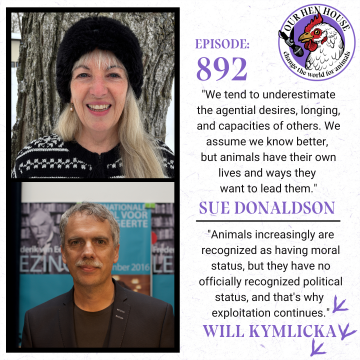
Sue Donaldson is a research associate in the Department of Philosophy, Queen’s University, Kingston, Canada. She is the author of several books, including Zoopolis: A Political Theory of Animal Rights (OUP 2011) and Animals and the Right to Politics (OUP 2025). She is co-convenor of the Animals in Philosophy, Politics, Law, and Ethics research group.
Will Kymlicka is a professor in the Philosophy Department at Queen’s University in Kingston, Canada, where he has taught since 1998. He has published widely on issues of justice and democracy in multicultural and multispecies societies. With Sue Donaldson, he co-convenes the Animals in Philosophy, Politics, Law and Ethics research group at Queen’s University, including its postdoctoral fellowship program, and teaches courses in animals and political theory and in animals and the law.
INTERVIEW TRANSCRIPT
Jasmin Singer: Welcome to the Our Hen House interview. This is Jasmin Singer,
Mariann Sullivan: This is Mariann Sullivan.
Jasmin Singer: And we are so pleased today to welcome back to the show, Sue Donaldson And Will Kimick... Kymlicka.... I'm gonna take that sentence again.
Mariann Sullivan: No, Kimlicka.. No, Kymlicka. You're right.
Jasmin Singer: I right. No, we're gonna leave all this in.
Mariann Sullivan: Like, is this your life?
Jasmin Singer: Kymlicka. Kymlicka. Uh, okay.
Will Kymlicka: Yep, that's fine.
Jasmin Singer: Kymlicka... Sue Donaldson and Will Kymlicka, two of the most important thinkers in the animal protection movement today, and the authors of Zoopolis: A Political Theory of Animal Rights, to talk about their latest book from Oxford University Press, which is called Animals and the Right to Politics.
And we've been really excited about this interview. Before we get to that, just a super quick reminder, since if you're like me, you're forgetting everything days, that the Our Hen House podcasts are now several times a week. We last year decided that that was a good shift to make, rather than having one 19 hour episode or whatever it was going for, Rising Anxieties comes out on Tuesdays, The Hen Report on Thursdays, and the long form interview on Fridays, and that's what this is.
The bonus for Flock members comes out on Mondays. Remember, we are a podcast and we're on YouTube, so please subscribe and hit like wherever you listen. So welcome back to Our Hen House, Will and Sue.
Sue Donaldson: Thank you, we're, uh, we're thrilled to be here!
Will Kymlicka: Thanks. Yeah,
Jasmin Singer: we're super excited about picking your brain and I think that, uh, congratulations by the way, on your new project and just putting it out into the world. We wanna talk about that. I think the best place to start is with the title. So what do you mean when you talk about a right to politics?
Will Kymlicka: The animal advocacy movement for the past, well, 50 years, I would say, has focused on defending the idea that animals have moral status. And so Peter Singer famously talked about expanding the moral circle. And, uh, Jeff SIBO has a new book about, uh, the same idea, expanding the moral circle.
The traditional goal has been to get animals into the moral circle. Getting animals into the moral circle is crucial. Um, and there's been actually some success in that, at least as measured by public opinion polls. Most people now agree that animals have a moral status, but it's done very little to date, to actually stop, uh, the system of animal exploitation.
And the reason, we think, uh, at least in part, is that animals are not in the political state, in the political circle. So animals increasingly are recognized as having some kind of moral status, but they're, they have no official recognized political status. And I think earlier waves of animal advocates just assumed that if, if everyone agreed that animals have moral status, that somehow political status would just naturally and inevitably follow.
But it's actually really complicated how to figure out the relationship between moral status and political status, even in the human case. The fact that we're all moral equals as human beings doesn't tell us very much about the specific political status or standing or rights of any given individual in relation to any given decision.
And so the basic goal of the book is to really shift focus towards this question of political status, political standing, political membership, and in particular that we should think about animals not just as, um, passive, uh, victims, as it were, of human political decision making, but as political agents in their own right. That, uh, when thinking about how to make sure that animals get included in political decision making, it's not enough to simply try our best to guess what their interests might be and to then advocate for them, but to actually look to see how animals themselves address the challenges of their lives, how they make decisions as individuals and as groups. How they resolve disagreements and differences within their, within their groups. And so one just sort of shorthand for that is that we should think of animals also as having a right to politics. Uh, they, they have a right to exercise control over their lives.
Uh, in some cases that right to politics is gonna be exercised primarily amongst themselves. A particular flock or herd will make decisions about how they want to act as a group, but in other contexts, humans and animals need to learn how to do politics together. And sometimes we need to think about forms of political decision making that, that bring together human political agency and animal political agency. Um, and so part of the goal of the book is just to trace out some of the different possible ways in which, uh, humans and animals do politics and, and do politics separately, and do politics together.
Mariann Sullivan: it, it is an unbelievably confu... well, maybe confusing... but it's a startling concept, I think to most people. You guys have been thinking about this for a while, but for most people are like, well, how would that work? One of the, one of the things you mentioned, one of the terms you used was political agents or political agency.
Is that the same thing as moral status? If you have moral sta... I mean, is that, has, is that a question that has been answered by the people who have delved into the question of moral status or is there, are there different aspects to political agency?
Sue Donaldson: Yes. So you can have moral status and moral standing, um, without necessarily having agency or significant amounts of agency. So one could imagine, you know, uh, maybe there are some animals, uh, some beings who can feel pain, uh, can, uh, you know, there, there are reasons why we should be concerned about them, um, because they, they have experiences, they have a, a self that experiences things. Um, but they may not be particularly agential in their lives. They may, they may be mostly on, you know, recipients of things that happen to them, and those things matter and we should, uh, worry about them if, if they, um, are sentient feeling, thinking beings.
But, uh, the agency question is, yeah, um, and specifically the political agency question are, um, taking us into the realm of, of action in the world, um, and making things happen in various ways. Um, and animals differ, I think significantly, uh, in terms of how they are active in the world, uh, the extent to which they are active in the world and, and make things happen that, that can, you know, benefit them or their, their group.
Um, and so it's, in many ways a lot of people have been primarily concerned, not with agency, but with the question of feeling, um, and thinking because that, that's enough, right? That's enough for us to care about what happens, say to a certain animal. If they, if they're, if they're capable of feeling pain, that gives us reasons to not hurt them. Uh, and so a lot of theorists, I think, have approached this from uh, what we call the kind of minimal animal, um, idea, which is we just need to theorize animals, we just need to get them into that, into that moral circle. And the capacity, for example, to feel pain is sufficient for that, but it's not sufficient for being a political animal, and that's what we're concerned with.
And that is much more about kinds of agency and specifically about forms of collective agency. So that's the agency that you have as a member of a community. How you do things with others, how what you can become and do is strongly affected by how others interact with you. Um, how you, uh, have ideas as a group about, about what you want to do or need to do. Um, here we're much more into a political realm where there's a lot of navigation that has to go on between members of groups about how to do things, um, and uh, what, what the terms of that collective life are. So that's a much more robust, um, idea of agency that we're, that we're dealing with there. Um, and we think it's, it's quite crucial. If, if we just always are talking about moral standing, that can be, um, uh, important for certain reasons, but it really doesn't help us think about how animals are political animals. Um, that's much more about their, their purposeful action in the world to, to, to do things, to do things together.
Jasmin Singer: I keep thinking of my niece. She's 15 now, but when she was thirteen and she, you know, I've, she knows that her aunt has been a vegan animal rights activist for well longer than she's been alive, but apparently she was like at a dinner with her, you know, immediate family. I wasn't there. And they were talking about, uh, about animal, animal rights.
And this is not an animal, they're not an animal rights family. And my niece at 13 said, That's ridiculous. Animals should not have to vote, or something like that. Like she just at 13 had like directly equated animal rights with like giving them the right to vote, which I thought was like, kind of funny and also I was like surprised that that's where her 13-year-old brain went. But it does make me think that there is a lot of ignorance out there about just the term animal rights, let alone what you're trying to convey here. Um. How do you bring this message to a more lay crowd? I mean, how, how do you, how do you get this across when we can't even effectively get across the very basic concept that animals deserve rights?
Will Kymlicka: So I think at one place in the book we say that the, the inner citadel of human supremacism is not actually the question of moral status, it's the question of, of politics. That, that when push comes to shove, many humans are willing to acknowledge that animals have moral status, but what we jealously preserve above all is the idea that only humans can do politics. That only humans are zoonpolitical, and only humans are political animals. And that's wrapped up with a whole set of ideas about how only humans are able to make choices. So animals are seen as being determined solely by genes.
Uh, they're genetically predestined to just, there's only one possible thing they can ever do, and that's been determined by evolution. Whereas humans alone amongst, alone in the planet, alone in the universe, humans are able to, to, to make choices. And that's why we need politics is because, uh, politics just is the process of, of making collective choices.
And so I, I think that we're not gonna make dramatic progress in terms of, uh, improving the, the treatment of animals until we challenge this human supremacism about politics. It's just not enough to say that animals matter because they suffer. That, that in and of itself does nothing to challenge this idea, uh, that politics is a uniquely human capacity and right.
And so, uh, I mean the, the good thing though is that, um, the ethologists, the animal scientists, have over the past 40 years, um, I mean, there's just this exploding literature which shows that animals have all sorts of different kinds of agency, including collective agency. That, that there are all sorts of circumstances where, uh, groups of animals, herds, flocks, um, need to make decisions together and there need to be mechanisms by which they, um, negotiate their differences. 'Cause there are differences in interests and, and instincts amongst animals, just as there are amongst humans. And so there's this really exploding literature that tries to document the diverse ways in which, uh, a whole variety of, of animals make collective decisions.
Um, and, and often in highly successful ways, not just in the sense that they come to some conclusion, but they, they're able to do this relatively peacefully. They, they don't break down into violence, into civil war. Um, that they're, many, many groups of animals are just as capable of making peaceful collective decisions as, as humans are.
And I think many of those stories, which we, we, many of those studies, uh, we devote a whole chapter of the book to, to discussing a lot of these findings. And in ethology, they, they just, uh, provide, in our view, kind of conclusive evidence that, that animals are, are political agents. Um, they exercise forms of political agency and they, they, they raise a whole series of, of fascinating questions both about how to make sure that we as humans leave room for animals to continue to enact their own form of politics.
So how do we make sure we don't get in the way, we don't undermine and subvert, uh, the kinds of politics that animals engage in? But also open up this vista for thinking about how we might do politics together. We have, we humans have our traditional ways of doing politics. Animals have their traditional ways of doing politics, but sometimes we need to figure out how to do politics together, and that's part of what we're trying to get at in the last third of the book.
Mariann Sullivan: Yeah, that really seems like, I mean, the really crucial piece is to why this could lead to actual, actual change in the real world if we, if we start to get this theory right and start to see it as beyond, uh, just caring for them. And I mean, I'm just gonna go back to that question that Jasmin's niece asked because I think it's kind of relevant.
I bet you get asked that question really a lot. I mean, she's not the only one who came up with that idea. And, and it's kind of the quintessential response, uh, to anybody who claims that animals should have rights. And, um, so, do we wanna give them right to vote? Like, like, and, uh, and what would that, I mean, let's get into a little bit in real world, and not just theory, like if, if we're, if we're gonna do this together in some way, can, can you give a little just some ideas of how that actually might work in the real world to give them votes of some sort?
Sue Donaldson: I mean, it's important I think, to think about what is a vote doing? And it's doing a number of things. It's, it's registering your preferences, right? When you vote. It's creating a, in, in a democracy, it's creating a situation where everybody gets to register their preferences and it, and it's, and everybody's preferences are taken into account.
So it's, it's, uh, it's part of ideas of equality and democracy. It's also something that happens, unfolds over time, right? We vote and then we vote again and we vote again. So, so we can, if, if we are unhappy, if we voted for a representative who does a bad job, then we can vote them out next time. So it's, so voting and elections are, are mechanisms for us to, um, sanction or, or correct, you know, the, the, the process of politics as it's, as it's unfolding. And of course, in the process of elections and voting, we do a great deal of exchange of ideas, deliberation, um, all kinds of things that hopefully inform the way we vote or maybe, maybe even dramatically change the way we vote. So all of those things are part of voting. And so what we say is basically that doesn't have to be done by, know, a paper or an automated ballot. How can we capture those things that are part of, um, of voting, uh, and electoral politics and, uh, transform them into something that, that humans and animals might do together? So if we go back then, that's, you know, that's finding out what those, what those preferences and interests and desires are. So it involves a lot of, of, uh, communication with, with animals and observing them and listening to them to to, uh...but it also involves opportunities for them, in that more deliberative dimension of the voting, um, process, opportunities for them to change us. Opportunities for us to change them in our, uh, ideas about how we think about things. So for us, that's crucial. 'Cause how, how does that work? I mean, animals aren't going to submit a petition with arguments to try and persuade, um, humans about things. It has to, we think this is profoundly important that this happens through sort of embodied relationships, right?
I mean, if we think about how animals change us in our day-to-day lives and how we change them, it's 'cause we have relationships and we build trust and we learn about each other and we see each other in different situations. We change each other. Um, we come to internalize the others, what the other cares about. Um, we, we experiment with, with things to try and find out, well, did I understand correctly, um, what this, uh, other individual wants or do we need to change things up to, to try and get more information? So a much richer idea of what it means to, uh, to deliberate with others as, as part of the decision process. Um, and then the other thing I mentioned at the beginning about, well, what are we doing when we're voting? It's also opportunities to, to, to choose those who speak for you in a representative situation, to sanction those who don't do well on your behalf. Uh, and so we have to think about ways of bringing, bringing that in. Like somehow the decisions that get made have to go back and animals need a, have to, you know, maybe it's a, a real world policy change in the, in a town say, and animals need a chance to then, um, respond to that, right?
And maybe they respond negatively, or, um, maybe they start rejecting the person who claims to be speaking for them in a particular situation, or... so, so we need opportunities to, to register their dissent, um, their desire to keep, to keep working on a problem that we, we haven't come to a final decision. And so one of the kinds of models we talk about in the book is, um, so first of all, we, we need to sort of open up a geography where humans and animals can be interacting in these ways that allow us to gain information about each other, come to trust each other, make judgements about each other, then we need people who are tasked with actually, um, making decisions. So it might be individuals who are very close to a particular group of animals and trusted by them. Or people with various kinds of expertise for observing animals and so on. But the point is that that can't be the first thing we jump to. That has to be, that has to come out of this richer situation where animals and humans are encountering each other regularly, doing lots of different things together, where animals have much greater mobility and opportunities. Um, so it has to be, it has to be more organically tied to a situation of, of real, uh, deliberation of, of humans and animals. So that's, those are the kinds of ideas that we talk about. What would it mean for the group around a particular animal who helped to represent their interests in this very, um, situated or organic way?
What would it mean for that to then feed up to the actual, you know, voting process? Um, and the voting process would prob, you know, might still, the final political decision might still be something that humans do, but it's part of this whole, uh, system. So many political theorists now talk about systemic democracy.
It's not just the voting moment, it's this whole ecology, um, where, um, animals are having lots of opportunity to change humans.
Will Kymlicka: I'm a political philosopher and in political philosophy, we've had this interesting shift in democratic theory from what was called a vote centric theory of democracy to a voice centric theory of democracy. So a vote centric theory of democracy says that what matters is that everyone gets a vote, but the evidence says, shows very clearly, that if the only way you participate in politics is by marking a ballot every four years, you feel entirely ineffective politically, no. No one feels they make a difference in the world by marking a ballot once every four years. So, uh, people have recognized that what's really crucial to democracy is that you're able to articulate your views that you hope other people listen, that you're able to be involved in some exchange of ideas.
Um, and then voting is the last moment. And as Sue says, it's iterative. You then vote again and again. But, but what, what gives people a sense of efficacy is voice not vote. That there'd be some mechanism by which you are able to make proposals to others, and you're able to express your views about other people's proposals.
Unfortunately in, in political philosophy, people have interpreted this idea of, of voice centric democracy in highly human terms. So they've assumed you need to use human language to engage in voice to articulate proposals. But what a lot of us have been working on over the past 15 years is showing that animals engage in political voice. They are making proposals to us, a as you walk down the street with your dog, but also as you walk through the park, you look at what the squirrels are doing, what the birds are doing, we can interpret them as, as engaged in this kind of voice centric democracy. They're making proposals to us about how they wanna share public space.
We can make proposals to them. It's, it's this embodied, iterative form, but so much of what political philosophies have been discussing lately under the concept of a voice centric democracy is, uh, can be applied to the way in which we interact with animals. I mean, so the older model of a kind of vote centric democracy if that's, if all you're focused on, if you're defining democracy is just marking a ballot every four years, then it's hard to see how it applies to animals. But this much richer idea of a voice centric democracy, we think has lots of opportunity for, for including animals.
Mariann Sullivan: Yeah, you know, it, it strikes me that this is a very difficult time, I think, for anybody in the US to think of, um, um, like we're trying desperately to hang onto the vote, you know? Uh, like that's the project. To like, like, I, I keep thinking of objections. Well, it would inevitably unfair, be unfair. It would inevitably be misinterpreted. Who could you put in charge? They would exploit, you know, because, and of course we do see that tremendously with animals, that the people who speak for animals are very frequently misrepresenting what must be their, their interests. But I mean, I, I am trying to get at this head of appreciating that we could go beyond the moment where we are and actually think of justice again and, uh, as a, as a real concept and actually get to, um, applying it to animals.
But I think even when people do that, I mean, you talk about these various approaches that have been taken. Like one of them I think is wardship. Critical resistance and cosmopolitan inclusivity. I mean, not none of those except maybe for wardship. None of those titles are obvious, I think, to people what they mean.
But could you kind of break down why, either go into them specifically, or why people who are trying to represent animals now and actually are trying, the models they're using aren't enough? Is that, is that a right way of putting that?
Sue Donaldson: Yes, so the first, the, the wardship model, uh, we also call it sometimes a consideration of interest model. Um, so this is the idea that to bring animals, so all these theists are concerned with bringing animals into politics, into that political circle that, that will was talking about. So how do we do that for, uh, on, on a wardship model?
The idea is that, well, no animals themselves aren't political agents, so they can't participate in this, in this process that we've just been talking about directly, but they have interests and those interests must be represented when humans make decisions. So humans are obliged to take account of those interests. Um, and so what that requires is that, you know, humans who know animals, human experts, define what their interests are and then, um, and then various schemes out there for how those would be incorporated into, um, into parliaments or other, um, forms of legislature, uh, legal and political decision making.
But the fundamental idea is that, um, unlike with humans where we think it's important that their voice be part of the process, um, the idea is that animals, they don't need to voice anything here, uh, humans have the expertise to know what animals' interests are. And many theorists in this area tend to li you know, assume that animals have a fairly limited number of interests.
Like , they have a lot, you know, some basic needs and, and wants, but we can identify those and it's where we should be focusing on is, is, is making sure that those are, are taken into account in human decision making. So that's inadequate for all the reasons that we've been talking about, right?
No animals are, uh, agential. They want control over their lives. They have ways of doing things that, uh, that we should value. And, and moreover, as as when we think about human democracy, that even if you think about adults and children, for example, adults always want to think that they know better, um, uh, what children's needs are or what's best for them. And of course, we then, as children grow up, have this very complicated process of assessing that change over to their, uh, taking more control over their lives. But the point is that we always tend to underestimate the agential, uh, desires and longing and capacities of others. Um, and especially humans vis-a-vis animals.
We just assume that we know better, that there are all kinds of things that they don't understand, that we are better at judging what their, their, their needs and interests are. Um, but that's not the point. The point is they have their own lives, they have ways that they want to lead them. And so there has to be, in the political process, a recognition that they, they have those, that capacity and desire and right to, to be self-determining.
So that's our issue with the wardship approach is that it just, it, it doesn't acknowledge that. Um, it just thinks that there is kind of objective interests that need to be, um, represented. Um, there isn't a process there that animals need to be part of. The resistance, uh, so there are a lot of critical animal theorists in recent years who've done this wonderful work on thinking about animal resistance and identifying cases of, of animal resistance. Um, so this is, um, animals pushing back in all kinds of ways, on, on, on, on how humans treat them, how humans govern them. Um, and so this is, this is definitely a way of recognizing animals as agents, right? This is animals not just being victims, not just taking what's meted out to them, but, um, but fighting back against those trainers or breaking out of that zoo or slaughterhouse or whatever it is. Um, and so this is important because it, I, it's, it is focused on animals agency, but it's, uh, our concern here is that the limitation is that agency isn't just about saying no, it's not just about fighting against the things that don't work for us and that we don't want. The kinds of agency that we're really focused on in, in this book are, are sort of positive forms of collective agency.
So when we need to get things done together as a group, all the things that we collectively need to, uh, organize and manage and take care of, um, and so. so, you know, both of these models that I've discussed so far, I mean, there are important elements of those that are part of our story. And of course, attending to animal resistance is, is crucially important, but our worry is that it's, it's not enough.
Um, and that we need to think about sort of legitimate forms of collective agency, not just fighting against illegitimate forms of, of, of government and power. Um, and, you know, a lot of people working in the critical animal studies tradition are maybe not anarchists, but, but, you know, have a lot of issues with, with state and state power.
And so, so there's just so it's understandable that they're, they're focused more on, on resistance type stories, um, than on, on this kind of positive dimensions of collective political agency. Um, so that's the, the limit there. And actually will, I'm gonna pass it over to you to talk about the, the cosmopolitanism.
Will Kymlicka: Yeah. Just, just a quick follow up on the first one, the, the wardship model, we have a long discussion about why that's, that's people's initial instinct. When, when it's pointed out that animals' interests aren't taken into account in politics, people's natural instinct, many people's natural instinct is to say, okay, let's appoint someone who will speak on behalf of animals.
So we call this politics on behalf of animals. Um, and it's a perfectly natural reaction and, and many city governments and others have appointed someone to speak on behalf of animals and in that way try to include animal interests. But as Sue said, I mean there, there are lots of reasons for thinking that this is, it's part of the story, but it can't be the whole story.
And just one of them is that on many of the most important issues, we think, we humans just are not in a position to know what animals want. So if one of the purposes of politics and of democracy is to find out, you know, what people want, what their preferences are, we do not yet know what many of the most important questions animals face.
So, for example, if and when we abolish factory farming, if and when we abolish animal agriculture, we are confronted with the question of what kinds of lives do horses, cows, pigs, chickens want to lead. I mean, it's amazing that we've lived with these animals for, for millennia, but we actually do not know what kinds of lives would they like to lead if they've been liberated from, from, you know, industrial factory farming. And there are, there are actually lots of different possible lives they could lead. And some places, like some animal sanctuaries are trying to give animals an opportunity to explore different possible lives. But this is a process of exploration. And in our view, politics, it includes, it's not just about, about counting existing preferences or existing votes.
It's a process of learning and exploring together. And so if we're gonna figure out a just future with animals, it's something we need to learn together, explore together. And so we need to think about politics as not just, you know, having a human speak on behalf of animals. We need to think about what would be spaces and places where humans and animals can collectively experiment, learn.
Uh, okay. And so that's, that's one of our reasons for thinking that the wardship model is just not gonna be enough, cause we just don't know. We don't know what animals think about many of the most important questions about, about the future. So the, the third option, uh, that we look at is cosmopolitanism.
And it's interesting here that for many animal advocates, and this, this too goes back to Peter Singer. Um, but, but it's found across a, a much wider range of, of, uh, traditions and schools of thought within animal ethics and animal politics. It's assumed that animals will do better in a world in which we get rid of borders and boundaries, and we all just become more kind of cosmopolitan in our political identities.
So clearly animal rights, any animal rights view is committed to the view that animals have moral status. And so moral status expands beyond the family, beyond the tribe, beyond the nation, beyond the human, to animals. So all, all animal ethics is cosmopolitan in the moral sense that it views, uh, moral status as expanding beyond any delimited social group or national group or nation state or whatever.
But we're interested in political cosmopolitanism, which is the idea that political boundaries should be weakened or dissolved, which could take the form of trying to create a global democracy. And there's a lot of interest in the idea of a one, one of our, our, our interlocutors, Alistair Cochrane, defends this idea of a kind of cosmopolitan, uh, interspecies global democracy.
Uh, or it could take the form of what we call terrestrial cosmopolitanism, which is the idea that the world belongs to all of us in common. And this is an idea that's actually quite popular across, again, across a range of, of, uh, uh, theories of animal ethics and animal politics that we should think about, we shouldn't think about groups of humans or groups of animals as having rights to particular bits of territory.
We should instead thinking about all the world belonging to all of us in common. And our view is that both political cosmopolitanism, the idea of a kind of global democracy, and terrestrial cosmopolitan, the idea that the world is a commons that belongs to all of us, all of these would, in practice, operate to license, uh, basically colonizing wild animal habitat. That the, it both would operate to justify the larger numbers of people all over the world staking claims to the resources on wild animal habitat, uh, staking claims to moving into their territory, um, and in ways that would be intensely disruptive for their, for their lives, including their, their forms of politics.
So what we try to do in the book is hammer over and over again that this capacity for animals to engage in politics is dependent on particular kinds of environments. We use the term holding environments. Um, and this, this is gonna vary from type of animal to type of animal, depending on the nature of their sociality, the nature of their, you know, environmental niche, their habitat.
Um, but that for all, both, for, for, so for non-human animals and indeed for human animals, our ability to effectively participate in processes of collective decision making are tied to relationships. They're tied to particular kinds of social relationships, social groupings and particular kinds of habitats and territories.
And so we, we, and we try to document this in a variety of ways across a number of different chapters, but we keep arguing that we need to resist what we call the cosmopolitan temptation. The, the, we need to resist the temptation that it would be a better world for animals if we just stop thinking about boundaries and borders.
If we all, we stop thinking about us and them, and we all just think of ourselves as earthlings who share a single earth in common. That's a very common view in, in a lot of different versions of animal ethics. And we actually think it could be a disaster for animals. It, it, it actually licenses, uh, it, it provides a grounds for the interests and preferences of humans everywhere around the world to be staking claims over the resources and habitats and lives of, of animals.
And so, our, our, you know, it's one of the crucial goals of the, of the book is to insist that if animals have a right to politics, this needs to be understood as tied, all it comes in a bundle. Their right to politics is in part a right to maintain a holding environment that sustains their politics and the holding environment that sustains their politics is a territory.
It may be a territory that they migrate from one to another. I mean, it's, it's complicated. How, how do we think about, uh, territorial rights in the case of animals? But that we need to think seriously about what are the social and ecological circumstances and conditions that make possible stable and effective forms of collective decision making.
And they're not gonna be cosmopolitan, they're gonna be bounded. And we need to think seriously about what are, we need to think about what are good boundaries? You know, good fences make good neighbors. What are the, what are the kinds of boundaries and borders that work well to sustain effective holding environments for humans and animals to, to, to engage in forms of politics?
And, and I, so we wanna put that on the agenda, uh, for animal, uh, theorists and activists to think about going forward. That, uh, we need to, we think, resist this kind of kneejerk opposition to everything that, that, you know, 'cause there's a lot of this out there, that people just have kneejerk opposition to boundaries and borders and, and just think that the world would be a better place if we stopped, uh, distinguishing insiders from outsiders, us, them, members, non-members, citizens, aliens, that we all just had a single, you know, we were all just earthlings on the earth.
Uh, I, you know, I, our, our argument in the book is that that would come at a very high price for a lot of animals. That would, that would render vulnerable many, many animals including, uh, their, their ability to engage in any form of politics.
Jasmin Singer: I love your concept of the, the minimal animal and, and how it shapes what, what changes we seek for them. Um, and I'm curious, in what ways do we have to change the way we think about who animals are? I mean, that's a, that's a process which even the most avid animal advocate has probably only just started.
So does that have to come first?
Sue Donaldson: Well, um, so certainly the openness to it has to come first. I mean, our view of all these things is it's, it's a process that we have to undertake, right? So in many ways what we're trying to do in our book is set some parameters or lay out some ideas about how to embark a process where we get to know animals as the varied and complex and rich beings that, that they are, um, rather than being locked into either, um, know, we're, we're locked into some bad scientific ideas that luckily are, are, are starting to fade.
We're locked into, you know, eons of human supremacy in how we think about animals. Um, we're locked into how we see them currently. Right? It's very hard to see beyond the, the actual, the existing current places where animals are and what it looks like they are capable of being based on what we see on a farm or, um, what we see in a town, uh, where, where dogs are walking around on leashes. Um, so, so we have to move beyond all those limitations, uh, all those ways that encourage us to think in terms of the minimal animal. Um, and so a lot of the project for us is about yes, how do we start to open up ways for us to see animals differently, and so we have that chapter on all the kind of scientific evidence.
So, so, so, and, and I think that goes a long way. I think people watching documentaries about animals or reading about animals can start to move beyond these, uh, traditional ideas we've had about, um, that they're, that they're just kind of operating either on instinct or, or by simple mechanisms of, of response to their environment and, um, and, and seeing the complexity. Um, but it also does involve, you know, we've talked about just opening up these spaces for interaction, um, because I mean, if you just think about the conversations you've probably had with people over the years about moments of insight or moments of change in their relationship with animals, it is often a, a relationship, right?
It is often an encounter, um, or a series of encounters where they've been pushed out of, of the way that they were slotting animals in some, in some sort of limited perspective. Um, and realizing that, yeah, that not only that there's a lot more going on, but the, but starting to think about, well, what's possible. Once, once you realize complexity of what's, what animals are doing, then I mean, the possibilities for what we might do together. Uh, we, we just, as Will said earlier, we, we just really haven't even started asking that question, let alone exploring that question of what that openness, um, actually might, might look like.
Will Kymlicka: So you asked, you know, does, does challenging the minimal animal come first? I, in the book we, we single out these two targets. Um, one is the minimal animal, which is the idea basically that animals are capable of suffering, but nothing else. And so they're not, yeah, they're not capable of learning or they're not capable of, of, of, uh, developing.
They're not capable of, of, uh, um, any forms of, you know, negotiation and deliberation and, and, uh, politics is what we're particularly interested. So that's one problem. But the other problem, the other target is what we call the capacity contract, uh, as a view about politics. So the capacity contract, um, is the idea that politics is best understood as, uh, a process by which the competent, those who are capable, govern the incompetent.
And so the capacity contract thinks about politics as an agreement amongst the competent about how they're gonna share power, including the power to govern the incompetent. And that is equally, I, I wanna say that's a kind of co priority in the book.
We wanna challenge the minimal animal, but I, I actually don't think we can fully challenge the minimal animal unless we also challenge the capacity contract as a picture of politics. Um, because that, that idea that politics is this kind of vehicle by which the competent govern the incompetent, um, it's not just bad for animals. It's also bad for children.
It's bad for people with cognitive disabilities. It, it, but it also just completely misunderstands how politics works for all of us. That, that, in order to have any plausible account about how we, humans and animals, how we engage in these processes of learning, exploring, resolving disagreements, we need a much more embodied idea about how people are expressing their views, how they are resisting things they find objectionable, how they make proposals to others.
And so, I think we need this richer picture about what politics looks like at the same time as we develop a richer picture of animals. And our hope is that these two actually work together, that as, as soon as we, we get a bit richer idea of politics, it's gonna be much easier to see the ways in which animals are rich, including rich in politics.
And similarly attending to animal politics helps to reveal the sterility and the absurd narrowness of the inherited idea of politics as this capacity contract.
Mariann Sullivan: I, I mean, I think this just seems like such an important question, like for what animal advocates are actually doing in the real world right now. Because the whole goal is very much the, some of the most substantial goals in animal welfare are based on a very minimal animal. I mean, I'm thinking particularly of cage free campaigns. Like, and I, I wanna get them outta those battery cages as much as anybody but... um, I'm, I'm not against cage free campaigns. I think I, I pulled this quote, some animal rights theorists think that focusing on the minimal animal has strategic benefits. Can you explain what you mean by that? And, and whether they're, I, I always wonder, like I'm all for cage three campaigns, but I don't understand what the next step is because they're sort of based on the idea that that's all those chickens need. Um, so that's something I'm struggling with a lot right now. I'm just curious to know like how that fits into this theory.
Sue Donaldson: So, yeah, so, so what we mean by choosing it, uh, uh, for strategic reasons. So what is the strategic reason for focusing on the minimal animal? I think what many advocates think is that to have, the best chance of a, of success in terms of say, accomplishing at least something, something valuable for animals, something good for animals, um, is to rest your strategy and to rest your arguments on premises that nobody can reasonably disagree with, right? So, uncontroversial premises, right? So almost nobody is going to disagree except, you know, industry stalwarts, that it's a good life for a chicken to live in a tiny little, um, cage. Uh, and that, and that, that doesn't cause, um, suffering and boredom and, and all kinds of things. Um, and we don't need to have an elaborate story about what the chicken's life could be, or all the forms of agency that she might be able to exercise in order to see that it's wrong for her to be in that cage. Um, she's a suffering, a being who can suffer, she's clearly suffering, um, so we need to change up those cages. And so, so the, the, the strategic idea is that you, yeah, you, you make an argument that nobody can disagree with, right? Nobody's gonna come back and say, oh, well, but those, you know, uh, I mean, nobody now on can, on, on solid grounds dispute things about, about animals feeling pain or, um, engaging in stereotype behaviors when they're enclosed or, or things like that. However, when it comes to things like, uh, exercising political agency, you're gonna get a lot more dispute. I mean, a, you're gonna get a lot of confusion and questions about what that means as, as we've been discussing, but you're also gonna get a lot more dispute about, well, how do we interpret? Um, so when elephants are following the matriarch, how do we know that that's 'cause they're choosing to recognize her leadership? Um, and so engaging in a, a, a form of politics rather than that they're just, um, defaulting to some sort of more innate or instinctive mechanism of, of following, say.
You're gonna, so you're gonna get a lot more arguments. So a lot of people say, listen, the, the, the situation for our animals is so catastrophic, we haven't got anywhere, or we've haven't got very far. We should take the gains where we can get them, and the gains we can get are the ones that we can, you know, nobody can argue with, basically. So yes, there's gonna be a political or economic fight, but nobody's going to disagree about what the, what we're aiming for and, and whether it's justified. Um, so I think a lot of animal advocacy and, and a lot of, you know, um, theoretical work too, sort of, uh, explicitly or, or, or not, um, is making that kind of assessment about the situation.
Will Kymlicka: So I think what Sue said is one version of the strategic reason for just invoking the minimal animal. But the, the other one that we discuss, uh, is there's been a reaction in the animal advocacy movement against, um, prioritizing some species that are seen as closest to humans.
And so, you know, the, uh, a lot of the initial, uh, advocacy was for, uh, primate rights, uh, The Great Ape Project and so on. And, uh, at times it looked like, uh, animal advocates were playing into a game in which the value of an animal's life depended on how close they were, how much they approximated a human life.
And animal advocates, I think, have rightly backed off from, or, or want to avoid, want to avoid engaging in forms of advocacy that just reaffirm human supremacy by setting up the human as the standard that other other animals need to meet. And, uh, the, the minimal animal as just based on suffering, serves that purpose of avoiding, uh, playing into these kind of human supremacist tropes.
And I think some people worry that our focus on a right to politics, um, could have the same effect of like what... we're saying that the right to politics is a right of the members of animal, the, the of social groups of animals, herds, flocks, and so on, um, when, if and when they have the need, uh, to resolve certain kinds of disagreements.
And so, like on our view, this is crucial to the wellbeing of those groups is to understand that they have forms of politics and we, and, and in thinking about their rights, we need to think about what rights will enable them to maintain and affirm and, uh, sustain their forms of politics. But it does, I, I think for some people, they are, uh, worry that if you go beyond suffering and you start to ask about, well, can animals engage in politics, then the answer's gonna be, well, maybe some animals can and some animals can't. And then it's gonna look like we're privileging some animals over other animals based on whether they can or can't do this or that kind of activity.
And, um, so, uh, this is, this is an issue that we, we address, we try to address in the book that, uh, that when we insist on the importance of recognizing animals' right to politics, this shouldn't come at the expense of protecting the basic rights of all sentient animals. Um, and so we're not trying to, and we're not trying to establish a hierarchy, we're not trying to say that the value of an animal's life depends on how much they do or do not engage in politics.
We're just trying to emphasize that for many animals, their wellbeing and their flourishing does indeed depend on their ability to engage in politics. And that there's no way to negotiate, no way for us to learn and explore and discover what interspecies justice could look like unless and until we're willing to engage in politics with animals, that's what we're trying to do.
Jasmin Singer: Hmm. Hmm. So why do, why do.
scientists who study animal behavior and who presumably have a much richer idea of who animals are, tend to maintain a very reductive view of them? Or am I wrong? Is this changing?
Sue Donaldson: Uh, I think it's changing. Um, now, change is always, you know, happening more in some areas than others. It's, it's fits and starts, but I'm actually curious about this. I, I, I was thinking about this recently. Boy, if I went back to high school or an undergraduate, you know, science education, what, what would I be learning about animals at this point?
I actually have no idea. Um, but my suspicion, based on what scientists are writing about, is that it would look entirely different than what I was taught in the seventies and eighties. Um, uh, so I think, I think many animal scientists are still very careful about the kind of language they use. Um, uh, and they, they are much more comfortable talking about animals' behavior from an external perspective, much less comfortable, um, speculating about what animals are thinking about and feeling while they're, while they're doing things. And so a, a few minutes ago I talked about the case of, animal uh, leadership. So of a, a matriarch, say in a elephant, um, family group and those who follow her. Um, and as we know, uh, I mean matriarchs, uh, it's not just a single matriarch. So, so often leadership in an elephant community is, is some, is dispersed amongst various competent adults. Um, but, but the leaders, they have long experience knowledge. They know where you go to get water in a drought season, they know how to handle a a, you know, um, uh, the, a threat from lions when they have young calves, um, they know how to meet up with the rest of the clan at different times of year for various purposes. Um, and so their, their leadership is crucial. But many animal scientists will describe that from the outside. They'll describe what's happening, but they won't necessarily take the step to think about, okay, so if I'm a young adolescent elephant and I'm following the matriarch, what am I, what am what's driving that?
Like, why am I, am I following her because I, I respect her judgment? Because I know that's, you know, a good, because she's gotten us out of d tricky situations before. And, uh, and, and so I know that it's a good idea to, to trust her judgment, uh, and to do what she advises. Uh, am I doing it just because that's what my friend elephant beside me is doing?
Or because that's what my mom, who's also part of the group, is suggesting that, um, uh, is, is leading me to do that. There's all kinds of possibilities there. And, um, and, and in many ways, uh, I don't think they are out of reach for us, but I think we're a long way from understanding, um, a lot of that sort of internal, those internal mechanisms that animals are doing when they are following the norms of a group, or engaging in decision making as a group, or all the things that are, that are politics. Um, and so I think scientists are giving us more and more richer and richer data from the outside that we can then start to hypothesize with, speculate with, learn from, um, devise. They're starting to devise different kinds of, uh, studies, um, that try to get at some of these internal mechanisms of either of following norms of, of respect, of leadership, of, um, uh, desire to be part of a group, a sense of group belonging, all all of these kinds of complex things that are parts of politics. So that is coming. So I think, um, I think scientists are, are giving us a lot more tools. Um, and, and one of the things we try to do in the book is just describe, uh, some of that science in a way that we think is fairly compelling, about what must be going on, um, internally for these animals.
Um, uh, and, and that they really are making deliberate, um, choices. They're dealing with conflicts. They're, they're exercising toleration and self-control in situations where they're not getting, you know, the group is going, making a decision that they're maybe not happy with. All of these things that we think of as part of, that crucial, um, practice of politics versus just that bullies always get their way and despots rule. Uh, but that it's a much more negotiated, navigated, um... but that's about psychology, not just about external behavior. And so I think we're starting to investigate those things. We're starting to ask some of the right questions. Um, and I think we're, we have more and more tools for doing that.
Will Kymlicka: Another way to put that is that science has, I think now... here's how I'd say science has progressed, uh, in a way that's good for animal advocates. I think scientists have proven beyond a shadow of a doubt that for many, many social animals, they do, in fact make decisions.
They have choices. They, they are not pre-programmed by genes. There's, there's lots of different studies that show that there, there are times and places where they need to make choices about where in which direction to move, uh, how they're going to, to, uh, what kind of, uh, food and, uh, how how they're going to deal with self-defense and so on.
So we know they make choices and there's growing evidence that those decisions are not made only by the alpha male. Like this was the model that I was raised with. You know, Sue was talking about what model of, of, uh, animal life were you raised in? So when I was raised, I, I, I was taught that, you know, there's always the alpha male who, who's a bully and who intimidates everyone else to come follow the rule of the alpha male.
Will Kymlicka: And that model has been conclusively, refuted for a very wide range of social animals. We know that, that the authority is dispersed. There isn't just one, uh, male who, who makes all the decisions, different animals in the group make different decisions, but also that those decisions are not complied with out of intimidation or as a result of threats of violence.
And so both of those, I think, are two huge steps in the direction of recognizing animal politics. But as Sue says, what's, what's missing or what's only partially, uh, started is okay, if you, to my mind, if you take those two steps, then the next obvious step to take is to theorize that what's going on within that animal group is a process of political negotiation, contestation, learning, um, uh, but also reconciliation.
When, when you lose a decision, there needs to be some mechanism for reconciling winners and losers. Uh, but many scientists are not yet willing to use this language of creating legitimate authority, respecting authority, acknowledging the, the legitimacy of decisions like that.
They're still worried that using this language, uh, assumes too much about what's going on inside the head of the animal in a way that's inaccessible. Um, and so, so there's still a gap between the description... I, I think we, we, we just need to acknowledge this, that the way we are describing what's going on is often one step beyond the way many scientists themselves would describe it. But in our view, given what they have already shown about the fact that these behaviors are not biologically programmed and they're not the result of alpha male tyranny, we're already, we have no alternative but to start theorizing it in other ways.
And that's what we're trying to do.
Mariann Sullivan: So fascinating, uh, what is going on in their heads. And, uh, I, I wanna ask you a question about emotion, but, but actually I think we have to end the interview here 'cause I know you have an appointment and I know we're, we've gone way over, but I, and I have one more question that I, I wanna bring us back to. And, uh, it's about, you know, because we're here in the US and all we can think of is, um, politics pretty much. And that's not just here in the us. I mean, it's a politically fraught time for a lot of people.
Do you think this means there's, it's a moment of possibility as well as a moment of fearfulness in rethinking how the world works and, and including for animals?
Is, is this an important moment for us to be thinking about how the world could change?
Sue Donaldson: I hope it is, um. I mean, I find myself very fearful about the current situation. Um, but I also imagine that, um, there are going to be lots of sort of unpredictable fallout from the place that we are now, and that means that we should be ready, right? I mean, sometimes I say, why am I working on this? Like, I just, I mean, I despair, that in my better moments, I think, okay, we need to be ready.
If, if... is there going to be a moment that arises? Is there going to be a general insistence, for example, that we renew our ideas of democracy? Like what, what are we doing here? Like, how, how do we have a politics where all kinds of people don't feel alienated and excluded to the extent that they're doing crazy things? Uh, how, how are we gonna do democratic renewal? Well, maybe that's a moment, right? Where well, maybe, maybe if we think about politics in this more capacious way by looking at, and we look at how animals do politics, um, and, and not just learn from that, but think about how we can do it all together. Maybe that's a project of democratic and political renewal, um, that we could get people excited about at, at the right moment. Um, and I think there's, there's many other things too. I mean, we, we, there's quite a few different kinds of political ideas that we're dealing with in the book, and I think in, in various cases, yeah, it's, it's, um, I don't have any immediate, uh, hopeful, um, expectations, but I do feel the seriousness of being, uh, ready with really, with the best ideas that we can, um, pull together, uh, you know, all all of the animal advocacy community, uh, so that we don't miss the chance if there is a chance.
Jasmin Singer: Well, that's, I mean, that's a beautiful way of ending. Uh, just remind our listeners the name of your book and how they can follow your work.
Sue Donaldson: Uh, so the book is, uh, Animals and The Right to Politics and it's published by Oxford University Press.
Mariann Sullivan: I'm just jumping in here to clarify the information about ordering the book because I'm sure a lot of you will wanna do so. Uh, the hardcover was published in December of 2025 and is available from Oxford University Press worldwide. So you can order it there. The paperback will be available, and I think that probably will be a lot more affordable, from March, 2026.
I hope some of you will be ordering it. It's a pretty serious book, but it's really important.
Jasmin Singer: Well, thank you. This is all really fascinating and you know, the day that we're recording this, I haven't even connected with Mariann about this, uh, yet, but the day we're recording this, I, I saw this article that just came out from New York Magazine called How Veganism Got Cooked. Plant-Based Eating was Supposed to be the Future, Then Meat Came Roaring Back. And you know, I think that like things just wax and wane and I, I, there is no linear path to liberation. Uh, but you are giving us a lot to chew on and a lot of hope, I think. So that's a really great way of ending it.
And I just, I, I wanna thank both of you Will Kymlicka. I did it. And, um, Sue Donaldson, much easier to say, uh, both of you for joining us today on Our Hen House. And I hope you'll stick around for just a few minutes for our bonus flock content. But, uh, for those of you who are listening, thank you so much for tuning in.
As I said earlier, subscribe on your favorite pod catcher and, or on YouTube and if you're interested in the bonus content, which I think sometimes it's really fascinating 'cause everyone's all like, kind of geared up already.
And, and I don't think you'll wanna miss this bonus content, I can already tell. So go to ourhenhouse.org/support to become a flock member. We'll talk to you next time.
_____________________________________________

Thank you for listening to the Our Hen House podcast! If you enjoy our podcasts, believe in our mission to effectively mainstream the movement to end the exploitation of animals, find community and solace in our shows and resources, and would like to show your support for vegan indie media, please make a donation today. Contributions of any amount are hugely appreciated. Our Hen House is a 501(c)(3) nonprofit organization, so it’s tax-deductible. Thank you for helping us create quality content!
Subscribe to our show on Apple Podcasts, YouTube, or your favorite podcatcher, and don’t forget to leave a 5-star review!
Check out Our Hen House’s other podcasts: The Animal Law Podcast, The Teaching Jasmin How to Cook Vegan Podcast, and the Antiracism in Animal Advocacy Audio Series.
Follow us on social media! You can find Our Hen House on LinkedIn, Facebook, Instagram, TikTok, Threads, or Bluesky.
The Our Hen House theme song is written and performed by Michael Harren.