 Apple Podcasts
 RSS
 Amazon Music
 Spotify
 YouTube
 PocketCasts
 CastBox
 Player.fm
 TuneIn
 Audible
 App not listed? Try this RSS link
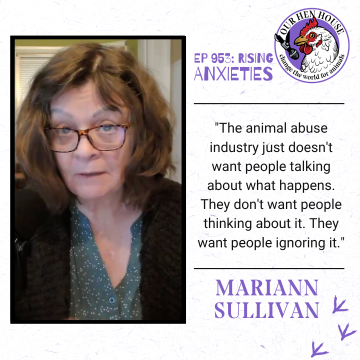 In this episode of Rising Anxieties, Mariann Sullivan tears through the week’s most revealing industry news — from egg producers finally grasping that animal advocates want them gone, to Oregon’s audacious PEACE Act inching toward the ballot, to the toxic gas hazards quietly killing dairy workers. She also covers the Cargill lockout rocking Colorado’s beef industry, the federal government’s creative reinterpretation of H-2A visa law to hand dairy farms a captive labor force, and a truly stunning Memorial Day message from the National Beef Association that somehow forgot what Memorial Day is actually for.
- PETA vs. Vital Farms: PETA bought stock and asked a pointed question at the shareholder meeting — Vital Farms declined to answer, proving the point better than any answer could have
- Oregon’s PEACE Act: The ballot measure to criminalize ranching, hunting, and fishing has enough signatures; even its own organizers aren’t betting on a win — they just want people talking
- Manure gas is killing workers: Cornell published a safety guide for toxic gases on dairy farms, because hydrogen sulfide and ammonia exposure is apparently still treated as a scheduling problem
- Cargill lockout in Colorado: 1,700+ workers locked out for weeks, with new allegations of antitrust collusion on labor rates — welcome to Big Meat
- H-2A visas for dairy: The Department of Homeland Security quietly opened the door for dairy farms to use guest worker visas, creating exactly the captive, rightless workforce the industry has always wanted
INTERVIEW TRANSCRIPT
Mariann Sullivan: Welcome to Rising Anxieties, where we talk about worry, worrying you, worrying me, worrying the industry. Like to focus on the industry, but don't always manage that. But we have a few things today. We'll get to that.
Uh, don't forget, we're a podcast. We're on YouTube. Subscribe, hit like where you listen. It really, really makes a difference.
Actually, subscribe and hit like even where you don't listen. That also really helps. And, uh, let's get into it. Our first story is from Watt Poultry, and the question they are asking, this is specifically by Meredith Dawson, a columnist of theirs: Will egg producers ever satisfy animal activist groups? Like, do they not know the answer to this question?
They will satisfy animal activist groups when they go out of business. Uh, like, it's like they keep pretending they don't know that that's the goal. It's like they're living like 30 years ago when all anybody d- focused on was humane reforms, and they didn't also add in that the humane reforms are only in the context of industries that should go out of business.
All right, PETA. They're focusing on PETA too, which makes completely clear that that's what they believe. "PETA's attack on Vital Farms makes one thing clear," she says. "The end goal isn't humane eggs. It's no eggs." Yes. Yeah. We've been making that clear for a long time now. They just can't... They, they can't believe it or they can't face it, or they think it's good to pretend we're deceiving.
I don't know. Uh, they're talking about the fact that PETA purchased stock in Vital Farms, which is one of these, quote-unquote, "humane producers," and submitted a question, um, for the shareholder meeting about whether they would stop marketing its eggs as humane and its hens as happy. Yes, happy. Uh, and, um, they didn't...
Vital Farms didn't bother addressing the question. I guess they don't have to. Um, and she points out that they are a 100% pasture-raised egg producer. And that is a standard that many argue, many argue exceeds cage-free. Well, yeah, I think most people would say that pasture raised exceeds cage-free. It's just not good enough.
So if pasture raised production, she says, is still not enough, well, it's not. It's apparent that the benchmark is not moving toward better welfare. No, that's not the benchmark. That's, that's an improvement. It's not the goal. It is moving toward no animal agriculture at all. Exactly. You get it. You get it.
Unfortunately, US egg producers have seen this scenario play out before. Yeah, we've been telling you this for years. Uh, when welfare advocates... Get this: welfare advocates pushed cage-free as the standard. Some producers invested in enriched colony housing as a middle ground. Well, they shouldn't have done that.
If the, if the groups were pushing cage-free, they should have gone for cage-free, not tried to find some compromise. But only to see the marketplace and activist groups move past it. Well, they didn't move past it. They were never there. Before those investments were ever paid off. Oh, now the cage-free transition tells the same frustrating story.
It must be so frustrating. Egg producers took on millions of dollars in debt to convert to cage-free housing to satisfy state mandates and customer commitments. Well, yeah, I mean, state mandates and customer commitments, we're not really talking about animal activist groups there, are we? They absorbed the same highly pathogenic avian influenza supply hits.
Yeah, it doesn't protect you from, from bird flu. Nobody ever said it did. As conventional producers... of course, all the egg producers got paid lots of money for all their dead birds. Um, and, and they're still being told that their birds aren't happy enough, even after all those birds died, like, in bird flu.
What is she talking about? Egg producers can't win a game where the rules keep changing. Thank you. Finally, you understand. You cannot win this game. It's not a game. It's serious. Vital Farms didn't engage PETA's question on June 10th, and that was probably the right call. It probably was. Probably was, because how are they gonna answer that? You know? PETA's trying to get them on record. They're not falling for that.
All right. Biting the hand that feeds you. Oregon, we're back to Oregon. They-- this is driving them insane. God, I love David Michaelson. Oregon considers ballot measure to criminalize ranching, hunting, fishing. This is from Fence Post by one Carrie Stadheim, and she gets a lot more right.
That, you know, I've been reporting on stories on this and, and they've all been confused. They all think it's all about hunting and fishing, and they only just kinda caught on that it's also about all livestock, raising and killing livestock. Like, that seems like a bigger issue. Um, those who are working to gain support for the measure, she says, have reportedly gained more than the 117,173 signatures needed to get it on the ballot this November.
Yes! But the state has until August 2nd, 2026 to certify the signatures. I'm sure, I'm sure there's a lot going on behind the scenes trying to get that-- trying to put the kibosh on that. Uh, the governor has voiced opposition. Well, of course, the governor has. I mean, like, I would like it if politicians were willing to come out in favor of banning all livestock production in their state, but that doesn't seem like it's gonna happen any...
We cannot rely on governors to, to take the lead here. Um, she-- and she's focusing on the hunting and fishing and, um, and it risks criminalizing common agricultural practices. Yes, it does. It does, Tina. All right. In addition to criminalizing the killing of animals for food, so this article does, uh, admit that, it would also make basic husbandry practices illegal.
So, I mean, once you've, you've criminalized killing them, like, unless you're really near... Well, I guess you could be shipping them to slaughterhouses in other states. They do ship animals really long distances to slaughter, but they also do all sorts of things that make raising them in the traditional, uh, ways difficult, like, uh, castration, docking, dehorning, artificial insemination, semen testing.
Uh, you know, you wouldn't wanna give up all of those practices 'cause that's really, you know, the name of the game. All right. This person from the Oregon Cattlemen's Association, Diana Wirth, she says that it's not surprising that Oregon is the target of this movement. Quote, "We..." This is, this is now what they're upset about. Just, just think about this. Quote, "We have a very fast and loose initiative process. The standard for qualifying for the ballot is extremely low, and the risks are incredibly high."
And she, she thinks there should be more signatures required, and the signatures should have to come from all different parts of the state. A lot of places do that. You know, because we really want to add to the unbelievable amount of overprotection that rural voters have. Um, and Oregon doesn't have that, um, so all of the votes could come from Portland.
Get it? It's so upsetting. They don't have to collect signatures in our rural communities. Uh, and so why are they so worried about this? All right. They, um, they are worried that it's gonna get on the ballot. Why is it so worrisome that it's gonna get on the ballot? Even the organizers say that they don't expect the, the measure to pass this year.
They've always said this. Listen to David Michaelson's, um, uh, from a couple of years ago, but they've been doing this for a couple years, for a few years, um, on, on the podcast. However, they are pushing to bring the progressive mentality... This is such a weird sentence. They are pushing to bring the progressive mentality in order to start the conversation to eventually gain sufficient support for the issue.
I don't know what that sentence exactly means, but I do know what they're trying to say. They're trying to say that according to the organizers, they don't expect it to just win. They, they wanna s- start people really thinking and talking about what it means to be slaughtering animals in their state and, and eating animals for-- Like, they wanna start a conversation.
That's what they're so worried about. They know it's not gonna pass. You know, like, even if it gets on the ballot, they don't think it's gonna pass. They just, they just don't want people talking about it. They don't want people thinking about it. They want people ignoring it. Um, they do claim to worry that it might pass.
Uh, this guy Dave Duquette says, "The act is called the PEACE Act, and the first couple of lines is about animal cruelty in the description. They will see that, and if they don't read into it what it actually means and what it is, I'm afraid they will just see that and vote for it." Well, I mean, you think the voters are even stupider than, than most of us do.
Like, seriously? And also, maybe people really are against animal cruelty. Maybe when you start talking about this in the context of animal cruelty, it matters. I don't know. So I guess they are worried that it will pass, but they wanna say... Because people are just really, really-- Our voters in Oregon are really, really stupid, and they don't bother reading things, they just vote for them because they're against animal cruelty. Well, there's something very interesting about that. All right, I'll stop talking about that, but it's so int- that's such an interesting article.
All right, from Hordes Dairyman, "Targeted Tips: New Manure Gas Guide Available." We talk a lot about them using manure gas as a fossil fuel, um, on factory farms, but Cornell University just put out this, uh, brochure, uh, or guide, Manure Gas Safety Technical Guide, which is addressing the other problem with all the gas from manure, is that it kills workers pretty damn regularly.
It's unbelievably dangerous, and so they put out a guide to tell these, like, yahoo farmers, these dairy farmers, what they should be doing to, uh, to deal with the toxic and combustible gases that pose threats on farm, including hydrogen sulfide, ammonia, nitrogen dioxide, carbon monoxide, and methane. It's no wonder people die.
I mean, they, people fall into these pits and die, like, all the time. Um, so they put out these guidances, like, uh, short-term exposure limits, 15-minute average time spent during a workday. Seems like it should be zero, you know? Ceiling exposure limits, peak exposure limits, available for certain substances allow for workers to be exposed for a short duration to higher than ceiling exposure only if they have no exposure during the rest of the workday.
Already, doesn't this sound bad? Like, have you, have you been in the manure pit yet and breathed in hydrogen sulfide? Then you, you better not breathe in anymore. Oh, if you haven't, you, you haven't? Y- you, you weren't in there today? Oh yeah, then you can go in.
Oy. Uh, all right. I just, you know, I haven't talked about this situation, and it's important, and it's not directly about animals, but it's important to keep an eye on, and it's this labor dispute that's going on in Colorado against Cargill, and this is really heating up, and so we should be keeping an eye on it.
This is from Ag Daily. New allegations against Cargill as Colorado beef plant lockout enters week four. So the workers, um, were organizing, um, and, uh, they hadn't yet gone on strike, and, and instead, you know, the, uh, the company took the initiative and, and did a lockout and closed the plant. You know, they're trying to kill any kind of labor progress, obviously.
I mean, almost all businesses do. Quote, "More than three weeks into a labor dispute at Cargill's Fort Morgan, Colorado beef, uh, processing f-facility." Colorada. Colorado. Colorado. Everyb- we all pronounce that wrong except unless you live there. Um, "Teamsters Local 455 has filed unfair labor practice charges against the company alleging Cargill unlawfully cut off workers' access to pay and benefits during an ongoing lockout affecting more than 1,700 employees."
There are laws about how you can't just close down your business to, um, to destroy unions, but obviously it's complicated, so there's a lawsuit going on. And this is one of Colorado's, um, largest beef processing plants with a capacity of 4,700 cattle per day. Okay, think about that. And they have not been "harvesting cattle" since April 23rd.
My favorite word, harvesting. They just steal the language every day. Um, all right, so it's a whole cartel that's been sued, Cargill, Tyson, a couple of other companies, um, that were sued for violating antitrust laws for price fixing, and now according to the director of the Teamsters Food Processing division, they're also conspiring to fix labor rates, and that's what the current lawsuit is about.
Uh, quote, "These large meat packers are monopolies that need to be broken up if they can't recommit to the communities that help make them successful." I would put that a little differently. They need to be put out of business, but, you know, my perspective is a little different.
All right. Also on labor and also from Ag Daily, new H-2A guidance could ease dairy labor crunch. This I've been talking about. I saw this coming. I knew it was gonna happen. I'm not saying I was the only one, but I did. I saw it coming. Uh, the dairy industry wants to use H-2A visas. H-2A visas are for temporary agricultural workers, like the theory behind them is that during the harvest you need really a lot of extra workers, so at that point you can bring in, um, these workers from, generally from Mexico and Central America.
Um, and dairy has been very frustrated by this because they don't have like this sudden point where they need more workers, so they don't have any excuse to use this law. But nowadays you don't need an excuse to use the law because you've got the Department of Homeland Security on your side.
For years, dairy producers have argued that the H-2A guest worker program wasn't built to fit the realities of modern dairy farming. No, it wasn't. Nobody ever said it was. While crops in many livestock sectors can demonstrate seasonal labor needs more easily. Yeah, 'cause they have them. Dairies have long faced a challenge.
Cows need to be milked every day of the year. Well, that's a, that's a statement that depends on a lot of, uh, things, doesn't it? That may be changing. On June 17th, the U.S. Department of Homeland Security issued a policy memorandum clarifying that dairy operations may qualify for the H-2A Temporary Agricultural Worker Program when they can demonstrate a temporary or seasonal labor need under existing law.
The guidance took effect immediately. Now, I've read the whole article, and nowhere in this article does it explain how those dairy farms can demonstrate that temporary, need for temporary or seasonal labor. But, you know, the fix is in. Let's face it. Uh, according to the USDA, for many dairy farmers, labor availability remains a significant challenge.
Yes, indeed it does 'cause they, the working conditions are horrific and the pay is crappy. Uh, actually, you could put that the other way. The working conditions are crappy, literally, and the, the pay is horrific. Um, the clarification provides additional certainty regarding the circumstances under which dairy operations may access the H-2AV program while maintaining existing protections for U.S. Workers and ensuring compliance with applicable federal law Um, Zippy Duvall, I swear to God that's his name, who's the president of the American Farm Bureau Federation, called the clarification an important step while noting that broader reforms are still needed. This is an important step, however, it does not fully solve the problem.
This, this is what Zippy had to say. Legislation is needed to achieve durable and lasting reform that will provide certainty and fairness to both farmers and their employees as they contribute to a strong and healthy food supply. All right. This is this is just a fix, but, you know, the, it's really not in compliance with the law from what I can tell, and they wanna change the law.
And what they wanna do, it's so clear that what they wanna do is they, they don't want people with any kind of power to be working on factory farms. Uh, they want an, an underclass, an underclass that has no rights. An undercla- I mean, even illegal immigrants, they don't have rights, but they have flexibility.
I mean, at least until the latest crackdown and, you know, they're trying to eliminate any of that flexibility. They move, can move from place to place. They can go back home. They, they, they have some kind of options. These workers have no options. They are basically indentured servants and, uh, they, they... It isn't dairy farmers who are hiring them.
It's contractors who move them from farm to farm, and that's what they want because, I mean, in my opinion, our new tech overlords and the rest of the whole bunch of them, that's what they want in general. They want an underclass and, uh, they would like as many as possible of us to be in that underclass. That's also quite clear Uh, and I think it's a first step.
All right. My last, um... This, this article is a little old, I apologize, but it made me so mad when I saw it that I thought I'd talk about it just a little bit. This is from Drovers. "The Memorial Day Cookout: Honoring the Heritage of National Beef Month."
Now, for those of you who are not in the US, I know most of you are, but some of you aren't, Memorial Day is a, it's kind of a, it's a very bifurcated holiday. It is, um, the commencement of summer here in the Northern Hemisphere and, uh, on May 30th and, and, uh, you know, generally a celebratory, uh, barbecues, which is how we celebrate, uh, all sorts of, you know, fun summery activities.
But it's also - It started, it was actually called Decoration Day. I remember when people used to call it... I think the name had changed by the time I was a kid, but, but, uh, I remember most adults called it Decoration Day, and it was a day where you were supposed to decorate the graves of the war dead. And, uh, it started after the Civil War, which was, you know, extremely, extremely traumatic experience, as any civil war is.
And, and it became a day where people would decorate the graves of, of those who had died, uh, in the Civil War, including, my understanding is that it included, uh, decorating the graves of, of the soldiers buried near where you were, well, from both sides, because, you know, this idea. It was k- some kind of mourning plus reconciliation.
Um, and there was a particularly moving, uh, episode. I don't know whether it was the founding of it or, uh, the first one or just one of the many moving, uh, events that happened in, um, South Carolina. in Charleston, and there was a huge... Well, a very big and very moving ceremony by freed enslaved people who reburied and honored Union soldiers, reburied from mass graves and, and buried them individually and honored the Union soldiers who had died. It's a, so it's a very, it's just a very skitzy, um, holiday.
It's both celebratory, but it's got a very deep and solemn meaning. It's not like a, it, it's not like a war victory kind of celebration. It's, it's a mourning, it's a mourning day, and most everybody knows that. It's not a secret, except for the National Beef, um, National Beef Association, is that what it's called?
Uh, it's just like, they wrap themselves in the flag all the time, and yet this is what they say about, uh, Memorial Day: "Fire up the grill this Memorial Day weekend to celebrate the unofficial kickoff to summer and the culmination of National Beef Month." That's what it is to them. And, uh, they don't say one word in this article about what Memorial Day is really about.
"Today, beef remains the undisputed anchor of Memorial Day barbecues and family dinners across the country. Uh, and, and, uh, as we enter the 2026 summer grilling season, it is the perfect time to honor the producers behind the US beef industry." That's not who we're supposed to be honoring on Memorial Day.
Uh, celebrating this month is about more than just a meal. Oh, maybe here now. It's about acknowledging the year-round dedication required to raise a high-quality protein product. Unbelievable. Unbelievable. I am so disgusted. Ah. Sorry about my voice. I know it, it's a little off, but I think that's it for...
That's what I've got for today. And, um, I will see you later in the week on Thursday for The Hen Report, and on Friday for The Interview, which is a very, like a very exciting interview this week. So it's an animal law podcast interview, but even those who don't usually listen, I think will be wanting to listen to this 'cause it's all about, um, rescue.
So, thanks for being here on Rising Anxieties, and don't forget to subscribe and join us on the other podcasts this week.
_____________________________________________

Thank you for listening to the Our Hen House podcast! If you enjoy our podcasts, believe in our mission to effectively mainstream the movement to end the exploitation of animals, find community and solace in our shows and resources, and would like to show your support for vegan indie media, please make a donation today.
Contributions of any amount will go towards our fundraising goal and are hugely appreciated. Our Hen House is a 501(c)(3) nonprofit organization, so it’s tax-deductible. Thank you for helping us create quality content!
Subscribe to our show on Apple Podcasts, YouTube, or your favorite podcatcher, and don’t forget to leave a 5-star review!
Check out Our Hen House’s other podcasts: The Animal Law Podcast, The Teaching Jasmin How to Cook Vegan Podcast, and the Antiracism in Animal Advocacy Audio Series.
Follow us on social media! You can find Our Hen House on LinkedIn, Facebook, Instagram, TikTok, Threads, or Bluesky.
The Our Hen House theme song is written and performed by Michael Harren.