Apple Podcasts
 RSS
 Amazon Music
 Spotify
 YouTube
 PocketCasts
 CastBox
 Player.fm
 TuneIn
 Audible
 App not listed? Try this RSS link
 The meat industry is sweating, and honestly, it’s about time. This week we cover a staggering array of stories showing just how rattled animal agriculture has become — from a desperate columnist panicking over $400 million in animal rights funding, to the USDA casually funneling $5.5 billion in taxpayer money to prop up an industry that apparently can’t survive on its own merits. Meanwhile, 51 Ridglan Farms rescuers face prosecution for removing beagles from a now-shuttered cruel facility, bird flu triples across Washington dairy herds with “strict biosecurity measures” that are clearly not working, a former vegan politician throws animals under a taco truck, and the UK government actually says the words “to prevent further suffering” out loud. The anxieties aren’t just rising — they’re doing a victory lap.
- Ridglan Farms prosecutions: A court commissioner found probable cause to move forward with charges against 51 defendants involved in the rescue of 22 beagles from the now-closed Ridglan Farms breeding facility in Dane County, Wisconsin — frustrating, but very much part of the theory of change.
- The meat industry’s Moskovitz meltdown: A Meatingplace columnist is sounding the alarm that effective altruism-funded AI executives could funnel up to $30 billion a year into anti-factory farming campaigns — and his big counterargument is that rural America should use data centers as leverage. Yes, really.
- USDA’s $5.5 billion beef bailout: The SPUR initiative is pouring $500 million in direct payments and $5 billion in guaranteed loans into beef slaughter facilities — because nothing says “free market capitalism” like socialism for slaughterhouses.
- Bird flu surges in dairy: Washington’s infected dairy herds tripled to 27 in a single week, spreading to a second county and infecting a dairy worker, despite “strict biosecurity measures” that seem about as effective as a screen door on a submarine.
- UK to phase out CO2 stunning of pigs: The UK government announced plans to end CO2 stunning of pigs — calling them “highly sentient and intelligent animals” — in a rare instance of a government acknowledging that animals can suffer and then actually doing something about it.
INTERVIEW TRANSCRIPT
Mariann Sullivan: Welcome to Rising Anxieties. Wow. Anxieties are seriously rising out there, including, definitely including the meat industry's anxieties.
I have felt for a long time that, you know, we weren't really getting as good stuff as we used to get, like from the industry, indicating that they really feel like they're worried about us and, and animal activism and all of their problems in general, but, you know, that ends today, at least for the moment.
All right, first of all, I mean, the story obviously we have to talk about is Ridglan, and this isn't, you know... I don't know whether this is positive or not. What do, what do you think? You probably already know what's going on. This is about the arrests, um, and, uh, and the prosecutions of 51 defendants in Dane County, Wisconsin, for the, the rescue at, uh, Ridglan Farms, the now closed down because of animal cruelty beagle breeding facility.
And, um, this is a, this is a short article from Action News 2 in Wisconsin, and, and, uh, it starts out saying, "A court commissioner found probable cause Wednesday in the case against 51 people charged in connection with the March removal of beagles from Ridglan Farms, allowing the case to move forward." I, I like the fact that they said removal and not theft.
They could have said theft. Uh, they could say whatever they want. Of course, rescue would be better, but, but removal is pretty neutral. Um, officers described what they saw when they arrived at the facility during a preliminary hearing in Dane County Court. I mean, this is not a huge, big deal. This is very preliminary.
Uh, they could have thrown out the charges against some of these defendants, but it's not really that shocking that they didn't. So no need to panic yet. It is annoying that these people have to, all f- whom are from all over the place, have to, have to show up for this, um, for these hearings and, and the ensuing trial, and it's really annoying that we live with the fear that they actually could get convicted and sent to prison.
Um, this is, this had to do with the rescue of 22 beagles that day, and, and they said they, quote, they said they were saving the dogs from animal cruelty, which obviously they were telling the truth. And the police officers testified, and the defense attorneys questioned whether the prosecutors had enough evidence to connect all 51 defendants, who- some of whom, whose behavior was extremely tangential.
They did not enter into the facility. They just took the dogs or whatever. Uh, and so the court found probable cause, and it will now move forward. Is this good? Is this bad? This is the theory of change. This isn't like an accident. The theory of change is to get into court and get attention, and they've already gotten loads of attention, um, on Ridglan and hopefully, and, you know, loads of, um, support, including from the local congressman, Mark Pocan.
And, um, and of course, Ridglan is now- Closed. So not to panic, but, you know, I, it's, it's... I just hate to see these people prosecuted. But I, even though if that is the theory of change, I really hate it. Uh, fingers crossed on this one, really big time. All right. So that is a sign of rising anxieties that, uh, you know, there are these arrests and prosecutions, but I'm talking much bigger articles than that.
Not bigger situations, but bigger articles that show bigger anxieties anyway. Uh, from Jack Hubbard on Meatingplace, and Jack Hubbard is definitely in the business of keeping an eye on, on animal activism and, uh, talking about what's going on and showing how it's, uh, nonsense from his point of view. So he's really worried.
I have never seen this kind-- This, it's kind of a pathetic article. He's talking about, I'll, I'll quote here, "For the past 10 years, the animal rights movement has been flush with cash from one major donor, California billionaire Dustin Moskovitz, a co-founder of Facebook and founder of the company Asana."
And as, as you know, and I know 'cause we're familiar with this fact, he has so far given more than $400 million to animal rights groups over the past decade, according to records by his Open Philanthropy Network, now rebranded as Coefficient Giving. And of course, it's Lewis Bollard who is, is in charge of the animal, uh, uh, anim- the animal portion of that fund.
Um, but he pretty much says this is only the beginning, and they're now starting to really feature effective altruism and try to come out against it 'cause I don't know whether they don't want it to be altruism or they don't want it to be effective, but they don't like it.
They don't like it at all. What fuels Moskovitz is a philosophy called effective altruism, which believes, among other things, that modern large-scale livestock farming, that's what they call factory farming, needs to be eliminated. Uh, yeah, well, they do-- they definitely don't like that. According to the man, I'm, I'm quoting again, who helps direct Moskovitz's giving to animal rights groups, people in the AI industry have already put $40 million into anti-farming groups.
They're not anti-farming groups. Like, nobody's against farming. We all like to eat. Uh, but I digress. Into anti-farming groups already this year. That's $40 million so far this year, and he thinks that $40 million could be the, quote, "tip of the iceberg," and, um, also says that he expects some observers, um, expect wealthy AI executives to send up, to send up to $30 billion a year to whatever causes they want, and opposing livestock farming is on the list.
I mean, we've known about this for a while, that all this AI funding and effective altruism funding was w- had been coming into the movement, but that it was gonna grow when everybody goes public. But I don't know, it sounds like he just found out, and, uh, he's pretty upset about it. The irony here, he says, is that the AI industry is poised to attack the very thing whose support it needs, rural America.
This is the best argument he could come up with to kind of assuage his fears, I think. All right. AI needs data centers to operate, and it needs a lot of them, so he's pitting the whole data center against anti-factory farming. But, uh, is all of rural America really pro-factory farming? You know, I know the big guys are, but, like, when you're talking about the voters who are really upset by the a- by the data centers, the ones who actually live in rural America, not the ones who own the factory farms, uh, I, I'm not sure that they're not against both.
I mean, factory farms are... Which would you rather have move in next door to your, to your house, uh, an AI data center or a factory farm? Neither is a really, really good choice. But he thinks this is the, this, this is the key issue. This is how they're gonna get them. Quote, "That means rural America will have a great deal of leverage over the AI industry moving forward.
It should act wisely, but it shouldn't be afraid to use its leverage." I mean, by it, it means rural America, which is not exactly one entity. But anyway, its leverage against those whose vision for the future is to radically change food production and put farmers and ranchers out of business. No, farmers are staying in business.
Ranchers, well, you know, I'm not sure that I could say that rural America is against ranchers, but they're against feedlots. Uh, and that's kind of a key factor. When you, if you have a ranch, you h- then you send your cows, generally, unless you're, like, some fancy pants outfit, you send them to a feedlot. So, uh, I bet you wouldn't want a feedlot to move in next door to you, too.
I think this is a whole lot more complicated than he's, he's, uh... This is so much fun, having them be so worried. Like I said, it's been a long time since they were that worried. Uh, but, you know, I mean, they still have the government on their side.
Also from Meatingplace, Brashears, Strengthening America's Beef Supply: How USDA Is Responding to a New Era of Market Challenges. This is by Mindy Brashears, who works with USDA. Just listen to that title again. How USDA Is Responding to a New Era of Market Challenges. Is our government really supposed to be responding to market challenges on the behalf of one player in the market? Is-- Like, if anything has ever been clearer that, uh, the, the idea that they're in favor of capitalism is nonsensical.
They're in favor of socialism, but socialism for themselves. Um, when I served as undersecretary during the height of COVID-19, I witnessed firsthand how vulnerable our food system can be when processing capacity becomes constrained. Uh, I witnessed how, how, um, vulnerable our food system can be when, when, uh, we're dependent on killing animals, uh, otherwise known as processing.
Anyway, um, it, th- the whole thing, all the disruptions in labor and supply chains threatened our ability to keep plants open. Plants are w- of course, what they call s-slaughterhouses. I, I still have to laugh every time I s- I hear that. Um, it's just so odd, you know? I know the derivation of the two terms is different, but it's just so odd.
All right. "I said then," says Mindy, "and I continue to say now, that food security is national security." Well, yeah, I think everybody would agree with that. It's really not, it's really not very controversial. Uh, but, um, but, you know, she's talking about a particular kind of food. While the-- She goes on to say, "While the pandemic strained processing capacity due to labor shortages, we are now confronting a cattle supply challenge that directly impacts the long-term health of the beef industry."
Okay, uh, who cares? I, I actually think-- I'm not sure she still works for the USDA. I guess she doesn't, but she used to. But she's talking about what the USDA should be paying attention to. Um, all right. A shrinking national... Like, who cares if there's few-- less beef? Uh, the pork industry will be pleased, uh, but so will I.
Uh, a shrinking national herd combined with growing global and domestic demand. Oh, so they're selling more, so we should s- use our tax money to support them in creating more because they're, they're, they, they're profitable? Puts increasing pressure on producers and processors alike. Who cares? Like, the government should not be in the business of making the beef industry bigger.
At USDA, we recognize... Oh, I guess she does still work there. It doesn't say here. It doesn't say. Uh, in my defense, it doesn't say Um, I'm looking. No, it really doesn't say. But I guess she still works there, uh, because she said we recognize. "At USDA, we recognize what is at stake. The American rancher plays a foundational role in our nation's security, economic strength, and rural prosperity."
What the actual fuck?
I mean, they're just choosing an ind- one industry over other ind- industries and spending our tax money to support them. All right, so these are the two programs that they've launched under the SPUR initiative. SPUR stands for Supporting Processors for US Ranchers. One is the SPUR direct payment program. There's $500 million for that, and that provides temporary financial support to small and mid-sized independent beef slaughter facilities, your tax money at work.
And two is the SPUR guaranteed loan program, guaranteed loans. Guaranteed loans are not loans. Um, $5 billion. $5 billion. This program provides a 90% loan guarantee to commercial lenders, empowering them to finance expansion and modernization projects for eligible borrowers, and basically provides for expansion of processing capacity.
USDA is building a more competitive, more flexible, and more resilient beef supply chain for the future. Uh, like, this is not what the government is supposed to do. We do not need a beef industry. If the beef industry can't produce enough cows to sell to people, or if people aren't buying enough beef to support the b- that's the beef industry's problem.
Like, w- we don't... Sorry. It's just insane, you know? Alright. Good news. Unfortunately not from the United States, but you know any news, any good news is welcome. UK government announces planned end of CO2 stunning for pigs. Now, all right, they're not gonna stop slaughtering pigs, I know. It's just a, it, it's just a step in the right direction.
But, um, it's kind of amazing. An eight-week consultation on phasing out CO2 stunning in the UK began earlier this month. Uh, this is by Liam Pritchett. And, um, the reason that the government has stated that it wants to end the CO2 stunning of pigs is, quote, "To prevent further suffering." The government, the actual, an actual government said that.
Um, it's a two to three-year... they're-- I mean, it's not set yet. The plan is to provide for a two to three-year transition, um, towards, quote, "more humane," unquote, methods. I would put that less inhumane, but, you know, whatever. It doesn't say exactly what methods they're planning on using. There is the use of an inert gases, which is not as, like, horrifying as being suffocated by CO2.
I'm not sure whether-- Uh, there's also electrical stunning, and now I've exhausted my knowledge of, of pig slaughter, which, you know, we have to know a little, but we don't have to know a lot. The announcement described pigs as, quote, "highly sentient and intelligent animals," unquote, capable of experiencing pain and fear.
Uh, like, so maybe we should stop eating them. There's an idea, but, you know, I don't, I don't wanna diminish good news. It is good news. You know, all of our good news is very, is, is, is in the context of the fact that everything's bad, but, you know, gotta see it when it's there. All right. Something else for the industry to be alarmed about, though they don't seem really that alarmed.
Remember, you know, talking about, um, bird flu in dairy farms? I feel like I haven't been coming up with a lot of articles on that. Well, it's back. Washington dairy bird flu cases triple to 27 in just a week's time. In case you're thinking that means 27 cows, uh, got sick, no. There are 27 herds, uh, and the virus has reached a second county and a dairy worker testing positive for H5N1.
He is not seriously ill, I will add. Um, there are also other, uh, states where this is grow- bird flu in dairy cows. They probably shouldn't have called it bird flu. Texas reported four affected dairy herds and Kansas reported one, so, you know, it seems like it's on, on the upswing again. And, um, state offi- you'll be glad to hear this.
State officials said strict biosecurity measures have been implemented. Yeah, I bet. So why they're, they're, they don't seem to be working. Uh, either these dairy farms are sloppy, which seems entirely possible, or no matter how strict your biosecurity measures are, they don't work. So apparently most infected cattle recover with supportive care.
This is not like, um, when bird flu affects, uh, chickens, in which case they just kill them all. Um, but full herd recovery typically takes four to six weeks. It spreads between dairy cattle through infected animals, contaminated milk, equipment, vehicles, clothing, footwear, and people moving between farms. So, you know, it doesn't sound like they're being that careful.
It-- This is, this-- Apparently, this strain is not from wild birds, which is always, you know, kind of a relief 'cause you can imagine them going out and killing a lot of birds. But, uh, you know, there's probably a lot more going on with bird flu than is being reported and, but, uh, this is pretty, this is a pretty big deal. Twenty-seven herds in Washington which did not previously have it is pretty disastrous.
Uh, all right. This is a huge issue for, um, the industry. Not as big as Dustin Moskovitz, I have to say, but a huge issue nonetheless. Um, immigration reform. And I've talked about this before. I don't have to talk about it too much.
But the, it's, this is kind of depressing. I'm sorry. But they're desperate, and they, they have now put together a piece of, um, legislation. It's bipartisan. This is not a, a Republican issue. It's more Republican than Democrat, but it's not. And there's a lot of Republican opposition because it involves letting in more immigrants.
But fortunately for, for people who hate immigrants, it doesn't give them any rights. Um, the Securing Agriculture's Workforce Act, uh, has, it has been, um, I think it's been introduced and, and, uh, uh, as, uh, some bozo says, uh, unfortunately... this guy Brockum. Oh, no, this woman Brockum of, um, NMPF, the National Milk Producers Federation says, "Unfortunately, in the ag labor conversations, the labor piece is driven by who has jurisdiction over Congress on that.
So they can't put the-- Because it's an immigration bill, they can't put it through the Ag Committee, in which case they could probably get it through. They have to go to the, um, to the, uh, Judiciary Committee." And, uh, but, you know, they're working behind the scenes. The machinations are, uh, are, are well at work, as, as she says.
But your comments were so powerful, talking to industry players, that Chairman Thompson just couldn't stand by. He knew that even though he couldn't include anything about ag labor reform in a Farm Bill, which, you know, would be, uh, he would-- I'm sure he would do in an instant. He needed to do something if he was supposed to be one of this country's agricultural leaders.
Great. Um, so they have managed to introduce this legislation. It is bipartisan. It's probably not gonna pass anytime soon because, you know, everything in, in, um, Washington is a total mess. Uh, and, uh, like the significant opposition is coming from the, quote-unquote, "far right." You know, sometimes these people are associated with, uh, certain right-wing causes, and sometimes they're not.
And this is, um, about H1... H2A visas, which are the ones where, uh, they bring in farm workers temporarily so that they can, um, not give them any rights to actually move on to, uh, becoming citizens in any way. And they're not really temporary 'cause people get shipped around from farm to farm or they don't have to be.
But dairy has not been eligible for them because dairy is obviously year-round work. There's nothing seasonal about dairy. And dairy wants in on this program because, uh, as, as i- in a, in a different article from the same thing, as this, this, uh, woman who runs Land O'Lakes, uh, said, like, uh, Americans won't, won't, won't do this work.
And it's not for lack of trying to recruit US workers. Quote, "It's just very difficult work, and in general, that's been very difficult to attract American citizens to." Uh, i.e., it doesn't pay enough, and you have to find people who are desperate in order to do it.
Now, to be clear I don't want to sound like I think we shouldn't allow immigration or immigration of farm workers, but they should have the same rights as any other immigrants, which, you know, at the moment is absolutely none, I know. But, uh, but what, uh, i- i- like if people are desperate in other countries, I would love to see support, uh, uh, i- to those countries, but I'm also happy to see, um, immigration.
But when immigration is used, as it is here, to give special rules to those immigrants so that they can be far more exploited and, uh, and, and terrorized because they're illegal, so like that means that we have an unsustainable industry. We have an industry that has jobs that are too horrible to be done by anybody but exploited people, and that is wrong.
I hope I explained that. You know what I mean. I know you know what I mean. Um All right. Manny Rootenel, really disappointing. This is a politician who I have s- I have supported in the past. Manny Rootenel, formerly a vegan animal activist, shows he's moved on with taco truck meet and greet. It's by Jesse Paul, and it's in The Colorado Sun.
He is, um... He's running for Congress in the 8th Congressional District in Colorado, and, um, he's currently in the state legislature in Colorado. And he has been dogged by Republicans over his past criticism of animal agriculture, and he was vegan, and this is, of course, why I supported him. And now he's eating, um, beef off of taco trucks, and he's not just doing that.
Um, like, why is this a big st- You know, it's such a huge story whether somebody's vegan. If he was gluten-free, nobody would care. Um, for Rootenel, it was a chance to prove that he does, in fact, eat meat after many years as an outspoken vegan animal activist, and he said how delicious it was.
And, um, his pa- he's brushed off criticism about his past statements as an animal activist. He once said animal agriculture is a horrific exploitative industry, uh, and that the globe must dramatically shift away from animal products and towards fruits, vegetables, legumes, whole nuts, whole grains and nuts.
Yeah. And but he since deleted Reddit posts that voiced support for a movement that aims to put animals on the same legal footing as humans. I really doubt that. Did he wanna give them the right to vote? Um, and in turn prohibit their slaughter for food and other uses. He now eats meat and says his past statements were the views of someone less informed.
All right. Do you have to throw people-- throw us under the bus? I've grown a lot, and I'm glad that I have. All right, I'm done. I'm done. I'm not gonna read you the rest of it. Ugh, I've grown a lot. It's just depressing, you know? All right, there's this, there's this pretty long article on WFMD, "CodePink Leader Adds Muscle to Well-Funded Fight to Ban Restaurant Delicacy."
This is mostly interesting becau- this is a pretty extensive... Um, uh, it's a Fox News outlet. A pretty extensive article about the campaign in DC, um, to ban foie gras, which is by a, a local grassroots, um, group, which we had on the, on the podcast, who, you know, have never denied the fact that it's also supported heavily by Pro Animal Future.
Um, but, uh, they like to-- and that, that-- they act, like to act like that was kind of a secret, but it's not. It's in public financial filings, reveal a far more heavily funded operation. And they, you know, they're spending a lot of money, apparently, according to this, which I see no reason why it should be false, 'cause it costs a lot of money to run a political campaign.
Like, what a shocker. A half a million dollars. I mean, like, what do they think? We just, like, go out in the street and wave signs and yell? Uh, no. Um, so they, they're very critical, of course, of Pro Animal Future, which says its local ballot efforts are part of a broader push to change public attitudes toward common agricultural practices.
Well, how dare they? How dare they? And they, um, Pro Animal Future alleges that birds are, quote, "force-fed." I mean, alleges? Like, the birds are force-fed. That's how you produce foie gras. Um, then there's a, the, it's a really long article. They talk about, like, the language of the, the, whether the language of the, um, initiative is, is too broad and, and, uh, whatever.
But, but they're frightened, you know? They're see-- Like, there's money, and they're seeing that we're getting somewhere, and they see it as, quote, "part of a broader effort to restrict what Americans can eat." Quote, "If they ban foie gras here, they'll eventually ban meat here, and they'll bring that to the rest of the country."
They can't, like, argue about it on its own merits because, you know, people think it's gross. Uh, they have to, like-- They have to act as if everyone's gonna have to be vegan. And even though that would make everybody really happy, people don't know that. And so, uh, that's why, that's why they always, uh, act like everything, every possible small reform is going to lead to you'll never be able to eat meat again. It's getting so old, guys.
Um, all right. I'm just gonna, uh, mention one other, one other article that was sent to me, and it's a very long article. It's very interesting. Um, this was sent to me by Goose Rodriguez, "The Bacon Wars: Pig Farmers Battle Tech Barons Over Animal Welfare." This is from RealClearInvestigations, which is apparently a right-wing, um, site.
I'm not familiar with it. And it starts off saying, "It was a summer of surprises for Iowa pig farmer Rob Brenneman." And they're talking about the campaign. They-- you know, mostly talking about Prop 12 again and the, um, Save Our Bacon Act. But they're also talking about, like, how powerful the anti, uh, the, the, the animal movement, not the vegan movement, not a, not the animal rights movement so much, but the, the anti-factory farming movement, which, you know, whether you think of them as two pieces of the same movement or two related but separate movements, really doesn't matter.
And the American Meat Producers Association, this is really-- this is a very informative argument about what's going on in the movement, so I highly recommend that, that you read it, uh, 'cause they're really worried. All right, this American Meat Producers Association is, um, i-is the, is the group that, you know, we've talked about before, that i-is basically supported and put together by, uh, I don't wanna say who it is 'cause, 'cause it doesn't say here and, and... But, you know, like, the big anti-factory farming groups in, um, in the movement. And, uh, and but also bringing in farmers, farmers who are raising animals in more humane-- less inhumane conditions, shall we, shall we say. That's what I prefer to say.
Um, and topping off the surprises, Brenneman, this farmer, learned that major funding for these multimillion-dollar ad campaigns about, uh, farm policy, um, a-a-against, um, certain political candidates regarding farm policy came not from competing agricultural interests, but faraway Californians who struck it rich in tech.
Sounds like they live in, uh, Oz or something. Faraway Californians. Like, they have farms in California. They have a lot of farms in California. "It's all a lie," Bredeman said. And, uh, the-- On one level, it says, "Bredeman and his porcine brethren..." His, his brethren aren't porcine. The pigs are porcine. "... are pitted in a traditional clash over states' rights, specifically California's Prop 12."
It is not a traditional clash over states' rights. It's an attempt to completely undermine states' rights in a way that has never been done before. But, um, but in a larger sense, the battle reflects the changing landscape of American politics and society. Don't you think they sound nervous? A newly minted t- as newly minted tech barons use their vast wealth to try and control their fellow citizens' lifestyles and choices.
So interesting that they are trying to get on the side of the everyday person. It's the same as that Jack Hubbard article I was talking about before, like, like, uh, getting rural America on their side because of the data centers. Just because some of these, um, AI folks, uh, who have made a lot of money are into EA, effective altruism, um they're acting like it's billionaires trying to force you, uh, to eat what they want you to eat.
The sides here are shifting and, you know, uh, I'm not really crazy about the fact that a lot-- about that we have so many billionaires, but if we do have them, I'm really glad that some of them anyway are on the side of the animals. It's so cool. Like, all of a sudden, we're the ones with the money. Of course, the d- the industry does have a lot of money.
All right, I'll go on. I'll just give you another quote. This is a long article. I recommend you read it, but I'm not gonna go through the whole thing. "They call it effective altruism. The expansive concept is that whatever will benefit th-the most people over time, even decades or centuries down the road, is the best policy to pursue."
Well, that doesn't sound that bad, and, you know, the whole question of, uh, future harms is, is, is very debated within effective altruism. Uh, but basically saying that what, uh, they-- the concept is whatever will benefit the most people is what we should do. That sounds kind of like a good idea. "While the values of Silicon Valley billionaires may differ from those of many everyday Americans, the tech titans have pledged to use huge chunks of the large private fortunes in history, the largest ch- private fortunes in history, to make their vision of a better world reality.
Part of that vision for many involves the treatment of farm animals, what they describe as, quote, 'farm animal welfare.'" Like how else would you describe it? "And the movement toward a plant-based diet for all." Wow. Money really talks, doesn't it? It's raising a lot of-- rising, raising a lot of people's anxieties. Such an interesting week.
We've got money, folks. Well, not we, but, you know, some people in the movement have money. Uh, so I guess that's it for this week. Uh, you know, these are really interesting articles, and there's a lot of interesting stuff going on. I guess I've said that. All right. Thanks for being here. We really appreciate it, and thanks for tuning in.
Don't forget to subscribe, like, and comment on your favorite podcatcher on YouTube, and tune into our other podcasts, The Hen Report and the Our Hen House Interview, and it would be a great i- We don't get any of this tech money. I just want to make that clear. They, they're not into Our Hen House. What can I say?
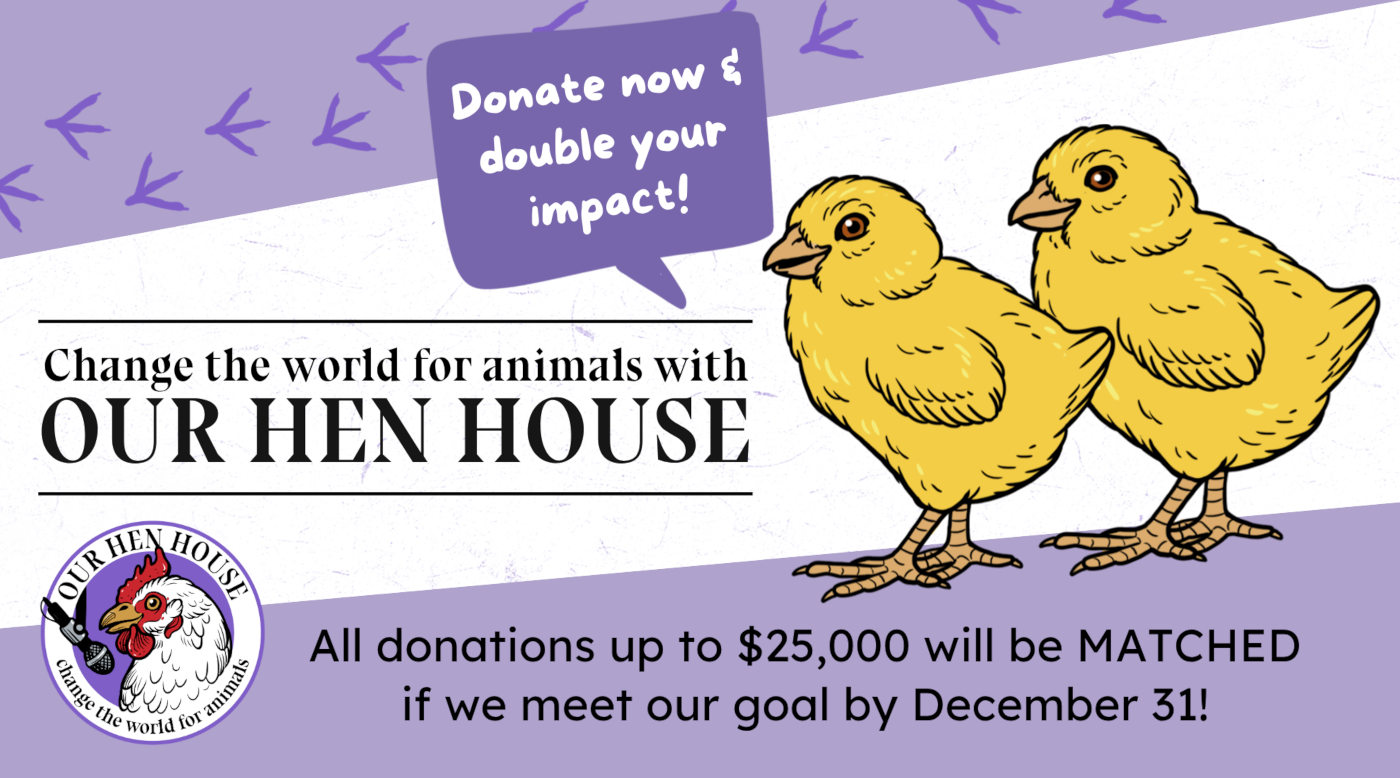
Um, but it, so if you can, please, uh, remember to donate and become a flock member at ourhenhouse.org/support. And this is really is crunch time for us. This is when we raise the vast amount of, um, the vast percentage of the money that we spend all year. So every donation up to 25,000 will be doubled by our barnyard benefactors, but only if we reach that total of 25,000.
Uh, and so any amount counts toward that, any amount you can afford, and I know it's tough times, so, uh, we, we know that's true. But if, if you can manage it, we would really appreciate it, and I will see you soon.
_____________________________________________

Thank you for listening to the Our Hen House podcast! If you enjoy our podcasts, believe in our mission to effectively mainstream the movement to end the exploitation of animals, find community and solace in our shows and resources, and would like to show your support for vegan indie media, please make a donation today.
All donations made before December 31 will be DOUBLED, up to $25,000 if we reach our goal. Contributions of any amount will go towards our fundraising goal and are hugely appreciated. Our Hen House is a 501(c)(3) nonprofit organization, so it’s tax-deductible. Thank you for helping us create quality content!
Subscribe to our show on Apple Podcasts, YouTube, or your favorite podcatcher, and don’t forget to leave a 5-star review!
Check out Our Hen House’s other podcasts: The Animal Law Podcast, The Teaching Jasmin How to Cook Vegan Podcast, and the Antiracism in Animal Advocacy Audio Series.
Follow us on social media! You can find Our Hen House on LinkedIn, Facebook, Instagram, TikTok, Threads, or Bluesky.
The Our Hen House theme song is written and performed by Michael Harren.